Friday, March 26, 2010

Altmark-Uberheim... Training proceeds apace.

For all one's ambitions and plans, one finds other things supervening and getting in the way. But ... we progress.

The pile of toys I photographed several weeks ago are beinning to take shape. The
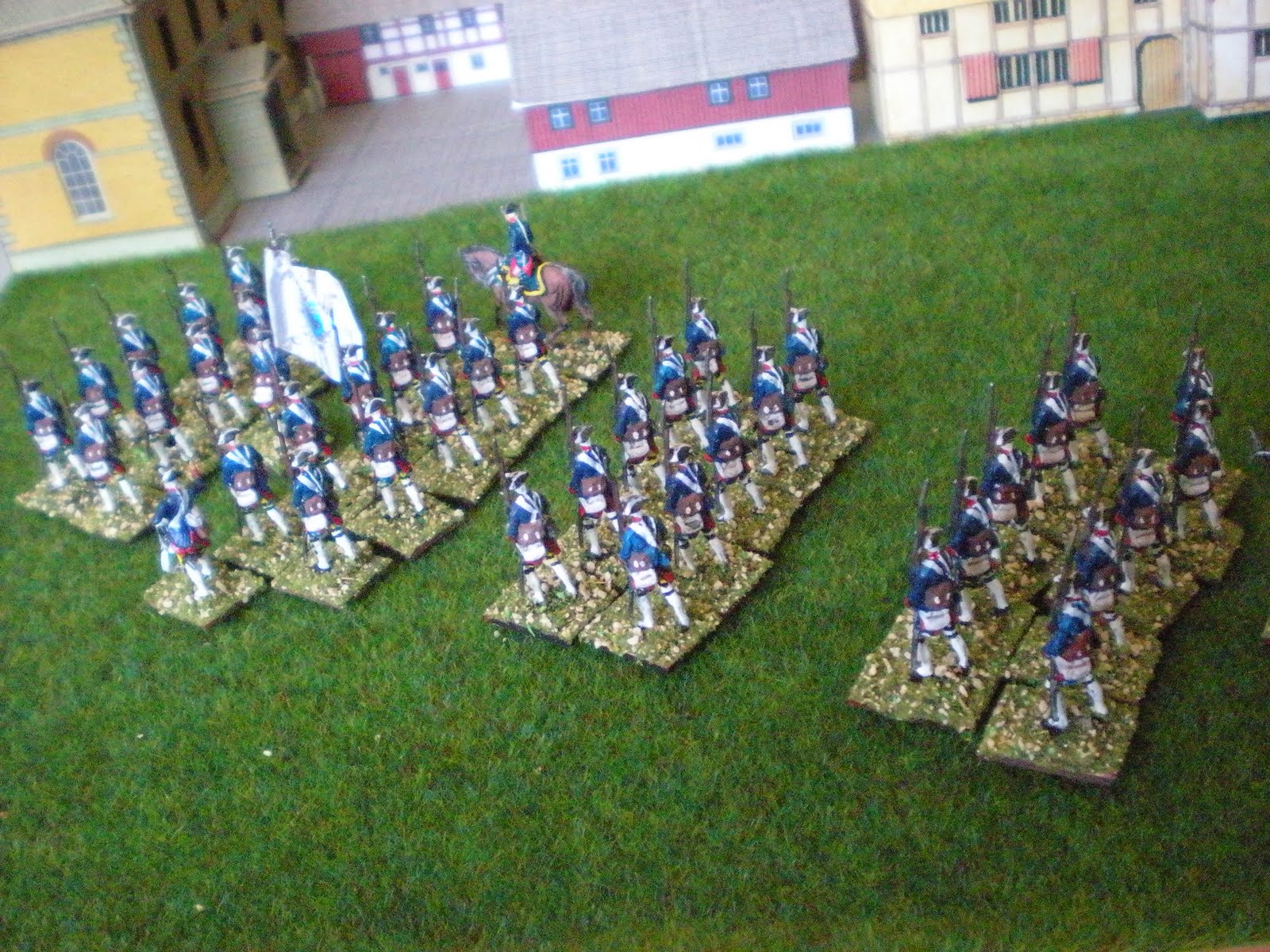
15th Altmark-Uberheim Infantry, the Guard have recently been observed on the Parade green of Linberg looking resplendent in their new uniforms whilst trooping the colour.


(Click on image for larger picture)
The colour, by the way, is simply hand drawn and coloured using 'transparency' pens on ordinary paper. I hope soon to have more pictures...


Friday, February 19, 2010

The Army of Jotun-Erbsten


My wargame buddy, Brent Burnett-Jones had recently mentioned the possibility of taking photos of the army I had painted up for his daughter, Caitlin, about 10 years back. Of course, this army had to belong to some country or another, and so the political circle of the Wholly Romantic Empire and its environs expanded to accommodate the Landgravate of Jotun-Erbsten. It's name suggests that this country was once indeed the mythical land of the Giants (Jotun), but in fact it is an anagram of 'Burnett-Jones'.

The army comprises Napoleonic French (?) infantry of mostly unknown manufacture (probably Revell), though the Garde Jager are Italeri, and the Feldpionierkompanie Airfix Guard pioneers with an ESCI artillery officer. The cavalry are Airfix, as are the artillery.

1st (Leib) Infantry Brigade
General......................... 1 fig
1st Infantry Battalion..........19 figs
2nd Infantry Battalion..........19 figs
8th Fusilier Battalion..........19 figs
The fusilier battalions are differenced by having green coats instead of blue. In each Brigade, the 'middle battalion' is differenced by having white pompoms on their shakos.
The 1st Brigade is differenced by having red cuffs, red drums.


2nd (Landgrafin) Infantry Brigade
General......................... 1 fig
3rd Infantry Battalion..........19 figs
4th Infantry Battalion..........19 figs
9th Fusilier Battalion..........19 figs
Second Brigade is differenced by having light blue cuffs on their coats, and light blue drums.


3rd (Erbprinz) Infantry Brigade
General......................... 1 fig
5th Infantry Battalion..........19 figs
6th Infantry Battalion..........19figs
10th Fusilier Battalion.........19figs
Third Brigade is differenced by having yellow coat cuffs and yellow drums.


Cavalry Brigade
General plus his ADC ............ 2 figs
1st Cavalry (Leibgarde zu Pferd).15 figs
2nd Cavalry......................15 Figs
1st Hussars......................15 figs


Army Troops
7th (La Garde) Jager...........19 figs
1st Feldartilleriekompanie (3 sections (models) and 14 figs
(To be upgraded to 1st and 2nd Feldartilleriekompanie each with 2 sections and 10figs)
1st Feldpionierkompanie........ 7 figs


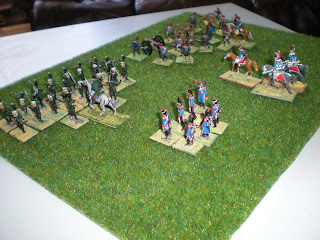


General Officer Commanding and staff
Marshal-General Count Bernhardt von Schwerin und Kussin
2 ADCs
Unfortunately, the picture doesn't do him justice...


A final overview...


A nice little army, it seems to me, totalling 249 figures including generals and ADCs, designed not only for pick-up battles but also for campaigning...

Wednesday, February 17, 2010

Thirty Years War figures...

Having over my 30YW stuff yesterday, taking those photos and posting them has led me to thinking about what Imagi-Nation belligerents might be called into existence for some sort of campaign? Probably King and Emperor or something similar.

How about the Imperium of Austeria and the Kingdom of Severia?

Of course, I won't be restricting the numbers to mere 400AP DBR - I reckon for 30YW, 500AP gives better balanced armies anyway, particularly for the Swedish whilst still using the Brigade system.

The fact was, I bought my 30YW armies with an entirely different view, with the army sized pre-determined. It works out at around 900AP of Imperialists and 750AP of Swedes according the the DBR accounting system.

Why the difference? My own rules rather favoured the Swedes - especially their horse - whose units were smaller, but rode in a single rank, and charged. Unless the 12-figure Imperialist horse shot very well, the 9-figure Swedish units more often than not would send their opponents flying. The Imperialist numbers made up for this and led to some very interesting battles.

I still have the battle maps of a series of actions fought under my rules (wish I still had that rule set), including the Battle of Coutras as a 'disguised scenario', and Nordlingen. Although these were played long ago, I wonder if there would be enough interest in a narrative with maps and pictures...?

Tuesday, February 16, 2010

Keeping the pot simmering...


It's looking like a month of not a lot happening, so I thought I'd just show some pictures of a 30YW project that died some years back (waiting for me to finish them off!). I had just written a one-brain-cell rule set for 30YW/ECW when DBR came out.
DBR proved to be quite popular, I recall playing a lot of Spanish vs Dutch games in the late/mid 1990's with 15mm figures, and experimenting with Ottoman Turks (using Byzantine DBM stand-ins would you believe...?).

But I couldn't make up my mind to re-base my plastics for DBR. I knew what would happen. Sure enough! It was like magic. Almost the moment I switched to DBR format, interest in DBR in Christchurch fell away to nothing. Not that anyone else at the time had 25mm armies? The problem was that the rules had at the time been insufficiently developed before publication - at least, so it was felt at the time. My argument that they were salvageable fell on ears attuned to a different story.

These days, a degree of interest has been revived, but I am perturbed to find that in the interveing 10-12 years, not a lot has changed (not to mention WRG's usual opacity creates the standard stupid arguments).

Now for some more piccies...


The pictures are posed as Swedish Foot attack an Imperial battalion that is supported by a gun battery. Imperial horse gallop to the rescue...
The figures are all from the Revell 30YW range, except for the light horse, which are HaT Mamelukes. They paint up very nicely as Imperial mounted Croats!


What's happening on the Wholly Romantic Empire front?
The following pics show work in progress: almost the entire infantry of Altmark-Uberheim.


In the following picture, all the marching figures have been consolidated into the Electoral Footguards (bearing an astonishing similarity to the Prussian 'Garde' of the 7YW!). Rather larger than my usual 36-figure unit, this has 44 - though I haven't made up my mind whether to have 5x8-figure companies, or 4x10-figure coys.


Not having a permanent set-up, this is a reasonable substitute (my wife bought me the split table/easel for Christmas - the green felt bit is my chessboard upside down...), the upside of which, I can get to watch 'Big Bang Theory' whilst painting the boys...

Tuesday, February 2, 2010

Electorate of Altmark-Uberheim

A few pics to show the woeful unreadiness of the Elector's Army well into the 3rd decade of the 18th century. Unfortunately, the two Airfix infantry regiments photographed, the Ewige-Blumenkraft leading, with the Muller-Thurgau in echelon have become 'surplus to requirements' since I obtained several years ago a sufficiency of Revell Prussian infantry. Those I have only just begun properly to organise and paint.


Not sure what to do with these fellows. I don't want to repaint them...
That field officer riding ahead of the Muller-Thurgau Regiment is none other than 'Der Alte Blitz' himself, the Elector Draco Spitzensparken. Not a good picture, I fear...


The cavalry will be retained: 2nd Cuirassiers, and the 5th 'von Ruesch' Hussars.


Readers might be wondering how Airfix Waterloo French Cuirassiers acquired their Tricorne hats. Well, among the Airfix AWI 'Washington's Army' there were a whole lot not-really-wargamable figures - dudes carrying the rum ration, two men carrying a wounded fellow to the rear, others lying down on the job, that kind of thing. Fine source of hats. I would like to keep some of the 'rum ration' guys, though, as sappers, possibly lugging barrels full of explosives...

As the Electoral army is supposed to have about 10 infantry units (ranging from the 44-figure Garderegiment to the 19-fig Freijagerkorps zu Fuss), and 6 cavalry there is a lot of leeway to make up...

Friday, January 29, 2010

'Is this 1806 all over again?'

The 'logical campaign is herewith set in the context of a broader campaign: that of May 1813. Marshal Dubonnet has been given a small Corps d'Armee, the XIV, and is operating some distance off the left flank of Napoleon's main force that is about to cross the Saale river near Leipzig. A few days into the campaign, and already the Berlin Press is expressing its worry over the likely outcome of the war.

BERLIN BLATTER 1 May 1813, Gross-huntersdorf.-
'The much anticipated and apprehended advance of the Ogre's hosts of Midian has begun in earnest, and already the first clashes of arms have taken place as the month of April draws to a close. The main body of the French armies, under command of the Emperor himself, has forced the passage of the Saale River at Merseburg and nearby places, and bid fair to capture Leipzig very shortly.

In the meantime, the redoubtable Marshal Davout, together with the famous cavalry leader, Sebastiani de la Porte, is operating to our disadvantage in the Lower Elbe region about Hamburg.

As it were linking the two widely separated forces, and possibly the greatest menace of them all, is the XIV Corps of Dubonnet - the youngest and newest of Napoleon's Marshals - having won a battle and presently advancing rapidly. Upon the 28th April, this Corps successfully forced the line of the Falsover River, northeast of Magdeburg, despite the spirited resistance of the Allied troops sent to prevent such a crossing. Since then, Dubonnet has swung his force eastwards and seems to be on the march straight for Berlin itself. The burghers of Magdeburg and Mockern might heave a sigh of relief at their towns being so bypassed, but should Berlin fall, the rest of Germany must follow.

Already thus early in the campaign, grave questions are being raised concerning von Jaxen's capacity for command. Are we to apprehend the general collapse that ended the 1806 campaign so ignominiously for Prussia? Ought von Jaxen to have held the line of the Falsover, or even the Elbe itself around Magdeburg?

Many correspondents may think so, but must before passing judgement consider the following. It is a fact that General von Jaxen was specifically chosen for this command by the Chief of Staff, Graf Gneisenau himself, an appointment warmly endorsed by no less a personage than Marshal the Prinz von Blucher. General von Jaxen has in the past proved time and again his capacity for semi-independent command: it seems hardly probable that at the crisis of his country's need he should suddenly fail.

However, it is true that he was wanting one of his regiments at Falshof. Whether this was due to lateness in arriving in the theatre, to the unit being engaged in some other important task, or to simple incapacity, we have been unable to determine.

Perhaps more disturbing for local observers is that for reasons no one can discover, Genl. von Jaxen's Corps seems to be diverging from the natural line of retreat towards Berlin. In blunt fashion, Dubonnet has been advancing on the most direct route along the line of the Havel River. The village folk have just about left Uszublunder deserted in the face of the enemy, complaining of having seen hardly a single Allied musketeer or trooper in the last few days. The divergent course of von Jaxen's corps somewhat to the south of Gross-huntersdorf begs the question: What is he about?

Perhaps his priority is to protect the northern flank of the Allied main army, now gathered about Leipzig under the command of General Wittgenstein. Alternatively, given the superiority of Dubonnet's force, has von Jaxen in mind to place his corps on the flank of Dubonnet's line of advance, thereby preventing his farther progress? This is a sword with two edges, particularly in the light of known French capacity to 'live off the land', that is to discover and steal provender from whence it might be found.

No doubt the next few days will reveal the intent of the good General, but we have reason to tremble for the fate of Germany. Less well known than many of Napoleon's other marshals, Dubonnet's ability is as yet an unknown quantity. His success at Falshof might be fluke or flair, but the very fact of his appointment to the Marshalate argues a capacity above the normal. General von Jaxen will no doubt find him a formidable opponent. Perhaps therein lies an explanation for von Jaxen's conduct of operations in the last few days; taking care to choose carefully his moment to strike.'

Tuesday, January 26, 2010

Grand Duchy of M'yasma

Whilst waiting for the opportunity to wargame the famous epoch making - and breaking - Battle of Potsalava - I thought I'd at least show a sampling of the formidable forces at the command of Constantine the Grand Duke.

To begin with, the light brigade, in which the sober elegance of the Pavlograd Hussars (Revell) is contrasted with the insouciant ebullience of the Malakhov Cossacks (Airfix Brit. Hussars, with piano-wire lances stuck through their right hands). A couple of other views...


... and to follow, Butyrski Infantry carries out exercises with 1st Field Company, the Grand-Ducal Artillery.

As the 1st field company loads and prepares to fire, Butyrski infatry, led by its Granadier Company, draws alongside at the double upon their left flank.

... and one final picture...