Showing posts with label Ulrichstein Campaign. Show all posts

Friday, November 19, 2021

Ulrichstein Campaign - Table of Links


The Ulrichstein Campaign

This campaign, beginning in 2011, was resumed, after an interval forced upon us by local earthquakes, in 2013.  It has been eight years since it concluded.  It was intended to be something of a curtain raiser for a much larger campaign, but for a number of reasons, the said earthquakes contributing, that never quite got off the ground.  Methought it time that the thing be 'consolidated' under this table of links.  I hope readers will find it sufficiently entertaining.  


Barricades of Zerbst

Barricades of Zerbst continued

An Epistle from Ulrichstein

Affairs of State; A Breakfast Conversation

Action of Lobrau

Action of Lobrau 

Action of Lobrau: Concluded

Ulrichstein Revisited

Rebellion: Bloodied but Unbowed

The Campaign Resumes


Battle of Schlangewasser

Battle of Zaltpig: Rebels Clash with the Army of the Elector


Battle of Zaltpig 2

Battle of Zaltpig 3

Battle of Zaltpig Concludes


Interlude in Zerbst

Allerednic

Battle of Zerbst 1: The Gathering Storm


Battle of Zerbst 2: Morning

Battle of Zerbst 3: Afternoon


Last Stand of the Rebellion 1


Last Stand of the Rebellion 2 


Last Stand of the Rebellion 3

The Final Chapter


Friday, March 29, 2013

Ulrichstein Campaign: Final Chapter

Early evening after the final battle of the revolt.
As  heavy rain clouds begin to obscure the moon,
 an Ulrichstein hussar waits on picket duty. 
 Accompanied by the aides and staff that could be accommodated in his headquarters tent, Marshal Francois Noailles eyed wordlessly the vision that shimmered gracefully into his tent, bowed and announced himself.  Broad shouldered, wasp waisted, and resplendent in the full dress uniform of an Imperial hussar officer, the exquisite creature seemed more suited to the kind of warfare waged in salons and milady's boudoir, rather than in the open field in all weathers.  Speaking of which, the Marshall could hear the first drops of rain beginning to fall upon his tent.  It was going to be a wet and uncomfortable night.
Archduke Piccolo handing his
hastily written message to his Aide-de-Camp
(from a contemporary George Bentlegg cartoon)


 'Count Gyulai Tambour,' the apparition introduced itself, 'Aide-de-Camp to Marshal General the Archduke Piccolo; bearing a written message to his Excellency Marshal Noailles.'

Count Gyulai Tambour delivering the Archduke's
message...
'Excellency, forsooth!' There was a rare courtesy to a rebel commander.  The Marshal did not expect that.  By way of reply, the Marshal flicked forth his left hand, palm upraised.  The emissary placed thereon a hastily rolled up paper, sealed with a rather worn red ribbon.  Before tearing open this roughly assembled document - clearly written in some haste - the Marshal indicated the wine decanter.  Silently, but politely, the hussar declined with a smile.
...to Marshal Francois Noailles, Commanding-in-Chief
the Rebel armies. 


'H'mmm...,' the Marshal begam to read,' "Time to call a halt to all hostilities..."; Humph! The usual form, I see: "shift from my own shoulders the responsibility for further effusion of blood..."; "...call upon you ... surrender ... forces in arms against the legitimate authority of Cornelius ter Plonk, Bishop of Ulrichstein." ...   No offer of terms, I see.  Unconditional surrender, I take it?'

The emissary seemed to have been well chosen: he understood the question at once. 'Aye, Your Excellency - and of Graf Raunchfester as well...'

'Speaking of whom: he should be here.'  The Marshal indicated to one of his aides to find and fetch his Rechburg ally, 'While we wait, was there anything you were to convey to me by word of mouth?'

'Aye,' replied the hussar, 'It was made clear that the Bishop is inclined strongly towards clemency, and, so far as circumstances permit, a return to the status quo.  He does want a proper investigation, though, into what happened to his grain convoys last year.  There are some names that will be held for trial - I do not have the list, of course.  But it has been vouchsafed to me that the Bishop values the commerce and enterprise of his northern flock, whether or no they follow the Church of Roma.  So he wishes to see it disrupted as little as possible by large scale executions, imprisonments and exiles.

'There will be some, no doubt,' murmured the Marshal, 'Myself among them I daresay.'

'Exile, Your Excellency,' quoth the emissary at once, 'As leader of the Rebellion's Army, Your Excellency could have expected no less.  But I have been authorised to tell you unofficially that you will be allowed seven days from the signing of the surrender document to wind up your affairs in Ulrichstein.' He lowered his voice a trifle, 'I do believe that the Archduke is ready to put in a good word should you ever seek service with the Emperor.'
Graf Raunchfester, two days later at the formal ceremony
appends his signature to the Instrument of Surrender.
 This was saying possibly too much.  Yet the Marshal could be certain that it was neither the Archduke's naivety nor his emissary's indiscretion that was at play, here.  Oh, he could haggle and delay and bargain, but  what he heard would be as good a deal he was going to get.  Might as well take it early as late.

'What of Rechburg?' the enquired the Marshal.

'The forces of Rechburg will leave this Bishopric at once.  A week should be ample to get them across the border.  All prisoners to be restored - Rechburgers after the corps has quite the country; rebels the same except for those on the list.  Your Excellency,' the Imperial aide paused briefly before continuing, 'Perhaps if I can return with your reply this evening...?'

'I'll speak to Graf Raunchfester first,' Barked the Marshal, at which the hussar nodded, unabashed.  The Marshal for his part had taken note that the officer before him was prepared to ride several miles in the dark and wet, at great hazard to the splendour of his uniform, to fulfil his master's wishes. The significance of that devotion to duty could not escape Noailles's experienced eye. He knew, the hussar knew, the distant Archduke knew: this revolt was over.  It was time the losers took whatever deal they could get...
The defeated and exiled Marshal riding off after the
formal Surrender ceremony.
But deep in his inner heart, Marshal Francois Noailles felt he would rather have been stricken down before the  Imperialist guns than be the man who, by surrendering the army, extinguished the last flickering hope of the  Ulrichstein Rebellion.

My thanks to Robin Sutton, 'Mosstrooper' and others who have recently joined the list of this blog's followers.  I am sorry that my output has been less than voluminous lately.  I hope to redress that in the weeks to come...

Monday, March 4, 2013

Ulrichstein Campaign: Last Stand of the Rebellion 3

Having carried the western end of the Chateau Ridge, the Archduke tried to maintain a heavy pressure all along the line.  On the left, the farm garrison of 3rd Brigade was brought under heavy fire from Imperialist artillery and Jager closing in to short range.  Heavily protected by nearby cavalry as they were, the Jager had little to fear even in the open from enemy mounted troops, as they decimated 3rd Brigade in the Farm.  


The Herzogtum heavies did burst out from behind the farm but they were met by the squadron of Khevenhuller Dragoons.  In a protracted battle of charge and countercharge, the Klutzenputz Cuirassiers defeated superior numbers and successive squadrons of Imperialist medium and light horse, but were unable to break out into the open country, nor create the space for the Rebel light horse themselves to enter the fight west of the farm.


(Eight Dragoon figures charged in a single line; the Cuirassiers' 12 troopers 2-deep.  As the lighter horse, the dragoons' 2 dice had to roll 3 or less to register hits.  The cuirassiers rolled 3 dice, but being overlapped on both flanks, two of those also had a reduced die range.  In the first round of combat, the dragoons scored 2 casualties and received 2 - luckily an even score.  Both sides surviving the morale roll, they went at it again in the following turn.  This time the Cuirassiers weight and numbers told.  Losing 2 again, they inflicted 4 upon the Dragoons, who promptly fled.  But to their left rear waited the Nadasti Hussars, for their turn to enter the fray...)

His first line having given way in the centre, Marshal Noailles hastily formed a second on the valley floor between the ridges.  Advancing through their own musket smoke, the Imperialists shattered this new line in moments; Gimmeitor-Oels Infantry lost a good half its numbers to the combined musketry of Baden-Durlach and Hildberghausen Infantry, and piled back to the rear.  

 At the same time Birkenfeld Cuirassiers surged over the ridgeline and into the rebel 2nd Battalion, which had formed into square betimes.  The result might have been expected: the loss of several of their number was shrugged off by the charging horse (passed morale roll) and  both sides lost very heavily in the subsquent close quarter fight.  The infantry saw off the cavalry, who retired back over the heights, reduced by half.  But the infantry had themselves been sufficiently shaken by the encounter to fall back in disorder to the North Ridge.
The Imperialists were clearly not having everything their own way.  Further, the Rebel guns had exacted some revenge for the defeat of Gimmeitor-Oels Infantry.  The gallant musketeers of Hildberghausen Infantry, having endured a steady and heavy toll to enemy gunfire and reduced in their final exchange of unpleasantries to little more than a third of their original strength, finally broke off the action and fled.

(Note to self: amend morale rules such that any modified Morale Factor less than zero counts as zero.   Hildberghausen rolled a 1 for its final morale roll, but its negative modifiers were such that a break and rout result proved to be inevitable.  Methinks this is a poor reward for the gallantry and stoicism under fire of that particular unit.  A 'Fall back in good order' would have been fairer.)


Returning to the Farm area, Graf Tympani, commanding in this sector, deemed the preparations sufficient to throw the Palffy infantry into the fray.  It was a thin line that defended the farm's hedgerows, and the musketry therefrom proved scattered and not very effectual (2 hits only).  To improve their chances, the Marshal ordered his large battery to fire in support of the farm.  Having passed within canister range, the column could expect considerable hurt from the guns - but they all missed!

(All three rolled sixes - a 1-in-216 deal - but under my rule set, as the target at the end of the turn is unavailable {in melee} it counts as a 'crossing target' with a reduction of the Die Range to 5.  Sixes don't count.  Had the column not reached the hedgerow, the 18, plus the 2 from musketry, would have resulted in 20 hits - casualties most likely in the range of 11-13, i.e. over 30%.  With such a loss, the unit would have had about a 50% chance of going through with the attack.)
Palffy overran the defenders with ease.  The few survivors abandoned the hedgerow and made off through the farm.  Meanwhile, the Khevenhuller Dragoons having lost their fight, Nadasti Hussars flung themselves upon the disordered Klutzenputz Cavalry.  Disordered as were the heavies, and the numbers very slightly in their favour, the light horse might have been expected to win the fight.  But the Cuirassiers held.  The hussars were not going to find this fight going their way at all.
Meanwhile, what of the other flank?  After a prolonged fight, the Rebel jager had driven the Pandour battalion out of the North Woods, or at least so it seemed.  


But General Plodt had indeed ordered the evacuation, pulling the Pandours in towards the south where he was shifting the weight of his force.  They were to cover the guns, now limbered up and heading to bring the chateau under gunfire.  In the meantime, he had formed Winterfeldt Infantry into column in an attempt to carry the place by storm.


Under cover of this assault, and contingent upon Winterfeldt's success or failure, Arenberg infantry also formed up ready to carry, take or seize the strongpoint.  As it transpired, the Chateau garrison flung back the Electoral infantry with ease, and with heavy loss.  At once Arenberg Infantry surged forward, broke down the doors and stormed into the buildings and yards.  This time the garrison found the fight much tougher, and were on the edge of having to abandon the place or surrender, when at last the Imperialists gave up the fight and fell back down the slope.
(This was an exciting combat.  The garrison scored 5 hits - very good fighting - but the attackers did even better, considering the odds: 8 hits!  A superb score!  But these have to be translated into casualties.  As it happened, the garrison's 5 hits became 4 casualties - about what you would expect.  The attackers' 8 hits became a paltry 3 casualties!    However, as neither managed to score 50% higher than the other, the combat at this point was 'drawn'.  It might have gone on to a second round next turn, but Arenberg just failed its morale roll.  The result if this was that they had to abandon the fight, but retained sufficient order to continue to present a front to the enemy.  The garrison passed its morale roll, and remained in situ.)

Though none too pleased at the outcome, Archduke Piccolo accepted the result as the risk he had undertaken in order to gain time. 
By this time the Electoral guns were beneath the walls of the chateau, and was preparing to blast the garrison out.
Amid the growing chaos in the centre, Marshal Noailles asked Graf Raunchfester to fling in the Schaggenstein Uhlans to stop the seeming unstoppable advance of the enemy infantry.  Down the slope they went, across the valley floor and through the boiling smoke.  Supporting Imperialist gunfire failed to stop the charge.  Taken by surprise, still in their line, the Imperialists' musketry proved ineffective, whereat the  horsemen rampaged into the hapless foot with lance, sabre and pistol.  As suddenly as they appeared, they vanished through the smoke - their charge a resounding success.

(Actually, I deliberately accepted the change in line, forgetting the effect of smoke in reducing the effect of the defenders' musketry.  I certainly had time to form square, as the light horse had begun their charge more than half their move from their target.  But even then, the foot were unlucky not inflict any hurt at all upon the Uhlans, whilst losing 6 figures of their own.  The result of the morale roll, however, was of a piece with the performance of the Imperialist foot all day.  Far from breaking of in rout, Baden-Durlach maintained their good order as they pulled their line back over the ridge line.)

Finally, the Klutzenputz Cuirassiers had held the hussars for a space (One bound in which they knocked over one hussar for no loss themselves.  As the 50% higher rule does not apply in the 1-nil case, this combat is considered drawn for this bound).  But once again excerted their heavier weight and threw back the Imperialist light horse.  But the Nadasti Hussars had left their mark, right enough.  Reduced to 50%, the Cuirassiers had had enough, and abandoned the field. 

Despite the series of successes towards the end of the day, Marshal Noailles could not hide from himself the fact that his army had been fought out.  The Farm, the anchor of his right flank, was lost, and about to be occupied by the Imperialists in strength.  Klutzenputz Cuirassiers had fought itself to a standstill seeing off two enemy units, and were about to quit the field.  The Chateau garrison still held, but in increasing isolation as the Rebel Army fell back in increasing disorder across the valley to the North Ridge.  Baden-Durlach had at last been driven off, but there was Alt-Colloredo Infantry about to take its place.  After its successful storming of the Farm, Palffy Infantry had rallied into line, ready to roll up the Rebel right flank.  The Rebel left flank was almost as much in danger. The Rechburg Artillery had been silenced some time before, and half the battery had had to be abandoned.  To bolster the centre, the line of earthworks had to be abandoned by 1st Brigade when the 2nd had been shattered.   Not much to stop the Elector's Corps, then.

The Marshal gave out his orders: his army was to quit the field.  He had lost over 400 prisoners and abandoned 4 guns, but his army, drawing off in good order, at least remained in being.  That would be a negotiating point of some value, however small.  But there was no disguising it:  the Rebellion was finished.

That evening, as Marshal Noailles sat in his tent sipping the last of his supply of Rhenish wine and contemplated the events of the campaign, he was disturbed by a small commotion immediately outside.  He waited, as a phlegmatic seeming commander would, until the corporal of the guard entered.

'Imperial officer, Herr Marschall,' observed the guardsman, 'Parliamentaire from Archduke Piccolo hisself he reckons, under flag of truce.'

'Very well, Corporal,' sighed the Marshal, 'Send him in.  Send for Count Raunchfester too, if you would be so kind.  I wish him to be present.'  

To be concluded: the End of the  Ulrichstein Revolt.  


Wednesday, February 27, 2013

Ulrichstein Campaign: The Last Stand of the Rebellion 2

These three pictures...
 As the Imperialists continued their steady and stately march,  Marshal Noailles could do little more than hunker down in the rear slopes of the Chateau Ridge, and in the strongpoint itself, and pull his cavalry behind the Farm on his right.


...present a panarama of the battlefield...
But the Chateau was proving something of a bone in the throat for the Archduke, flanking as it was any attempt to force the ridge, or to storm the east-facing earthworks

...looking north from behind Imperialist lines
For his part, General Plodt was doing his best with his exiguous army to assist the Imperialists.  The Pandours had pushed the Rebel Jager half way through the East Woods, but  their drive had become stalled in the face of determined resistance.  The Electoral infantry also left the safety of the ridge crest and advanced upon the field works.  This was something of a thankless task for the Electoral infantry, under a galling gunfire, and unlikely to make head against the strong defence line facing them.  But for Plodt, and for the Archduke they were performing a vital function as the electoral guns brought down a hail of shell fore upon the Rechburg cannon.
The Rebel 2nd Bde can be discerned behind the Chateau Ridge
awaiting the  Imperialist attack.
 Their masking work done, Prittwitz cavalry drew back to make room for the Electoral Winterfeldt and the Imperial Arenburg Infantry to engage the Chateau garrison.  Considering the protection enjoyed by the latter, the early volleys were deadly enough, but if the Rebels were to be forced out, the range had to be closed - or else an all out assault mounted.
Looking west along the battlefield.  The yellow flags
clearly show the line of 2nd Brigade.
 In the centre, the Imperialists had paused in their advance preparatory to a concerted surge over the crest line.  Hildberghausen Infantry skirted the west end of the ridge, to find a reserve line already being prepared.
 But behind Hildburghausen, whose advance served to mask developments behind them, A mass assault was  in preparation to force the farm.  Second Artillery was already in action battering the lead battalion of 3rd Brigade.  Heavily protected by cavalry, the Feldjagerkorps were enveloping the Farm from the West flank, drawing ever closer.  Palffy Infantry edged forward in an assault column, ready to decide the issue.
All too soon, Hildberghausen and Baden-Durlach crested the ridge and delivered a blistering short range volley into the Rebel 3rd Brigade.  For their part, the latter's reserved fire did considerable execution among their foes as well.

 A brief but savage fire fight saw the right and centre battalions of 2nd Brigade break, and make off to the rear.  The larger Imperial units were able better to withstand the punishment, though Hildberghausen, directly under the Rebel guns, found itself unable to advance further.

On the east flank, the Rebel Jager had not only arrested the Pandours' advance through the woods, but had driven them back out again.  This was however, more than balanced by silencing of the Rechburg guns.  So heavy were their looses that the survivors had to abandon have the ordnance as they made of to the rear.

Having edged the Rebels, barring the Chateau garrison, off the Chateau Ridge, and forced the enemy army within a restricted perimeter; the Rechburg guns having been put out of action, the Imperialist stood ready all along the line to begin the decisive assault.  The Archduke felt certain that right now the fate of Ulrichstein lay teetering in the balance...

At this point he game was adjourned.  Neither of us realised it would be three weeks before we could resume and conclude the action.  So far the Rebel Alliance right flank and right-centre had been forced back, and the Rechburg guns put out of action.   But all this had come at a price, Imperial and Electoral losses so far having been the heavier overall.  

Monday, February 25, 2013

Ulrichstein Campaign: the Last Stand of the Rebellion


The Rebel Army awaiting attack south of Zerbst, a half-mile distance.
Facing east, a line of earthworks greets the corps
of Altmark-Uberheim

Disappointed with the indecisive outcome from the Battle of 13th March, Marshal Noailles drew back his forces almost to the outskirts of Zerbst itself, the last only stronghold of the rebellion.  He knew, as did his ally, Graf Raunchfester, that now it was a case of do or die.  His strategy of the central position had almost succeeded,  so close, but its failure meant that he was reduced to simple defence against his converging enemies.
Ulrichstein Revolt, Campaign Map.  Red crosses
indicate Loyalist of Imperial vicyories; the blue, Rebel successes.


Forcing back without a pursuit the electoral Corps at Zaltpig Marshal Noailles knew would merely delay them the few days his Army needed to join Raunchfester to strike at - and defeat - the Imperial Army advancing from the south.  His Rechburg Ally had done as much as his small contingent could to delay the Imperialists, even winning a minor cavalry combat at the outset of the season's campaign.  But how could such a small force make head against perhaps three times their numbers?  Far from deciding the Revolt, the action had proved an untidy, unsatisfactory affair that pleased no one.  But the Rebel had much more reason for dissatisfaction.  Now had come the moment of truth: the Rebel Alliance had to face superior numbers and win... or go under.

The Corps of Altmark-Uberheim, arriving shortly
after daybreak, 21 March 1739
At first light of the equinoctal dawn on 21st March 1739, the rebels responded to the bugle calls and stood to arms.  At about 6:30, Electoral cavalry could be seen skirting around the southern end of the East Ridge.  Trumpet and bugle betrayed the presence of Electoral infantry forming up behind the hill crest to the east, whilst a swarm of Pandours - little more than single company -approached the 'North Woods flanking the high ground.  At once Noailles dispatched his 7th Jager battalion - what remained of it after two battles - to face them.
Orders of Battle (Summary)
Trockenbeeren-Auslese:  Archduke Piccolo
Line Infantry:                3120 (156 figs)
Jager:                             380   (19)
Horse:                          1320   (66)
Gunners:                         360   (18)  16 cannon (4 pieces)
Total:                          5180 (259)

Altmark-Uberheim:  General Plodt
Line Infantry:                 1000  (50)
Pandours:                        240  (12)
Horse:                             580  (29)
Gunners:                          160   (8)   8 cannon (2 piexes)
Total:                           1980 (99)
Total 'Loyalist' army: 7160 (358 figures) and 24 cannon (6 pieces)

Republick of Ulrichstein"
Line Infantry:                  2980 (149)
Jager:                               300   (15)
Horse:                              640   (32)
Gunners:                           280   (14) 12 cannon (3 pieces)
Total:                              4180 (209)

Herzogtum von Rechburg:
Line Infantry:                   1100  (55)
Horse:                               420  (21)
Gunners:                            160   (8)   8 cannon (2 pieces)
Total:                             1680  (84)
Total 'Rebel' Army:     5880  (293 figures) and 20 cannon (5 pieces)

In addition to such natural advantages the rebel defensive position had to offer, the Chateau was a very strong place, and the farm also offered some advantage to the defender.  In addition, The Rebel Army had had time to throw up a 300-pace length of earthworks.  Facing eastwards whence the Electoral contingent were expected to arrive, Marshal Noailles felt himself able to mass his cavalry on the other flank.

An aside on the strength of fortified and other defensible places.  The farm was of only moderate defensive strength, but that applied to hedgerows, wall, and buildings.  The Chateau proved to be very strong, as events were to prove.  Finally, the earthworks gave very good protection against fire, but rather less against a direct assault...
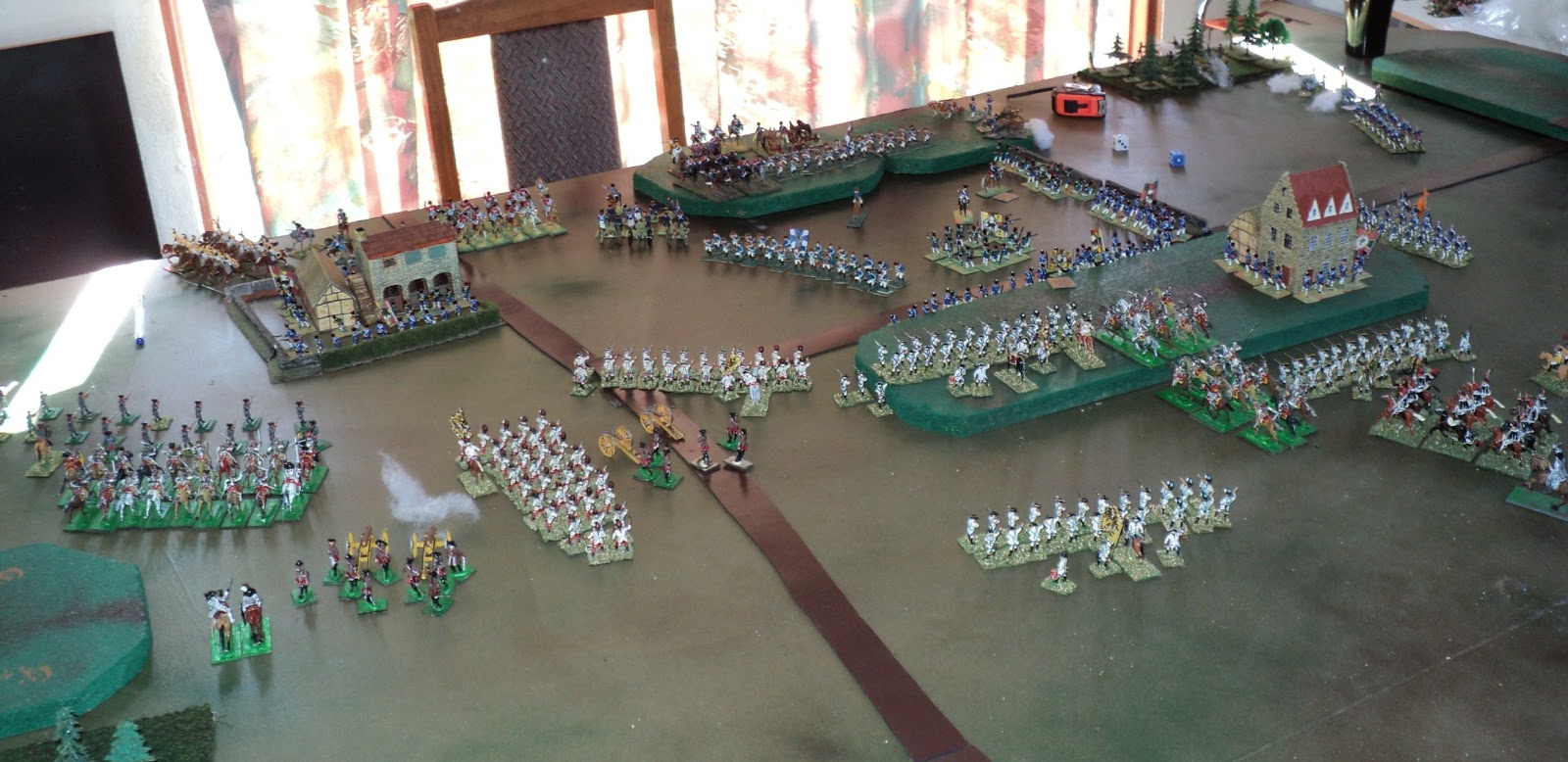
Arriving from the south 2 hours after dawn, Imperialist forces under Archduke Piccolo advance in the face of Rebel gunfire.   Birkenfeld Cavalry links up with Uberheim horse NE of the chateau.

The Imperialist main army was rather slower to arrive, spilling onto the field just as 8 o'clock could dimly be heard, striking from the Rathaus clock tower in Zerbst, a scant half-mile away.   The Rebels' occupation of the central position had prevented better coordination between their enemies.  However, observing the earthworks facing his small army, General Plod had decided to mark time until his Imperial Ally could arrive.

In situations in which troops are to arrive from off table, their ETA - expected time of arrival - is calculated at a certain time of day, or move number, not less than 3. Then a die is rolled determining the actual time of arrival, up to 2 moves early or late.  The Electoral contingent arrived 1 turn early; the Imperial forces, 2 moves late.

No sooner the Imperialists were deployed, than they began their stately and steady advance towards the enemy lines.

From this point, and for the remainder of this posting, I'll let the pictures carry most of the narrative...
The Rebel Alliance, have massed all their horse - 1060 in all - on their right flank...
                                   
General view looking eastwards of the rebel alliances forces drawn up.
The Cavalry advance around the woods to strike at the Imperialist left.

The 940 Imperialist horse on the west flank are supported by the 380-strong
Feldjaegerkorps - hurrying to occupy the woods - and a gun battery.
The first clash.  The Heavy Squadron of the Composite Regiment
attack, but are flung back by superior numbers of Rebel cavalry.  
As the heavy squadron flees, the second, dragoon, squadron charges the disordered rebel horse
and exacts a fearful vengeance against their heavier but disordered foes.
  Isolated and defeated, with Imperial jager lining the wood nearby,
the Rebel horse begin a long retreat to the rear of the Farm..


Imperialist foot make the long advance into the fire of the combined
Rebel artillery - 12 guns.  Alt-Colloredo Infantry bear the brunt of accurate enemy gunfire.

To the right of Arenburg Infantry, The Imperialist Birkenfeld Cavalry links up with the Electoral horse, and menace  the ridge line.  

The understrength Prittwitz Cuirassiers swing right to mask the Chateau Grau strongpoint.

Closer, and ever closer march the Imperialists.  But all they can see on the ridge are the
gaping guns of the Rebel battery.  The Rebel 2nd Brigade wait behind the crest.

The general advance by the Imperialist horse, accompanied by jager and guns,
on the West flank.  The remains of the defeated  Heavy Squadron
have rallied betimes.

The rebel horse has been pushed right back to the farm.  Protected by their own horse, the jagers
swarm over the ridge beyond the West Woods.  Hildburghausen infantry protects
the horsemen's inner flank.

Approaching the crisis.   Rebel gunfire induces Alt-Colloredo Infantry to fall back,
whereat Baden-Durlach shakes out into line and takes up the advance.
As Imperialist horse, foot and guns draw menacingly close,
the Rebel gun battery limbers up and drops behind the hill crest...
The battle has scarcely begun!  But meanwhile, what - if anyrthing - was happening on the eastern flank?
What, if anything, was the Corps of Altmark-Uberheim contributing to the battle?