Showing posts with label Elchingen. Show all posts

Friday, February 21, 2020

Carnage at Elchingen (2)

We left the previous episode, the attack of Loison's Division having been brought to a standstill, with the midday arrival of Malher's Division, its two brigades in battalion columns, advancing astride the Unter-Elchingen road. 
Badly mauled though Loison's Division had been, one battalion still remained clinging to its southern quarter of Ober-Elchingen.  This corner was to remain in French possession for the rest of the day. Of course, the Austrians had the strength in numbers to have driven out the French at the point of the bayonet, but it appears that command and control problems inhibited any such show of aggression.
The next few pictures show the situation on the French left at around midday, the time Malher's brigade began its march upon the right. 

The liaison between Loison's and Malher's wings was maintained by Colbert's light cavalry (hussars and chasseurs).  Small as this formation was, it was hard to risk it against the mass of Austrian infantry upon the plateau beyond the escarpment.  At one point about mid-afternoon, the 10th Chasseurs-a-cheval felt sufficiently emboldened to chance their arm against the Austrian Schwarzenberg Uhlans.  It did not go well.  Although the chasseurs inflicted some hurt upon the uhlans, the latter doubled the pain upon the chasseurs.  Off went the chasseurs, and Colbert was left with only his hussars in hand.  These he declined to risk further.
But by now the main interest in the battle was being sustained by Malher's nine battalions, his brigaded skirmish companies and two gun batteries.  As Labassee's brigade, led by a cloud of skirmishers, pushed up against the escarpment just west of Unter-Elchingen, Marcognet developed his assault upon the village.
The latter flung the Austrians in short order out of the southern sector of the place, and even induced the Austrians to abandon the eastern.  It seemed that the whole village would very quickly fall into the hands of the French.  Meanwhile, Laplanche's dragoons, accompanied by horse batteries, were fetching a wide sweep around the eastern end of the village, in the hope and expectation of falling upon the Austrian flank.  
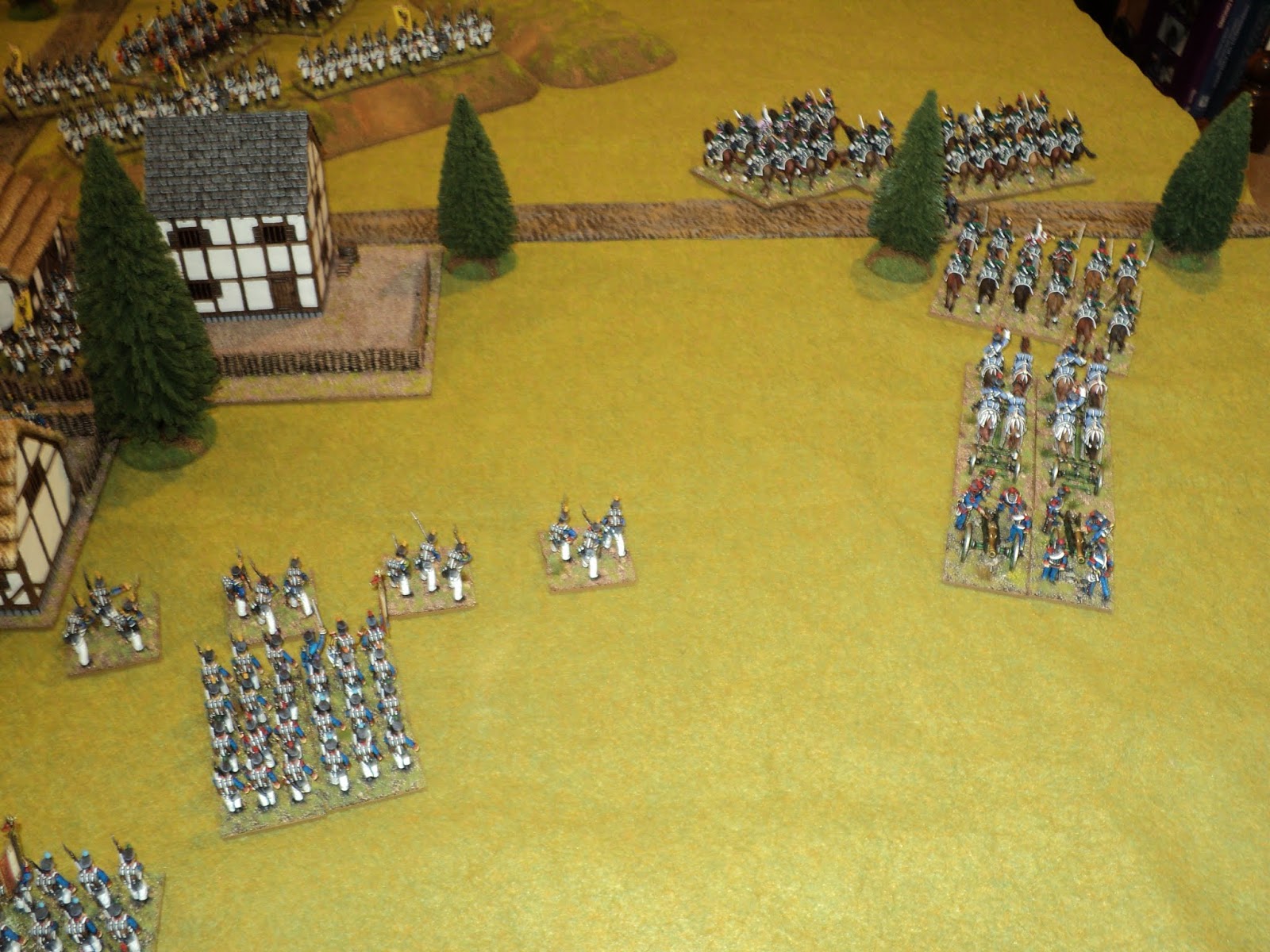
This attack seemed to promise rather better results than achieved by Loison...
... and then it all stalled. The defenders of the village were Austrian grenadiers, and they seemed determined to stay. At this point, Marshal Ney bethought himself to move closer to the Unter-Elchingen action to ensure the attack would be kept up, unrelenting. Now, in this rule set, when rolling to activate formations, French units must score anything but a 6 on a D6 to do much apart from shoot. I gather that the Austrians have to avoid rolling a 5 as well.  However, if a formation (Division) commander is within the command radius of the Corps or Army commander, a 'failed' score may be rerolled. In effect, a formation commander 'under command' rolls two dice. That was why Ney moved.
The above picture tells the story.  Now within Ney's command radius, Malher promptly rolled double-6.  Reliable hitherto, General Laplanche (still outside Ney's command radius) also rolled a 6. The whole battle hinged on what was happening here - and for a whole turn, nothing was happening! So infuriating, one simply had to laugh.
Unfortunately for the continuing narrative, I forgot for a considerable time to take any more pictures, which left the most dramatic moments without a pictorial record. Once Malher's Division again lurched into motion, Marcognet continued to find his eviction notices being defied by the lone and isolated grenadier battalion. For his part Labassee pushed up the escarpment unopposed, his skirmishers pushing forward into the Austrians' faces. Although inflicting some damage upon the Austrian infantry, the French weren't having things their own way there, neither.
On their side, the Austrians had pulled in their left flank, leaving the Unter-Elchingen garrison isolated, but making way for two regiments of cavalry - what appeared to be the Hohenzollern-Hechingen Cuirassiers and the Blankenstein Hussars. Continuing their sweep into the Austrian left rear, the 18th and 19th Dragoons charged up and over the escarpment and into this enemy flank guard.  Eighteenth Dragoons swiftly rode down the opposing hussars. One might have expected the reverse result from the 19th Dragoons' encounter with the cuirassiers. The melee was certainly prolonged, and the dragoons knocked about, but the heavier Austrian horse also broke in rout.
French jubilation can be imagined, as can Austrian dismay.  The rout of the Austrian flank guard, and the impending irruption of French horse and guns upon their now exposed flank caused several infantry regiments in turn to break towards the rear.  The beleaguered grenadiers in the Unter-Elchingen promptly abandoned the place, leaving it altogether for the French.
All this was most encouraging. Were French fortunes about to reverse?
Not... really. That glorious cavalry charge was the one bright - even brilliant - spot upon a very dark day, apart from a further glimmer, towards dusk. Labassee's projected assault upon the Austrian left centre was abruptly repulsed, though with heavy loss on both sides.  Two of Labassee's battalions were shattered and departed the field, as eventually were the skirmishers.   
My main reason for going after the villages was that they together formed bastions punctuating the escarpment 'wall'.  Capture them, the main Austrian position would be vulnerable to attacks from the flanks.  This was not 'how it was done' historically.  Then the French just punched straight through the centre, up and over the escarpment. When I surveyed the field, I didn't believe such a course achievable, though maybe I ought more to have used linear formations.
Malher and Laplanche having pretty much achieved all they was going to achieve, it remained for Loison to see what he might accomplish with what remained of his exiguous command.  A battalion of light infantry had maintained a watching brief ever since late morning, suddenly, late in the afternoon, saw a chance to carry or seize the west end of Ober-Elchingen.  In they went; out went the garrison; and now half of Ober-Elchingen was in French hands.
As night drew in, both sides could contemplate the stricken field.  Who had won?  At the time, I figured it to have been a French defeat, plagued all day by misfortune.  It was certain my French corps had been fought to a standstill, and the Austrian army remained firmly on the field.  I didn't quite realise that the Austrian army had taken almost as severe a battering.  
The 15 units the French lost were spread fairly evenly throughout the Corps, only Rouget's brigade being so badly wrecked that but one battalion remained in hand.  At least 3 other brigades were within an ace of breaking.  Austrian losses were far less evenly distributed.  The 14 lost units were largely from 3 small (and therefore somewhat brittle) brigades.  But what secured for the French a semblance of victory - enough for Emperor Napoleon to claim it as such in his Bulletin - was the capture of half of Ober- and the whole of Unter-Elchingen.  But the cost had been practically to have wrecked VI Army Corps.
My thanks to Mark Ottley for inviting me to join in such an enjoyable and fine game; and educational too.  Some aspects of the rule set in use were a little perturbing to Paul and me both, but I believe that they are still under a certain amount of fine tuning.  There was no problem with overall playability, esopecially with Mark keeping very busy as moderator.   The entire kit and caboodle - armies, terrain and table - are his, and a joy to play with as well as to look at.  Paul and I have had many a battle. It is not unusual for them to lead, such as this one was, to 'un combat acharné '.  

Monday, February 17, 2020

Carnage at Elchingen

The games that Mark (author of the Chasseur blog) put on at his house are becoming something of an annual (or more) event.  And very enjoyable they are, too: fine table set-up, lovely soldiery to order into battle, and a genial host.  Last Friday but one (7 February 2020) was the occasion for one of the tensest tabletop battles I have ever fought.  Unfortunately my not very coherent series of pictures aren't going to do the thing justice.

The action was the first really major action fought at the beginning of the War of the Third Coalition, 1805.  Ordered to recross the Danube River to the north bank to cut off the main Austrian army being encircled around Ulm, Marshal Ney forced a crossing south of the twin Elchingen villages, stormed them and forced back the whole Austrian line commanded by General Riesch (and General Werneck, according to my, more ... erm ... general, source).  It appears that Mark got much of his information for the scenario from this very interesting and attractive resource:  Obscure Battles.

Mark opted here to umpire the game, whilst Paul ('Jacko' of the Painting Little Soldiers blog) and I chose sides.  I took the French - rolling a die and calling 'odds/Austrians-evens/French' - Paul the Austrians.  I can't say that the opening situation looked all that encouraging - masses of Austrians, none too many Frenchmen on the table.


The action opened with Loison's infantry Division having crossed the Danube, and advancing upon the Ober-Elchingen village.  Villatte's Brigade - brigaded skirmisher companies, 4 infantry (line and light) and two gun batteries - advanced directly upon the place.
Rouget's brigade - another unit of brigaded skirmisher companies plus 5 line and light battalions - moved up alongside towards the ridges east of Villatte's objective, where awaited a line of Austrian  infantry covered by a screen of skirmishing jagers or light infantry.  Accompanying Rouget was General Colbert's small brigade of light cavalry, 3rd Hussards, and 10th Chasseurs-a-cheval.
A considerable distance off to the right, General Laplanche's Divsion of Dragoons had been taking an interest in an Austrian brigade almost as isolated.  A quick charge by 19th Dragoons was quickly rebuffed by an Austrian square.  This was really a probing attack.  Two of the Austrians quickly scuttled into the Unter-Elchingen village, which place they began to prepare for defence.  The third, delayed by the dragoons, didn't make it before being crushed by Laplanche's horse guns.

Villatte's attack on Ober-Elchingen was immediately successful, if only partially.  One battalion broke into the southern quarter of the village, which was to remain in French hands for the duration of the action.  The attempted storm of the west end, however, was being held up.
It was about this point at which matters became very turnip-shaped for the French. The first forebodings, perhaps, could be seen in the advance over the difficult escarpment by a mixed force of Austrian cuirassiers, grenadiers and line infantry. Immediately to hand on the French side was the line of skirmishers, with a light infantry battalion set to support them. Perhaps Marshal Ney (myself) was a little too sanguine about his prospects of holding any Austrian counterattack in this region.
Meanwhile Rouget had also suffered a setback: the loss of his unit of brigaded skirmisher companies.  It was touch and go whether their rout - outshot by their Austrian counterparts - would carry off  some of the close-order foot behind them.

At this point I shall digress from the narrative to discuss something about morale rules, and what happens, or is supposed to happen, when units 'see' a rout.  Personally, I believe that units disappearing over the horizon because - and solely because - of other units routing, was vanishingly rare, except on occasions in which the routers actually burst through, as we might call it, the 'testing' unit.  I'm not talking individuals, here - the Napoleonic wars were notorious for people making off, under this or that excuse, to the rear.  But the units as a whole, I believe, would stick unless they themselves had good reason (taking heavy losses themselves) to apprehend their future at the enemy's hands.  Even if it were true that such things happened more often than I believe to be the case, I would still be inclined to error on the side of 'unit heroism' if only to make our war games less subject, shall we say, to Hexahedral caprice.*

Much less am I persuaded that skirmishers suddenly breaking to the rear would set off in sympathy  the supports seeing this.  Skirmishing clouds were flexible, constantly moving,  soldiers working in pairs, moving back to replenish, replaced by someone from the skirmisher reserve, and, if pressure mounted, sidling back behind the first main line.  No one would take much notice of what they were doing, being (a) used to the behavious of skirmishers to front and flank; and (b) more focused upon what might be coming out of the smoke in front of them.

I have occasionally thought about writing in my tactical level Napoleonic rule set a simplified system for grande-bandee minor tactics, but probably even then it's not really practical at higher than brigade level games.
Having said all that, I should probably have formed my battalion columns into line, and had a go a battering my way up and over the escarpment (represented as a ridge-line in this game).  However, apprehending the possible eviction of Villatte's battalion clinging on to its section of Ober-Elchingen, Rouget send across his left hand battalion to relieve it.
 On the right, Laplanche was disinclined yet to engage the enemy too closely.
Events developed suddenly and rapidly west of Ober-Elchingen.  Although the French infantry caused some damage to the Austrian foot, the cuirassiers cleared the difficult slope of the escarpment, and surged straight into the nearest close order foot, just as the latter were about to drive into the abandoned west end of the village.  The French skirmishers scuttled out of the way, the line infantry failed to form square betimes, the cuirassiers rode straight over the top of them.  Ploughing on, they rode down a second laggard unit, before finally making off.  These disasters very nearly broke Villatte's Brigade.  It seemed that they would be unable to undertake any further positive action.  Yet, perhaps there was still some fight left in what remained.  (Unfortunately, in all the excitement I failed to take pictures of the unfolding drama.)
Rouget's brigade was to share Villatte's misfortune - only more so. My persisting with the battalion columns had to do with the hope of bashing through the Austrian lines at some point, but I also had my eye on the east end of Ober-Elchingen. Villatte was unlikely to take the place with what remained of his force.  Possibly that distraction led to my allowing events to get out of hand.
Although the enemy skirmishers were driven off, the subsequent firefight with the Austrian lines pretty much settled the hash of the leading French battalions.  One of the centre battalions broke, and carried another with it from the field. This left the right hand battalion isolated but for Colbert's light cavalry, and Colbert was not about to hazard his small brigade against Austrian foot at the top of a difficult slope.  It was not long before that lone battalion, too, departed the field of battle.
This was getting embarrassing.  Villatte's Brigade badly knocked about; Rouget's actually broken, though he managed to keep a couple of battalions in the field, one of them still holding on to a part of Ober-Elchingen.  So reduced had the available French forces become, it was very tempting, perhaps, to call the battle right here, before the arrival of Malher's Division astride the Unter-Elchingen road.  Mark even suggested it, with the idea of restarting, I think, but I much preferred to carry on.  If we were to go down, let's go down big.
Malher's Division was as powerful as Loison's.  On and to the right of the road marched Marcoginet's Brigade: 3 light and 2 line battalions and the brigaded legere companies.  Advancing to the left was Labassee's 4 line battalions, plus the divisional artillery, also screened by a cloud of skirmishers. Flanking this Division: Colbert's light horse covering the left, and Laplanche's dragoons, ready, now, to sweep around the Unter-Elchingen village, into the Austrian flank.  The stage was set for Act II of the Carnage at Elchingen...


This seems to me a good moment to pause in the narrative, to resume later on.

* Hexahedra, the Goddess of Random Number Generation using Dice.