Showing posts with label 'Latin' Wars. Show all posts

Saturday, September 15, 2012

Ain't Verlinden...

 At last: finished. Well, sort of finished.  The Hummels have been built, painted and one of them at least has a crew - two figures from the Airfix SdKfz234/4 Armoured Car kit.  This first picture was taken before 'weathering', the others after.   This might not be apparent in most pictures.  I have a fairly minimalist approach to weathering, though these vehicles could stand more, methinks.


Close up of the fighting compartment, with crew added.  This won't win any prizes - the number could be touched up, and certain other little flaws reveal themselves.  This ain't Verlinden quality modelling by any stretch.  But on the whole I'm not at all unhappy with the end result.

I have found the best method of getting track to look right is glue and staple the ends together.  To the objection that the staple will spoil the appearance of the vehicle, the answer is [A] make sure the stapled but is up under the superstructure overhang, and [B] paint it out with some dark colour - black, even.
 As mentioned earlier, the gun came without some of the extra bits like hydraulic elevating gear, and traversing and fine adjusting wheels and handles.  Figuring that as they would in general be hidden in the superstructure, I was not at first going to bother with them.  I am glad I changed my mind about that.  On the other hand, unlike the original ESCI kit, which moulded them in, I left off the seats either side of the gun and the boxes on the floor near the rear.  Another good decision, I feel.
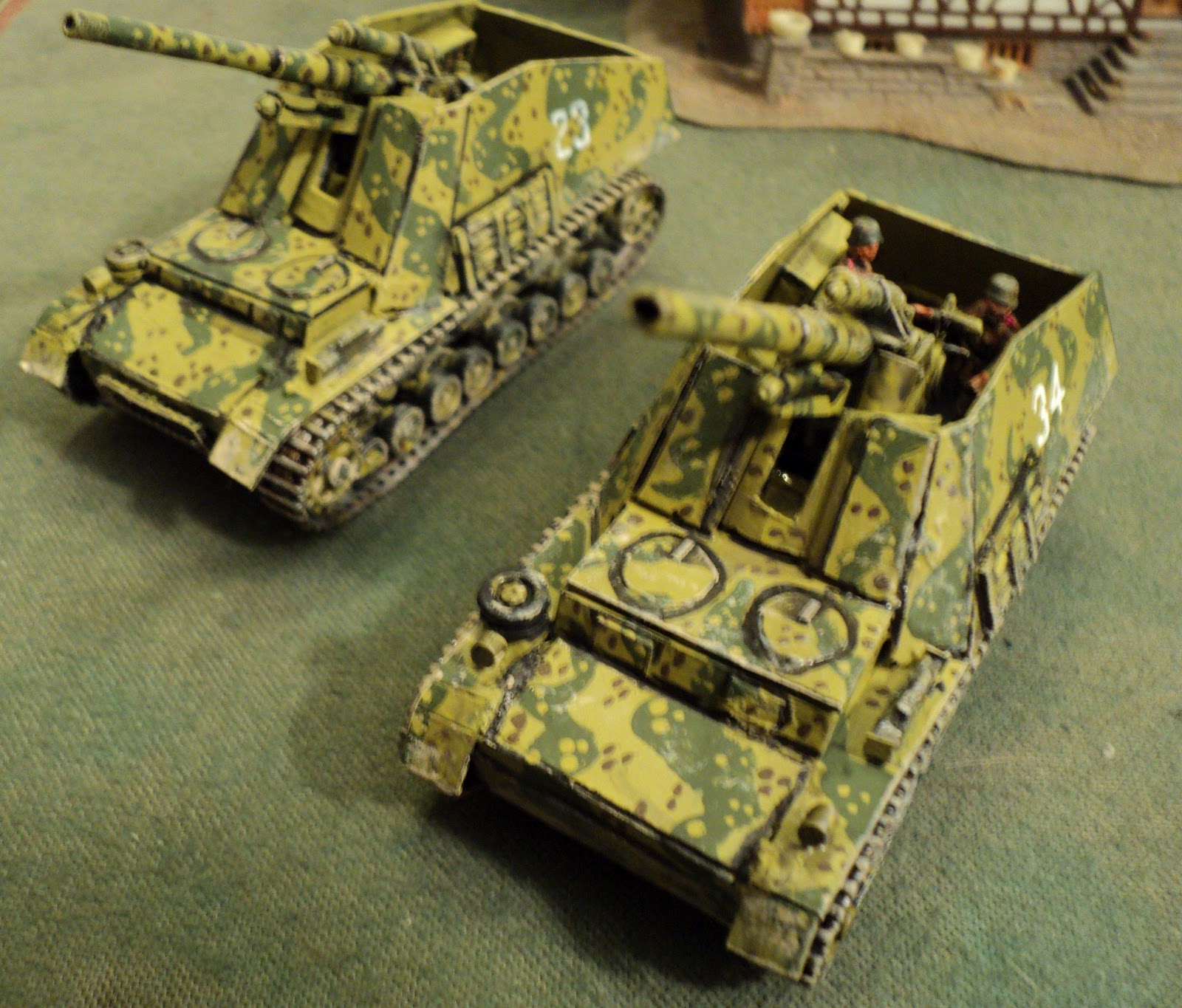
 Vehicles 23 and 34 in battery.  Well, they won't be part of the same unit for long.  Brian (A Fist Full of Plastic) will get one of them; the other will remain in my own army forming a Command Decision SP battalion with 2, maybe 3, 10.5cm Wespes.
Have gun; will hunt.


Whilst working on the Hummels, I also began some repair and refurbish work on some other vehicles Brian had given me or that I had had waiting (clamouring) for my attention for some considerable time.  

This Hunting Tiger just needed the tracks put on, the mudguards re-attached and the gun refitted.  In painting this vehicle I discovered that 'German Cavalry Brown' is very reddish in colour.  I know, I know - I ought to have used 'Chocolate' but my feeling is that it is rather a brownish sort of brown, and I did want reddish in the camo.

 Rear view of JagdTiger going off to hunt something.  I rather like this simplistic ESCI kit.


Also in my possession were a couple of Tigers that badly needed a refurbish.  The one Brian gave me looked OK, but the paint scheme didn't 'fit' with my preferred livery.  So they both got a repaint.  Probably they would have benefited at that from having their original paint job stripped off, but I wasn't prepared to put up with the hassle.

I painted over the top.  It shows a bit - these vehicles are a tad rough, but, seen at the usual distance one views these things on the war games table, they look rather better than these pictures indicate.


My real bugbear are the tracks.  For one thing, they were put on differently for each vehicle, they were flimsy, flopped about all over the place, and the ends were untidily put together.  The bad part, I discovered, was that they were apparently glued up under the overhang.  At any rate, They could not be removed safely.  

Faute de mieux I left them as they were, except that I glued the road wheels down onto the tracks as well.  This was not a total success (as the right-hand track on Tiger 511 shows.  

But the key thing is, they are Tigers.  I now have the beginnings of a Tiger Company (Heavy Panzer Company 651 in the service of Orotina) which will comprise 3 Tigers (the third being a metal model from Dragon, painted Panzergrau), plus a Panzer IIIN with the short barrelled 7.5cm gun.

Further to the camo: I don't really know if the scheme I have here was ever used by the Germans.  But, for mine,  it looks as though it might have been.  What commends itself to me is that I doubt anyone will be using it, which identifies my stuff as being mine!  And, of course, it looks OK - well it does to me!

Sunday, July 8, 2012

When scratchbuilds go bad...

There are times when the model you thought you were making comes out rather differently from what you had intended. 
So with these pieces.  Intended as 57mm Anti-tank guns, they look sort of OK, but the trouble was that [a] I made the gun shield too large, and [b] set the whole gun too far back on the axle.  After much humming and hahring, and indrawn breath through the teeth, I find I can't live with them as 57mm anti-tank guns.  Aty the same time, the construction is such that modification (disassembly and reassembly) is not really an option.

What to do then?  Of course they don't look bad enough, as guns, for me to dismantle them; and indeed they look none too dissimilar to later model 76.2mm field/anti-tank weapons.  And so they'll become.  Incidentally, the gun barrels on these are lengths of wooden rod (dowel) obtained from the local modelling shop.  The 57mm AT guns will be a project for another day, destined (of course) for the 1st Guards Mechanised Brigade.

Why 'Guards'?  Well, my 1st Mech Bde wargames formation has been in existence some 20+ years now, and, with one unfortunate exception, has never lost a battle.  In a Command Decision competition back in '93, its seven T34/76s and 'Experienced' infantry took on 'veterans' and even 'elites'; King Tigers, Panthers, Comets and  Challengers, and fought them all to a standstill (3 draws out of 3).  Only one such opponent had as few as my 7 tanks, and 3 of those were King Tigers.  I was very proud of my Brigade's performance that weekend.  A small tactical error on my part robbed them of victory over the elite guys, too.


They deserve their 'Guards' appellation!

Tuesday, July 3, 2012

Cardboard Guns...

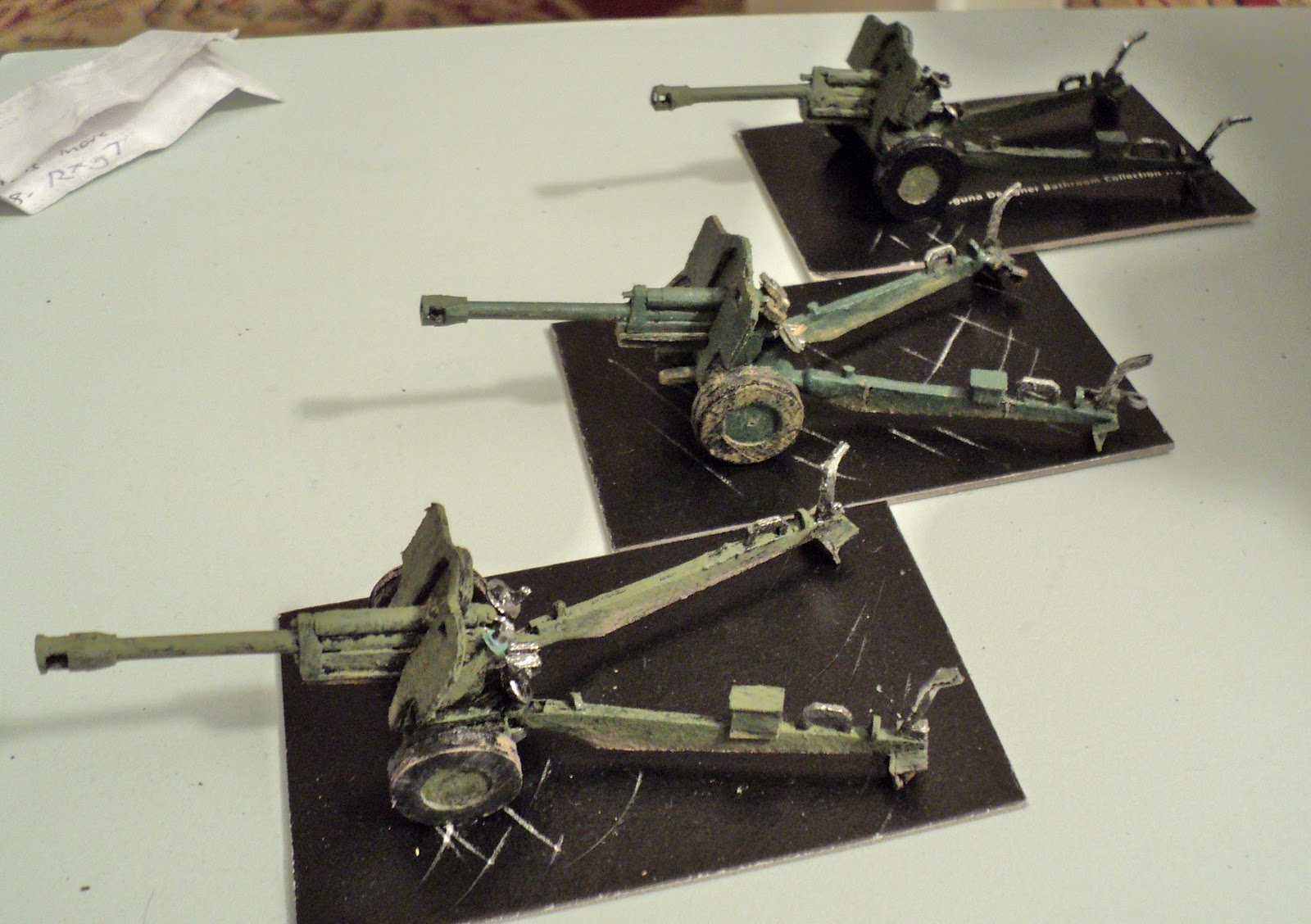
Field artillery regiment; 1st Guards Mechanised Brigade
 About 20-odd years ago, when money was short and time was long, I wondered how I was going to acquire the guns I needed for my Russian (or Pan-Andean People's Republican) Army.  A rather crudely scratchbuilt set of infantry guns didn't pass muster, though one of the more outspoken critics offered to lend me a metal field piece from which to draw up templates for scratchbuilding.  The first results you see here: the First Artillery Battalion of 1st Guards Mechanised Brigade.
The middle gun in the line above was the first built, all from cardboard, chads, and bits of ball-point pen.  Even the wheels were cardboard, made up of layers that vaguely suggested a tread, and the outer circle having its centre cut out for a better representation of tyres and hubs.   That centre gun also has its towing assemby, a rather fiddly construction from thin cardboard (cereal packet), paper and a discoid section cut from the ink reservoir of a ball pen.
Finally, the muzzle brakes were fashioned, again from ball-pen ink reservoirs.  Trial and error suggested the best method was to sharpen a length of reservoir with a pencil sharpener, cut out square sections on either side, up near the blunt end, leaving a millimetre or two untouched.  Then shave off slivers top and bottom of the whole thing.  Then it can be slipped over the end of whatever you are using for a gun barrel.  For these guns, it was modellers' white plastic tube.

From what I've seen and read of Sovier artillery, I'm guessing this was an early war - possibly a pre-WW2 design.  Perhaps someone can correct me on this.
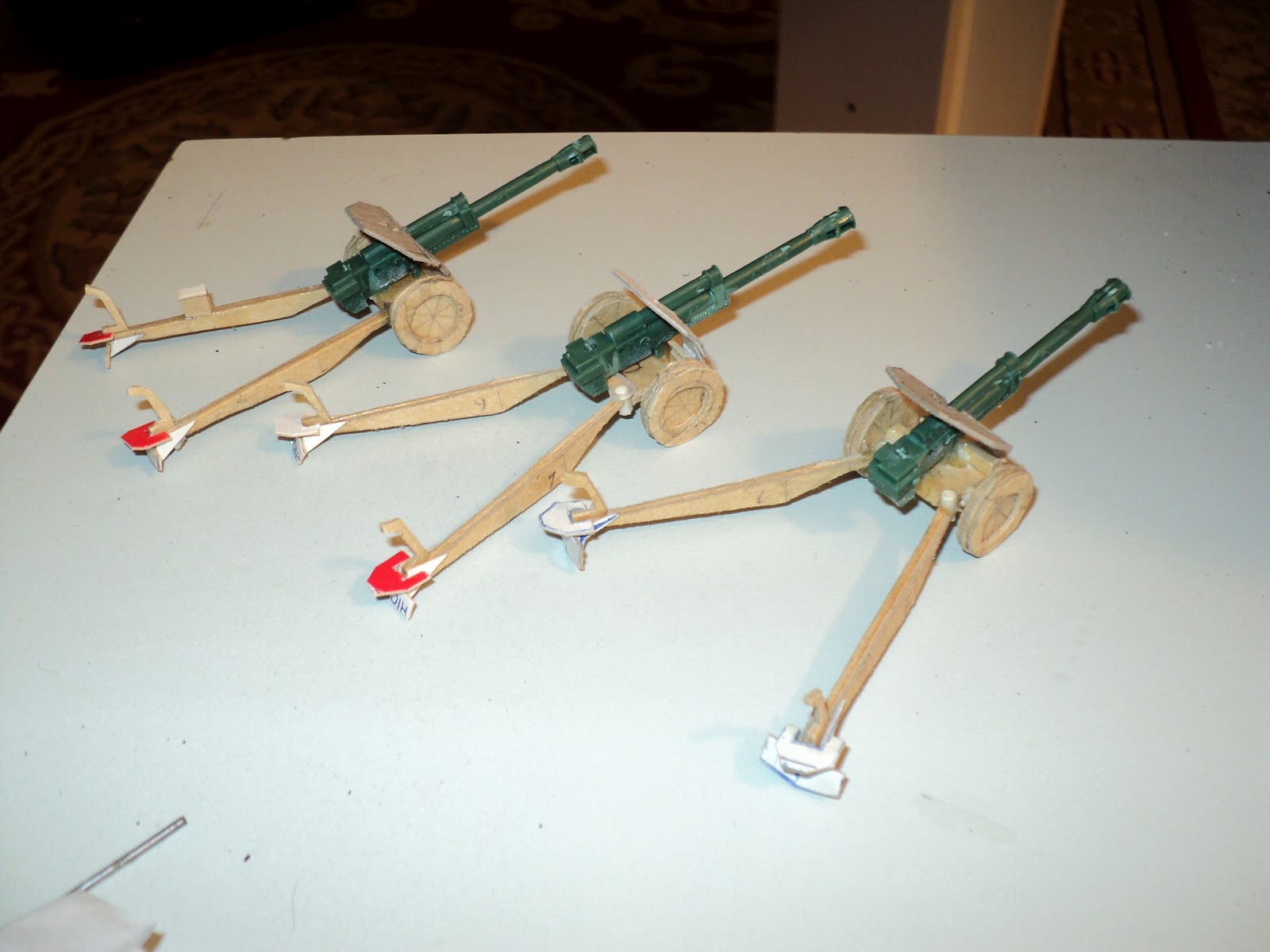
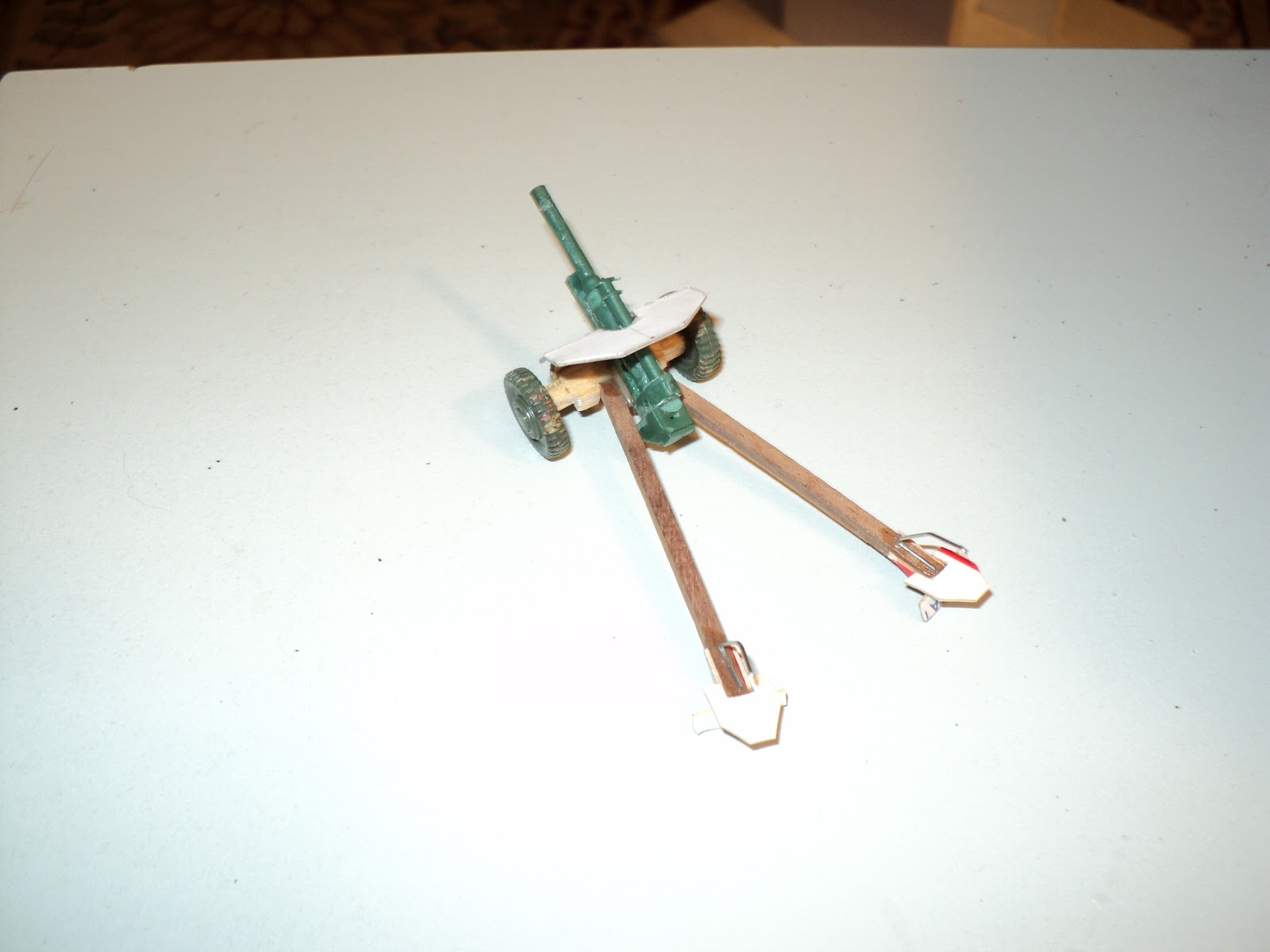
A fourth field gun, same calibre (76.2L39) under construction.  Until very recently I had not based them, slotting gun crew stands between and under the trail legs of the pieces.  Unfortunately, the construction isn't very robust, and even before the earthquakes, pieces had to undergo periodic repairs.  This usually meant retaching the legs.
76.2L39 Field gun under construction.  Beer mats make very good bases...

A few years ago, I was given some spare parts from a number of gun, AFV and vehicle kits a friend had already assembled.  The easiest such conversions were the guns.  There were enough gun barrel and breech black assemblies to form a regiment (We're talking Command Decision, here) of 152mm Medium pieces.

This is the way they have been for quite a while now - a few years at any rate.  Still a few bits and pieces to add.
They will also get the same sized bases as the other field guns.  These bases have no meaning in CD terms, that being defined really by the base of the gun crew stand.

There was, however, just the one 122mm piece.  This one, though, I gave 'proper' wheels.

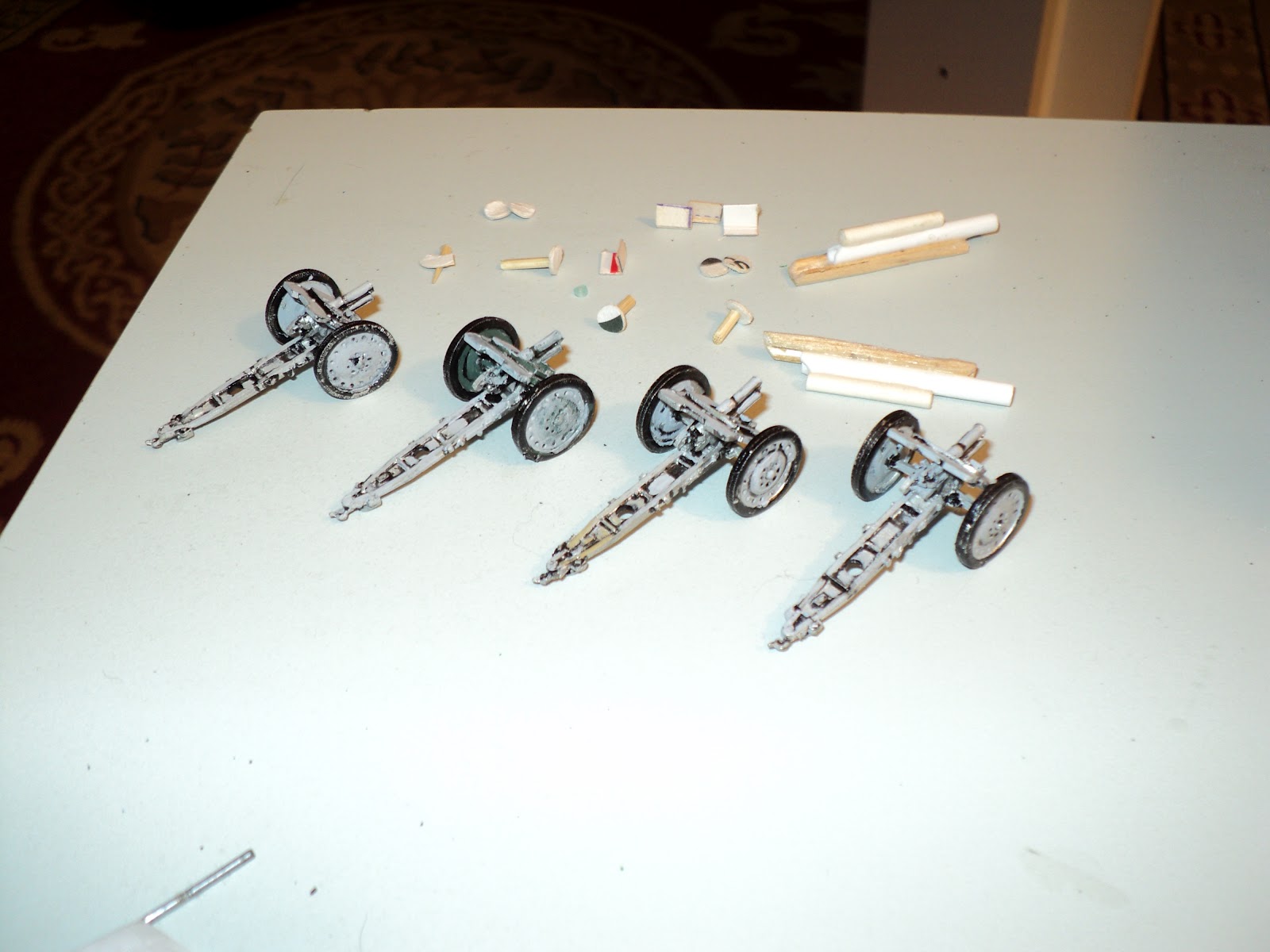
As it happened I had already made a beginning on a couple of other 122mm gun/howitzers, but hadn't worled out the breech blocks.  Incidental to a later picture you will see some of the bits involved.  Not much progress there, though.


And now for some infantry guns.  This was really where I came in, trying to construct some of these small guns with, at the time, no worthwhile information on what they looked like.  A few years ago I acquired these white metal pieces at a bring-'n'-buy.


So far they have received no more than an undercoat.


What formations will get these guns?  Probably some of the less well-equipped Rifle Brigades in my army, but the decision is still pending.


Finally: a couple of 'Quick-built' Italeri ISU152s.  Such vehicles features in a recent article in the Plastic Warrior blogspot, but they had different gun barrels.  I had forgotten that they came with alternatives.  I opted for the short barrelled guns with the 'shark-gill' muzzle brake.

The earthquake damage to the far vehicle (above pics), though quite apparent in the b&w picture, turned out to be quite easy to repair, and will be completely hidden by a paint job...


...once they have been dusted off!

Saturday, June 30, 2012

PAPR Tigers

1st Guards Mechanised Brigade - veteran of many an action -
less its armour and other heavy equipment.
The battalions are also shown without their Mortar and Anti-tank Gun Companies.
 One of the attractions of Imagi-Nations is the capacity to create (more or less) historical armies, even use them in familiar environments, but without being too restricted by historical perecedent. In particular, it is hard to refight the entire East Front campaign, especially given the changes in the nature of the respective forces in that war. Given smaller countries, with less than a tithe of the vast prototype armies, gives you the scope for a larger story than can be provided by one-off pick-up and scenario battles.
I Battalion, 1st Guard Mechanised.
  Two rifle companies advance with the SMG platoon, supported by the MMG company.  The Anti-tank Rifle company guards the right flank; the Battalion commander remains with its reserve company ready to exploit success.

One of my Imagi-Nation campaigns goes under the 'working title' Latin Wars, a period of warfare among small Latin-American countries that begins towards the end of World War Two.  One of these countries, formerly called Vespuccia, has shortly brfore overthrown its Dictator government, substituting for it one with a more societal, though nationalistic, programme Certain political commentators called it Socialist, others even Communist (George Orwell, though sceptical in view of his observations concerning the Stalinist regime in the Soviet Union, was inclined for the time being to scatter praise upon its social ambitions) yet it managed for several years to fly pretty much under the radar of United States's vigilance (paranoia) concerning such regimes.    Not that the revivified State hid behind any euphemistic appellation: the Pan-Andean People's Republic was exactly as it announced itself to be.
I Battalion, again.

The fact was, this was a populist nation, run by a populist leader, with a populist, and popular, social and economic programme of reform.  It quickly became clear, however, that it's popularity did not extend far beyond its borders, barring a few sympathetic commentators.  Distracted by the World War and the subsequent falling out with the Soviet Union, the USA was at first, however, inclined let the bordering dictatorship of Orotina to bring down this upstart nation.


III Battalion.

The Pan-Andean government found no shortage of volunteers for its armies, as it quickly mobilised  several units for the impending war with Orotina (you can see as how this is going to have a distinctly 'Red Army' look, eh?).  Not that the latter needed any encouragement from the Great Powers.  Expansionist in any case, and casting covetous eyes upon the recently nationalised natural resources President Adolfo-Augusto Ximenez  was inclined to the view that by rights the entire nation of The People's Republic was territoryintegral to the Orotinian State, to be brought under proper government (i.e. his) by force. 
Brigade HQ, 1st Guards Mechanised,
 with the Brigade SMG company and some light trucks.

Calling themselves the Tigers, the early Pan-Andean units gave a good account of themselves in the early fighting along the border as Orotina tested it's opponent's mettle.  Orotinian propaganda expressed contempt for the PAPR Tigers, but this achieved no more than to induce the Pan-Andean volunteers to wear the name with pride.   Orotina was to find that, despite its advantages in equipment and training, they were not going to have things all their own way in the wars that followed...

These pictures show the 1st Guards Mechanised Brigade, less its heavy equipment and armour. 

MMG Company with Airfix MMGs.
  Most of the figures are also Airfix, but the gunner on the right hand one is ESCI
 As these pictures show, some touching up work would not go amiss, it having been eight or nine years since last I painted them and flocked their bases.  They have not travelled as well as they might have done, nor have the earthquakes been very kind (several troops got dumped twice from a great height upon the floor). 
Anti-tank Rifle Company, armed with single shot PTRD anti-tank rifles.
 This brigade features also a mix of Airfix, ESCI and HKKO figures.  HKKO?  Hong Kong Knock-Off.  Mostly ESCI in this Brigade.  I liked the ESCI rifleman figures, but there were really rather too few of them and too few poses (the standing and kneeling firing are very good).   The ESCI MMG is much less crude than the Airfix version, but I much prefer the latter's gunner, sitting behind the weapon.  Pity Airfix did not do the same for its Vickers MMG.
Another pic of III Battalion, 1st Gds Mech Bde.
  A mix of ESCI and Hong Kong knock-offs.
  Some of the latter have pins substituting for their SMGs
 I also found the ESCI and the HKKO figures nicer to paint.  The Airfix chaps were marred by flash difficult to remove. 
SMG Coy, First Gds Mech Bde.  These are Airfix.
  The rather munted helmet worn by the officer figure probably ought to have something done about it...
Of course, this is just a small part of the PAPR army.  I still have to sort through the Tank Brigade, the three Rifle Brigades, plus assorted security and border companies, and special units that make up the whole force...


Saturday, May 26, 2012

Breakthrough at San Angelo - Part 3

Gran Bolivarian infantry, #1 Section awaits an attack
that never arrives...

Having cleared out the leading enemy infantry from the fringe of brush flanking San Angelo, the Orotinians pressed on.  As the infantry swept through the brush, the Mark IV and one of the Mark III tanks eased up to the stone wall behind which the sole Crusader tank so far encountered was smouldering gently.


At once the armour came under fire from a 6pr anti-tank gun a short distance beyond.  At the same time, a Boys Anti-tank rifle team, finding itself too distant for an effective shot, tried sneaking along behind the stone wall to close the range.

Both sides had a measure of luck, here.  The 6pr gun's shot simply went wide, and the Boys team, spotted by the Mark III commander, escaped the quick burst from the tank's co-axial machine gun.  But their position was becoming precarious, as the Orotinian infantry rapidly approached.


A brisk tank and anti-tank firefight quickly ensued. 


The Boys rifle fires ... and misses!
Just as the Orotinian infantry burst out of the brush, the AT Rifle team squeezed off a shot at the Mark III.  A complete miss!  A sad fate for what had been a suicidal attempt: under a hail of small arms fire, the anti-tank rigle team were eliminated.

A tank shell eliminates half the 6pr gun crew!


The 6-pounder's first shot drew attention at once to to both AFVs, which returned fire with high explosive and machinegun fire.  With men dropping all around, the gun fired back with a will, switching its fire to target the more dangerous-seeming Mark IV.  It was a fortunate as well as fortuitous choice.  The solid shot penetrated the gun mantlet beside the main gun, putting the vehicle out of action.
The Orotinian commander was now in something of a quandary.  Could he continue the attack?  Down to two tanks, one of those on the other side of the road guarding against a possible counter-attacck from that direction, his infantry was as much depleted.  As the latter swept across field towards the anti-tank gun, its remaining crew having been wiped out by the panzers' HE, he ordered the left flank Mark III to check out the situation in its part of the field.
End of the action: the lone effort of the Mark III tank is stopped cold
by a single shot that penetrates the front hull.
Disaster!  In a village back yard, the defenders' second 6-pounder gun was waiting just such an opportunity.  Early in the action, it had had a go at the tank through the gap between the village and the tract of forst to their front.  Unsuccessful, the crew had waited patiently, half expecting the enemy to emerge around the other end.  The gun's first shot settled the matter before the tank crew could see whence the threat would come.
An unfortunately fuzzy picture of an
Orotinian armoured infantry platoon
At once the Orotinian commander yielded the palm to the defenders.  Having one tank left of the five with which he began, and just 19 men remaining of his 40-strong platoon, it was clear to him that further progress could not be achieved if he were to retain sufficient strength to resist a likely counterattack.  It was unlikely he could succeeed at all!
Gran Bolivarian infantry - two sections of a platoon.
  Nearest the camera is a Boys AT Rifle team stand
 adapted from first generation Airfix figures.
  This counts as an ordinary infantry stand when I'm using Command Decision rules.
The Gran Bolivarian losses, though severe enough, were light compared with their opponents: some 13 men - 7 from #2 Section, 2 anti-tank riflemen, and the 4 6pr gun crew - plus a Crusader tank.  The situation was clear: the attack had been defeated, San Angelo was safe.

Overall, the Airfix rule set offers a framework for a brisk and enjoyable game.  But I do believe a deal of work needs to be done to make it really playable, especially if infantry are to have a role on the table-top...

Wednesday, May 23, 2012

Breakthrough at San Angelo - Part 2

As the recon light tank erupted in flames, the commanders of the mediums frantically searched out whence the deadly shot had come.  It soon became clear that the range had to be closed for an effective shot by the Mark IIIs, but the Mark IV dropped at once into action.  The first exchange of fire was 'honours even': both missed.  But soon enough the three Mark IIIs were ready.  At four to one odds, even with the partial protection of the stone wall (which I tended to think of as offereing a partial concealment rather than protection against solid AP shot), the Crusader might have been better advised to have bugged out when he could. 

Four against one!  The Crusader's 6pr gun knocks out the centre Mark III, but the left hand tank drills the Crusader turret with a solid shot.  The PxIV missed altogether; the other PzIIILs strike the wall directly in front of the enemy tank.  That the turret hit was effective saved me from deciding how much protection the stone wall could give to the Crusader's front armour!
True, a Mark III suddenly clanked to a stop, smoke billowing from its hatches.  But a 5cm solid shot punched through the Crusader's turret armour, and ended the fight.

The executive decision to which I alluded rather abruptly before ending the last posting was this.  About to adjudicate the response of the Gran Bolivarian infantry observing the approach of the Orotinian armoured infantry and tanks, I saw two aspects of the rules that reminded me why the Quarrie WW2 battlefield was such a hostile environment for miniature infantry.  First was that the range: long range being 900 meters - 900mm in the Airfix rule set. 
The second was that rifles had a rate of fire of 4 shots per 30-second turn; and machine guns could claim a target of anyone within an unspecified arc.   This seemed to me far too punitive.  Right there I let the ranges stand, but reduced the rifles to one aimed shot per turn, and machine guns to 3 shots (SMG), 4 (LMG and vehicle MG) and 6 (MMG).  Even that was bad enough...
As the leading sections dismounted, the incoming laid low four from #1 and two from #2 Sections - a third of the 18 men dismounting. 

At just under 600 meters range, it would be a long time before these lads could get close enough to shoot back - that is, to within 100 meters.

As the rest of the platoon pressed on, accompanied by the armour, it became clear that the planned 'suppressive' fire wasn't going to work.  Under the spotting rules, anyone in cover could be spotted only at very short ranges - 100mm on the table.  There were no rules that allowed speculative fire into cover from which enemy fire was emerging, or might be expected.   A firing unit became easier to acquire, yes, but only within the standard spotting range.  There was absolutely no chance of the leading Sections (#1 and #2) getting close enough to make a difference, and indeed, half their remaining dozen men were cut down as they struggled forward. 
Gran Bolivarian infantry fire: SMG (green), LMG (red), and rifles (white).
 Good shooting at that range - though they must be getting a bit edgy
 with Orotinian panzergrenadiers so close - 6 hits out of 10 shots.   
Once within range at which they could engage the Gran Bolivarians, #3 and #4 sections dismounted, and pushed forward into a hail of fire.  Half a dozen were at once bowled over by the defenders in the brush;
Vickers MMG catches the right flank of #4 Section...
 and when part of #4 Section strayed to the right, three more were cut down by a hidden Vickers gun.

But these Orotinians were now in a position to fight back.  Spotting their assailants, #3 and #4 Sections gave back everything they had.
#4 Section shooting into the scrub.  Not terribly effective:
 just 3 hits - 1 from the SMG, 2 from the vehicle MG.

Not especially accurate, their shooting was deadly enough.   Brutal as the exchange had been, and the Gran Bolivarians had got slightly the better of it thanks to the Vickers MG, as the clatter and bang of the firing died away, there was nothing left of the Gran Bolivarian infantry section that had borne the brunt of the attack.  The Orotinians could now advance into the town...
Slightly more effective, this: 4 hits.
 This patch of scrub is now clear of the defenders...

To be continued...