Showing posts with label Byzantiad. Show all posts

Sunday, April 17, 2022

Byzantiad - Insurrection in Italy: Battle of Langobardia


The armies lined up for battle: Imperialists on the right
Kantankeros's rebel army on the left

Following his defeat near Brindisi, the rebellious George Kantankeros fled with the remnants of his army to the northwest. In the region of Langobardia, he hoped to gather more strength with which to preserve his realm and, withal, his life and freedom. A few days sufficed for the Emperor to put affairs in order at Brindisi, and therein to establish a base of operations. That task done, he set out with his army to settle accounts with the rebellious Governor.
Michael Psellophanes, Byzantiad

The armies from behind Imperial lines.

Though unable to gather his whole strength, Kantankeros had added a cavalry unit to the force he had fielded at Brindisi. He hoped this time to give a better account of himself. All the same, it was a formidable army the Emperor had brought across the Ionian Sea, the cream of the Imperial military.  
The Imperialists attack!

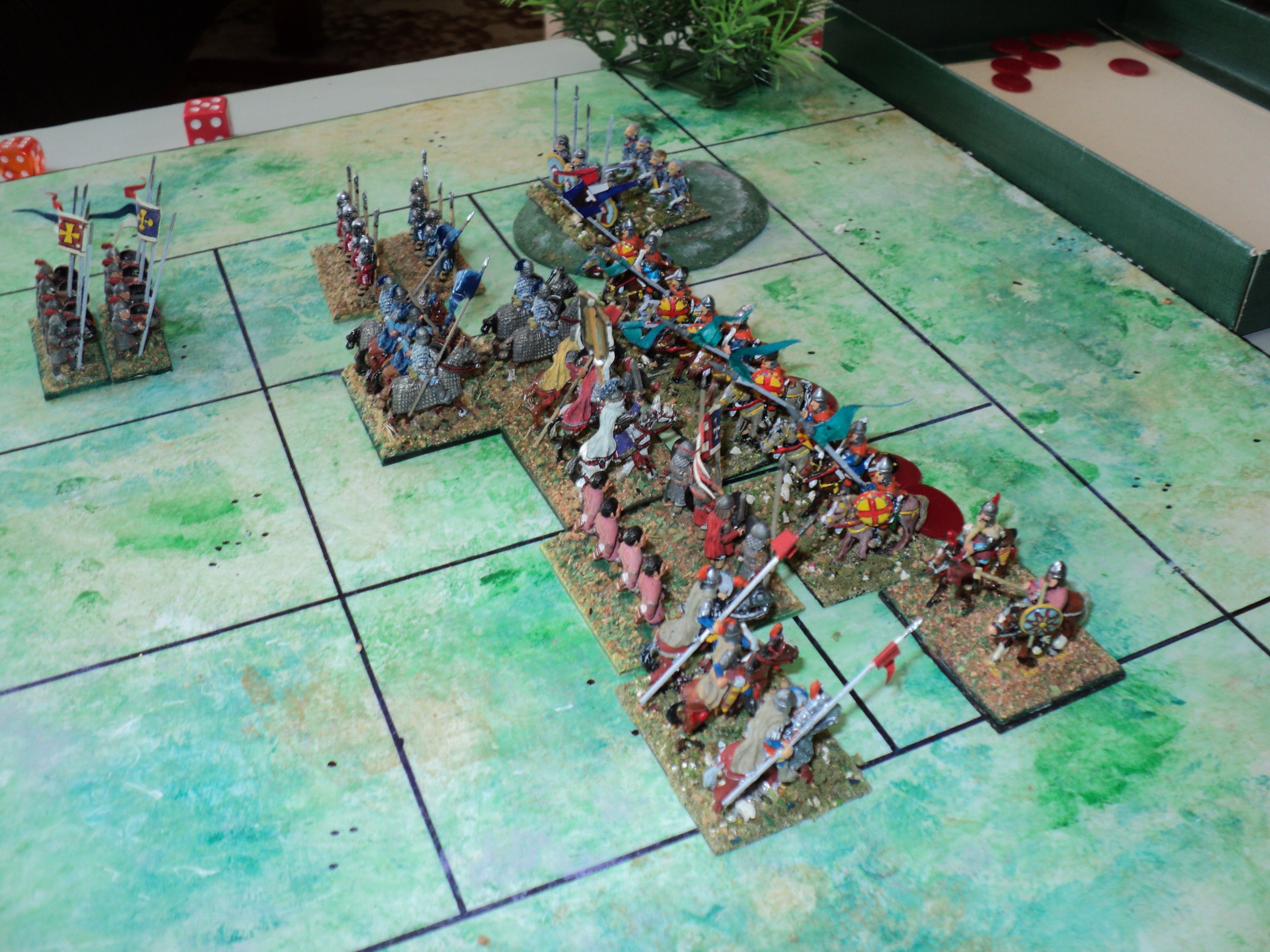
The cream of the Imperial military was eager, at that, to engage their adversaries, and advanced rapidly across the plain to reach the rebel lines. They were drawn up with the skoutatoi ('protected bowmen' as I call them) occupying an elevation of the right flank, and the cavalry along the rest of the front. The light horse were on the left. The Imperial army advanced with the skoutatoi, backed by heavy cavalry on the right, the Emperor's own troop backing up his extra heavy kataphraktoi in the centre, and on the left, the Varangian Guard and the marines set to assail the high ground.
Experimental pic with units side-by-side
instead of in tandem.

At this point, the eagle-eyed reader will observe a change in the 'posing' of the pictures, with units aligned side-by-side in each square, rather than in tandem. I have to admit it looks well, though of course only one close combat is adjudicated in each, the 'second' element counting towards support the first. But then, how does one decide which is the 'first' or 'primary' fighting element at any given time? Once I'd sorted out this turn, I went back to the 'tandem' arrangement. After all, it does suggest successive battle lines. Mind you, with the 'linear' arrangement, in any given combat with two units in the square one could simply 'pick one', rather than designate beforehand which is supposed to be the lead unit. This might be worth looking into.
After close combat.


First blood went to the Imperialists, inflicting heavy casualties upon the rebel centre, but worse, the heavy horse on the left were routed from the field. The rebels' only success was to repulse the first attacks by the Varangian Guard upon the hill.
Heavy losses among the rebels; but that hill is proving
hard to take!


The marines took up the fight on this wing, surging up the slopes, with the rallied Varangian Guard returning to the fray. As the struggle continued in the centre with no further progress on either side, the light horse holding a tenuous left flank also suffered some loss. At this point of the battle, the rebels had lost four strength points, the Imperialists, none!
Heavy Imperial pressure all along the front

Even though the marines were in their turn repulsed by those stout skoutatoi on the hill, the trend of the battle seemed unlikely to alter its course. But the Goddess Hexahedra is ever fickle - quite without memory, according to tradition. One may never predict what is to happen based upon what went before. It was probably true to say this battle didn't alter its course, but perhaps one could say a dam seemed to be placed across it. 


The first slight hint that the Imperialists were not going to have matters all their own way appeared on the right. The arrows of the light horse began to pick off the bows and spearmen among the skoutatoi facing them. This hint, however, was perhaps hidden by the rout of the lead cavalry unit from the rebel centre. Kantankeros was left with his own bodyguard to face the might of the kataphraktoi and Tagmatic kavallaioi commanded by the Emperor in person.

A second rebel unit bites the dust!
The deadly arrows of the rebel prokoursatores proved too much for the Imperial skoutatoi, and they soon broke up and fled. This was hardly a disaster, though, as behind them stood a body of kavallarioi.  Surely they would be more than a match for light horse that had already taken some stick? The 'score' at this point was Imperialists, 2SP lost; Rebels, 5SP lost.
But now it id the turn of the Imperialists to
bemoan losses.  The skoutatoi rout.

The Imperialist army once more closed with the enemy. The Varangian Guard mounted the third assault upon the infantry-held hill, with the help of the rallied marines. For all their earlier reverses, losses on this flank were negligible on both sides (i.e.nil SP). Meanwhile, all along the line, the rebels were presenting a thin and seemingly permeable front.
Imperial attacks resumed.

But that line was proving harder to crack that the Emperor awaited. True, the light horse were for the moment driven from the field, but the losses among the Imperial army were beginning seriously to mount. For that insignificant success - the light horse would soon be back - the Imperial loss had grown to 4SP; the rebels' was still on 5.  
The first sign the Rebel line is wavering...

The battle line wavered as rebel units, driven back, rallied, and returned to the charge. First it was the light horse, then Kantakeros's own troop, and then the defenders of the hill, with the third assault, forced altogether from the feature. But they had exacted a toll: one SP from the Varangian Guard. Now the 'score' was 5 SP lost to both sides.  

Still grimly hanging on...
The Varangian Guard storming the hill defended 
by rebel skoutatoi


As the Guard fell back once more to rally and reorganise, the marines were left to occupy the hard-won high ground. Meanwhile, the rebels had more or less restored their line (the victory criteria I make contingent upon who has the initiative at the time, either the second half of an IGoUGo turn, or who wins the initiative roll. So far the rebels had been lucky).

The hill is lost!

For all the difficulties the rebels succeeded in throwing in the Emperor's path, they were barely hanging on. It seemed merely a matter of time before the final collapse would ensue.  

But not yet!  A counterattack by the rebel skoutatoi drove off the marines, and recovered the high ground. The Imperial left had it all to do again! Instead, they were to suffer their third repulse of the day,  as the marines were driven back upon the Varangian Guard.
The hill changes hand a second time - but 
for Kntankeros, the battle is lost

The final blows were struck on the right and in the centre.  Although damaging the heavy cavalry facing them, the light horse were finally put to the rout, and abandoned the left wing altogether.  In the centre, a terrific battle led to both sides having to fall back. (This is shown by the two pairs of sixes, orange being Imperial, green for the rebels.  The first pair are the combat dice: both scored hits without having to calculate for adjustments.  The second pair were the outcome: both sides forced back. Both sides could have taken the SP hit instead, but it would have made no difference.  The loss of the light horse decided the battle.  The total loss on both sides now stood at Imperialist 5SP; Rebel, 7SP).
Fierce fighting in the centre


So the survivors of Kantankeros's army drew off to the west, the rebel Governor himself suffering no hurt in the combat. For the second time, though, his troops had, in the face of apparently imminent defeat, proved stubbornly difficult to overcome. Failure to capture of kill the rebel leader meant there would be at least one more battle before the boot and heel of Italy could be reclaimed by the Empire...


To be continued ... Battle of Apulia


Tuesday, April 5, 2022

Byzantiad - Pecheneg Raid 3

Opening clashes

 Pecheneg Raid 3 - Battle of Heraclea

"Not for nothing was Isaac Salonikos renowned for his determined attacking play in the fashionable game of war, petzia, or skaki, as it was beginning to be called.  Few were his defeats, but on the occasions of defeat, he was ever eager to retrieve his fortunes in another game.
First blood this time to the Byzantines

So it was in warfare. Two successive defeats - both of which might well have been victories - were not enough to discourage this commander. So it was that, at the forest close by the Thracian town of Heraclea, he once again caught up with the raiding Patzinaks. Apart from the hound-like tenacity of the Roman leader, the Patzinaks were by this time heavily laden - encumbered, withal - with booty. Already their thoughts were perhaps leading them towards beginning their homeward journey, that they might enjoy the rewards of their violent emprise.


Placing his peltastoi on the right as most suited to fighting in woodland, he set the skoutatoi on the left, supported by his least reliable cavalry unit, and installed himself at the head of the main body of cavalry in the centre. The onset of the barbarians was met at once by the determined advance of the Romans..."
Michael Psellophanes,  Byzantiad. 
The skoutatoi forced back momentarily; 
the Byzantine centre edging the raiders back

The rout of the Pechneg right wing light horse

The opening clashes to begin with met contrasting fortunes in the three sectors of the field. On the left the skoutatoi were forced back by the horse and foot archers both, though not without serious loss to the light horse (1SP). In the centre, Strategos clashed with Khan - and it seemed that the Roman leader would prevail, driving back his adversary. On the right, the peltastoi, fighting at the wood edge, were being held by the Pecheneg light horse. 


Isaac Salonikos's band overthrown, but the 
Pecheneg leader himself has been forced 
from the field
Returning to the attack on the left, the Romans threw back in rout the light horse before them, and followed up to bring the bowmen into a combat with spear and sword. On the right, the peltastoi also began to assert some dominance, gradually edging back the light horse to their front.  
Total victory on the Byzantine left!
Then, disaster struck in the centre. The impetuosity of the Byzantine charge drove back the Pecheneg leader well enough, but the latter was taking a fearful toll. Salonika's personal command disintegrated, he himself unhorsed in the fray. For the briefest of moments, it seemed yet again, the Byzantines would know defeat.
The Byzantines were not to be denied this time. Despite their own losses, the skoutatoi reduced the enemy bowmen into a crowd of fugitives, and the peltastoi on the right continued their relentless drive. Soon not one Pechneg unit remained upon the field of battle.

Pechenegs driven from the field


At this point, the four surviving Pecheneg units had all been herded into the 'rear reserve' area, a zone permitted under the rules to hold two. So two light horse units had to be eliminated - presumably made off into the countryside, thence to find their way home as best they could. With just two units remaining, the Pechenegs could not hope to recover their fortunes. They fled.

Isaac Salonikos, unhorsed in battle, observes his victory on foot.


The losses to both sides were a deal fewer than they had been in the previous two battles, just 4SP apiece, not counting the elimination of two units from the overcrowded reserve zone.  But it was an undoubted Byzantine victory this time, and brought a term to the Pecheneg raid. There is, I think, no need to depict the Byzantine chivvying the defeated raiders back across the Bulgar border, nor, I dare say, Bulgar light horse escorting the raiders back across the Ister (Danube) River. So ended the Pecheneg raid.

Final victory for the Byzantines!

To be continued: The Fatimid Invasion - Crossing the Orontes.


Monday, April 4, 2022

Byzantiad - Pecheneg Raid 2

 Pecheneg Raid - Battle of Adrianople

"Following his hard-fought victory over the Romans at Anchialus, Khan Torol led his Patzinaks deeper into the Imperial interior, rieving, sacking, burning and plundering all the way. His army might have been tracked by the smoke of burning farmsteads and villages, and the tales of woe from refugee townsfolk.   
Byzantines try to envelop the Pecheneg left
Undaunted by his earlier reverse, the Strategos, Isaac Salonikos intercepted the raiders on the banks of the Lefkopotamus River, its early spring spate this day somewhat abated to little more than a rill.  Lining the near bank with his main body, he left his better cavalry bandon hidden on the other side of the river, ready to fall upon the Patzinak left as they pushed forward.
That Salonikos had no intention merely to defend the river line was very soon made clear.  All along the front, his line advanced, and the battle quickly developed into the Roman attempt to envelop the raiders' left wing.  Although the Patzinaks held the wings, and even inflicted loss upon the Romans, their centre was driven in.  The early auspices seemed to light upon Roman arms..."
Michael Psellophanes, Byzantiad.

The fighting is favouring the raiders so far...


This really and truly ought to have been a Roman (i.e. Byzantine) victory, despite the early blood-letting (losses of strength points) very much in favour of the raiders.  However, the driven Pecheneg centre was soon back, and the battle between the bowmen and the peltastoi was then settled in favour of the former.

The peltastoi have lost 2SP and must rout...

At once, the Byzantine reserves had to be thrown in on the left, whilst the battle on the rest of the front remained unresolved. True, the flanking cavalry was forced back, but that setback was only momentary. Once again they returned to the charge. All the same, the loss of 4SP against just 1SP, indicated that the Byzantines might be facing a second defeat.

Salonikos himself shores up the broken left


Fearing for his bowmen on the right, the Khan joined that part of the fight with his entourage of nobles. The fight between his light horse archers and the Byzantine heavies ought to have been settled in favour of the latter, but the lighter horse were more or less holding their own. The cavalry routed one band of light horse, but the skoutatoi having been driven back across the stream, freed a second light horse band to prevent an immediate breakthrough. Despite the disparity in losses, and the disappearance of the peltastoi the Byzantines seemed at least marginally to have the edge.


The fighting grows keener


For a space, the deadlock remained unresolved, the Byzantines even losing another strength point (5-3 now in Pecheneg favour).  Then the unengaged skoutatoi once more entered the fray, just as the cavalry in the centre put the opposing light horse to the rout.  Salonikos now had the victory in the hollow of his hand...

Initiative roll - a very rare Byzantine 'win'

... and here is where I made a rather large mistake. Those two dice you see is the initiative roll at this point - and it was a very rare 'win' to the Byzantines (the Pechenegs seemed to have a monopoly on the initiative during these battles). Since it was the Byzantines' move, and the Pecheneg reserve area is empty, I ought to have called the battle here - a Byzantine victory. I have no idea why I didn't.
The situation critical for the Pechenegs


Seeing the Pecheneg centre disappear scattering across the plain, the local cavalry commander bethought himself to strike into the rear of the embattled Pecheneg right. Meanwhile, the other flank looked equally parlous for the raiders.

I might have guessed how it would go. It were ever thus. The cavalry's 'shooting before combat' was a frost, and the close combat into the rear of the Pecheneg horse went D6=1 for the Byzantines; D6=6 for the Khan. The hit upon the Byzantines meant to kiss a strength point goodbye. 
Utter disaster for the Byzantines! The kill off the 
bowmen, but at such a cost!


The follow-up went no better. Once again the Pecheneg horse went unscathed, the Byzantines took a second hit, and routed. On the riverbank, Salonikos took over from his hyperkerastai and finally spitted the enemy bowmen upon his lances. The cost was high, his personal command depleted. Upon the Khan's counter-attack, they promptly collapsed. Salonikos himself was caught up in the rout and barely escaped harm (the dice roll for risk of personal injury was OK). By a miracle, the Kkan Torol had broken out of encirclement.
  
Having successfully fought his way out of a trap
Khan Torol now sets out to finish off the
enemy

So quickly had fortunes reversed, and they didn't end there. The hyperkerastai soon went the way of the kavallarioi. The long unresolved fight upon the Byzantine right at last reached its conclusion - the remaining Byzantine heavy horse also breaking off and fleeing into the hills. It was left to the skoutatoi to make their way from the field. Themselves battered from the tough struggle, the Pechenegs let them go. 
No wonder. They had lost 8SP, the Byzantines lost 11.  But the raid could continue...


Now, as I really ought earlier to have called the Byzantine victory, I did consider (looking back over it) doing so, and ignoring the subsequent game events. But that seemed to be a waste of further exciting moments, so I stayed with the result of this one as narrated. Two victories have the Pechenegs chalked up. When next Salonikos catches up with them, it will be not far from the Gates of Byzantium...

To be continued - the Battle of Heraclea

Thursday, March 31, 2022

Byzantiad Army Lists - PW Nomenclature

I thought here I would 'redo' the army lists in terms of the troop types described in the previous posting, with strength points.  I have found occasion since first publishing it to modify the EXCEL table in my previous posting.  Otherwise the Army lists have simply been copied across from the earlier posting, and relisted in Portable Wargames 'Byzantiad' format.


 Byzantine Provincial (Thematic) Army:

1 x Commander: Provincial Governor/ Strategos with Thematic Heavy Cavalry unit - 3SP 
2 x Thematic Heavy Cavalry regiments - @2SP = 4SP (one may be 'poor')
1 x Protected Bowmen - 2SP
1 x Bow Light Horse - 2SP OR 1 x Cavalry - 2SP
1 x Loose Order Spear/Javelins unit - 2SP OR  Lance/Bow Light Horse - 2SP

6 units, 13SP

Byzantine Imperial (Tagmatic) Army:
1 x Commander: Domestic of the Schools (δομέστικος τῶν σχολῶν) with Tagmatic Heavy Cavalry - 3SP (elite)
2 x Tagmatic Heavy Cavalry regiments - @2SP = 4SP 
2 x Protected Bowmen regiments - @3SP = 6SP
1 x Lance/bow light horse - 2SP

6 units, 15SP

Byzantine Imperial (Tagmatic) Army:
1 x Commander: The Emperor with 1 Tagmatic Heavy Cavalry unit - 3SP (elite)


1 x Tagmatic Heavy Cavalry regiments - 2SP 
1 x Cataphract regiment - 3SP (elite)
1 x Varangian Guard Close Order Spear regiment - 3SP (elite) 
1 x Protected Bow regiment - 2SP
1 x Lance/Javelins Light Horse - 2SP

6 units, 15SP

1. Lombard/ Norman
1 x Commander: King or Duke with Charging Cavalry = 3SP (elite)
2 x Charging Cavalry @ 2SP = 4SP
2 x Spearmen @3SP = 6SP
1 x Bowmen - 2SP

6 units, 15SP


Normans ... or maybe Lombards.


2. Bulgar Empire:
1 x Kavkhan, OR the Tsar if objective is conquest or defence of the realm with Heavy Cavalry = 3SP (elite)
1 x Heavy Cavalry= 2SP
2 x Close Order Spearmen @3SP = 6SP
2 x Bow Light Horse @2SP = 4SP

6 units, 15SP

3.Pechenegs:
1 x Commander: Khan with Noble Heavy Cavalry - 3SP (elite)
4 x Bow Light Horse @2SP = 8SP
1 x Bowmen @2SP OR War Wagon @3SP

6 units, 13-14SP

4. 'Kievan' Rus
1 x Prince of Kiev with Axemen @ 4SP (elite)  or Heavy Cavalry @3SP (average)
4 x Close Order Spearmen @ 3SP = 12SP
1 x Close Order Spearmen @ 3SP or Axemen @ 3SP or Bow Light Horse @ 2SP

6 units, 17-19SP

5. Abasgians/ Georgians
1 x Commander: Prince with Charging Cavalry - 3SP (elite)
1 x Charging Cavalry - 2SP
2 x Close Order Spearmen @ 3SP = 6SP
1 x Bowmen - 2SP
1 x Bow light Horse - 2SP

6 units, 15SP

6. Bagratid Armenian

1 x Commander: Prince with Charging Cavalry - 3SP (elite)
1 x Heavy Cavalry - 2SP
1 x Bow Light Horse - 2SP
2 x Close Order Spearmen @3SP = 6SP
1 x Bow Light Infantry - 2SP

6 units, 15SP

7. Seljuk Turk
1 x Commander: Sultan with Heavy Cavalry - 3SP (elite)
4 x Bow Light Horse  @2SP = 8SP
1 x Bow Light Horse or Bowmen or Bow Light Infantry - 2SP

6 units, 13SP


8. Fatimid Egyptian
1 x Commander: Appointee of the Fatimid Caliph with Heavy Cavalry - 3SP (elite)
1 x Heavy Cavalry - 2SP
2 x Protected Bowmen @ 2SP = 4SP
1 x Loose Order Spearmen - 2SP
1 x Bow Light Horse - 2SP

6 units, 13SP


Bulgars? ... or Abasgians?


One might observe from this list that some armies are more formidable - at least in aspect - than others.


Something about Campaign 'moves'.

I'll really have to 'wing it' to start with.  But here's the general scheme.

1. 'Political moves'.  
This is where allegiances and hostilities are determined.  At present, the plan is to roll for these whenever a particular campaign 'ends'.  I have to admit, the criteria for 'ending' a campaign might not be clear cut!  These 'moves' will represent about 1 month's events.

2. 'Campaign moves'.  This is generally an invading force moving from battlefield to battlefield along the connecting lines.  The defending forces will be assumed to have marched up betimes to face the invaders.  I have given the 'Barbarians but one army, but in fact they might sometimes have two: an invading force and a defending force, depending upon events.  These will represent about 1 week's events.

In general, 'Campaign Moves' are suggested by the progress of battles, not of army movements. 

It is possible that some distance restriction will have to be placed upon the availability of defending forces, especially Byzantine Imperial.  However, it is not unreasonable to suppose that the Imperial Army based in Constantinople could intervene within about a month in Italy if called upon.  


A point about shooting.

Just today someone in the facebook group (The Portable Wargame) asked about adding +1 to dice rolls for shooting without moving.  Not having considered the matter, I was, upon reflection, inclined not to do so, mainly on the grounds of scale.  I have also more than half an idea I forgot to add this factor in my recent 'raid' campaign games (though I did use other modifiers). 

Tuesday, March 29, 2022

Troop types for 'Byzantiad' campaign

In my last posting, I presented several army lists , but provided no information ('stats') then upon strength points or weapons or fighting capability. At that point I had not yet determined 'labels' identifying troop types. I'll do that in this posting, and then later present the Army Lists again with the appropriate 'stats'. The following 'stats' are designed specifically for use with the FP3x3PW rule set.


In the centre, Byzantine cataphracts making
life miserable for Bulgar spearmen


 Some further explanations are called for here.

Those types that have a shooting range listed may shoot at any target in the adjacent square (Range 1).  They may also shoot before close combat, whether contacting or making contact.  However they can shoot only once in their own turn, counting as 'shooting before contact' if they are then moved into close combat.

Some troops are permitted under this regime to shoot before close combat only, when contacted or making contact.  They may not shoot in any other circumstance (it's a shooting range thing).

'Shooting before contact' takes place only at the beginning - i.e at the moment of first contact - of a close combat that lasts over more than one turn.  If contact is broken off, then shooting before contact can apply to a subsequent close combat.


Byzantine skoutatoi: 'protected bowmen' 
as I have styled them, on account of the 
leading rank(s) of spears.

Note that opposing forces in adjacent squares are not necessarily in close combat.  Who initiates a close combat moves the combatant unit to overlap slightly the edge of the square containing the enemy.  Any supporting unit must be in front to rear (or possibly flank to flank)  contact with the attacking unit.  Supporting units do not add to shooting before contact.

I'm thinking of permitting light horse to retreat 2 spaces if forced to retreat.  However, it is an option that might not very often be realisable.

I have finally abandoned my suggested reduction of light troops to SP=1 as being unnecessary as well as impractical.

Abasgian 'charging cavalry'.

Commanders -

Owing to the way my armies have been assembled, I am considering attaching generals/ commanders/ rulers permanently to their units, rather than as separate stands.  This will have the following effect:

Such units add 1 to their standard SP.  This will make a Rus axemen command unit - the Druzhina - a formidable unit indeed at 4SP; unique in this campaign. 

The commander's unit will always have the extra +1 to close combat, and to shooting, if applicable.

If the commander's unit is supporting a close combat, rather than being directly engaged, the combatant unit will receive +1 bonuses for the supporting unit and the general, both.

If the commanded unit takes a hit that reduces its SP, the fate of the command is rolled for, a '6' indicating the loss of the commander, and hence an extra loss of SP.  It will also lose bonuses for the commander's presence.

For the rest, the rule set to be followed will be the FP3x3PW modification of the DPW rule set for 'Ancients' warfare.

To be continued -
- The modified army lists. units identified by 'type'
- The Byzantiad Begins
Spoiler alert:
      Barbarian raids in the north and southeast
      Provincial disaffection in much of the Empire's Mediterranean littoral
      One provincial commandant declares an independent despotate...