Monday, August 29, 2011

Jono's world: the Raesharn Navy...


In my last posting I indicated that I was beginning building navies for the belligerent powers. The biggest of these is that of the aggressive, expansionist island nation of Raesharn.

Rather than write a whole bunch of stuff about it all, here are some pics of where we are at so far. About 2/3 of the Raesharn Navy is complete, barring a fair bit of touching up...

Heading posting, the flag battleship of Hideo Sokituya, Admiral of the Red. Here is the same vessel from a dive-bomber's point of view.

A battle squadron steaming through the Straits of Omez. Fortunately the skies are clear of Kiivar aircraft...

Two carriers of the 1st Carrier Squadron. Two more need to be built to complete the squadron. Chances are, though, that the present squadron organisation will be abolished in favour of 'Carrier groups', though nobody has many carriers...

Three cruisers of 4th Cruiser Squadron. The Cruiser Squadrons will each comprise 5 units, rather than the 4 in the heavier squadrons and the destroyer flotillas.

A comparison of the sizes of the Battleship vs Cruiser. Actually the differences aren't apparent, here, on account of the smaller vessel being much closr. The Battleship is 6cm long by 1.5cm in the beam; the Cruiser 5cm by 1cm.

A destroyer leader of 6th flotilla. These were made from what were going to be battleship pieces for a version of the Auckland students' 1970s 'War Game'. Rather than waste them, I narrowed them to about 5-7mm, their length remain at 40mm and modified the crude superstructure. Having made 3 2-gun turrets before, a couple of destroyers kept them (including this one), but most get single-gun turrets, one forward, one aft. Of course, all destroyers count the same...

Having built 4 destroyers, I felt they were a little high-sided, given that the battleship hulls have the same thickness. I left these ones flush decked - the 6th Destroyer Flotilla...

Destroyers of 7th Flotilla. These are split decked... Not sure the improvement is all that marked, really... Here they are sailing in the company of a Raesharn cruiser. The size difference is quite noticeable, here.
Destroyers of 7th Flotilla escorting a convoy of tramp steamers and tankers plying the strait between Raesharn and Omez.
Comparison between Battleship, Cruiser and Destoyer...
Elements of the Raesharn Battlefleet on pre-War manoeuvres: 1st Carrier Squadron, 2nd and 3rd Battle Squadrons, part of 4th Cruiser squadron; all flanked by 6th and 7th Destroyer Flotillas.
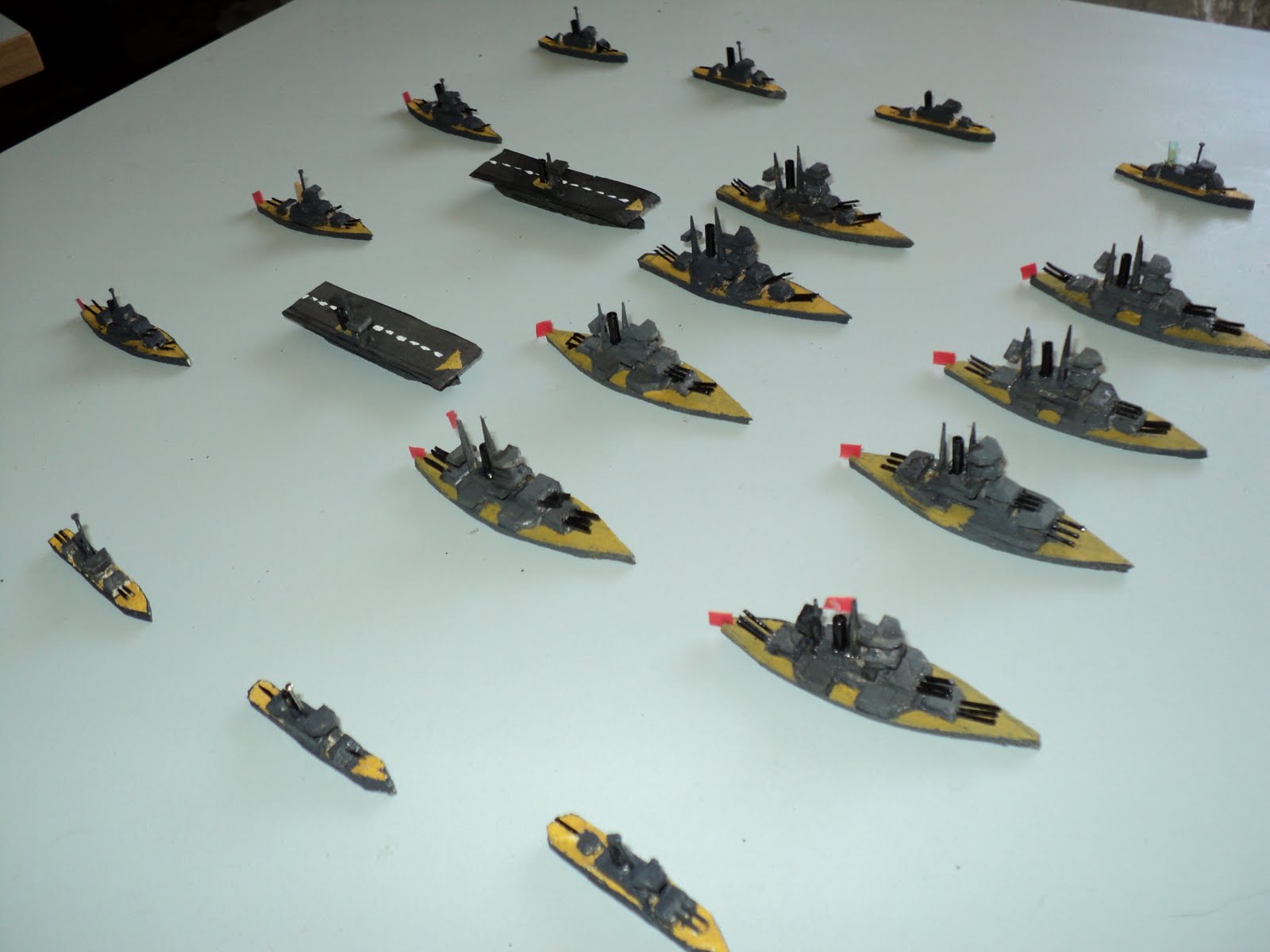
The Squadrons and Flotillas are numbered sequentially, beginning with the carriers. It tends to disguise, or inflate, the actual numbers of the smaller craft. I don't really want to make 32 destroyers...

This is all intended to make up Raesharn's as a very large navy. The Kiivar navy, by contrast, suffered steep losses at the outset of the war, and its entire Battlefleet (when I've built them) will comprise a single carrier, a couple of Battleships, 3 cruisers and 4 destroyers. They will also have a number of submarines in operation (as will Raesharn, of course; though the Straits of Omez are dangerous waters, even for submarines.

Meanwhile, Jono has agreed to construct the Sarbian Navy - also smaller than the Raesharn, but, together with the Kiivar, should be able to contest the oceans.

Wednesday, August 3, 2011

The possibilities of an imaginary world...


It has been a long time since my last posting: we've had another pretty hefty earthquake, which once more sent some of my wargames stuff hurtling floorwards, but fortunately casualties remain pretty light. Last week we had a pretty decent sort of snowfall - a bagatelle for Northern Hemisphere types - but rare enough in Christchurch to be interesting to us. Here's the view of our front yard....

Meanwhile, work is still being done on Jono's World. The thing with an imaginary world developed to the extent Jono has, it allows for all sorts of ways one might handle the campaigns and wars. The 'big figure' forces are being painted and organised; but we have also looked into the campaign as a whole as a board game. Sort of like Axis and Allies, or SPI's Global War of the 1970s.

I am reminded, however, of a delightful invention by a bunch of students in Auckland in about 1972. The 5ft by 5ft playing board was made from a soft wood-based product called Pinex, painted blue, and divided into 1-inch squares. Upon this, a couple of continental land masses and a couple of large islands formed the world. The whole thing was so large it had to be transported by trailer.

This world was the political arena for the aggrandizement of 6 warring nations: America (White), Britain (Blue), Germany (Grey), Japan (Yellow), Russia (Red) and New Zealand (Green). The colours were those of the playing pieces for each nation. These were not bits of card, but representations of each item: an Army, Naval and Air Base for the three services; aircraft (bombers, fighters and air transport); warships (Battleships, carriers, cruisers, destroyers and submarines); army units (Tanks, infantry, AA). You also had a merchant marine, which served a special function.

The appearance of this thing, called by its makers simply The War Game in midgame had to be seen to be appreciated. The units were made from wood, cardboard, matchstick, wire - whatever was easy to work with. For instance, bombers were all 4-engined, the fuselage being an unignited matchstick (the bulbous head, painted a contrasting colour looked like the perspex front turret/cockpit arrangement; a wing with two match heads (painted black) on each side; and the twin rudder tailplane, like that of a Lancaster bomber, finished the thing off. The whole was pierced with a pin with the appropriate coloured bead, which could be poked into the pinex board by way of a stand.

For all its magnificent appearance, though, at the time I played the game (once or twice) the thing did need a fair bit of development work. The sole provision for growth lay in the merchant marine, but lack of reciprocity tended to stymie their real potential. The handling of aircraft needed a look as well. All the same, it was a mighty conception, and even 40 years later, I recall it with a certain wistfulness.

It with the view that the game was viable that set me to thinking of creating my own, a project that proceeded very slowly until brought to a halt, pretty much, by Axis and Allies. But the advent of Jono's world has revived the whole project. As were were building land forces already, I bethought me of some toys I bought 'on spec' several zillion years ago. Under the brand name 'Mighty Armada' there were several battleships, aircraft carriers and submarines, along with merchant vessels as well. But what made these things so interesting was the addition of seaport facilities, with docks, cargo sheds, fuel storage tanks and cargo-handling cranes; breakwaters and moles to create a snug harbour; and tugboats to bring vessels safely to their moorings. An example of one of the battleships - recognisable as Bismarck - heads this posting. I've added the white paint here and there, as well as the masts.

But I also wanted playing pieces for a board game. These were to be slightly more elaborate than the ones I had had in mind for my version of The War Game, and the result (unpainted), is what you see here.
More than somewhat 'cartooned', what you see is a battleship: 6cm long by 1.5 wide. Cruisers will be 5cm; destroyers 4cm.

To be continued...

Monday, June 20, 2011

Jono's world: Sideon IV


'Following amphibious invasions & the pincer-like moves by combined Omez/Raesharn in the north ... Kiivar [troops] were driven back from the densely populated lowlands towards their capital& the great Kiivar River. The capital suffered prolonged & heavy bombing attacks from the Raesharn airforce. 300,000 Tazgen 'volunteer' troops came to the front to bolster the battered Kiivan infantry and armoured forces. The Kiivar forces had already lost 70% of their armour in the bitter bloody battles of [66940AA]. ...'

It must be some ten or eleven or so weeks back that this dude turns up one Sunday at the Woolston Club with a fascinating story to tell. He had constructed an imaginary world, Sideon IV (Sy'-de-on Four), with a history (the AA in the date indicates 'After Arrival') of imperial wars. In particular, he was beginning to think of building up toy soldier forces for a global war that begins 66,940 years after humans arrived upon this planet. Technology is similar to, but not precisely the same as, human technology of this world in 1940.

I was hooked pretty much at once. Jono (Johnno), as he called himself, had built up quite a comprehensive military world, with maps, descriptions of the armies, navies and airforces of the belligerents, including technical data of their equipments. Having compiled folders of history and technical data, he seemed to me to have a solid basis for a wargames campaign - and not just a campaign, but a full scale war.

Here's a sample:


... and these are just the Raesharn armed forces - and there's much more on them as well.

At any rate, Jono and I are both building small Kiivar and Raesharn forces with 'El Cheapo' plastic soldiers and toys, and modified models. I agreed to work up a quick-play rule set, basing my ideas roughly on Panzer Marsch, but with a much simplified combat system. The first draft was tried out last Sunday.

The scenario was a 'front line adjustment' during the winter of 66941, after the Raesharn sweep though the Kiivar littoral finally ground to a halt agonizingly close to the Kiivar capital, and its road and rail links to the north.


Lying in No Man's Land parallel to the front lines, was a road both sides desired as an aid to lateral communications for the quick transfer of reserves and reinforcements from one flank to another. Committing 6 infantry platoons, a squadron of medium tanks supported by a half-platoon of assault engineers, the whole backed up by a light Anti-tank gun and a scratch half-battery of artillery, the Kiivan had the slight edge in strength, the Raesharn lacking artillery other than a field modified heavy assault gun.

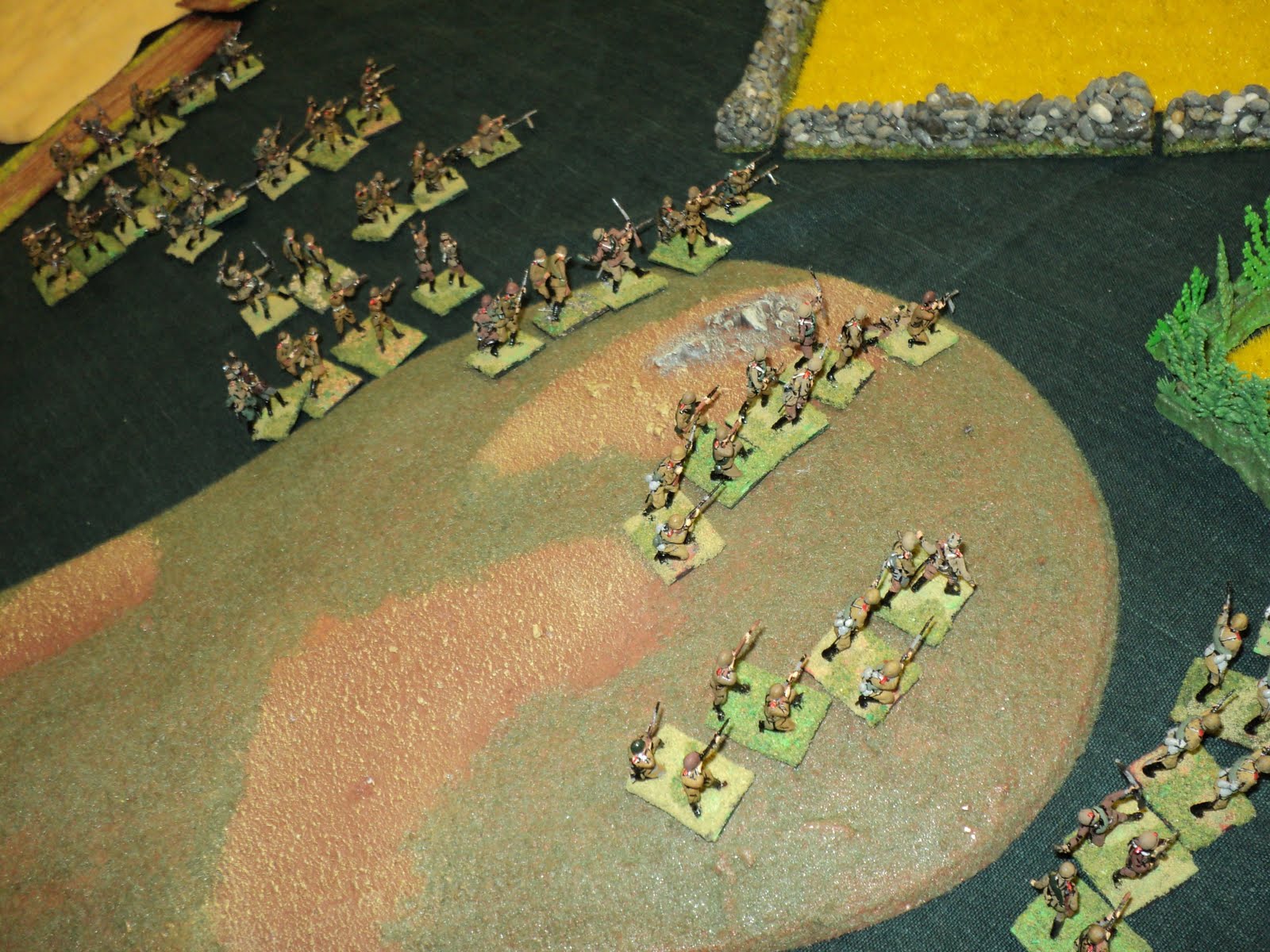
The Raesharn left flank, advancing tentatively towards the Kiivan right centre. It is not apparent from several of this pictures, but the overall grey of the Raesharn uniform is broken up by green and tan patches for a camouflage effect.

Raesharn centre: infantry supported by a light tank and anti-tank gun.
Raesharn right, a medium tank advancing towards an abandoned hamlet, with infantry that includes a light-machine-gun section. The 'camouflage' uniform colours are more apparent, here.

Close by the hamlet, a composite squadron of Kiivar tanks - two gun tanks, and a close-support tank. The red balaclava hatted guys belong to the half-platoon of assault engineers. For this 'play test' they were treated as ordinary PBI. Jono assembled and painted all the AFVs and the single AT gun possessed by each side in this game. He also painted the Raesharn infantry; I painted my own Kiivar foot.
The Kiivar artillery, their FO standing on the distant ridge. Obviously the Kiivar have been through the mill, this half-battery cobbled together from a modern 10.5 cm howitzer and a 3-inch field piece of unknown provenance and antiquity. The Raesharn M35 assault gun eventually silenced the larger piece (knocking over half its crew), but the Kiivar artillery caused considerable losses among the Raesharn infantry.
For this rule set, I invented a device for use with artillery. Here it is in action. One of the square's diagonals represents the line of fire; the area the beaten zone; the centre the point of aim. The point of aim is adjusted by the roll of a pair of differently coloured dice. The thing is turned over for direct fire, with more accuracy, and special 'on target' rules. The idea still needs some tweaking...
Altogether, I can see a very promising campaign in prospect...

Monday, June 6, 2011

More OMOG...


Recently a friend, having come into a job lot of wargaming stuff, flicked onto me a few BMC Yorktown figures he found therein to add to my small forces. More Amercans and Hessians - I mean British Grenadiers - about 10 foot figures of each, but including two or three new figure poses I didn't already have. A couple of gunners, and some poor beggar taking an incoming round. But I got another mounted and a couple of foot officers which got painted up as the reverse of the first lot. At any rate, here are some pics of the boys...


One NCO figure supposed to be aiming a pistol in his left hand and holding a sword in his right was missing his pistol hand and the sword blade. Some surgery on the latter to carve away the hand guard and accommodate a length of wooden rod, and a manual transplant on the other arm gave me a very nice flag bearer. From several angles his pose is dramatic indeed. Unfortunately I have only one other similar figure, which I am reluctant to treat in similar fashion for a British flag bearer. I think one of the American NCO figures (different pose) will have to turn his coat in order to provide at least one bearer (no: Maledict Ranold is another character that will no doubt emerge later on...). Whence comes to that, should he display the King's or the Regimental colour? Tough call...


Unfortunately, the freeby didn't extend to another cannon, mortar or gun emplacement. Never mind. We did get another mounted commander, and now have quite a few officer characters to whom we may attach a name. On the American side: Horatio Styles, George Mashington, Nathaniel Greenyham (or should it be Nathaniel Veridian?); on the Brit: Lord Whye, Genl Portcullis, and Banastre 'Bally' Mirleton.

Portcullis rides a dappled grey horse. To be sure it looks a bit like a fairground mount - one you'd find on a carousel - but I rather like the look of him. A fine steed indeed.


A couple of scenarios using the OMOG concept will be published shortly on this blogspot.
(To be continued)

Tuesday, May 24, 2011

WW2 Action ...


My previous posting showed the early moves of a 1944 Russian Front confrontation played at the Woolston Club a fortnight or so back. The map in the previous post showed the Soviet (my) moves and plans. Now here is what developed:

The intended Soviet thrust up the road was at once stymied by a couple of panthers off to the right, between a tree topped hill and a line of poplars. Their first shot kbnocked out a T34, which was bad luck for the four riders scrambling to dismount. My return fire wasn't too bad - hits scored - but they did little more than scratch the paintwork.

That pretty much set the tone for the day. It wasn't long before the lead tank platoon bugged out. The second took its place, and fared even worse. Two of its three tanks were quickly knocked out, including the platoon commander, for precisely no harm to the enemy, whereat they, too, headed back east, at a rather faster pace than the first platoon had done.


Meanwhile, the respective forces closed up on the centre. There was a brisk exchange between the remnants of the lead SMG section and the advancing panzergrenadiers which wiped out the former for the loss of three Germans. There followed no further action in the centre as neither side wished to try the defensive mettle of the other. Nor would the IS2s advance beyond the field of haystacks.

The Germans did feel, however, that something might be tried on their extreme right flank. The first T34 platoon had joined the LMG platoon in hull down positions to await the enemy next move.


It was not long coming: the preparations had already been made. A platoon of assault engineers joined the platoon already on the west slopes of the hill, whereat the latter surged over the crest. At once the Russian light machine guns opened up, felling a number of the enemy, but the return fire, in much greater volume, exacted a heavy toll. The tanks supporting the LMG platoon refrained from firing. Armed only with AP ammunition as they were, their commander unwisely attempted long bowls again with the panthers, which had, in the meantime, drawn a little closer. The result was no better than those earlier - a single 'clonk' of a non-damaging hit. The panthers gave their usual demonstration of marksmanship; at once the second platoon commander's tank started belching smoke. The remaining tank abandoned the LMG platoon...

The action petered out here - we agreed that the Germans had got the better of it, but the Russians were still in a position to defend the ground they held, except on that extreme flank. But the Germans will not have found exploitation of their success there all that easy. The Russian still has two T34s available in rear of the woods ready to try conclusions with the panthers at much closer range. Elsewhere along the front was pretty much a standoff...

The rules used for this game were Panzer Marsch a favorite set of my opponent, Tony Ormandy. But you can see that my army is more designed for Command Decision. Unfortunately, several rifle brigades of CD infantry don't translate to much more than a rifle company under PM!

Monday, May 9, 2011

Unfinished Projects: Some WW2 action...


This weekend saw the second of two recent outings for my WW2 stuff, after an hiatus of I don't know how long.

My pictures of the first action weren't much chop - basically a tank action between my nine PzIVH tanks against Tony's eight Shermans and three Firefly tanks. At the end of the action, the respective infantry were eyeing each other with hostile respect, and the tank action had petered out with the loss of six AFVs on both sides, but with the Germans better placed in terms of ammunition than were the Tommies.

Last Sunday's action led to something of a defeat for my Russians, whose morale was as good as their shooting - bally horrible. At any rate, here are some pictures of the action.

The map shows a tract of country somewhere in Belorus, early to mid-1944. Tony Ormandy commanded elements of a German Panzer Division: a kampfgruppe comprising a composite Panzer platoon of two Panthers and two Panzer IV Mark H, a company of panzergrenadiers, with two assault engineer and a mortar section by way of support.

German panzergrenadiers passing through Rusgorod village:


German mortar platoon deploys...


Panther! Tony's Panthers Mark A covering the German right flank. Panzer #113 was built from the kits of 5 separate manufacturers; #121 a resin model...


German assault engineers lying in wait...


I opted for simple: An understrength company of T34/85 tanks carrying a SMG tank desant platoon; a rifle company with elements of a machine-gun company (5 LMGs and 4 MMgs) under command; and an independent platoon (overstrength) of 3 IS2 heavy tanks. Unusually for the Soviets, there was no artillery of mortar support.

Medium Tank Company advances up the road carrying their tank riders...
Overhead view of the Rifle Company, advancing in line of section columns across the open country...
General view of the Soviet advance...


Sitting in the background of that last picture is a dude with a very interesting and intriguing Imagi-Nations project in train. That will be the subject of a future posting...

(To be continued...)