Friday, August 17, 2012

War on Marnon...


 The colonial rivalry between Ruberia and Azuria upon the Island of Marnon came to a head when each began to find the other imposing a limit upon their further expansion.    Negotiations failed to shift either side from giving up an inch of the territory they held, despite awkward border anomalies: the respective salients in the north (Fourborough was almost surrounded by Azurian territory) and the Azurians with only the city of Cinqville linking north and south west of the Sea of Marnon.  Talks led to argument; argument to threats; threats to ultimata; after which both sides began hastily to mobilize.  At last, on 1st April 1869, the Azurian army surged across the border into Ruberian territory.
After a recent trade of surplus stuff, I recently found myself in possession of a bunch of figures and symbolic tokens from the old "War: Age of Imperialism" - an Eagle Games supplement for their figures and board game.  Brian (A fist full of plastic) thought they might go with my 19th century Azuria/Ruberia wars.  I thought the figures a bit on the small side, and yet they might  still come in handy.  Bethinking myself of a post several weeks ago by Bob Cordery in his Wargames Miscellany, could the map warfare be adapted to horse, foot and guns?

Ruberian (Red) and Azurian (Blue) armies mobilising along the border.
About to draw up a map from scratch, I recalled suddenly the map board for the old Wizard's Quest game (one of the few board games that I ever really fancied).  Methought a little war between the forces of Azuria (Blue) and Ruberia (Red) might be a useful context to try out a system similar to that developed by Bob.
The Ruberians have concentrated 3 Army Corps in the south,
 aiming to take  Town #5 (Cinqville) and  #6 (Sixbourg)
Wargames rules for Azuria-Ruberia map game wars:
1.  Units and Formations
    -  Each figure is a leader, or an element of one of the three arms, Horse, Foot or Guns.  Foot elements are infantry or engineers, Horse elements are Cavalry, and Gun elements, Artillery.
    -  Each figure of foot or horseman holding a firearm represents a Division of Infantry or Cavalry respectively.
    -  Each gun or engineer figure (on foot with theodolite) represents an  Artillery Train or an Engineer Train, respectively.  
    -  A mounted figure with sword is a leader - general, marshal or field marshal.  He rolls no combat dice as such, but adds to combat depending on arms present.
    -  An Infantry Division costs 1 Currency Unit (CU) to raise, and rolls 1 combat die.
    -  A Cavalry Division costs 2 CU to raise, and also rolls 1 combat die.
    -  An Artillery Train costs 2 CU to raise, and rolls 2 combat dice.
    -  An Engineer Train costs 3CU to raise and rolls 1 combat die in defence only.
    -  An Army Corps comprises a leader and at least 2 other figures (Divisions), a minimum of 1 up to a maximum of 4 foot; and 0-2 horse, 0-2 guns and 0-1 Engineer.
    -  A Cavalry Corps comprises a leader and 1-4 Cavalry Divisions, plus 0-1 Artillery train.

(Note 1: as it happens, the number of figures was quite limited: 15 infantry, 6 cavalry, 5 guns, 5 leaders and I think 5 engineers, for each side.  I am very tempted to make this a design limitation).
   
The Ruberian IV Corps holds Tripolis,
 but only small garrisons defend the fortified city
  of  Fourborough (visible at extreme left) and Monoton (out of picture).
  The Azurian III Corps has been posted in the headwaters valley of the Amnon River...
2.Turn Sequence:
   - Both sides roll 1xD6, higher score deciding whether to move first or second.  Call the side that moves first Side A; the other, Side B.
   - Side A rolls 1xD6, the score giving the number of formations (Army Corps) or independent units he wishes to activate this turn.  An activation may be a move from one territory or city to another; an attack from one territory or city to an adjacent one; or a task carried out by an Engineer Train.
   - Note that Army Corps may detach elements, and or add elements to itself without cost, but if separating, the individual elements must pay to move if doing so.
   - Side A moves each Division or Corps in turn, resolving combats as they occur.  Note that he need not decide at the beginning all the units or formations he is going to move, deciding each depending upon the result of earlier movements or attacks.
   -  Side A having used as much of his allowance as he thinks fit, Side B rolls 1xD6 and follows the same move/combat procedure.
   -  Finally, both sides roll 2xD6 to determine available 'funds' (CU) to raise further units.
Azurian I and II Army Corps are poised to attack Monoton and Fourborough.  
The weak Ruberian V Corps  keeps the enemy III Corps bottled up in its river valley...

3. Move distances and rules:
   - Infantry Divisions, Engineer Trains and Army Corps move 1 map area (territory) per turn.
   - Cavalry Divisions, Cavalry Corps and Leaders may move up to 2 territories per turn.
   - Cavalry Divisions and Cavalry Corps can not attack in mountains, but may move therein unopposed, and can defend.  If present in an Army Corps, they add no dice to the attack, but the leader can still count its presence in determining how many dice he adds (this reflects the limited - but not negligible - capability of cavalry in this sort of country).
   - All troops spend 1 movement point entering and another exiting mountains.

   - Cavalry Divisions may move 2 territories in woods only if neither requires an attack.


Having 'won' the roll for first move (5 to 3), Azuria begins hostilities.
To open the ball, I Corps (Azuria) attempts to storm the stronghold of Monoton
4. Combat:
   - Each division and/or Army Corps rolls 1xD6 per infantry and cavalry unit; and 2 per artillery.
   - In addition, the presence of a leader adds 1xD6 per arm present: Horse, Foot, and/or Guns.
   - Finally, an Engineer Train rolls 1xD6 only if part of a defending force (or is attacked when unattached); OR if part of a force attacking a walled or fortified town, subtracts 2xD6 from its defence value.
   - A unit or formation defending a city may add the equivalent of 2 infantry divisions (2xD6) for an unfortified, and 2 Artillery Trains (4xD6) for a fortified city.
A sharp repulse for I Corps at Monoton.  It receives 3xD6 for the 2 horse and 1 foot, plus, having a leader, an extra 2xd6 for the two arms (Horse and Foot): 5 dice altogether.  They fail even to dent the defences.  As an unfortified place, the Ruberian garrison adds just 2xd6 to the 3 it gets for the foot and guns.  There being no leader present, there is no further addition to the number of dice.  All the same, one of the Azurian units will have to retreat...
   - A combat is resolved by both sides simultaneously rolling the number of dice determined as above, with the following outcomes:
     For each Double-1: 1 Artillery Train destroyed;
     For each Double 2: No effect;
     For each Double 3: 1 Cavalry division destroyed;
     For each Double 4: 1 Infantry division destroyed;
     For each Double 5: 1 Infantry division destroyed;
     For each Double 6: 1 Division retreats (whether independent or part of a Corps; if the latter, owning player chooses) to nearest unoccupied or friendly territory or town;
     If a Triple 6 appears, the whole formation retreats 1 map space, after other losses taken off.

Note 2: The sections in red italics represent rules I'm not 100% sure about yet: whether to add them at all, or maybe modify them.

To be continued: an account of the First Marnon War, 1869.

Monday, August 13, 2012

Species War 2 (War of the Roses)

It has occurred to me that perhaps I ought to show how I modify flag downloads from the standard square or rectangle into something more like a rhombus or parallelogram.  I have found that rhomboidal paper flags 'drape' in much more realistic fashion once you fasten them to their wire pole.
Paul of 'Paul's Bods' having mentioned the Grimsby Wargames Society's free download, I availed myself of their resource.   Here is the first page of the House of Lancaster as it appears on site and when downloaded.  Nicely coloured and shaded.  Now, normally I don't bother with shading flags, figuring that they are self shading.  But that depends upon how much trouble you take to obtain a realistic looking 'hang.'   But since the shading is there, I'll take it.  With thanks.

Here is the result of my attentions using the Microsoft  'Paint' software - a utility I have found very handy for wargame projects.  You 'select' the shape of left-hand side, and skew it vertically at an angle of your choice.  Then select the right hand side, and skew the same angle, but negative (actually, I generally do the right hand side first, but that's neither here nor there).  Note that the images are skewed from the centre, not from the edge.  So if you have left a narrow centre strip to accommodate looping around the wire flagstaff, select that and slide it into position.  It's not easy to do it accurately (less when cataracts render one eye dysfunctional), but I don't worry overmuch about it.  Any flaws can be touched up.
In the above, the top 4 flags were skewed 20 degrees, the next two 10 degrees, and the bottom, 15 degrees.  The fourth row has one skewed 10 and the other 15 degrees.  The choice is entirely arbitrary. and there is nothing against going as high as a 30 degree skew.  More than that may involve unwelcome distortion, but I've never tested it.

Sunday, August 12, 2012

Species Wars...

Well, the species in question are in fact floral, to wit: Roses.  This was one of those projects that I began full of enthusiasm and gung ho about ten or twelve years ago.  I don't know anyone who manufactures Wars of the Roses figures as such, but it seemed to me that the Hundred Years' War fellows would do.  
 The pictures that follow depict where I reached in a fairly short time and have done nothing with them since. Based, modified and ... unpainted.  We begin with the mounted knights and commanders.  This is a Yorkist army commanded by King Edward IV, with Richard of Gloucester as his sub-general, and William de Hastings classed as 'Ally-general'.  The whole army was build along DBM lines, although I was already becoming disenchanted with that rule set (too many ill-considered amendments, to my mind, that wrecked a fine concept).
 The banners are my usual wire and paper types, hand drawn and coloured with OHP pens.  Incidentally, I will regret the passing of the dear old Overhead Projector, because the pens - water soluble and insoluble both - are great for colouring paper flags.  A disc of sprue with a generous dollop of glue gives the flagstaff a vaguely lance-like look.
 Above is the contingent of Burgundian pikemen.  These were adapted from halberdiers or billmen.  These were already a good pose, but the only ones really adaptable as pikemen.  A flag bearer and a knightly fellow on foot eked out the limited number of figures available .
 One troop type absent from the Revell set, as you can imagine, was the currour - a lance armed cavalry less well protected and armed than the ponderous men-at-arms. I selected a foot figure already standing rather aggressively with feet apart, trimmed off whatever weapon he was holding and added a wire lance.  A couple of other figures gave me a command element, although they don't sit their mounts as straight as they might. The horses I nicked from the Airfix Napoleonic Royal Horse Artillery set.
 The lances are probably overlong, but I quite like them that way.  I have always felt the the Revell knight lances could have benefited by half a centimetre's extra ... erm ... longitude.
 Now we come to the guts of the army:  the Yorkist foot.  The Revell box had rather a limited number of bowmen, so some other figures were issued with wire bows.  As I have been given to understand that the English long bow was, unstrung, scarcely distinguishable from a big stick, I didn't worry overmuch about appearances.  
 I further eked out limited numbers by placing on every other stand a knightly figure in plate armour and a standard bearer.  Two stands, then, required just 6 bowmen.  I could perhaps have placed 3 figures per stand, but, aside from being not 'per spec', would have looked too sparse.
The flags will be replaced.  Now the famous Warflags site, very useful source though it is, is rather limited in it's Wars of the Roses range.  The bad part is that on several flags, the pattern on the reverse side has not been mirror imaged from the obverse.  Many wouldn't notice, and most that do probably wouldn't worry over it.  I do.  But my own efforts, based on information I had about distinguishing badges and symbols, I've never been satisfied with.
 These final pictures show a line of skirmishing hand gunners, in the distance a body of billmen, and closer to a smaller group of dismounted men-at-arms.  Owing to the limited number of mounted knights in a pack, I was pretty much forced to leave these men-at-arms on foot, 'paying' for Bd(S) (9AP) as Kn(I) (10AP).  
 But then, I'm not into wargames competitions, the motivation for which I have been for well over thirty years at a loss to understand.  Also in the pipeline, though less well advanced is my Lancastrian Army.  Having acquired a few 'Sheriff of Nottingham' figures, I'll have a few 'levy' type stands, and some Italieri 100YW figures I bought several years ago will provide several of the bowmen and knights.
Meanwhile, what to do about the flags?  A couple of years back, an advertisement appeared on TradeMe in which the booklets featured in the pictures below were going for what to me looked like a song and a dance.
Heraldic Banners:
 the open pages belong to a third of the white covered  booklets by Thomas Coveney.  
 So I bought all four; no one else seemed interested in placing a bid.  Good luck for me.  The numbered flags are cross referenced to the associated nobleman or knight, with a brief comment on their affiliation.  The top booklet (by Pat McGill and Jonathan Jones) opens to reveal (inter alia) leaders' standards, beginning with Henry Sixt, and prominent members of the House of York.
The first half-dozen of some 36 banners depicted in this wee volume.
The plan is to scan down the flags and select several for each side (York and Lancaster).  There are ways of 'mirror-imaging' to obtain a two-sided flag or banner; and of skewing the image in the vertical plane to give the printed out paper flag a better 'drape'.  I left the mottos off my hand drawn banners as being too difficult to render well in the scale I had designed them.
The banners of Edward as Duke of York (before becoming the fourth King of England of that name);
  Richard, Duke of Gloucester (the future Richard III); and Richard, Duke of York, their father.

Saturday, August 11, 2012

'Mighty Armadas'

The mighty Yamato
Naval subjects have been the topic of recent postings on several blogspots I follow.  Having mentioned my 'Mighty Armada' collection in a comment on 'Pauly-Wauly's' Other Blog,  it occurred to me (because he suggested it) that it would make a fine topic for a posting on this one.  I think when they turned up (this was the late '70s or early '80s) at a then well-known Wellington bookshop, I bought the entire stock, though I never did form any clear plan on how I was going to use them.
Yamato and Mushashi.
  The latter was modified using a third Yamato for parts (a move I now regret).

These look rather like Bismarck and Tirpitz
I have recently considered using them for Jono's World, but much longer ago had another possibility in mind.  It seemed likely that my mid-20th Century Imagi-Nation, Gran Bolivaria, would have acquired some sort of blue water navy, perhaps surplus ships of the greater powers as World War Two was drawing to a close.

...but these two I've never been able to identify.
 I think they might be  American vessels


Of course, it was too much to expect that a small, none too wealthy, Latin American country could get hold of large battleships (which were at the bottom of the sea anyway), but suppose these were cruisers?  The Yamato class might be thought of as heavy cruisers, the others as light.  As it happened, I also had a model of Prinz Eugen, which was of a size with these vessels.  Cruisers, then, they were.  Orotina purchased the Prinz Eugen for a song (that it participated in the Bikini Atoll nuclear trials is a myth...).  So Orotina has a navy in being to ensure that Gran Bolivaria does not rule the seas in their part of the world.


Mighty Armada came with aircraft carriers.
  Unfortunately, the aircraft are jets.
These aircraft carriers are, therefore (in my 'Latin Wars' terms), quite small ones - escort carriers, withal, each with a complement of, say 20-25 aircraft.  In Jono's World, however, they would be (are) fairly large, and carry perhaps three times the number of aircraft. 


The Merchant Marine
But it was what follows that drew me to the whole collection: the merchant marine, and  the sea port.  These gave a whole new dimension: the possibilities of commerce raiding, attacks upon escorted convoys, raids upon the docking facilities, 'Pearl Harbour' type operations.
The only ocean liner in the collection.
 It is missing its masts, which always were a bit loose.
The size of these merchant vessels also tend to indicate we aren't dealing with large warships, here.
Wolf pack!
Altogether, the whole collection seemed to me replete with the promise of hours of endless fun.   Pity I never really got round to doing more with them...
A tanker being guided in to dock by a flotilla of tugboats.
Already docked is  a vessel  loading export  goods for North  America.

 The Sea Port with wharfs, cranes, fuel storage and holding sheds.

Sunday, July 8, 2012

When scratchbuilds go bad...

There are times when the model you thought you were making comes out rather differently from what you had intended. 
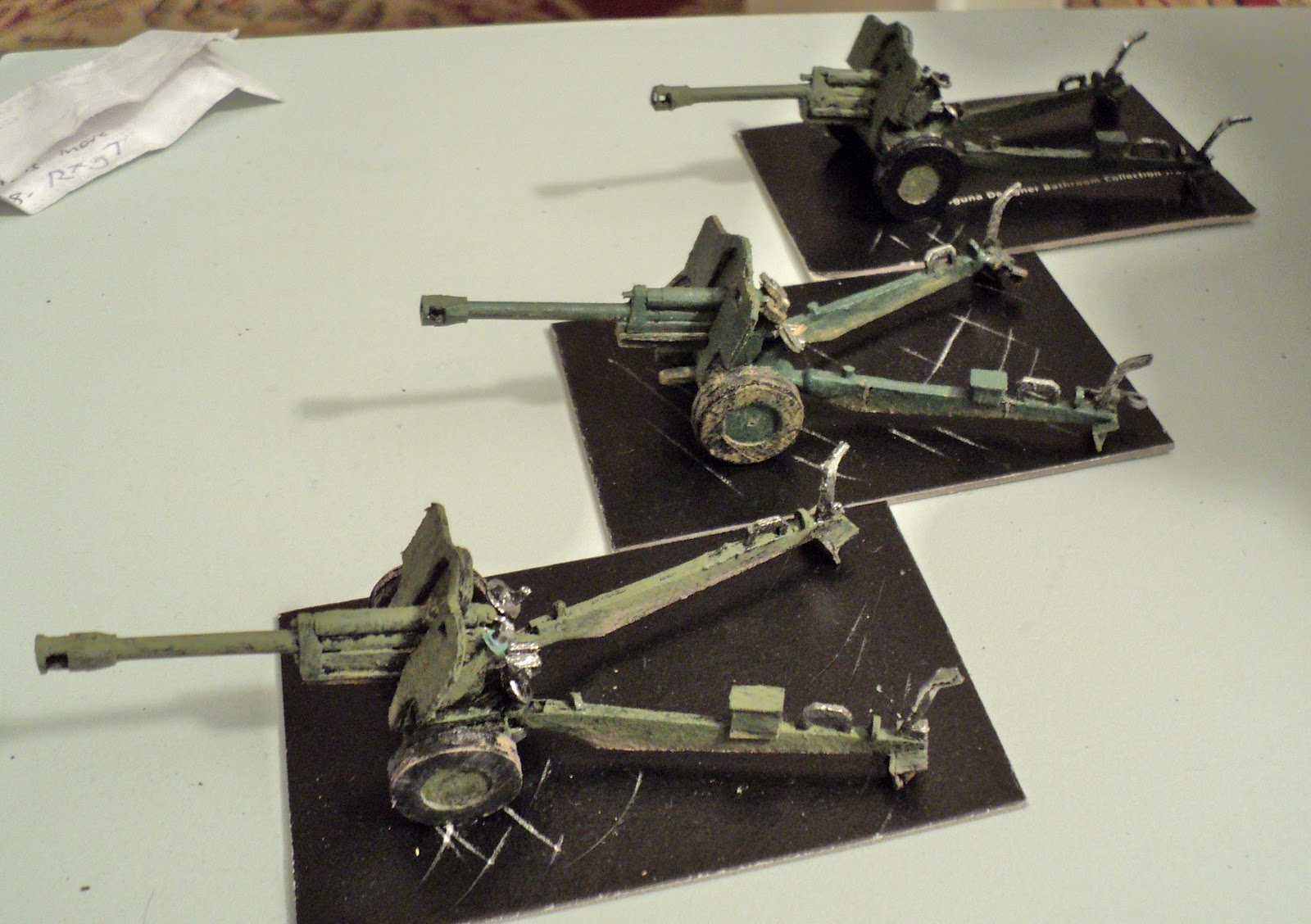
So with these pieces.  Intended as 57mm Anti-tank guns, they look sort of OK, but the trouble was that [a] I made the gun shield too large, and [b] set the whole gun too far back on the axle.  After much humming and hahring, and indrawn breath through the teeth, I find I can't live with them as 57mm anti-tank guns.  Aty the same time, the construction is such that modification (disassembly and reassembly) is not really an option.

What to do then?  Of course they don't look bad enough, as guns, for me to dismantle them; and indeed they look none too dissimilar to later model 76.2mm field/anti-tank weapons.  And so they'll become.  Incidentally, the gun barrels on these are lengths of wooden rod (dowel) obtained from the local modelling shop.  The 57mm AT guns will be a project for another day, destined (of course) for the 1st Guards Mechanised Brigade.

Why 'Guards'?  Well, my 1st Mech Bde wargames formation has been in existence some 20+ years now, and, with one unfortunate exception, has never lost a battle.  In a Command Decision competition back in '93, its seven T34/76s and 'Experienced' infantry took on 'veterans' and even 'elites'; King Tigers, Panthers, Comets and  Challengers, and fought them all to a standstill (3 draws out of 3).  Only one such opponent had as few as my 7 tanks, and 3 of those were King Tigers.  I was very proud of my Brigade's performance that weekend.  A small tactical error on my part robbed them of victory over the elite guys, too.


They deserve their 'Guards' appellation!

Tuesday, July 3, 2012

Cardboard Guns...

Field artillery regiment; 1st Guards Mechanised Brigade
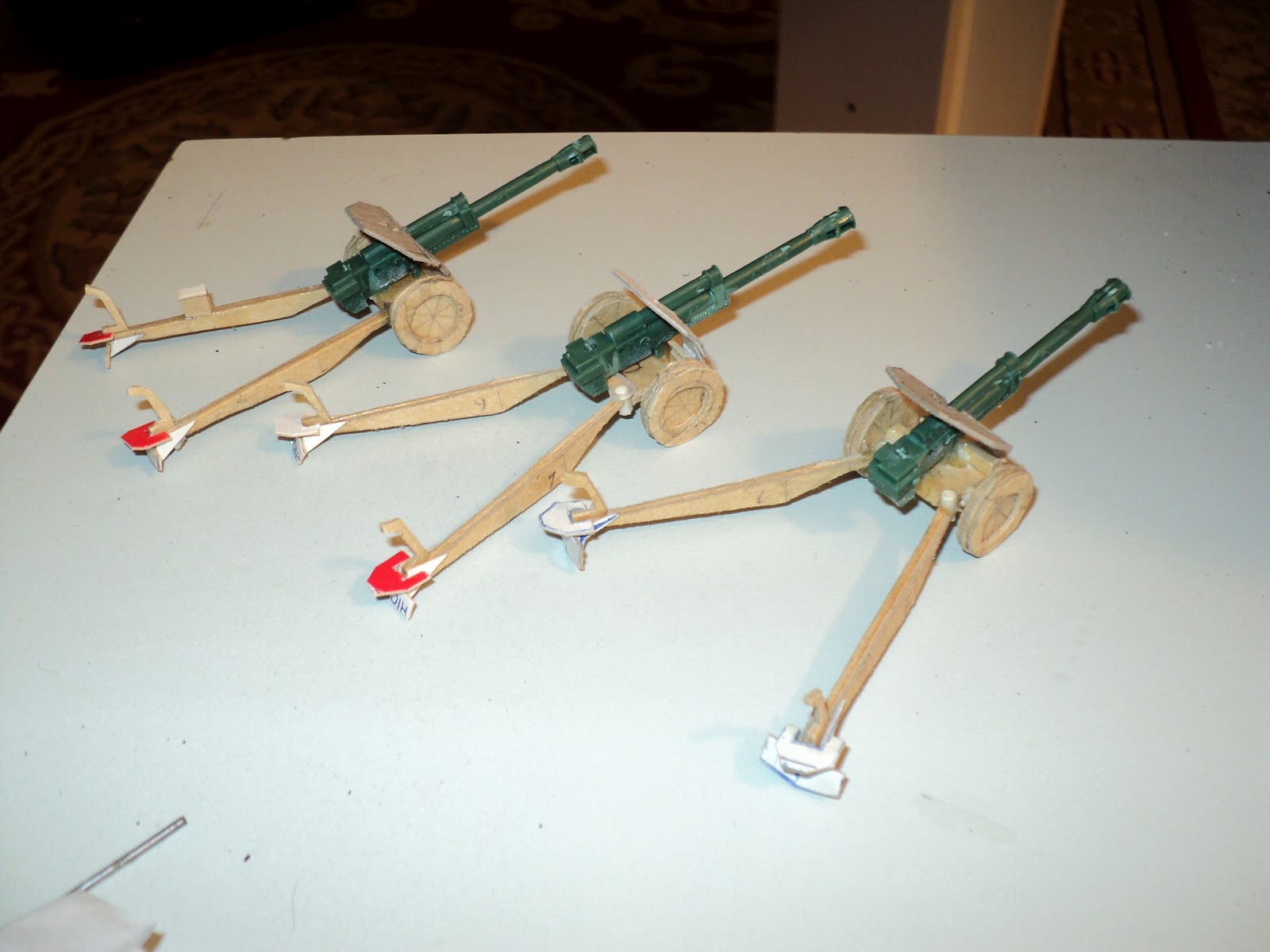
 About 20-odd years ago, when money was short and time was long, I wondered how I was going to acquire the guns I needed for my Russian (or Pan-Andean People's Republican) Army.  A rather crudely scratchbuilt set of infantry guns didn't pass muster, though one of the more outspoken critics offered to lend me a metal field piece from which to draw up templates for scratchbuilding.  The first results you see here: the First Artillery Battalion of 1st Guards Mechanised Brigade.
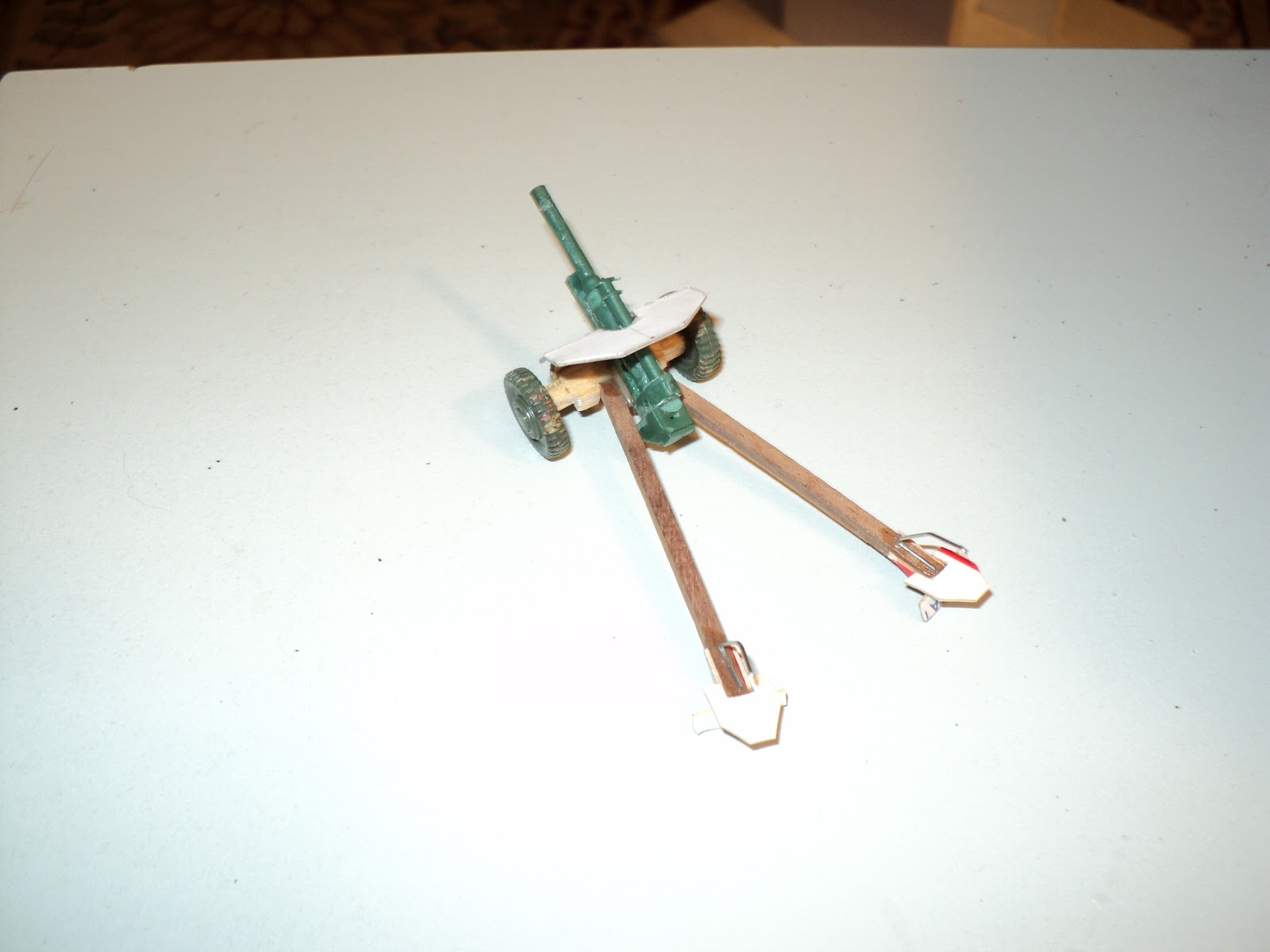
The middle gun in the line above was the first built, all from cardboard, chads, and bits of ball-point pen.  Even the wheels were cardboard, made up of layers that vaguely suggested a tread, and the outer circle having its centre cut out for a better representation of tyres and hubs.   That centre gun also has its towing assemby, a rather fiddly construction from thin cardboard (cereal packet), paper and a discoid section cut from the ink reservoir of a ball pen.
Finally, the muzzle brakes were fashioned, again from ball-pen ink reservoirs.  Trial and error suggested the best method was to sharpen a length of reservoir with a pencil sharpener, cut out square sections on either side, up near the blunt end, leaving a millimetre or two untouched.  Then shave off slivers top and bottom of the whole thing.  Then it can be slipped over the end of whatever you are using for a gun barrel.  For these guns, it was modellers' white plastic tube.

From what I've seen and read of Sovier artillery, I'm guessing this was an early war - possibly a pre-WW2 design.  Perhaps someone can correct me on this.
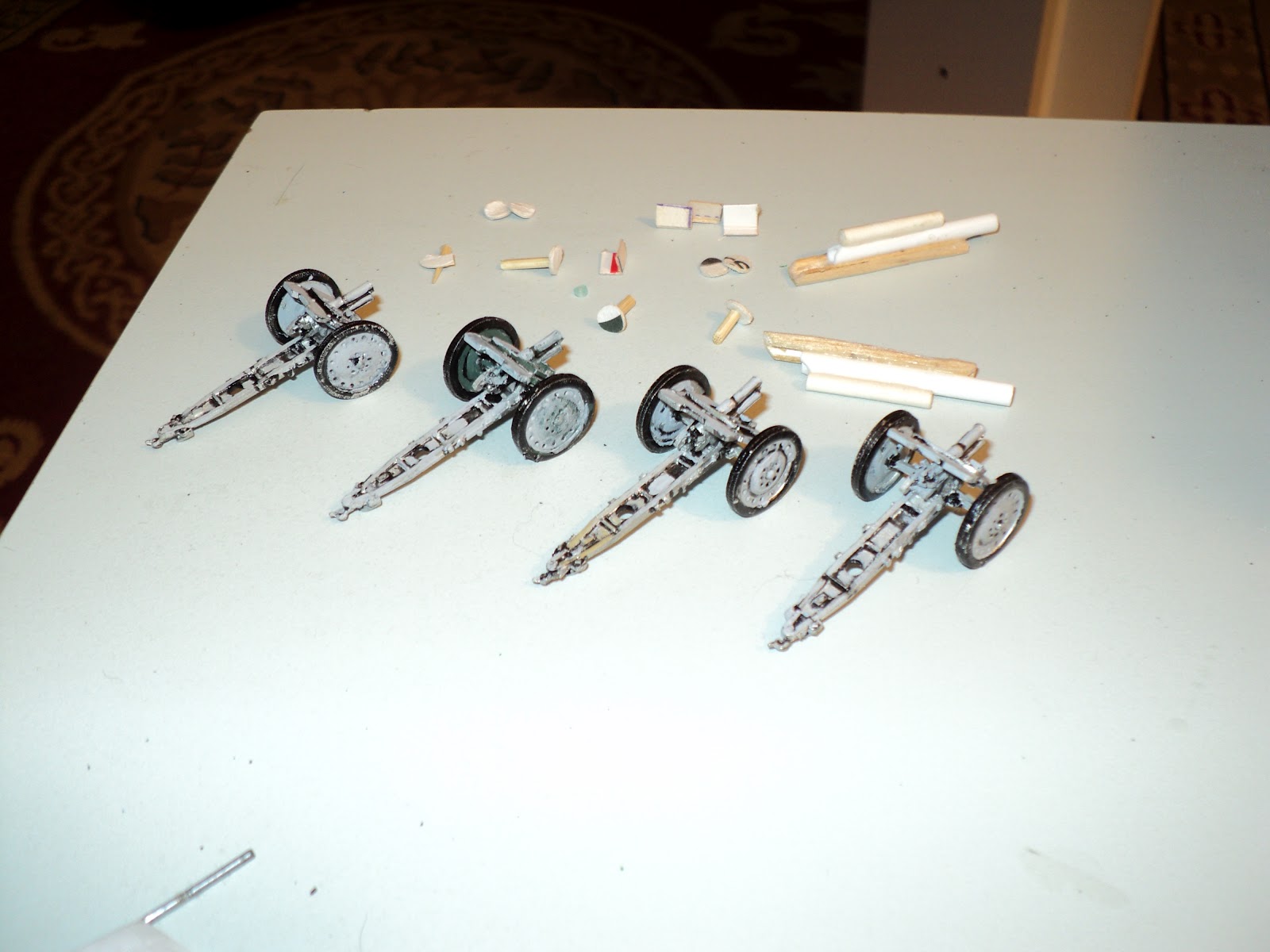
A fourth field gun, same calibre (76.2L39) under construction.  Until very recently I had not based them, slotting gun crew stands between and under the trail legs of the pieces.  Unfortunately, the construction isn't very robust, and even before the earthquakes, pieces had to undergo periodic repairs.  This usually meant retaching the legs.
76.2L39 Field gun under construction.  Beer mats make very good bases...

A few years ago, I was given some spare parts from a number of gun, AFV and vehicle kits a friend had already assembled.  The easiest such conversions were the guns.  There were enough gun barrel and breech black assemblies to form a regiment (We're talking Command Decision, here) of 152mm Medium pieces.

This is the way they have been for quite a while now - a few years at any rate.  Still a few bits and pieces to add.
They will also get the same sized bases as the other field guns.  These bases have no meaning in CD terms, that being defined really by the base of the gun crew stand.

There was, however, just the one 122mm piece.  This one, though, I gave 'proper' wheels.

As it happened I had already made a beginning on a couple of other 122mm gun/howitzers, but hadn't worled out the breech blocks.  Incidental to a later picture you will see some of the bits involved.  Not much progress there, though.


And now for some infantry guns.  This was really where I came in, trying to construct some of these small guns with, at the time, no worthwhile information on what they looked like.  A few years ago I acquired these white metal pieces at a bring-'n'-buy.


So far they have received no more than an undercoat.


What formations will get these guns?  Probably some of the less well-equipped Rifle Brigades in my army, but the decision is still pending.


Finally: a couple of 'Quick-built' Italeri ISU152s.  Such vehicles features in a recent article in the Plastic Warrior blogspot, but they had different gun barrels.  I had forgotten that they came with alternatives.  I opted for the short barrelled guns with the 'shark-gill' muzzle brake.

The earthquake damage to the far vehicle (above pics), though quite apparent in the b&w picture, turned out to be quite easy to repair, and will be completely hidden by a paint job...


...once they have been dusted off!