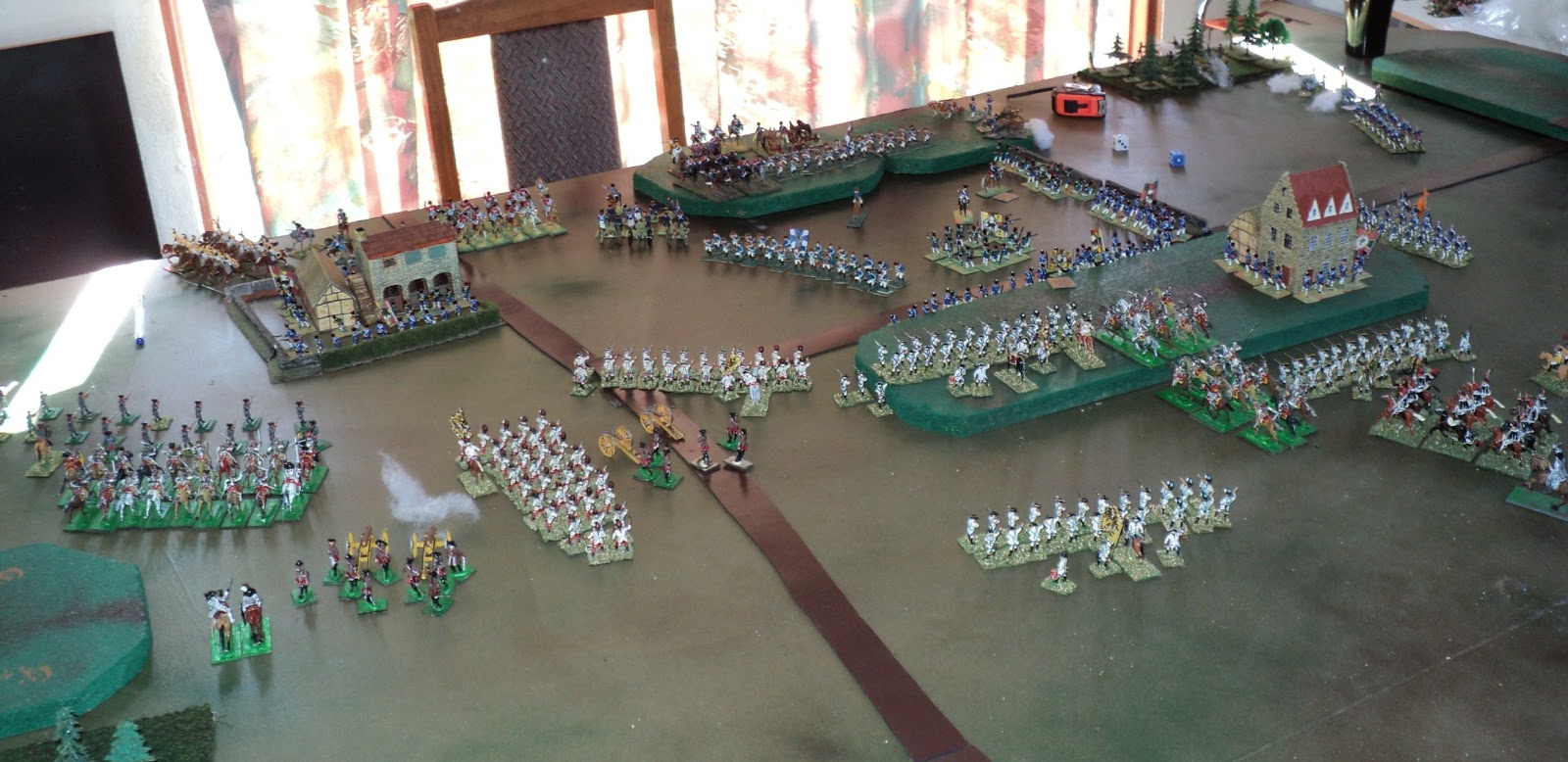
Wednesday, February 27, 2013

Ulrichstein Campaign: The Last Stand of the Rebellion 2

These three pictures...
 As the Imperialists continued their steady and stately march,  Marshal Noailles could do little more than hunker down in the rear slopes of the Chateau Ridge, and in the strongpoint itself, and pull his cavalry behind the Farm on his right.


...present a panarama of the battlefield...
But the Chateau was proving something of a bone in the throat for the Archduke, flanking as it was any attempt to force the ridge, or to storm the east-facing earthworks

...looking north from behind Imperialist lines
For his part, General Plodt was doing his best with his exiguous army to assist the Imperialists.  The Pandours had pushed the Rebel Jager half way through the East Woods, but  their drive had become stalled in the face of determined resistance.  The Electoral infantry also left the safety of the ridge crest and advanced upon the field works.  This was something of a thankless task for the Electoral infantry, under a galling gunfire, and unlikely to make head against the strong defence line facing them.  But for Plodt, and for the Archduke they were performing a vital function as the electoral guns brought down a hail of shell fore upon the Rechburg cannon.
The Rebel 2nd Bde can be discerned behind the Chateau Ridge
awaiting the  Imperialist attack.
 Their masking work done, Prittwitz cavalry drew back to make room for the Electoral Winterfeldt and the Imperial Arenburg Infantry to engage the Chateau garrison.  Considering the protection enjoyed by the latter, the early volleys were deadly enough, but if the Rebels were to be forced out, the range had to be closed - or else an all out assault mounted.
Looking west along the battlefield.  The yellow flags
clearly show the line of 2nd Brigade.
 In the centre, the Imperialists had paused in their advance preparatory to a concerted surge over the crest line.  Hildberghausen Infantry skirted the west end of the ridge, to find a reserve line already being prepared.
 But behind Hildburghausen, whose advance served to mask developments behind them, A mass assault was  in preparation to force the farm.  Second Artillery was already in action battering the lead battalion of 3rd Brigade.  Heavily protected by cavalry, the Feldjagerkorps were enveloping the Farm from the West flank, drawing ever closer.  Palffy Infantry edged forward in an assault column, ready to decide the issue.
All too soon, Hildberghausen and Baden-Durlach crested the ridge and delivered a blistering short range volley into the Rebel 3rd Brigade.  For their part, the latter's reserved fire did considerable execution among their foes as well.

 A brief but savage fire fight saw the right and centre battalions of 2nd Brigade break, and make off to the rear.  The larger Imperial units were able better to withstand the punishment, though Hildberghausen, directly under the Rebel guns, found itself unable to advance further.

On the east flank, the Rebel Jager had not only arrested the Pandours' advance through the woods, but had driven them back out again.  This was however, more than balanced by silencing of the Rechburg guns.  So heavy were their looses that the survivors had to abandon have the ordnance as they made of to the rear.

Having edged the Rebels, barring the Chateau garrison, off the Chateau Ridge, and forced the enemy army within a restricted perimeter; the Rechburg guns having been put out of action, the Imperialist stood ready all along the line to begin the decisive assault.  The Archduke felt certain that right now the fate of Ulrichstein lay teetering in the balance...

At this point he game was adjourned.  Neither of us realised it would be three weeks before we could resume and conclude the action.  So far the Rebel Alliance right flank and right-centre had been forced back, and the Rechburg guns put out of action.   But all this had come at a price, Imperial and Electoral losses so far having been the heavier overall.  

Monday, February 25, 2013

Ulrichstein Campaign: the Last Stand of the Rebellion


The Rebel Army awaiting attack south of Zerbst, a half-mile distance.
Facing east, a line of earthworks greets the corps
of Altmark-Uberheim

Disappointed with the indecisive outcome from the Battle of 13th March, Marshal Noailles drew back his forces almost to the outskirts of Zerbst itself, the last only stronghold of the rebellion.  He knew, as did his ally, Graf Raunchfester, that now it was a case of do or die.  His strategy of the central position had almost succeeded,  so close, but its failure meant that he was reduced to simple defence against his converging enemies.
Ulrichstein Revolt, Campaign Map.  Red crosses
indicate Loyalist of Imperial vicyories; the blue, Rebel successes.


Forcing back without a pursuit the electoral Corps at Zaltpig Marshal Noailles knew would merely delay them the few days his Army needed to join Raunchfester to strike at - and defeat - the Imperial Army advancing from the south.  His Rechburg Ally had done as much as his small contingent could to delay the Imperialists, even winning a minor cavalry combat at the outset of the season's campaign.  But how could such a small force make head against perhaps three times their numbers?  Far from deciding the Revolt, the action had proved an untidy, unsatisfactory affair that pleased no one.  But the Rebel had much more reason for dissatisfaction.  Now had come the moment of truth: the Rebel Alliance had to face superior numbers and win... or go under.

The Corps of Altmark-Uberheim, arriving shortly
after daybreak, 21 March 1739
At first light of the equinoctal dawn on 21st March 1739, the rebels responded to the bugle calls and stood to arms.  At about 6:30, Electoral cavalry could be seen skirting around the southern end of the East Ridge.  Trumpet and bugle betrayed the presence of Electoral infantry forming up behind the hill crest to the east, whilst a swarm of Pandours - little more than single company -approached the 'North Woods flanking the high ground.  At once Noailles dispatched his 7th Jager battalion - what remained of it after two battles - to face them.
Orders of Battle (Summary)
Trockenbeeren-Auslese:  Archduke Piccolo
Line Infantry:                3120 (156 figs)
Jager:                             380   (19)
Horse:                          1320   (66)
Gunners:                         360   (18)  16 cannon (4 pieces)
Total:                          5180 (259)

Altmark-Uberheim:  General Plodt
Line Infantry:                 1000  (50)
Pandours:                        240  (12)
Horse:                             580  (29)
Gunners:                          160   (8)   8 cannon (2 piexes)
Total:                           1980 (99)
Total 'Loyalist' army: 7160 (358 figures) and 24 cannon (6 pieces)

Republick of Ulrichstein"
Line Infantry:                  2980 (149)
Jager:                               300   (15)
Horse:                              640   (32)
Gunners:                           280   (14) 12 cannon (3 pieces)
Total:                              4180 (209)

Herzogtum von Rechburg:
Line Infantry:                   1100  (55)
Horse:                               420  (21)
Gunners:                            160   (8)   8 cannon (2 pieces)
Total:                             1680  (84)
Total 'Rebel' Army:     5880  (293 figures) and 20 cannon (5 pieces)

In addition to such natural advantages the rebel defensive position had to offer, the Chateau was a very strong place, and the farm also offered some advantage to the defender.  In addition, The Rebel Army had had time to throw up a 300-pace length of earthworks.  Facing eastwards whence the Electoral contingent were expected to arrive, Marshal Noailles felt himself able to mass his cavalry on the other flank.

An aside on the strength of fortified and other defensible places.  The farm was of only moderate defensive strength, but that applied to hedgerows, wall, and buildings.  The Chateau proved to be very strong, as events were to prove.  Finally, the earthworks gave very good protection against fire, but rather less against a direct assault...
Arriving from the south 2 hours after dawn, Imperialist forces under Archduke Piccolo advance in the face of Rebel gunfire.   Birkenfeld Cavalry links up with Uberheim horse NE of the chateau.

The Imperialist main army was rather slower to arrive, spilling onto the field just as 8 o'clock could dimly be heard, striking from the Rathaus clock tower in Zerbst, a scant half-mile away.   The Rebels' occupation of the central position had prevented better coordination between their enemies.  However, observing the earthworks facing his small army, General Plod had decided to mark time until his Imperial Ally could arrive.

In situations in which troops are to arrive from off table, their ETA - expected time of arrival - is calculated at a certain time of day, or move number, not less than 3. Then a die is rolled determining the actual time of arrival, up to 2 moves early or late.  The Electoral contingent arrived 1 turn early; the Imperial forces, 2 moves late.

No sooner the Imperialists were deployed, than they began their stately and steady advance towards the enemy lines.

From this point, and for the remainder of this posting, I'll let the pictures carry most of the narrative...
The Rebel Alliance, have massed all their horse - 1060 in all - on their right flank...
                                   
General view looking eastwards of the rebel alliances forces drawn up.
The Cavalry advance around the woods to strike at the Imperialist left.

The 940 Imperialist horse on the west flank are supported by the 380-strong
Feldjaegerkorps - hurrying to occupy the woods - and a gun battery.
The first clash.  The Heavy Squadron of the Composite Regiment
attack, but are flung back by superior numbers of Rebel cavalry.  
As the heavy squadron flees, the second, dragoon, squadron charges the disordered rebel horse
and exacts a fearful vengeance against their heavier but disordered foes.
  Isolated and defeated, with Imperial jager lining the wood nearby,
the Rebel horse begin a long retreat to the rear of the Farm..


Imperialist foot make the long advance into the fire of the combined
Rebel artillery - 12 guns.  Alt-Colloredo Infantry bear the brunt of accurate enemy gunfire.

To the right of Arenburg Infantry, The Imperialist Birkenfeld Cavalry links up with the Electoral horse, and menace  the ridge line.  

The understrength Prittwitz Cuirassiers swing right to mask the Chateau Grau strongpoint.

Closer, and ever closer march the Imperialists.  But all they can see on the ridge are the
gaping guns of the Rebel battery.  The Rebel 2nd Brigade wait behind the crest.

The general advance by the Imperialist horse, accompanied by jager and guns,
on the West flank.  The remains of the defeated  Heavy Squadron
have rallied betimes.

The rebel horse has been pushed right back to the farm.  Protected by their own horse, the jagers
swarm over the ridge beyond the West Woods.  Hildburghausen infantry protects
the horsemen's inner flank.

Approaching the crisis.   Rebel gunfire induces Alt-Colloredo Infantry to fall back,
whereat Baden-Durlach shakes out into line and takes up the advance.
As Imperialist horse, foot and guns draw menacingly close,
the Rebel gun battery limbers up and drops behind the hill crest...
The battle has scarcely begun!  But meanwhile, what - if anyrthing - was happening on the eastern flank?
What, if anything, was the Corps of Altmark-Uberheim contributing to the battle?

Thursday, February 21, 2013

Space Marine - trade mark, or literary trope?

My recent posts, on  the term 'Space Marine' and Games Workshop's claim to have trade marked it, have generated a lively response, as I believe it has done on other blogs that have addressed the topic.  Having expressed my own views on the matter from the point of view as how an ordinary Joe or Jo might see it, I bethought myself that perhaps a little research would be in order.

This proved rather more interesting than I awaited.

To start with, I looked up the incident that led to the current furore.  This was Games Workshop issuing threats against one M.C.A. Hogarth, the author of e-books, including Spots the Space Marine, and Amazon the purveyor of said e-books.  It has to be said that GW noted that it was obliged to protect its trademark for 'space marine' or else risk losing its trademark status and the protections it afforded.  I'll come back to this.
Adeptus Astartes - there you are:
An easily recognisable  - iconic even -
GW Space Marine trademark.

So Amazon pulled the title, unwilling to defy the GW Company, and M.C.A. Hogarth also declined, unless she received a good deal of financial assistance from third parties, to enter lists.   The spirit was willing, for sure, but the pocketbook was weak.  As is the case for the little guy almost invariably when faced with threats and legal intimidation. (Incidentally, it gets worse.  People can come in as backers in a case like this, but if costs are awarded against their backee, they may find themselves liable to stump up for those in addition to moneys already pledged.  Apparently this happened in a libel case, and the right-wing loser's pals got badly stung.  Very well, but it makes it that much tougher for the ordinary Jo in this case).

As a result of Amazon's action, the ordure struck the rotors; several authors came in to the argument in defence of Ms Hogarth, and Amazon, I gather, has reversed its decision and reinstated the title.

Space Marine: 1936
A few things also came to light during the course of my (rather hasty) research.  For one thing, at least three SF writers are known to have used the expression space marine(s) in story, well antedating GW's use of it: the first being one Bob Olsen (Nov 1932) "Captain Brink and the Space Marines" Amazing Stories Vol 7 Nr 8, and (1936) "Space Marines and the Slavers" AS.  The much more well-remembered E.E. 'Doc' Smith used the term in his Lensman series from 1934 to 1959.  And I already knew that Robert Heinlein (1959) had also used the expression.  I don't doubt GW has acknowledged the prior authorship and coinage, but did they seek permission or licence to use it?  If not, why should GW require permission or licence from anyone else?

Further, a certain video game company (Blizzard) has been using 'Space Marine' or 'Space Marines' in their operations at least since 1993.   Did GW issue a challenge?  Indeed, it did.  Back in 1996 or thereabouts.  GW lost.  Where does it leave their claim in respect of Amazon and Ms Hogarth?  Looking bally rocky, it seems to me.

So what is a trademark?  It is, according to Wikipedia, "...a recognisable sign, design or expression that identifies [distiguishes] a product or service of a particular source from others.  The owner of the trademark can be an individual, business or any legal entity."   Clearly we haven't any quarrel with GW's trademark stylised double-headed eagle nor in the design of its figures.  They are legitimately GW's intellectual property (IP) and trademarkable (and copyrightable) according.

It seems to me this - qua image -
would be trademarkable.
It is the expression 'space marine' as such that is the sticking point.  For one thing, it is clearly a literary trope well and truly in the public domain after its first use in the 1930s.  No question of E.E. Smith or Robert Heinlein infringing copyright.  If it were a case of trademarking the image to the right of this part of my text (say), I don't think anyone would have any problem with that.  The expression 'Space Marine' pure and simple is too generic to be trademarkable.  Bear in mind, Ms Hogarth was not developing figures, but using the expression in precisely the same milieu as did Olsen, Smith and Heinlein: a Science Fiction story.  Having said that, it appears that GW is also entering the literary field.  A bit late in the day to start claiming trademark on account of a literary interest.

Consider:  Space is seen as much like an ocean lying between planetary 'landmasses'.  It is easy to see why, given human history, and just as easy to see why space vehicles are thought of as ships, or vessels, rather than as chariots or carriages.  And, given the presence of  soldiery customarily carried upon military ships of war to effect shore landings or for ship defence, usually called 'Marines', what would you have?  Probably the most famous would by the American variety: The US Marine Corps.  Since they operate in space - or in extraterrestrial environments - Space Marines.  It's a trope.

It has been pointed out that GW's claim to Space Marine characters in the context of their Warhammer 40000 AD game - i.e. in a space operatic setting of the year 40,000 AD or thereabouts - in effect claims an exclusive right for the expression in any other setting.  In other words, every time the word Space Marine is heard,  GW's Space Marine figures and designs must be inferred.

Here's a the implication.  I design a story: Science Fiction, set in the year 19,042 Anno Domini in which lobster-like interstellar space conquerors - call them Nippers -  invade the Solar star system, at last being brought to a standstill on Mars.  The Earth despatches space-going vessels, loaded with troops that are to effect a landing on Mars, recapture the Henderson Space Field (lying near a valley feature called Waddell Canal) from Nipper hands, and finally to drive the Nippers off the planet.

The Earth troopers - behaving in precisely the same manner as the USMC in an analogous situation - effect a landing, withstand heavy suicidal counterattacks, wrest the Henderson Field from the Nippers, and, after a prolonged campaign in which the Nippers continually attempt to reinforce the Mars garrison holding out in Waddell Canal, reconquer the planet.  The Nippers retreat to Jupiter, leaving isolated garrisons in the asteroid belt, intending hang on to as much of their solar conquests as they can.  The Space Marines  Starship troopers  United Space Marine Corps - nope, that's been done, too - MEXFORCE (Mars Expeditionary Force)  then undertake a campaign of planet hopping before finally threatening to overwhelm the Nipper Base of Operations somewhere in the Oort Cloud.
I found this image whilst trawling through others.
Whose (if anyone's) intellectual property is being stolen here?

I can't use the term 'Space Marines' in such a story?   Really?  I've made the analogy pretty damned obvious.   I'd have to use Space Marine, surely?  How could I write the story without it - as clearly the whole point is to retell the story of the US Marines' WW2 campaign in an exterrestrial setting?

It turns out that there is a difference between TM as trade mark and the Circled R, which means 'registered trade mark'.  The protections of the latter are rather the greater, though the former does indeed offer some protection against wrongful use of the owner's IP.  But registration does require an assessment by the registering authority as to whether a trademark is indeed registrable.  That really suggests that one operating a TM has to be very careful in enforcing what it sees as its rights.  If it transpires its TM isn't valid, or the claim is otherwise specious, the claimant might have a problem.  Imagine if the outfit that accidentally TM'ed the word Nazi (apparently it was a typo), thought they would try and make good on the TM.  Ye-e-es.  Ri-i-ight.

Well, Donald Trump did try to copyright 'You're fired!'  Just because you're a Fat Cat doesn't stop you from being a complete and utter clod.

I mentioned earlier that GW alluded to its obligation to defend its IP (and presumably its trademarks) in order to obviate their lapsing (see Games Workshop: Legal Page 4).  It is true that a failure to defend IP will lead to its entering the public domain after a period of time (I can see a fishhook in this, but that's for another time).   GW did not have to be so quick off the mark.  Not even close.  It might have been a smart plan to consider this more carefully, whether indeed Ms Hogarth's use would impact in any way upon their  own product; whether the thing was sufficiently serious to warrant a follow-up.  If it came to a question of the trademark lapsing, GW could always have argued that in the circumstances, they considered Ms Hogarth's use of the expression would not impact upon their product in any way (not in the same market, say).  That is a perfectly acceptable line to take (if they can persuade the judge).  The time to test the trademark would have been if some figure designer, using his (or, as it might be, her) own unique designs wholly dissimilar to the GW, but under the label Space Marine Millenium 20 (say), went into business selling figures.  Her (or maybe his) counter-claim in re restraint of trade might have had more traction...

As  final point, GW might well have painted themselves into a corner.  It seems that there is a protection (sort of) against the Fat Cattists heavying their slenderer brethren.   If the Fat Cattist fails to go through with the threat, that leaves friend Fat Cattist liable to a counter-action.  It is doubtful that Ms Hogarth or Amazon will take this up, but, if GW simply allows the matter to drop, then it can count itself lucky if they don't.

Some sources:
http://tvtropes.org/pmwiki/pmwiki.php/Main/SpaceMarine TV Tropes
http://mcahogarth.org/?p=10593 M.C.A. Hogarth
Games Workshop: Legal Page 4.  Upon first reading it all sounds so reasonable, and most of it is. But... I seem to have seen something like this before.  I may get back to you on this...

Since I wrote this, I have discovered that Cadbury has successfully trademarked the colour purple.  I am not making this up.  The Cadbury company has already heavied a small UK choc making outfit who attempted to use the colour purple for its Christmas range - purple being associated with the Nativity.  This range, by the way, was being offered for charitable purposes.  It could be argued that they trademarked  the particular shade of purple that has been assocated with Cadbury for nigh on 100 years.  If the trademark authority bought that argument, they were clearly being short-sighted to the point of clinical blindness.  As for the Cadbury company, you can tell it is no longer owned by anyone associated with the Society of Friends, eh?

It wouldn't matter a hoot what shade of purple the small outfit was using.  Cadbury would argue that as the ordinary consumer is not likely to be all that skilled in discriminating between shades of a colour, this or that particular shade being associated with Cadbury, might suppose the small outfit's product was part of or endorsed by the Cadbury company.  It is a cast iron, brass bound, 100% guarantee that Cadbury has stolen from the Commonweal not only all shades of the colour purple, but I will bet the colour violet and darker shades of lilac as well.  

Just imagine what will happen if and when the Cadbury company discover a toilet cleanser that uses purple packaging... Good luck the Cadbury Company.

But I've known for a long, long time that the crazies have taken over the nuthouse....


Wednesday, February 20, 2013

Copyrights and such...

The troops of Altmark-Uberheim arriving on the field shortly after
daybreak, 21st March 1739.
The 'Space Marine' gig has generate a lively exchange of views in this and one or two other blog spots.  On the whole subject of patents, copyrights, trademarks and 'intellectual property' so-called, my view is that the whole system needs a global judicial review with the aim of wholesale liberalization.  I have no quarrel with the notions of copyright etc, but it is my belief the Fat Cattists abuse the system, enriching themselves at everyone else's expenses, claiming the while to be looking out for the little guy.

Yeah, right.  Ask James Taylor about his relationship with Warner Bros, to take a sample instance.

Consider this little lyric:

Average Guy

I always have been mediocre,
Just an ordinary joker.
I was swallowing my pride,
My soul shrivelled up inside.
I made no try for fame,
Like everyone else I wanted to be the same,
The middle ground I've staked my claim:
I'm just an average guy.

I never had much real ambition,
Never sought for recognition,
I never wanted to fly so high,
So I didn't even try.
I never strove to make my name;
I never courted popular acclaim;
And so I am what I became:
I'm just an average guy.

This ditty can be sung, and whistled, I daresay, to the tune of John Lennon's Jealous Guy.


Imperial troops arriving upon the field shortly before mid-morning
21st March 1739.
Aside from the acknowledgement - a common courtesy - that this parody owes something to Mr Lennon's hit number, what, if anything, else do I owe?  What if I were actually to sing the thing.  Out loud, I mean, possibly even in public?  What if I were to record the thing on DVD for commercial sale (OK let's gloss over the likelihood or otherwise of worthwhile sales)?  If royalties were due for the use of Mr Lennon's tune, what then does that say about the legitimacy of parody as a literary or musical art form?

Meanwhile, the pictures are a foretaste of the 'final' battle for Ulrichstein.  The tabletop action had to be suspended owing to the general decrepitude of both players, the one being hospitalised for a week or so for quite a serious illness, the other having various consultations over the same period with doctors, dentists, podiatrists, audiologists and Uncle Tom Cobbleigh and all...

Tuesday, February 12, 2013

Solidarity: Space Marine

Along with others who have remarked upon this sort of thing, the above is an expression of my annoyance, anger and disgust at Fat Cattist types who attempt to claim copyright for that which is already in the public domain.   Hence my use of the expression 'Space Marine' in my drawing above, in defiance of Games workshop's bogus claim to have the expression under copyright.  By law, they do not.  By US law, (I checked) no one can legally claim copyright for that which is in the public domain.

 Just wait and see if anyone will claim copyright for the English Language.

Saturday, January 26, 2013

Battle of Zerbst 3. Afternoon.

General view of Imperialist line
Looking west from the east flank.
Continuing the Archduke Piccolo's report to the Emperor of the Battle of Zerbst, 13 March, 1739.

 The morning action having failed to achieve the destruction of the Rebel left flank, I drew in what remained of our Horse, and regrouped the whole Army to face the retaliation I hoped the enemy would attempt.  If it took several hours to complete my preparations, he too was finding the undertaking required lengthy regrouping from the defensive stance he had adopted at the outset.  Palffy Infantry was marched to the right flank to form a front behind which the Cavalry could retire and reform.  The 1st Artillery Company was withdrawn from the hill upon which it stood and was to redeploy in the centre of Palffy Regiment, forming 

The Rebel left flank
also looking westward
a formidable line should the enemy seek to attack it. The open flank to the east was to be covered by the Cavalry.  Meanwhile, Hildburghausen infantry took over the position evacuated by the artillery.


Soon, masses of enemy cavalry began approaching Palffy's position.  Dense columns - or successive lines - of infantry looked set also to attempt the rising ground where now stood Hildburghausen immediately behind the crest.


By now our preparations were about complete.  Second artillery were in the process of deploying on the flanks of the defile between Hildburghausen's hill and the Jagers' dense woodland.  Behind them stood the Baden-Durlach Infantry, with a detachment of Alt-Colloredo forming upon its left, with its own left flank thrown forward.


Whilst Palffy Infantry and a battery form a line,
Imperialist cavalry rally to their right rear.
 On the left Arenburg and a detached company of Alt-Colloredo formed a re-entrant awaiting an attack by what appeared to be a full Brigade of Rebel infantry, supported by jagers and Heavy Horse.  On this flank, however, the enemy declined to try conclusions, whilst the action developed on the other flank.
General view of the eastern end of the battlefield
( Unfortunately, once again, picture taking got forgotten as a brisk action developed on the right flank, and it all happened between this and the next picture.)

The action on the right opened with a quick attack by the 1st Ulrichstein Cavalry.  But by this time the artillery detailed to support the infantry had arrived betimes and were already waiting for this moment.  The Palffy Infantry gallantly held their volleys to the last moment, the enemy horse were seared with canister at point blank range, and the whole attack collapsed before they could make contact.  In short the enemy cavalry were served out in the same manner as our own Trautmannsdorf Cavalry had been earlier in the day.

The end of the rebel attacks.  The assault by 1st Heavy
Cavalry against Palffy Regiment was seen off by gunfire and musketry.
The infantry assault on the hill met at short range by Hildburghausen infantry.
 Shortly afterwards, the enemy 5th Battalion, supported by a regiment supplied by the Herzog von Rechburg, began mounting the hill to assault Hildburghausen Infantry.  That gallant corps once again lived up to its reputation for hard fighting.  Advancing to the crest, they delivered into the faces of the enemy such a blistering series of volleys that scarce a third remained with the colours at the end of the half hour.  True, Hildburghausen lost some 80 men out of the line, many due to the fire of the Rechburg supporting infantry, but it is estimated 5th Bn lost three times as many, and the Rechburgers did not come off unscathed, neither.
The Imperialists on the left await a Rebel attack that never comes...
 That decided the action, right there: not so much the decisive victory we felt entitled to expect early in the morning, but far less than the crippling of of one of the pincers closing upon his army that Marshal Noailles must have been counting upon.  
The Archduke, still harbouring notions of attack, heaps up
horse, foot and guns on the right flank...
 As the enemy drew back I had begun building up towards our right (eastern) flank with the view of renewing our own effort there.  However, by now it was already mid-afternoon, and Baron Glockenspiel represented to me (actually it was Barry) that we had already achieved enough to claim the victory - at least from a strategic point of view - and rather than risk compromising the success we had gained by an assault of uncertain success, we should wait.
 Somewhere east of Zerbst, General Plodt of Altmark-Uberheim must once again be marching upon Zerbst.  The city could not be allowed to fall whilst the Imperial Army remained undefeated, therefore the rebel Army must retreat.  Within two or three days the decisive battle must be fought, and, with the cooperation of the electoral troops, the Imperialists would have the superior numbers.
 Reluctantly, the I allowed myself to be persuaded.  The action sputtered to a halt, as the opposing armies faced each other across the shallow valley east of Asper Village.  Confident that the enemy would evacuate their positions overnight, I gave orders for tomorrow's follow-up.  Losses in this action were slight - some 400 on our side, and somewhat over 500 of the enemy.  
Back at their start lines, the rebels await the nightfall.
The battle is over.
I remain, Sire, your most humble and obedient servant,
Archduke Piccolo, Marshal-General

The Ulrichstein Campaign to be continued...

Wednesday, January 23, 2013

Battle of Zerbst 2. Morning

Dawn, 13 March  1739
Rechburg troops advancing;  Ulrichstein Rebel Infantry
arrivingon the field.
From: Marshal-General Archduke Piccolo commanding
Army of Guarantee of Integrity of Ulrichstein
HQ Near Asper Village (2 days' march south of Zerbst);

To:  His Imperial Majesty Emperor Violoncello VI 
At: Schnitzel.

14 March 1739.

Sire:
I beg leave to report a victory over the Rebel Army and their Ally the forces of the Herzogtum von Rechburg yesterday.  Though not as decisive as we might have hoped, I believe our success leaves us in a position - with the assistance of the troops of Altmark-Uberheim - to bring the campaign within a few days to a final and successful conclusion.
Rechburg Infanty occupy Asper Village; Cavalry on either
flank.  Ulrichstein Brigades move up.
Yesterday's was two battles in effect: the early ,\morning attempt by Graf Tympani's Horse to overwhelm the Rebel left flank, ultimately unsuccessful despite his victory over the Uhlans of Rechburg; and the afternoon attack by the insurgents upon our line.  That was seen off with serious losses to the rebel cause.
The Imperialist line.  Moorgham Village anchors the Imperial left,
and Graf Tympani's Cavalry surge forward on the right.
The early dawn saw our army approaching the Paisley River - a stream fordable along its length with only moderate difficulty - and passing through the village of Moorgham.  In the distance to the north, we could see the Rechburg troops approaching.  No sign of the Rebel Army, but owing to the determination of the Rechburg approach, it seemed clear that Marshal Noailles's forces could not be far off.
Baron Glockenspiel's command: Imperial troops on the left flank.
(As it transpired the Rebels began 'off table'.  Each Brigade had to roll for time of arrival, with the ETA being Move 3.  The tariff was:
Roll 1: Celerious Commander Brigade arrives 2 moves early (i.e. Move 1);
Roll 2:  Diligent Commander; Brigade arrives 1 move early;
Roll 3: Arrive on time;
Roll 4: Arrive on time;
Roll 5: Unforeseen delays; Brigade arrives 1 move late;
Roll 6: Dilatory commander; Brigade arrives 2 moves late (i.e. at Move 5).

Well, Barry (Marshal Noailles) rolled 3 dice for the infantry Brigades.  Triple 1.  There are times when you wonder if there is a God or Goddess of Wargames - Bellona perhaps.  If so, she has a wicked and capricious sense of humour.  So all the infantry and the guns (I forgot to do a separate roll for the artillery)  arrived on Move 1.  The Horse must have been acting as a rearguard for the army, for they turned up late at Move 4.)
Looking along the Rebel line.


As the Horse, massed upon our Eastern flank, splashed across the stream, our infantry were finding the crossings progressing rather more slowly.  My plan was before the arrival of the rebel horse, to assail the enemy left if I could, anchoring my own left upon the village of Moorgham.  This place was somewhat protected from the west side by a tract of impassible country penetrated solely by the river gorge.  Although a company of Baden-Durlach garrisoned the west face of the village, no attack developed from this sector during the whole day.  The remainder of the regiment formed a front along the river bank together with a battery.  The jagers protected this front for a space, then regrouped for a transfer to the dense woods a short distance from the far bank.

A general view of the battlefield
Meanwhile, the enemy troops were shaking themselves out into a holding position around the Asper Village and the hills and ridges east therefrom.  The Rebel light infantry penetrated the light woods hard by Asper's west side, whilst the Rechburg Heavy Cavalry (identified as the Klutzenputz Cuirassiers) fetched a sweep around the west side of the timber and menaced our left.
A view of the Rebel line, looking northeastwards.
Observing the lack of enemy cavalry to his front - save the lone Schaggenstein Uhlans - General Graf von Tympani hoped by a quick advance to overwhelm the rebel foot and guns.  In this he got rather ahead of his supports, only a single battery being in a position to offer help.  The enemy practice proved far more effective than anticipated.  Nadasti hussars, already much reduced in earlier actions, fell back early.  Khevenhuller dragoons suffered a similar fate, and the gallant charge by Trautmannsdorf Cuirassiers against the overlarge Rebel battery was broken up by canister and grape.  
The Imperialist Horse ride into Artillery Hell.
Nadasti Hussars have already broken  and are disappearing
out of the picture to the left.  Anhalt-Zerbst are engaging the
Uhlans; Trautmannsdorf are preparing to charge the guns
Possibly over-boldened by all this, plus the timely arrival of the Ulrichstein Horse, the Rechburg Uhlans offered battle to our Anhalt-Zerbst Cuirassiers.   Nothing loth, the Cuirassiers at once charged and flung them back with heavy loss at trivial cost to themselves.  But the fact remained that we had incurred very heavy losses overall to our Horse, with The Hussars, Dragoons and Trautmannsdorf Cuirassiers out of action for the rest of the day.  We could no longer count on any superiority in that arm, and still
faced a considerable deficit in terms of foot and guns.  Nevertheless, I saw no reason to suppose the action had yet been decided.


Far to the rear, the Imperialist infantry are still moving up,
unable to help the cavalry.
Confident that the enemy needed a decisive victory more than we did, we continued to offer battle.  For the remainder of the morning, I drew in the cavalry on the right whilst building up a front of foot and guns.  By this time the Rebel Horse had long since arrived upon the field.  In the circumstances, then, it seemed meetest to leave off our own attack, and invite the enemy to try his luck.  By no means were we to accept the repulse of our cavalry as the arbiter of the action.


(Unfortunately, the Archduke doesn't seem to have conveyed a true impression of just how shatteringly effective the rebel gunnery was. The reason for the paucity of pictures at this point was I was so caught up in trying to force home a telling cavalry attack - with few supports - in the teeth of the galling gunfire of 15 guns (5 models), that I forgot about  getting the camera into action. Three cavalry units reduced by more than half - and Trautmannsdorf Cavalry didn't even make it to the guns.  The temptation would be at once to start fiddling with the rules, but one ought not to be over-hasty in this regard.  It would have been equally tempting to concede the palm - I know many wargamers who would have done - but upon reflection concluded the battle was not yet lost.)

After the cavalry action (in the excitement of rapidly unfolding events,
I simply forget to take pictures).  Suffice to say, Kevenhuller dragoons
were shattered under the accurate and massed gun fire and are disappearing out of the picture,
  Trautmannsdorf  broke themselves upon the rebel guns.
Birkenfeld and Anhalt-Zerbst  Cuirassiers cover their retreat.
A lull settled over the field as we made arrangements to form a line.  The jager won the race for the thick woodland, aided by an earlier incident in which the enemy light foot came under accurate fire from our 2nd Artillery Battery near Moorgham.
So effective was our gunnery that the enemy jager retired hastily into the light woodland whence they had emerged.  But it soon became clear that the guns would be wanted nearer the centre of our line.  They were ordered to cross the bridge and deploy in the defile between the wood and the rising ground to the east of it.

At the same time, Baron Glockenspiel, commanding at the village formed his available troops - Baden-Durlach and Arenburg Infantry into a re-entrant, flanked by the impassible ground on the left and the jagers in the woods on their right.
The enemy were finding it difficult to bring their forces in a position to attack.  Nevertheless, the ball was in his court, and time was not on his side.

(The effect of my rule set is to give the whole thing a rather stately feel - it takes time to do things.  This affects both sides, of course.  There are certain things that make life difficult.  I do not allow guns to fire over the heads of friendly troops.  Such a practice was Not Done - for a given value of 'Not Done', of course.  The other is the problem of passage of lines.  I'd give something to know how it was effected, but I suspect the wargamers' interpenetration has the effect - and the credibility - of Star Trek style teleportation).
Within a few hours, our preparations were complete, and we could face with confidence whatever the enemy might attempt to our discomfiture.

To be continued...