Monday, February 10, 2014

Cardboard Cars - and other Army Men schemes...

I really ought to be following up on other topics - something about combat game mechanics, marking the state of troops, play testing rule sets, and the opening battle that, in 1740, though the Emperor Violoncello was yet living, triggered the War of the Imperial Succession - but, to be honest, I'm just not in the mood.   Instead, how about some pics of stuff I've been doing in respect of my Army Men project.


I began these 'Beaverbug' light armoured cars about 6 months ago, but until recently had only completed the hulls.  Here they are as of a week ago, with front grilles, engine hatches, vision slits and turrets added.  

 Four are armed with a light 20mm cannon; the fifth with a MMG.  The last was Brian's idea ('Uncle Brian' of A Fist Full of Plastic blog spot).  Originally I was thinking of a couple of these in a turretless 'open topped' vehicle, and a 'dry run' indicated they would have looked fine.  But in the end I stuck him in an open topped turret instead, and made just the one.  It serves as the command vehicle, offering anti-personnel support fire.

'C' Squadron, 17th Recon Group, on the march.  The commander in in the centre of the column.
 A section of the recon Group's Assault Platoon: tan trousers, brown jackets, green helmets.

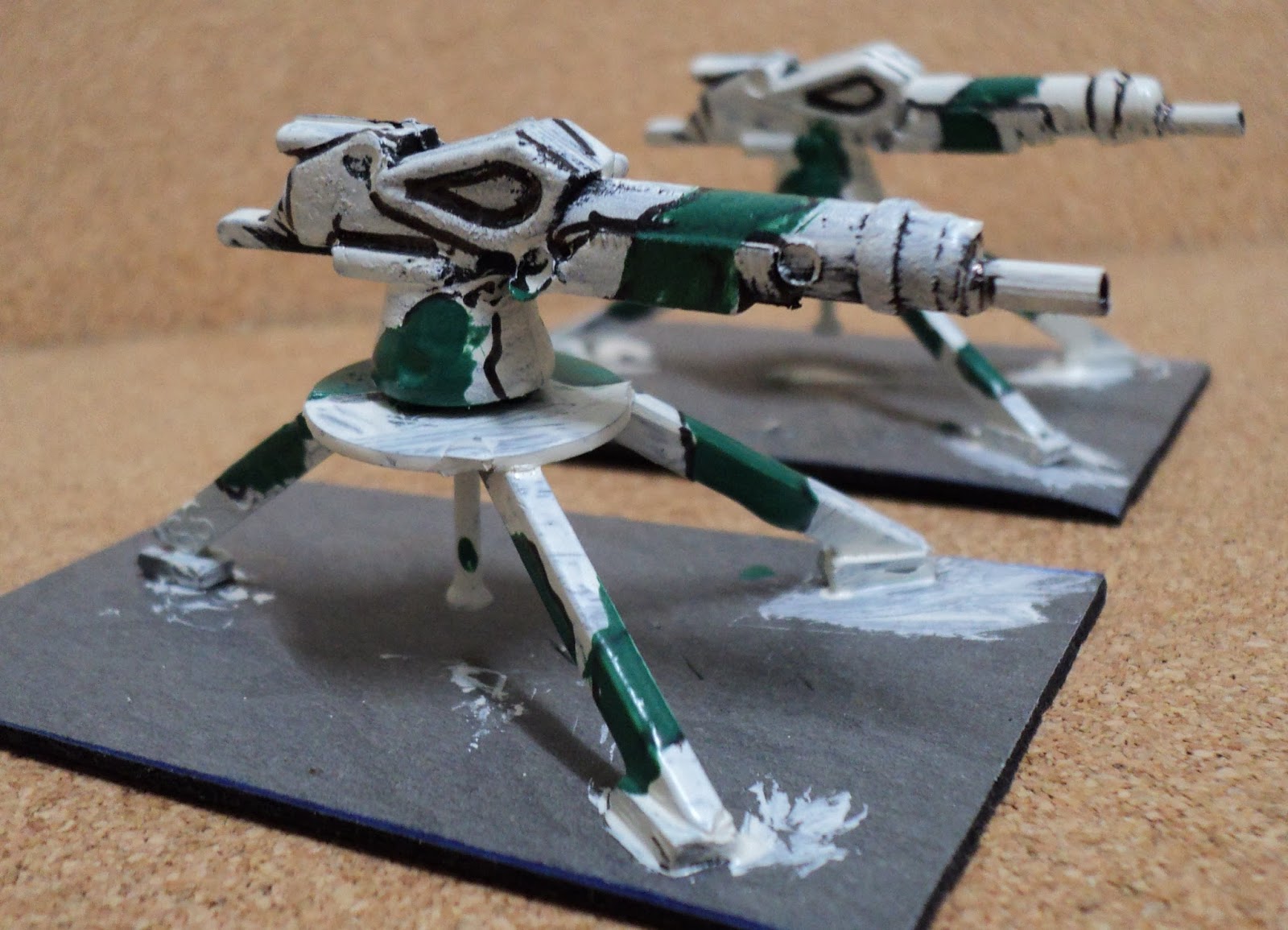
Now these things have become my Kiivar water-cooled HMGs.  The gun bit was originally the weapon atop a buggy-like vehicle that you will see below.  The turn table and legs were made from sprue pieces from the Wargames Factory 'War of the Spanish Succession' figures.  A brad driven through the circular sprue centre and into the base of the gun gives it a traverse capability.

These are the vehicles that originally transported those weapons about.  A heavily trimmed and cut down figure has become the driver, and a great deal of surgery was done to achieve the standing machine-gunners.  I can't say it was a tidy job, but they don't look too bad from a distance. 


The  camouflage scheme on these scout buggies I've decided as the standard for the Kiivar Army, though it is intended as a rag-tag sort of affair.  

The Beaverbug Armoured Car Squadron in its final livery.  The first digit of the vehicle number indicates the squadron - 'C' Squadron in this case.


I've used house paint on these, a good deal of it left over from painting the kitchen just before Christmas: a very light beige and a darkish green.  The green is heavily outlined with black marker pen.
The next few pix I've added 'cos I think these little guys make a handsome force of armoured cars.
Of course these are light vehicles, two of a crew (driver and commander/gunner), of moderate cross-country performance, so not what you would call 'fast'.  The Raesharn equivalents will be larger and faster, and possibly armed with a coax cannon and machine gun - unlike the single weapon with which the Beaverbugs are equipped.

 'C' Sqn/17th Recon advancing: armoured cars, supported by scout buggies and a Recon Assault Squad.


           A lower angled view...


Finally, I painted up the very few recognisably Japanese figures as a section of the infantry of Omez - allies, or more accurately, auxiliaries to the Army of Raesharn.  


The yellowish uniform colour, with an ink over-wash (Nuln Oil) comes out rather well, though the paint job itself is pretty untidy.  The putties and webbing has been done in an off-white, pale beige colour and also over-washed.  A single section won't do, of course, so I'll probably add in other figures to bulk them out into at least a platoon of 20 figures, and possibly a 2 or 3-platoon company of 50 or 60 figures.  One thing I'm not short  of is Army Men figures!

Sunday, January 26, 2014

Interacte: Something different...

This posting is something of a an intermezzo between my previous and my intended next posting.  Looking at Bob Cordery's Itchy and Scratchy rules concept, and the armies he pictured in his (at this date) last posting, it seemed to me a good idea look again at my Ruberia-Azuria War.  Here's where the project is at so far...
ESCI Zulu Wars and NW Frontier British and Sepoys.  Now forming the
Ruberian armed forces.  The sepoys probably won't remain sepoys...
 Above, rather a bad photo of the Ruberian Army as presently constituted.  It is wanting its Gatling guns, still. I suspect that the Itchy and Scratchy concept would tend rather to subsume Gatlings and mitrailleuses, but I can think of ways around that.  One is to re-scale my armies - double the number of elements, say, per Division.  Actually, my original project had 3 stands per Ruberian Infantry Division.


1st Cavalry Division, Ruberia.
More or less consistent with Mr Cordery's vision, above is Ruberia's I Army Corps: 3 Divisions of 2 Brigades apiece, 1 Cavalry Brigade, Artillery Brigade, and a Corps command element.  Bob doesn't show this last in his organisation, but it does occur to me that such an element can represent 'Corps troops' - engineer/pioneer train, command, and possibly logistic support as well.  Just a thought. As it happens I don't have too many command figures, so I might have to rethink this (bigger Corps maybe?).

Ruberian 1st (and only) Cavalry Division (above, right).  These were given to me years ago (by Mark, of the Chasseur-a-cheval blog spot, clearing out surpluses), and as I hadn't the heart to do anything with the excellent paint work, all I have done is rebase them.

1st Army (?) Azuria: I, IV and V Army Corps.

Army of Azuria - or at least part of it.  Or maybe it is one of several Azurian armies.  Here, this comprises I, IV, and V Army Corps.  Each Corps comprises 6 Infantry Brigades (3 Divisions), 1 cavalry Brigade and 1 Artillery Brigade (48 guns). I really would like to add a mitrailleuse stand... 
1st Cavalry Division, Azuria, comprising 2 Cuirassier and
1 Lancer Brigade.


 Azurian Cavalry Division: 3 Brigades, plus command.  Should I add a horse artillery element? The stands, by the way, are much deeper than Bob Cordery's, to accommodate the rather looser formations of the second half of the 19th Century, more or less in accordance with the Phil Barker Horse Foot Guns game system (which I'm unlikely to take on).  
Azurian  Brigade, Imperial Artillery.  At 48 guns, this would comprise
2 x 24-gun regiments.
Above, a close-up of a heavy artillery element in progress.  well, I would call it progress had any actual work be done on it for the last mumble years.  It is an ESCI Napoleonic British piece, its barrel replaced by what you see here as a rifled gun reinforced at the breech.  That knobbly bit at the back is from a brand of toothpick very useful for war gamers.

1st (Ruberian) Cavalry Division with Royal Horse
Artillery attached.
Finally, another look at Ruberia's Cavalry Division - and Mark's paint job - with a smaller rifled artillery piece intended as horse artillery.


Tuesday, January 21, 2014

War Games Design Issues...

A recent posting by Big Andy of 'Glorious Soldiers' though not lengthy, posed some interesting, and, speaking for myself as a war gamer, important issues.   One of these had to do with the kinds of rule sets that subsumed regiments or battalions into larger formations, brigades and above, that have little 'unit personality' to them.  This struck a chord.
ACW firefight between two 27-figure regiments at short range.
Armed with smoothbore muskets - it must be early in the war - volley groups are 6.
Die Range is 4 that is pip scores greater than 4 are ignored..
I have long wondered why it is I've never had the hardness of heart to transform my Airfix ACW regiments and battalions into brigades.  As brigades tended to take on the name of their commander (retaining such names well after said commander had moved or passed on) one could argue that [a] they formed a de facto tactical unit, and [b] they did have a unit - or strictly speaking, formation - character of their own.  So why not change? 
Result of shooting.  USA did well, scoring 10 hits!
CSA shooting is below par -  only 5 hits.

The reason for my conservatism, I think, that 'formation character' is still made up, in part, from the character of its constituent regiments and battalions, along with their respective commands.  

The 'impersonal'  style of rule set, such as Volley and Bayonet, I've never really cottoned to - at least not for 'pre-industrial' armies - though I actually thought highly of the DB* concept qua concept.  A friend saw in DBM a board game with miniatures, and I believe he wasn't far wrong.  But Volley and Bayonet I never could get my head around.  I'll be honest here and say I rarely had any luck with that rule set - some very improbable things would happen (I mean, really WTF country) - and found I wasn't learning much of anything, neither.  Some of the game mechanics struck me as so artificial as to make it impossible to rationalize in terms of what might be happening internal to the unit or formation, or indeed to the situation I was looking at as a battlefield context.  I mean, what's with this 'go stationary' thing? I didn't like them because they just didn't suit me.  sometimes that's the way it goes.

USA's 10 hits are divided into a group of 8 plus a remainder group of 2.
The 8 dice rolled give 5 distinct pip scores, ignoring duplicates; the 2 group rolls
double-1 - 1 distinct pip score only.  1 plus 5 = 6 casualties.  The CSA's 5-dice group
very fortunately comes up with 5 casualties!
I've been looking at Pike and Shotte lately, and there is no doubt they produce nice armies with individual battalia.  They are quite flexible about how you present your armies, though with an over-riding 'envelope' (if you like) of footprint ('base') per block or battle line 'units' (I won't go into the authors' idiosyncratic use of the word 'unit').  Even then you can adapt to your own requirements.

The first moments of the fire-fight lose the USA 5 figures; the CSA 6.
As these losses are greater than 10% for both sides, both would require a morale check,
but for our purposes, let us suppose they 'pass'.
There are a number of matters therein though that I might have problems with.  For one, a reasonable sized Pike and Shotte army demands a hell of a lot of figures.  I bought quite a few Revell 30YW figures in the mid-1990s and wrote my own, rather old-school, rules for them. That rule set I wish I still had. Then came DBR.  It seemed to be enjoying a popularity in this part of the world (I started using my Byzantines to stand in for Ottoman Turks late 17th century).  I delayed and delayed converting my plastics to DBR, partly because I would have had 900AP of Imperialists and 750AP of Swedes, but mainly because I was afraid that what did happen, would happen.

The firefight continues.  Losses have reduced the volley-groups
to 3 each (the US extra figure is ignored).  USA scores 3+1=4 hits; CSA, presumably
blinded by smoke, score none at all!
It was like magic.  Almost the moment I made the change, re-basing my figures, local interest in DBR evaporated practically to nothing.  It was if Fate, Kismet or Karma had been waiting with bated breath and sand-filled sock for me to make the commitment.  Yet that loss of interest was understandable.  It seemed to many of us that DBR was wanting a lot of further development.  Mind you, wargamers' attitudes also counted for a great deal.  The designer tended to think in terms of region and periods, and quite explicitly stated as much. Having a lot of sympathy with the designer's view, I formed the impression that what was uppermost in war gamers' minds was ... ***COMPETITIONS**** (think bells and whistles, here).

The 4 hits scored by the USA work out to 3 casualties - or
to be precise - 3 fewer figures remaining with the CSA colours.  Reduced now
to 18 figures - two-thirds strength - the CSA might be well advised
(supposing it passed its morale check) to pull out.  The USA have no need to check morale
this turn...
It was the war gamers' complete and utter refusal to see DBR in any other than ****COMPETITION**** terms (do you detect a note of scorn here?) that led to the long hiatus for about 10 years (a little bit of a revival has taken place since then - not that DBR had undergone much refinement in the interim).  I'll give an instance of the way ****COMPETITION**** war gamers think.  The 16th Century Muscovite army list included wielders of firearms that we might call arquebuses. These hadn't the range of later firearms, and might have been classed as (I) - 'Inferior' - but because these guys were armed with an axe, and historically (I gather) were not above getting up close and personal, they were classed as (S) - 'Superior.'  This gave them a 200-pace 'musketry' range.  I place the word 'musketry' deliberately in quotes, for reasons that should soon become apparent.
Pike & Shotte rule book, Volley and Bayonet profiles
DBR Swedish foote.
Of course, distant combat tended to be discussed in the rule set in terms of  'shooting' and 'shooting ranges'. But it seemed to the punters a bit strong that the Russian dudes should be able to foot it with and even defeat enemies armed with technically superior weapons like firelocks or whatever.  Bearing in mind this argument was being waged in the context of early 16th Century guys taking on 17th century guys, it seemed to me that the designers' decision could be justified even so.  If you were facing an enemy known to be the bloody-minded sort not apt to keep their distance, 200 paces distance might not seem very much separation.  You might be much less apprehensive of incoming bullets than of incoming Muscovites armed with axes.  Do you know, no one, not one single person, would give this argument a moment's consideration?
V & B profiles are 3-inch square. or 3-inch by 1.5-inch.  Though the minimum
equivalent profiles should be 8cm square or 8cm by 4cm, and would accommodate my
DBR basing a little better, the figures would look bally thin.
But if I go the Pike and Shotte way (please pardon the lengthy, though no doubt fascinating, digression), it will require another change of bases (no easy task) and my Swedish army will be able to field precisely one Brigade of 3 battalia.  I suppose it will do, but in Pike and Shotte terms I'll be looking at a small army...
I have to admit, though, that crammed on this way and photographed
 from a low angle does give us a dramatic picture... But maybe
15 'pikes' per stand and 10 shotte per 'half-stand' would look the part...?
 Then there are some peculiarities that I would certainly accept for solo play - but as a game of skill between two or more people?  War gamers sometimes talk of a 'long run' when discussing the vagaries of the dice. But in a given war game, there is no 'long run'.  Some situations are more crucial than others, for one thing, but even with fistsful of dice, there are too few rolls to constitute a long run within a single game.  In my view, if rules designers choose to take out of a player's hands control of his own army - even just a sizable chunk of it - there has to be a very good reason.  Volley and Bayonet does this without sufficient reason  in my view, as does General de Brigade.  The net effect is simply to piss me off.  I have an uneasy feeling Pike and Shotte, with some very idiosyncratic game mechanics, might turn out to be Poke and Shitte.  But I hope not...
For play testing purposes, this is probably what I'll do.
I still think very highly of these Revell figures.
The accompanying ACW pictures are by way of illustrating the shooting rules I use for my 'Horse and Musket' type games.  I've kept things pretty basic and simple, just to illustrate the mechanic.  Very similar, but not precisely the same, as used by Charles Grant's The War Game.  The 'Die Range' concept comes from the Wizard's Quest board game.

Acknowledgements:
Welcome to the 98th 'follower' of this blog spot: 'Rosbif' of the blog spot Monsieur le Rosbif and Johnny Frog.  Check it out.


Monday, January 13, 2014

Command and Control: Modified Charles Grant rules.

Just recently Mark Dudley of Ilkley Old School blog spot  proposed an interesting compromise of Charles Grant's The War Game morale rules to fit his 16/32 figure infantry and 8/16 figure cavalry units.  The two numbers for each means that depending upon the scale of the action he can field the 'standard' 32 figure infantry, or, for larger battles, 16-figure battalions.  Given that Mr Grant's rules involves infantry units of 5 officers and 48 men; and cavalry of 4 and 24 - that is to say large units with an HQ element distinct form the main body of troops.
Two infantry regiments in the service of the Grand Duchy
 of M'yasma.  Each comprises mounted CO, subaltern, flag and
musician, 1 8-figure Grenadier coy, and 3  8 -figure musketeer coys;
a total of 36 figures apiece.  Figures are ESCI.
Mark has decided to dispense with the distinct HQ element, bringing the officers in with the main body.  But then he was faced with the two-fold problem of how to assess morale.  Particularly he needed one rule that would work irrespective of the size of the battalion.  He also wanted it to be easily assessed - increments going up by easily determined fractions of the whole.  Simplest seemed to be to apply a modifier to morale for every 1/8th lost from the original strength.

But how to deal with officer casualties?  First of all, how to determine them? (Roll of 1D6 each time the unit takes losses, as Mark does).  What is the moral effect?  (Further loss to command and control).
Two Napoleonic French units of (mostly) first generation Minifigs that I've never
had the heart to retire.  The lead unit has been augmented by
a few otherwise orphaned kneeling firing guys of indeterminate
origin.  Lacking musician figures, these units don't really 'fit'
the Charles Grant 'model' for determining command and control.

Here's my comment:
"I reckon you have a good compromise, here, but much depends upon how many 'officer figures' you have in your organisation.

"I've headed in much the same direction as you have with my Napoleonics, my 27-figure infantry units (6 coys of 4 plus HQ of officer, flag and musician) being reduced to 24 (and thus generating new units).  My organisation used to be inconsistent in this respect, my cavalry (mostly) being 12 figures all up.

"Going back to the Chas Grant handling of officer casualties, it seemed to me that there need not be any change, there.

"I think I feel a posting coming in in my own blog on this subject, so I'll enlarge upon it there.
Cheers,
Ion"
My standard WSS Imperialist battalion/regiment: 2 Officers,
2 flags, 2 drummers and 30 other ranks.  No separate HQ line.
Figures are Wargames Factory plastics.

It seemed to me this is an interesting topic upon which to enlarge.  Having dispensed with the separate battalion HQ in my Napoleonic armies, and am doing the same with my new War of the Spanish Succession army.  Incidentally, I'm also going the flexible route with the WSS, with 36-figure infantry and 24-figure cavalry units as standard, but which may be split respectively into 18-fig and 12-figure units.  My 7 bn and 3 cav rgt army then comprises 14 bns and 6 cav rgts.  Part of the reason for the change to my Napoleonic armies was my acquiring second hand a  British army comprising 20-figure battalions that included an officer, drummer, and two flags with 16 'other ranks.'  To make it 'fit', the other armies really had to be adjusted. 
Double-scaled WSS Imperialists: the 36-figure unit split
into 2 18-figure battalions comprising Officer, flag, drummer,
and 15 other ranks.  When painted, the two units will (obviously)
have the same uniform.
But I'm not consistent.  My 7YW-period imagi-nations armies comprise 36-figure line infantry each with 4x8-figure companies (1 grenadier) plus HQ of mounted Colonel, subaltern, flag and drummer; and cavalry of 2x8-fig squadrons plus HQ of C.O., flag or guidon, musician.  Although I have occasionally thought to change it, my ACW infantry standard remains C.O. flag, musician and 24 other ranks (though there are some variations in the numbers of 'other ranks').  Cavalry units are smaller, but retain the 3-figure HQ thing.

American Civil War Union regiment comprising
CO, flag bearer,  bugler, and 24 'other ranks'.  HQ element distinct from battle line.
Figures are Airfix, the flag paper and wire attached to the running figure.
Now, for these games, my combat system for musketry is are very similar, and owes a great deal to Charles Grant's original idea, but with modifications.  Actually I thought I had invented my idea, but CG's scheme, which I had read some time before, must have been lying dormant in my memory.  At any rate, it involves volley groups to obtain 'hits' and a method of resolving 'hits' into 'casualties'.  I won't go into details here, but I regard my method a refinement that is easier and less rigid to apply, and slightly less bloody.

How officer casualties come into effect lay in my method of resolving 'hits'.  As my method did not 'pick out' individual figures within a specific 6-figure target group, but was added to and applied across the target unit as a whole, the appearance of double 6s in a 'hit group' would imply an officer casualty; and treble-6s a General Officer casualty if there was one present (i.e. standing within 5cm [2"] of the target unit).  
24-figure Austrian and Hungarian Grenadier columns,
 led by skirmishing jager, attacking a French-held village.  The 'HQ'
figures form the second rank within the columns.
I find that this system would work whether you had a separate HQ group or not, provided the number and type of officers were exactly the same.  The main difficulty is that it isn't easy to accommodate Grant's system for 5 HQ figures to 4 or 3.  These days, I am disinclined to trouble with officer casualties at all, but I do like the idea of flags as trophies.  So my rule sets have an option whereby, having lost a melee, a unit takes a separate 'morale' check to determine whether it kept its flag(s) - one colour or two in a given unit representing a 'stand' of colours.  Otherwise, if an officer is a casualty, his identity is diced for if there is a choice.  For instance, 101st new York has taken some stick and it is determined that an officer has been lost.  The choices are the C.O. and the musician (not the flag).  Rather than 50-50 the option, I enact that a 6 needs to be rolled for the CO to be taken.  The reason is that the CO figure represents one man and his HQ staff.  Several of the staff may be lost with the CO surviving.  Had the musician already been lost, then there is no option: off goes the CO.  The musician, then, is there solely to absorb one 'officer' casualty.  The presence of the CO himself offsets some of the effect of losses, cancelling one negative. 
American Civil War infantry in action.  Airfix figures.  The stone wall,
by the way, is made from real stones.
I reserve the loss of the flag to a melee outcome, or - very rare event this - the annihilation of the unit.  Years ago, in a Gettysburg refight, a regiment of Howard's Corps, facing most of Rodes's Brigade just west of the town lost every single figure in one bound to incoming musketry and gunfire.  Even though there was a heck of a lot of incoming, this outcome I had never seen before with my rule set and was totally unexpected.  I awarded the flag to the nearest Confederate regiment.
Imperialist infantry in battle array, the 4-figure HQ element in each 36-figure
regiment forming a '3rd line'.  Hilburghausen and Arenberg Infantry form
the front line, Alt-Colloredo the second, together with Trautmannsdorf
Cuirassiers.  Infantry are Airfix AWI 'Washington's Army' and
'British Grenadiers'; the cavalry are ESCI Napoleonics with tricornes
replacing the helmets.
The reason for this simplification is that my armies having developed somewhat piecemeal, there are some inconsistencies in composition of the units.  The numbers in my Austrian battalions when switching from 27 to 24 figures, were eked out by a large surplus of drummers I had obtained some years before on account of a mistaken order (which turned out to be a piece of luck). So each of my Minifigs units comprises 1 officer, 1 flag, 2 drummers and 20 other ranks.  Other units, made up of figures from other manufacturers (Warrior, Hinton Hunt (?) and another, unknown lot), all obtained second hand, have a different composition.  As a result for Napoleonics at least, I have pretty much dropped officer casualties at all, barring the flag thing.


Wednesday, January 8, 2014

Odds and endses

 One of the benefits of reading other people's blogs, is that you get ideas that you can add or adapt to your own schemes.  Yesterday on our grocery expedition I made my occasional detour to the Warehouse toy section to see what goodies might appear.  Seeing this item separated from similar types, I recalled Evil Uncle Brian's 'Fist full of Plastic' blogspot, which featured the acquisition of a couple of Buffalo MPCV - Mine Protected (I thought it meant Multi-Purpose) Crew Vehicle.  at $10.99 I thought the price reasonable, not at first observing the 'Reduced to clear' label at $4-00 less.
 So the Army of Tchagai will have acquired a useful engineering vehicle...

Meanwhile, I was thinking that my 'Army Men' (I'm thinking of dropping the 'Jono's World' label) armies could use some battle flags.  Partly it is to add colour, but they will also be useful for identifying purposes.
In the foreground a green and red Omez flag, and the flag of
93rd Raesharn Infantry
 Raesharn has 'rayed' flags, its Omez allies the  per saltire vert-and-gules, fimbriated argent; and the Kiivar opposition the azure and or scheme of nested lozenges and squares.
 Below; the 'Red Dawn' flags of 55th Armoured Infantry and 70th Infantry.  The Kiivar flag is of the 34th Regiment.
 On an entirely different topic, Brian had found a use for one of my surplus Wargames Factory muskets to create an amusette.  Thinking that this was a great idea, I bethought myself to undertake the construction of one or two myself.
 First the wheeled pavises.  Not mush to these: wheels from Airfix plastic artillery (one a Napoleonic British piece, the other from the ACW set).  The axle is a match in one case, a length of skewer in the other.  The vertical timbers are also lengths of skewer, and top and bottom of this shield 'finished' with timbers cut from a ice lolly stick.  There is no trail.  The aperture for the firearm is slightly right of centre, as one might imagine for a right-handed musketeer or jager.
 The centre piece of the pictured trio is something else, though still coming under the amusette definition, I gather.  This is a bally great firearm mounted upon a light carriage rather like an artillery piece.  The firearm is from an orphaned LEGO part that appeared in a job lot of Army Men I was given a couple of months back. True, it is over scale and looks it, yet it also looks the part it seems to me.
 The other two firearms you see in the pictures make use of the rifle butts cut from Army Men figures to create our battle flag bearers.  The near one has had its butt shortened by half so as to be held properly by its owner.  Although the information supplied in Brian's article suggested the use of amusettes in the field, I'm inclined to reserve them for siege warfare, or for the occasional 'kleiner krieg' battle.