Wednesday, November 10, 2021

Woodscrew Armies Campaign - News Flash


July 30, 1889

China Reclaims Lost Territories

Chinese Army On The Move

Tenth Army Mobilizes


It never rains but the heavens open wide and discharge a deluge upon deserving and undeserving alike. Whilst the attentions of our leaders and military have been engaged upon our northern and eastern frontiers, we in the West have been left to our own devices with no succour but that which might be afforded by Tenth Army, commanded by General Thos. J. Jackson.

Major-General T.J. Jackson
An Army from China has been discovered to have entered the Forbidden Zone, to make good for the Emperor his claim to the territories stripped from his Imperium twenty years ago. Such was the outcome of the aggressive war waged by China against this country. Clearly, the lesson administered by the Union has been forgotten, if it were ever learned. 

Let us remind readers, however, that the Denver Discourse  demanded to know why the vast tract of country upon our western borders was not annexed outright.  Why was the frontier not extended two hundred miles or more westward?  It seemed to Us at the time that such a Destiny was Manifestly written in the stars, if it were not in the signed Treaty and thence into historical record. But no. Vast tracts of valuable territory was to be left fallow, abandoned but for stragglers and strays and woebegone waifs.  It was to remain the home of bear, bison and bobcat. Just the occasional patrol, no doubt easily evaded, were what remained to keep the region from repopulating.

Meanwhile, just about our whole army has been engaged in sanguinary wars far from this region, only the Tenth Army left to maintain watch and ward over the hundreds of miles of frontier. The Chinese have invaded the Forbidden Zone a month since, with a vast army - reports indicate 100,000 troops at least - equipped with modern weapons. Against this formidable array, Genl Jackson proposes to oppose his army, weakened, be it noted, by a whole brigade - a whole quarter of his strength. The whole of 40th Brigade is engaged in detached duty in Mexico - a service of such importance, according to government and military sources,  that it may not be recalled. If General Jackson can muster more than 20,000 troops with the standard complement of supporting arms, it would be a miracle. And what can 20,000 avail against five times that number? 
 
We extend, of course, to Tenth Army all the best wishes and 'good lucks' in the world. But the General Officer Commanding is well known for his eccentricities, infamous for his overweening ambition, and notorious as a rigid martinet. These might be overlooked in a commander of impressive martial appearance and unblemished record. Major-General Jackson is distinguished by neither. His appearance is slovenly and dowdy, the ancient kepi he favours pulled low over his eyes; and, mounted, his seat is said to be the worst in the whole Army. His record might generously be described as chequered, the occasional good conduct punctuated by acts of dilatoriness and downright insubordination. He is a known pettifogging mediocrity who owes his exalted rank to his longevity of service, friends in high places and the ill-fortune of his betters.

To such a one must we then entrust our safety, and the security of our Western Frontier.  So, what has been the upshot? The General pokes his nose into an ambush at the first contact with the enemy.  Of course, our gallant soldiers, with their superb equipment and training, got him out of that Yangzigu scrape, little credit to him. What does this 'Napoleon of the West' do next?  Hangs out one of his brigades to face unaided a vastly superior enemy force, whilst he himself seeks some minor glory elsewhere.  He reckoned without the sublime abilities of his subordinate, Brigadier-General Isaac Bidwell, who, holding off three or four times his numbers for a whole day, extricated his command still in being and in good order. Perhaps in this able commander we might observing a credible replacement when his Army commander receives from his Court Martial the cashiering he richly deserves.

Action at Yangzigu - by an Eye Witness


Latest news is that General Jackson is still in command, but two brigades, not yet fully refitted from their exertions against other foes, are being attached to Tenth Army, if they have not joined that army already. It seems that General Jackson is as profligate with the lives of his men as Crassus on a spending spree was with his money. The commander of 19th Brigade (5th Army), Brig-Genl Josh. Chamberlain is well known for his exemplary record; that of 17th Brigade, Brig-Genl Jubal A. Early is renowned for pugnacity, not unalloyed with a certain rash carelessness. 


This writer has heard that the Army Commander proposes to form the two under-strength Brigades into a small army-corps, under the command of General Early. Are we to add to General Jackson's crimes and shortcomings that of nepotism? General Early is well known to the Army commander; Chamberlain much less so. To be sure, General Early is senior, but what should that avail when a commander of superior merit is to hand? 

The campaign remains ongoing. According to the latest reports from troops returning from the front, the Chinese Army is still at large in the Forbidden Zone. So too is Jackson's command. We await further events with hope considerably intermingled with trepidation. 

(Special Correspondent) 

Tuesday, November 9, 2021

Woodscrew Armies Campaign - Bidwell's Holding Action


Bidwell's road block
As Tenth Army marched south to face the southern Chinese Column, General Jackson detached a small force under his senior brigade commander to guard against Chinese moves from the north.  He needed time to defeat and drive off the Chinese right wing, the south Column, thence to retrace his steps to face the main Chinese army.  A suitable battleground for a holding action seemed to be a village - another desolate semi-abandoned spot - nestled between two plateaux of high ground and through which, veering southeastwards, the road passed.

The detached column comprised:

Commander: Brigadier-General Isaac J. Bidwell
37th Brigade - 24 infantry figures, 2 MG crew figures, 2 light artillery figures = 31
Part 10th Cavalry Brigade - 13 troopers, 2 flying artillery figures = 15
210th Pioneer battalion = 4 figures

Total, including command: 51 figures (8500 all ranks) 2 Artillery, 1 MG

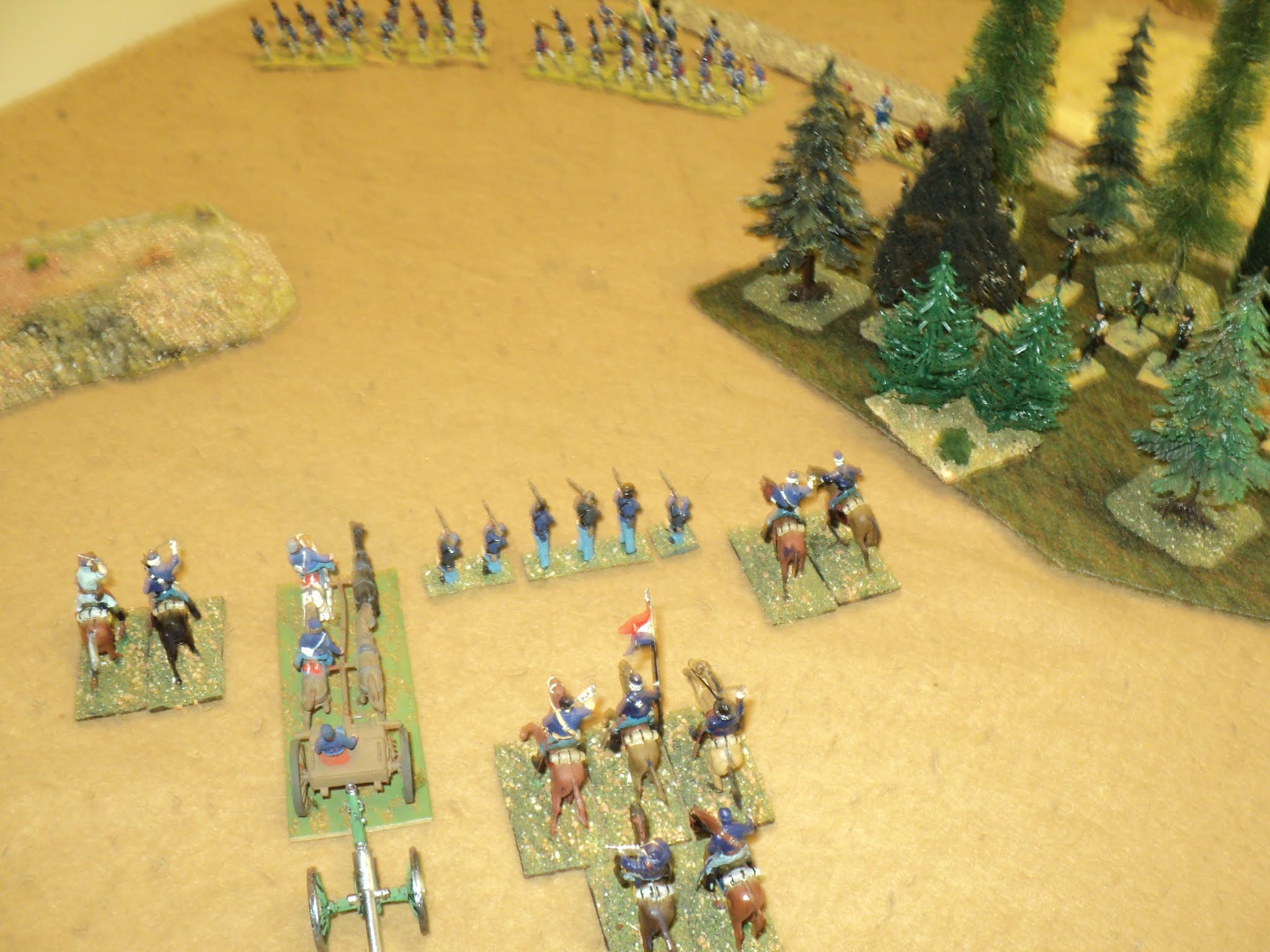
The pioneer battalion at once set to work tracing out some hastily built field works in the high ground flanking the village. To the left of the village, stood the main body of 37th Brigade: 4 battalions and the brigade artillery. The two remaining battalions were thrown forward on the right of the road to lurk within a small piece of woodland in the plain.  Behind  them the field work on the high ground housed the cavalry's flying artillery. The troopers, mounted for the moment, stood in reserve close by the road to the rear, though their facing anticipated a Chinese flanking move around the woods on the right. The Brigade machine guns occupied a small work between the village and the wood. Having completed their work, the pioneers garrisoned the village, which formed the point of the V-shaped front.
Union view of Chinese arrival 

They were barely in time. A day and a half, and half a morning, Bidwell had been allowed to complete his preparations. Scouts scanning the back trail reported a large Chinese army advancing slowly and steadily southwards. Quite without cavalry they were unable to prevent Union observation, and their own scouting revealed almost nothing. Meanwhile, coming up from several miles to the south they could hear the muttering rumble of distant guns. Clearly, Jackson had found his enemy.

Seeking to keep his forces in motion, T'ai Kun Wu had decided not to wait the two or more days for the North Column to join him but set out as quickly as his slow-moving forces permitted to pursue the Union forces down the southeast road. Lacking horse, he was forced to use some of his regulars to form strong flank guards, the 1st Regular Unit on the right (west) and the 2nd Regular Unit on the left, distant from the road roughly a mile. His best troops, the 8th 'Blue Leopards' led the van along the road, followed by the artillery and the three conscript units. The 3rd Regular Unit brought up the rear.  

The whole West Column force comprised:

Army Commander: T'ai Kun Wu

1st Regular Infantry - 28 figures (M/L Rifle)
2nd Regular Infantry - 28 figures (M/L Rifle)
3rd Regular Infantry - 28 figures (M/L Rifle)
8th 'Blue Leopards' Light Infantry - 19 figures (single shot B/L Rifle)
10th Conscript Infantry - 19 figures (S/B Musket)
11th Conscript Infantry - 19 figures (S/B Musket)
12th Conscript Infantry - 19 figures (S/B Musket)
1st Artillery - 2 figures (M/L Rifled Ordnance)

Totals: 163 figures (27,000+ all ranks), 1 artillery.

The Chinese view.  

Once again I had recourse to C.S. Grant's Programmed Wargames Scenarios for this one: #4. Holding Action.  Although the disparity of numbers is a deal less in the published scenario, I figured that the Union superior individual firepower, plus some field works, would go some way to level the battle ground. Of course, at numerical odds of more than three to one, it was never likely that Bidwell's command could hold indefinitely - nor did they. The approach of the Chinese Army was also programmed: the order of march, and the timing of arrivals of the main column and the flanking units.

First action - skirmishers of 2nd infantry against
two Union battalions in the woods
It was about mid-morning of 20th July that the Chinese West Column came up to Bidwell's road block.  The country hereabouts being easy going, and as the trail veered southeastward, the left flank guard unit arrived a good half hour before the column along the road. They at once threw out a skirmisher screen as they drew closer to the wood where awaited the two Union battalions. In the ensuing little battle, the skirmish line was quickly driven in, but the Regulars pressed on to close the range and bring more musketry to bear. Outnumbered more than three to one, perhaps the Union's quicker rate of fire and the cover of the woods might have stood off the 2nd Regulars for a considerable time.  
Magnificent shooting by the Chinese regulars!
Enough to drive the Union out of the wood.

But someone had trained the Chinese regulars well. Though taking fearful losses themselves from Union rifle and gun fire, their superb musketry cut down more than half the Union infantry and drove them quite out of the woods. Rather than plunge into and through the trees after them, 2nd Regulars began to skirt the woodland with the view to coming down upon the Union right flank.

(It occurs to me I ought to explain that last picture.  I use a volley group and 'die range' system for shooting. It the range the shooting was taking place, the volley group for the Chinese muzzle loading rifles was 6 figures, and the die range, 3.  So the unit threw 4 dice (24 rifleman figures) counting pips on any roll of 3 or less.  The unit could reasonably have expected to score 4 hits - halved owing to the cover of the trees.  But instead they rolled eight hits, halved to four.  The 'normalising' roll that follows made no change, so the Union riflemen in the woods lost 4 figures.  That was a tremendous score for the Chinese, though they lost very heavily as well.) 
Looking west...
All this while, the remainder of the Chinese column was pouring onto the field.  The 1st Regulars on the right arrived at about the same time as the head of the main column. Wishing to husband his best formation, the 'Blue Leopards', T'ai Kun Wu drew them to the right off the road in front of the woods, to make way for the artillery and the conscripts.  
Chinese columns pouring onto the field...
Shaking out into line, 1st Regulars advanced steadily towards the dug in 37th Brigade on the hill. Switching their target from the 2nd Regulars, where the guns had done some execution, the Union light artillery took some time to get the 1st Regular's range. As the enemy were approaching the Union line at a rather acute angle, the latter had perforce to refuse their left flank to bring their rifles to bear.
Duel between 37th Bde and 1st Regular Infantry


By now the wings were becoming fully engaged: on the Union left, the main body of 37th Brigade against 1st Regulars; and on the right, the half-brigade of Union cavalry were facing off against 2nd. In the centre, the Chinese conscripts had deployed into brigade columns, rather than lines, partly in the interests of speed, and partly because T'ai Kun Wu planned to storm the Union centre with the whole weight of conscripts in successive columnar attacks.  
Battle on the wings, build-up in the centre
As it transpired, the outcome of the attacks on the flanks were more or less resolved before the central columns could be fairly engaged. Mostly behind breastworks and backed by artillery, the main body of 37th Brigade made short work of the enemy below. Their withering fire scythed down the regulars like grass. Within the half hour, what was left of 1st Regulars broke and ran back the way they had come. The Union had lost fewer than 200 men; the Chinese loss seven times as great. But following that unit a large column of over 3000 was rapidly approaching.

Devastating Union shooting - enough to disintegrate 
1st Regulars

On the other flank, the dismounted cavalry had advanced to meet the approaching 2nd Regulars as the latter came around the woods. Knowing their repeating carbines to be outranged by the Chinese muzzle loaded rifles, the Union horsemen were eager to try conclusions. 'Boys, this will be short but desperate,' quoth Colonel Otho Strahl of 59th Regiment, 'Fire at will!'
Firefight between 10th Cavalry and 2nd Regulars

It surely was. As expected, the Union carbines, supported by enfilading gunfire (which actually proved ineffectual), exacted a severe toll upon the Chinese infantry. In return, having already given indications that the Union had to deal with a fine and well led unit, the Chinese regulars' fire, slower, but with double the numbers of firearms proved devastating. The cavalrymen lasted no longer in the firing line than the 1st Regulars at the other end of the field. Greatly reduced, they scrambled back to their horse-holders.

For their part, 2nd Regulars had also had their fill of this battle, and backing off from the gunfire from the flying artillery on the hill, drew off behind the woods. All things considered, that unit had given as good as it had received - a record that was not lost upon the vigilant T'ai Kun Wu.

Bidwell's command begins to pull out in good order

By this time it was becoming apparent to Brigadier Bidwell that his line could not be held much longer against the steady build-up of Chinese strength. The earthworks on the left having served their purpose, he pulled back the Brigade infantry, leaving the guns in place for the moment to keep the enemy in play. The infantry was to reunite with what was left of the detached battalions behind the village. The pioneers' wagons already sent off, that battalion was also ordered to evacuate the village, and the machine gun group to abandon its works. From its lofty height, and with nothing more to fear from the northern flank, the flying artillery turned their attention to the column (10th Conscript) approaching the town.

Brief rearguard action by infantry
 as the artillery makes off
As the following column, the 11th Conscript Infantry, surged up the slope, the 37th Brigade artillery limbered up and made off just barely in time.  Nor did the 10th Cavalry's flying artillery tarry overlong within their works.  Drawn up across the road, the Union infantry covered the unpanicked but hasty retreat of the guns, knocking over a few Chinese coming on past the village.  The last of the Chinese regulars and the 'Blue Leopards' were too late to affect the outcome.
Union withdrawal


Distancing themselves from close pursuit, Brigadier-General Bidwell's command drew off in good order down the road.  Bidwell congratulated himself upon holding up three times his number for the best part of a day, and well within the losses he was instructed would be acceptable.  For his part, T'ai Kun Wu called a halt a little beyond the village just taken, though the day still retained an hour of daylight.  The distant gunfire to the south had fallen silent sometime before the noise of this holding action had ceased.  

End of the action

As the Chinese were left in possession of the field on this occasion, they were able to gather in a higher proportion of stragglers, and to take several prisoners of war as well. Their overall loss was about 2500, almost all from 1st and 2nd Regular Infantry. The Union loss was less than half that - fewer than 1200, though approaching 200 were listed as 'missing'. Those unfortunates were later to find themselves marching under guard toward Yangzigu.

In his tent that evening, General Jackson had just begun penning his report on the battle he was to call 'Weshall Pass', when a dusty and dishevelled rider pulled in to camp. Without undue ceremony, he was ushered into Jackson's tent. During almost a whole day's action (so Jackson was generously inclined to believe) the Chinese armies from the north had been held back. And now, having drawn off in good order, Bidwell was marching to join him.  

Picking up his pen to resume his report, he was interrupted again by a second messenger. This one had been riding for days with a small escort up the road from the border. His army was to receive reinforcements, he was told.  17th and 19th Brigades from 5th Army. Having been recently engaged in fighting at the other end of the country, they would be under strength - just 80% of its riflemen - though the supporting arms were complete.  They were still some distance off - he imagined that the 17th would be crossing the border about now, 6 days away, then, and the 19th had not yet left the railhead.  He was pleased with their commanders, too, one of whom he knew personally, the other by repute.  He would be glad of the reinforcement.

But... he was not going to wait for them.  There was an enemy column not a day's whole march from him, and probably marching south.  Tomorrow, he would meet it at ... he glanced at his rudimentary map - Liaoyan.   Yes.  That was the place...

To be continued...  


Sunday, November 7, 2021

Woodscrew Armies Campaign - Battle of Weshall Pass

Chinese South Column offering battle...
Just before dark, on 19 July 1889, mounted scouts reported to Tenth Army HQ that a Chinese column was close by, and seemed to be preparing to offer battle. Arriving at a pair of hills between which passed the main road - more a sandy trail - they seemed to be deploying, ready to face the Union army come the morning.  
Union Tenth army approaching.

With his usual dawn promptitude, Jackson had his army moving at first light of the 20th. Whilst the cavalry, 38th Brigade and the heavy artillery marched up the main road, 39th took a parallel trail to the left. Coming in sight of the enemy, drawn up along the twin hills, the cavalry, followed by the heavy guns, drew off to the left of the main road, filling much of the gap between the two brigades.
Opening salvo by Chinese artillery


The deployment and distribution of both armies were programmed.  The action some readers might recognise from C.S. Grant's Programmed Wargames Scenarios,  '1. Hill Line Defence'. In this I ignored the deployment of 'light troops' - everybody is 'light' in these armies, apart from the Union heavy artillery - and went for the overall deployment instead. The roll for the defenders (Blue Force was the Chinese column) led to 40% being placed in the centre and 30% on either flank.  To achieve this without doing violence to unit integrity, led to the distribution as follows, who landed on which flank also decided by die roll:

Right flank -
6th Regular Infantry - 28 figures 
Artillery battery - 2 figures and 1 smoothbore cannon
 - 30 figures and 1 gun

Centre - 
22nd and 23rd Conscript Units @ 19 figures
 - 38 figures

Left Flank -
21st Conscript Unit - 19 figures
2nd Cavalry Unit - 12 figures
 - 31 figures.

Total: 99 figures, 1 artillery (16,500 troops total)
Union left and centre.  In the distance, 23rd Concsript
Infantry behind a crumbling stone wall
Seeing the enemy laid out in this fashion, General Jackson determined upon an attack on both flanks at once.  This was as the die roll determined: 40% of his troops on either flank, and 20% in the centre, as follows:

Right Flank -
38th Infantry Brigade - 24 figures with 1 Gardner MG (2 figs)  and 1 field artillery (2 figs) - 28 figs

Centre - 

10th Cavalry - 12 troopers with 1 flying artillery (2 figs) - 14 figs
110th Heavy Artillery - 2 batteries @ 2 figs - 4 figs
 - 18 figs

Left Flank -

39th Infantry Brigade - 28 figures (1 MG and 1 Artillery).

Total: 74 figures, 5 artillery, 2 MG (12,333 troops total).

Heavy losses to 21st Conscript infantry from 
Union rifle, MG and gun fire.
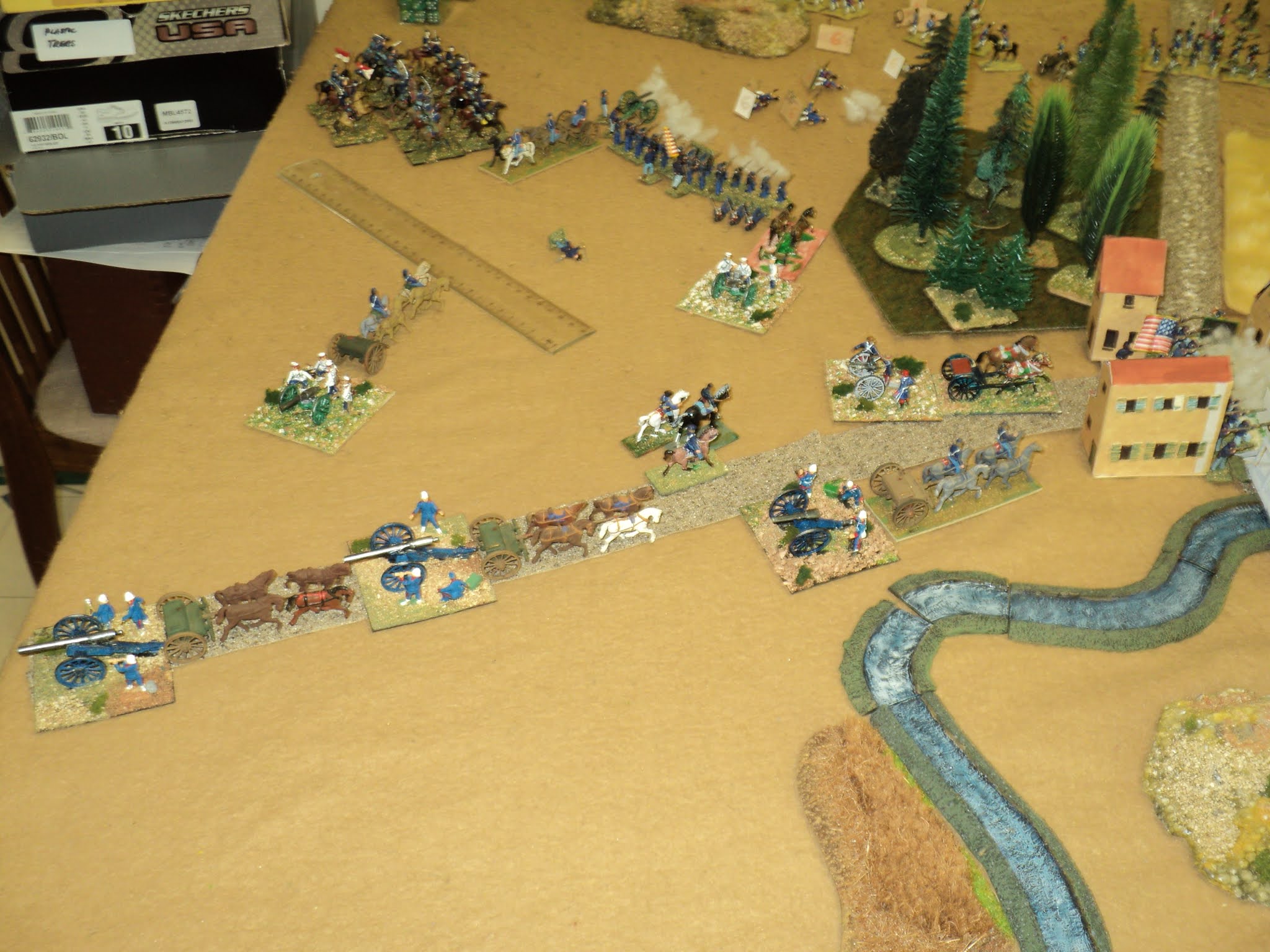
The Union infantry seemed eager to come quickly to grips with the enemy, for they advanced rapidly up the trails.  On the left, 39th Brigade early on came in for an effective fire from the sole artillery the Chinese column possessed, and began to lose a steady trickle of casualties as they advanced. At that they tended to leave their supports behind. Although they came in for an uncomfortable half hour pushing forward into the shot and shell, they maintained their steadiness until they came into the range of their rifles. In the meantime, the brigade artillery began a counter-battery against the Chinese cannon, forcing the latter to limber up and draw off.

Less harassed on the other flank the 38th Brigade infantry pushed right through the abandoned village that masked a spur of the hill behind it, the Brigade artillery and MGs passing to right and left of the place.  To the latter's left the cavalry deployed for dismounted action.  This proved rather unfortunate, for, just as Union rifle fire drove in 21st Conscripts with heavy loss, the Chinese cavalry, outside all expectation, essayed a charge.  

The reckless charge of the Chinese Horse 

Taken completely by surprise, the Union cavalrymen's panicky carbine fire failed to stop the onrushing horse - two thousand horsemen against one thousand carbines. Though many a pony or rider was brought down, it was their very reckless impetuosity that carried the Chinese horsemen into the Union line.  The mounted Union command joined the fray, with the horse holders following. A cloud of dust descended over the scene, from which, very soon, the Union horse, such as remained, came skedaddling out. Despite heavy losses, in the confusion, many of the dismounted cavalrymen had found mounts and escaped.

(A note, here:  This is one of those low-probability results that make any war game - and any battle, I dare say - such a chancy business. Actually, the charge oughtn't to have been made at all, according to the program.  But those horsemen seemed so eager to go, I just had to let them. For all that, for all the advantages I gave the Union - high firepower, and men-for-man equality in the melee, slinging in the mounted command the dice simply ran for the Chinese.  That's the way the cookie crumbles, sometimes.)

Union heavy artillery in action
As the battles developed on the flanks, the whole time the Army heavy artillery brought down a heavy fire upon the area of an old abandoned farm, where, behind a crumbling stone wall, waited the 23rd Conscript Infantry. Quite unable to respond, those unfortunates had to endure a considerable punishment, including the loss of their commander.
Duel between 6th Regulars and 39th Brigade.
At last, the Chinese artillery having been driven in, 39th Brigade came up against the 6th Regular infantry.  Magazine rifles against muzzle loaders could have but one result, however reduced the former numbers.  Within the half hour, just barely keeping their order, the Chinese regulars fell back. Right on cue, on the other flank, 38th Brigade mounted the spur beyond the village, decimating and driving back the 21st Conscripts.  With losses mounting at an alarming rate, Hung T'u Sun, the South Column commander sounded the retreat as his corps streamed off into the lowering sun.
38th Brigade sweeps all before it...

Apart from the cavalry debacle, General Jackson was satisfied with the outcome. There was no pursuit, much though he would have desired one. The cavalry were done for the day. He estimated that the corps just encountered was now 4000 men the poorer. His own casualties were a little greater than he might have desired, some 1167 men. These included Colonel Tarrant C. Hazebrook in command of 39th Brigade, whose shoulder wound had required his left arm to be strapped up, though he remained in command. As the Army reorganised overnight, he was already thinking about the morrow's march north.  

How had Brigadier Bidwell fared? Would the Army wake up in the morning to greet the broken shreds of his brigade, streaming southward, with hordes of Chinese in pursuit? Of a mind that such questions tended eventually to answer themselves, the Major-General turned down the lantern and composed himself to sleep.

To be continued: Bidwell's Holding Action.


Tuesday, November 2, 2021

Woodscrew Armies Campaign - New Plans

Following the successful action of Yangzigu, and the near destruction of a whole Corps of the Chinese Army, Major-general T.J. Jackson was eager to follow up, even to encounter what seemed to be the core of the whole enemy force, not so very far - according to information offered by prisoners - along the road whence the defeated column had retreated. Even when messages arrived from the south from his trains a day or so to the southeast with news that a Chinese column was somewhere to the west of them, the general was inclined to follow instincts.  There was a fourth column somewhere to north as well.  Smash the middle and separate the wings by two or more days - the campaign could be wrapped up in short order.


It was the urgency of the message from the south that decided Jackson against that course of action.  As it was there were all sorts of ways the central push could go wrong, and the whereabouts of all three enemy columns were by no means certain.  Perhaps if his line of communications to the distant railhead had been more duly eastwards, nothing would have dissuaded him from that course.  The major commanding the train reckoned that there had been some contact between his escort companies (nominal, giving the wagons some defensive firepower in the event of attack) and mounted enemy scouts and patrols.  There were strong indications that a powerful Chinese force was in the offing, and approaching.
Strategic situation and moves 
July 17th-20th


As his army camped hard by the town just captured, its decrepit timbers fueling the campfires against the unseasonable chill of the mid-July evening, the general sat near his tent, scrawling out the orders for the next day.  Having already given out that the army should prepare to retrace its steps, he was accosted - if that is the word - by a young trooper:

'We won the battle, General - shouldn't we march against the enemy?'
'That we shall, sir!' was the quick reply.
'So we'll be advancing backwards, then?'
'I think I may say I am satisfied, sir!' 

The General's alternate plan was this.  With his whole army he would march south, but about a half-days march would detach Brigadier-General Bidwell with 37th Brigade, half the cavalry and the pioneer battalion, there to form a road block against any enemy following them.

With the remainder of the army, 38th and 39th Brigades, the rest of the horse and the heavy artillery, he continued on south, seeking a fight with any sizeable body of enemy he found there. The half-brigade of cavalry he sent on ahead to locate the enemy force.  The prisoners he also hurried forward along the road under a slight guard.  He did not concern himself overmuch about escapees - not in this wilderness, and not with his commissariat at full stretch already.
General Jackson's plan.
The Union horsemen soon discovered small bodies of Chinese horse roaming the countryside, obviously engaged in scouting, patrolling and screening (as best they could) the main column.  In a series of clashes (which cost the Union perhaps 150 men, the Chinese three times that), the cavalry pushed in the screen and found the Chinese column still a half day's march west of the train, and a brisk day's march south of Yangzigu.  (These 'clashes' and skirmishes, by the way were carried out 'on paper' using the SCRUD system of combat resolution. Overall a little over 2000 Union cavalry were operating against 2500 Chinese - 13 dice against 15.  The better trained and better mounted Union horse added one to each die score.  The result was 1 Union figure lost against 3 Chinese - which was a pretty good result for the Chinese!)


Meanwhile, what was happening in the Chinese camps and headquarters?

For his part, realising that his column was discovered and a powerful Union command rapidly approaching from the north, the Chinese commander, Hung T'u Sun, finding a suitable defensive position, turned to face the enemy.  His horsemen he called in - and he waited.

Marching almost due eastward, still a half-day's march from Yangzigu as evening of July 17th drew in, the West column began to encounter the broken shards of Li Kuan Yu's column.  It was a little dismaying to find that just two formations were still in hand of the five formations that the column comprised.  And they were conscripts who had seen little or no action in the day's battle.  The question was, what to do with the tattered remains of the regular formations? 

T'ai Kun Wu called upon Li Kuan Yu to rally his broken units, gathered up the two surviving conscript units and continued on eastward.  At the same time he sent messages to Prince Zeng Seng-Bao to redirect North Column southwards.  He estimated it might be two days for the message to reach its destined ears.  

Reaching Yangzigu, to his surprise without incident, T'ai Kun turned West Column down the south road, in pursuit of the departed Union force.  The 15th and 16th Conscript formations from East Column he dropped off at Yangzigu with instructions to place the settlement in a state of defence - more by way of keeping them employed than to improve such defensive qualities the settlement possessed.  The rest of East Column having rallied (he hoped) would join them there.  

The march south proceeded rather slowly, for without cavalry he was forced to rely on regular infantry formations for his flank guards - 1st and 2nd to the right and left respectively, well off the sandy, semi-overgrown road.  The 8th 'Blue Leopards' formed his advance guard, and the 3rd Regulars his reserve.  The bulk of his column comprised the 10th, 11th and 12th Conscripts and his precious rifled guns.

T'ai Kun Wu runs into Bidwell's road block...


So it was that about midmorning, Saturday 20th July, West Column came up against Brigadier Bidwell's road block.  But by that time Jackson's attack upon South Column, several miles to the south, had been under way several hours...

Jackson's Army faces off against
Prince Hung T'u Sun's South Column.

To be continued: Battle of Weshall Pass

A note on the Battlefield names for most of this campaign.  The region being pretty much abandoned for most of a generation - certainly lacking a regular government - locations even when known to the Chinese would not be to the Union.  So, being the 'protagonist Army' - the Chinese being the OPFOR antagonists - they will assign their own names to battles - hence, Weshall Pass - the Union encounter with South Column.  The blocking action of Bidwell's command will become known to posterity as Midla Nowhere Ridge.

Monday, November 1, 2021

Woodscrew Armies Campaign - First Action


Early skirmishes between 10th Cavalry and the 
9th 'Green Tigers' light infantry.


In the battle that was to develop, both sides seemed eager to get to grips.  As the skirmishing about the town continued on between a few hundreds on either side, the western half of the Union cavalry brigade formed a flank guard: two battalions dismounted, and the other forming a mounted reserve on either flank. In the distance, along the road west, they could descry approaching the long columns of Chinese infantry.
Chinese Conscripts marching to battle


Arriving on the field, General Jackson ordered up 37th Brigade to take over the fight for the town, whilst the half-brigade of cavalry were to mount up and join the rest of the formation over to the west. Thirty-eighth Brigade following on the 37th, Jackson directed to cross the river where it bent eastwards, and fetch a loop around the town,  recross behind the place, and assail the Chinese left rear.

37th Brigade takes over the fight for the town;
38th Brigade sets off on its flank march
Focusing upon the considerable numbers of enemy to his front - though still distant - Brigadier-General Remington E. B. 'Reb' Klamath tended to overlook the possible menace to his right, that gloomy dark woodland none too distant from the mounted half-battalion on that end of his line.  Sure enough, the bulk of the 9th 'Green Tigers' had been making their way through the thick undergrowth.  This took some considerable time, during which the 37th Brigade were bringing vastly superior numbers and firepower to bear upon the town's garrison.  
Half the Union cavalry as flank guard in mixed
mounted and dismounted formation - flying 
artillery to hand

A battalion appearing upon the left flank of the infantry shortened the odds against the 'Green Tigers'  infantry, but, despite the cover of woodland and tumbledown urban dwellings, their fewer numbers and the Union superior rate of fire, began to tell. A further 'Green Tigers' battalion suddenly appeared lining the woods athwart the flank of 10th Cavalry. Several horsemen fell to their galling fire. The dismounted line quickly changed front to take up the deadly duel. Although several more cavalymen fell, they brought down a fearful retribution, completely shattering the battalion facing them.  

The gallant fight of the 'Green Tigers'
The morning's fighting sustained by the 'Green Tigers', alone on the Chinese side, had exhausted that formation. Against heavy odds, the cost prohibitive, their resistance collapsed before the rest of the East Column could be fairly engaged. The scant survivors of the gallant 'Green Tigers' fell back in disorder, through the woods and out of the town, and scattered off to the northwest.  

General view...


The Column Commander, Li Kuan Yu, was later to give due credit to the 'Green Tigers'' performance, having inflicted heavy losses upon the Union soldiery, and having held their positions long enough that 6th Infantry might occupy the village ahead of the enemy. So they did, but the commander of the 6th observed movements to the southeast that indicated a likely flank march by the enemy.  Whilst about a third of the formation entered the town, the remainder lined the riverbank against the likely appearance of Union infantry on the other side.

Part of 6th Chinese Regulars anticipating the 
38th Brigade flank march
If the Chinese hoped to enter the village first and in time to place it in a defensible state, they were to be disappointed.  As the 6th entered the northern end, there were the Unionists, en masse, at the southern.  The firefight that ensued could have had but one result, but by sheer grit and determination, the Chinese held their ground for a considerable while, whilst the decisive events unfolded behind them
Urban fighting.  Against enormous odds, the 
Chinese held out for a good hour.

The flank march of 38th Brigade took a long time - a good couple of hours at least.  As they emerged from a gap in the hills - the Gardner guns mounting the one nearer the bridge - they saw well over 2000 infantry lining the west bank of the river. For his part, Li Kuan Yu ordered those 2000 to cross the river and engage the Union formation before they could properly deploy.
By this time, 39th Brigade had long since entered the field, and promptly marched westward to support and take over operations on the west flank from the cavalry.  Following them came the 110th Heavy Artillery.
The arrival - too late to see action - of 
110th Heavy Artillery
As the 39th marched westward, the cavalry mounted up, and withdrawing a very short distance to their left rear, made way for the newly arrived infantry. The flying artillery, however, they kept in action against the approaching Chinese lines, 13th and 15th Conscript formations. Accompanying the the latter was a battery of smoothbore cannon. These ordnance opened up a long range fire against the 39th Brigade column. An unlucky shell burst beneath Brigadier-General Lyle B. Atkinson's horse, occasioning the demise of mount and rider, both.  
Destruction of 13th Conscript Formation
Retribution was not long delayed.  Deploying well within range of their own magazine rifles, and far beyond that of the conscripts' muskets, they opened up a telling fire. Advancing, they did come in for some loss to Chinese gunfire, but their own rapid fire simply shredded the 13th Conscript formation. Within the half-hour, their scant remnants were scattering westwards.
6th Regulars engage 38th Brigade before the latter
can deploy
The 6th Regulars at least had firearms that could match the range of the Union, however disparate the rates of fire between muzzle loader and magazine. Quickly splashing across the marshy stream and mounting the opposite bank, they opened a brisk fire upon the Union column before they could properly react. But just as Jackson demanded a great deal from the troops he commanded, those troops could be relied upon to deliver. Unfazed by the enemy fire, and their, losses 38th Brigade took up the fight with deadly effect.  
Duel between 6th Regulars and 38th Brigade
At this point I'll take up the narrative from a game mechanics point of view.  The significant dice in the picture preceding are the low scoring ones.  Their pip scores add to the hits upon the enemy; at this long range, only 1s, 2s and 3s count, for a total of 14 hits by the Union (superb shooting!) and just 2 by the Chinese (they had done well so far, but this was no better than average).  These hits get 'translated' into losses by a system of my own devising, but which owes a good deal to a certain late Charles Grant.  The two hits scored by the Chinese cost 38th Brigade two figures in addition to the four already taken out earlier.  But the 14 hits by the Union worked out at 9 lost to the 6th Chinese Regulars - more than 60% of the formation that crossed the river.
Superb Union shooting!
Now, these battlefield losses represent not only KIA, WIA and MIA, but also stragglers and others who, for reasons legit and otherwise, 'leave the colours'.  Many of these will no doubt return to their units after the action has ended.  So these battle losses are divided into sixths. How they are dealt with depends upon the outcome of the action. 

Who stays in the field (wins) recovers half the battle losses (three sixths) at its end, the other half being permanently lost.
Who leaves the field (loses) recovers one-third of battle losses (two sixths) at its end, with one sixth becoming POW.  The final half is also permanently lost.


6th Regular Formation... shredded
The resistance of 6th Regulars collapsed under the shattering blow just received, the remnants recrossing the river and abandoning the village.  This defeat, and the routing of 13th Conscripts signalled a general retreat by the Chinese East Column, even though two conscript formations, 15th and 16th, had not been engaged.  The battered corps abandoned the field and reeled westwards.
Chinese column retreats

There was no real pursuit - the Chinese withdrawal had been too precipitate for contact to be maintained. The cavalry might have gone after them, but they had been knocked about rather badly early in the day, and Jackson had no desire to use them wantonly. Who knew what else might be in the offing?
End of action
The Union had won its first encounter - hardly to be wondered at, as they had the numbers (20,000 to 18,000 in round numbers), and vastly superior firepower into the bargain. Overall losses amounted to 2167 on the Union side, and all of 6000 on the Chinese (including 1500 prisoners of war).  The latter's best two brigade-sized formations were so reduced as to bring into question their possible disbandment.  These numbers are after returns of stragglers, etc, and amount to 13 figures lost on the Union side, and 36 lost to the Chinese - most of them from their best troops, the troop scale being 3 figures to 500 men.
End of action
The victory won, General Jackson was soon enlightened as to the strategic reality of the situation. Messages were arriving from LOC troops down the road southeast seemed to indicate the presence of a large body of Chinese troops somewhere down that way. Prisoners questioned confirmed the existence of this South Column (Nan Zhuzi); in addition, suggesting strongly the existence of two more columns, one to the west (Xi Zhuzi) and another to the north (Bei Zhuzi).  

Of immediate concern was the apparent threat to his lines of communication and his trains. Hastily preparing his plan for the continuation of the campaign, General Thos. J. Jackson issued his orders...

To be continued...