Showing posts with label Long Live the Revolution. Show all posts

Sunday, March 19, 2023

Long Live the Revolution: the Whole Story

Here are the links to all the postings for the whole 'Long Live the Revolution' campaign narrative, from the small beginnings in a regional market town, reaching as far as the national capital, and finally receding to whence it came. This list means you won't have to fossick among a whole lot of other postings, especially for the last few chapters.


1.   The War Against the Raj

2.   The Opening Battle - Madasaiwannabe

3.   The Provincial Capital - Maimajikwand


4.   Battle of Maimajikwand - continued


5.   The Railway Station - Maibad Junction

6.   Battle of Maibad Junction - continued

7.   The Sea Port - Khandibar


8.   Battle of Khandibar - continued

9.   The Capital City - Nawabisbad


10.  Battle of Nawabisbad - continued

11.  Return to the Station - The Government Counter-Offensive


12. Second Battle of Maibad Station

13. Return to Khandibar 


14. Return to Maimajikwand - The Government Resurgent


15. Second Battle of Maimajikwand

16. Full Circle - The Final Chapter


Will there be a sequel?  Possibly.  And maybe we haven't heard the last of Colonel Peenut Buttahjars, either. The Nawab, Maibiwih Khan, forbore to visit much in the way of reprisals against the townspeople of Madasaiwannabe, figuring that those who didn't accompany the Colonel into the northern hills were probably not revolutionaries anyhow - or at least, not fanatical about it. He figured that some punishment against provable recreants - for a given value of the 'proofs' - were sufficient, lest he exasperate the populace into a more dangerous revolt.

More to be apprehended was a neighbour to the north. Nimruz, a semi-arid, half desert and half mountain country, was to develop a rather unhealthy interest in some rich mineral country along the Tchagai border. This would lead to border incidents, the Nimruz army fueled by large quantities of equipment supplied by the vast Confederation of Collaborative Collective Peoples - the CCCP.

The Empire of Harad, and its neighbour, the 
Nawabate of Tchagai.


Wednesday, March 15, 2023

Long Live the Revolution - A Final Chapter?

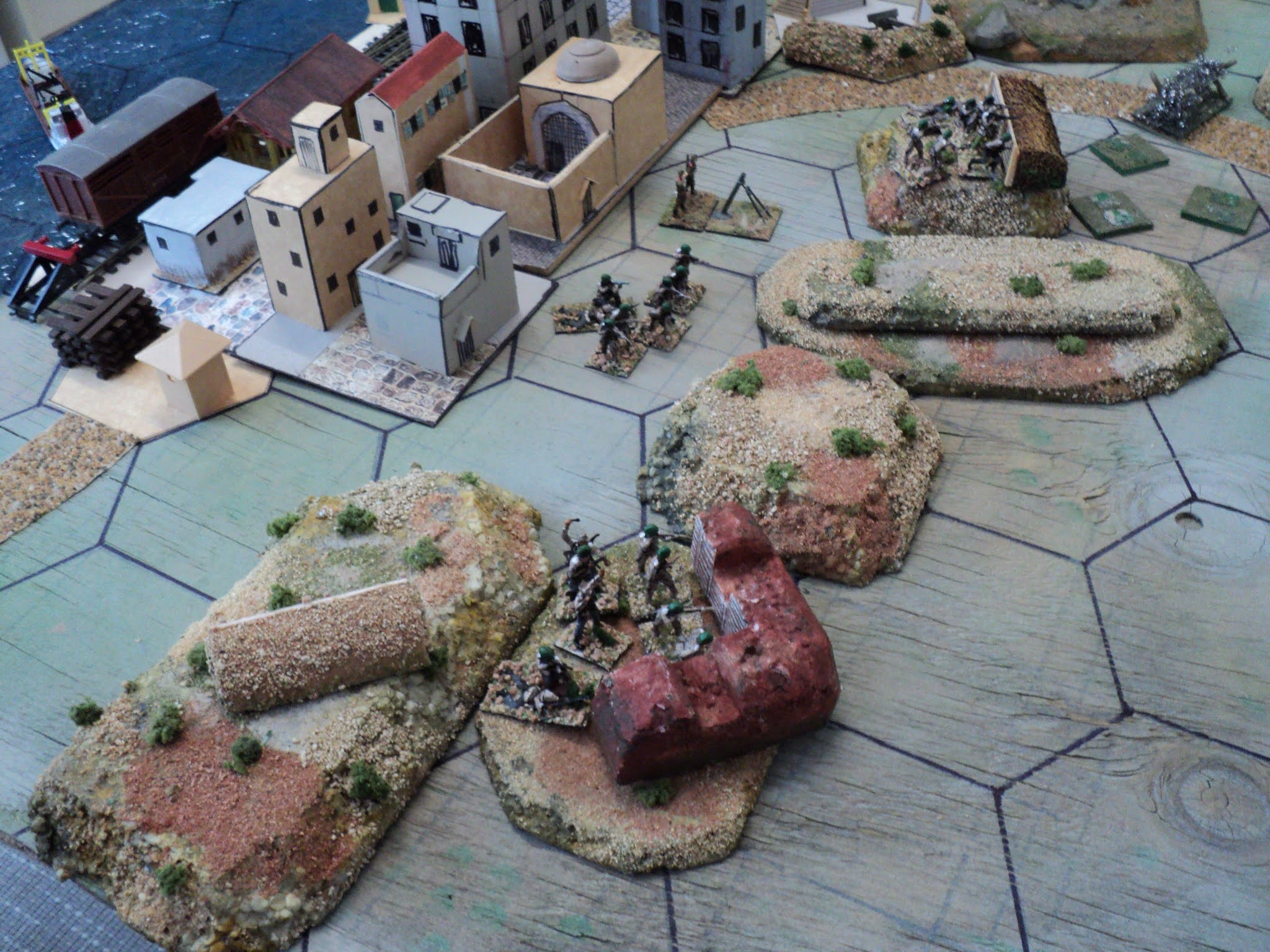
 At last driven back to the cradle of the BARFist Revolution, Colonel Peenut Buttahjars and his revolutionaries remained holed up in the regional capital, Madasaiwannabe, at the head of the Maimajikwand Valley. The months of battle that had taken him to the country's capital, Nawabisbad, and back again had depleted his revolution of personnel, equipment and enthusiasm.  A certain amount of fortification work was completed before the scouting screen espied distant clouds of dust - 'no bigger than a man's hand' - far to the west.  They were approaching fast.


At last, I finally got around to a closing-off episode in a major chapter of the History of the Nawabate of Tchagai.  Would it be a final stand? Might it yet lead to a resurgence? For the earlier narratives of the 'Long Live the Revolution' campaign, I commend you to the labels on the right. Once this is finished, I will be posting a 'Table of Contents' post for this campaign. Then one can read it as a continuous yarn. For now, here are links to 
... the previous chapter, and 
... the beginning of the campaign.

As the first battle in the campaign was fought on a square grid rather than the hexes for the other battles, I went back to the squares. Although the field is not as large as the hex board, I still went with my adaptation of the Portable Wargame method of allocating Strength Points for the respective forces; that is to say, increasing the base number and dice rolls by 50%. 

The Revolutionaries, defending, got 18 + 3D6 SP.  The roll was average: 11, so the BARF forces amounted to 29SP.
The Government, attacking, got 18 + 6D6.  Again, a fairly average roll: 21.  So they got 39SP. 

During the course of the campaign, I allowed the defenders half the difference in SP for defence works.  These amounted to 5 stretches of field works @ 1SP each. Two were placed each side of the town, somewhat refused from the west face of the built up area. The last extended the front of the town's face to the right.  Behind this last earthwork and the one on the ridge to the south, stood a company of infantry. The remainder protected a fixed anti-tank gun company either side of the town, and the Rebels' sole support unit of mortars. A third infantry company garrisoned the town, along with the machine guns. The Colonel's HQ was also within the town's precincts.


The Forces were:

Revolutionaries (defending):
Commander: Col Peenut Buttahjars, plus staff, stalwarts and stooges, and HQ truck = 6SP
3 (understrength) Infantry Companies (Nrr 1,2,3) @ 3SP = 9SP
1 MG Company = 2SP
1 Mortar Company = 2SP
3 (understrength) Light Armoured Squadrons @2SP = 6SP
1 6pr (medium) AT Gun battery = 2SP
1 2pr (light) AT Gun battery = 2SP
All units count as 'Average'. 

Totals:
11 Units, activate 5,6,7 depending on die roll
29SP, Exhaustion Point -10 (Rout Point - 15); 5SP of field works added.


Government (attacking):
Lt-Colonel E. Mugglethwaite, plus staff and scout car = 6SP
3 (understrength) Companies of the 18th Siliputti Regiment @3SP = 9SP
1 MG Platoon of 18th Siliputti Rgt = 2SP
3 (understrength) Companies of the 17th Choklit Ghandi Regiment @3SP = 9SP
1 MG Platoon of 17th Choklit Ghandi Rgt = 2SP
3 Sherman medium tank Squadrons (A, C, D) of 6th Bananarahmaputra Hussars @3SP = 9SP
2 x 25pr Field batteries @2SP = 4SP


Totals: 
14 Units (counting an artillery unit and its tow as a single unit, something I ought not to have done).
Activate 6,7, or 8 units, depending on die roll.
39SP, Exhaustion Point -13SP (Rout Point -20) 


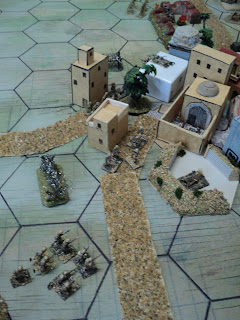
Colonel Mugglethwaite's plan was more a right hook than a double envelopment. The Siliputti Regiment, accompanied by the Bananarahmaputra Hussars' armour, was to storm the ridge south of the town, then exploit on into the rear of the place. A secondary left hook, supported by the artillery, was charged with seizing the heights flanking the rebel position, then take the enemy in flank. This 'left hook' was to be carried out by 'C' Company of Choklit Ghandi Rifles. The other two rifle companies and the machine guns would bring on a fire action against the main enemy front.


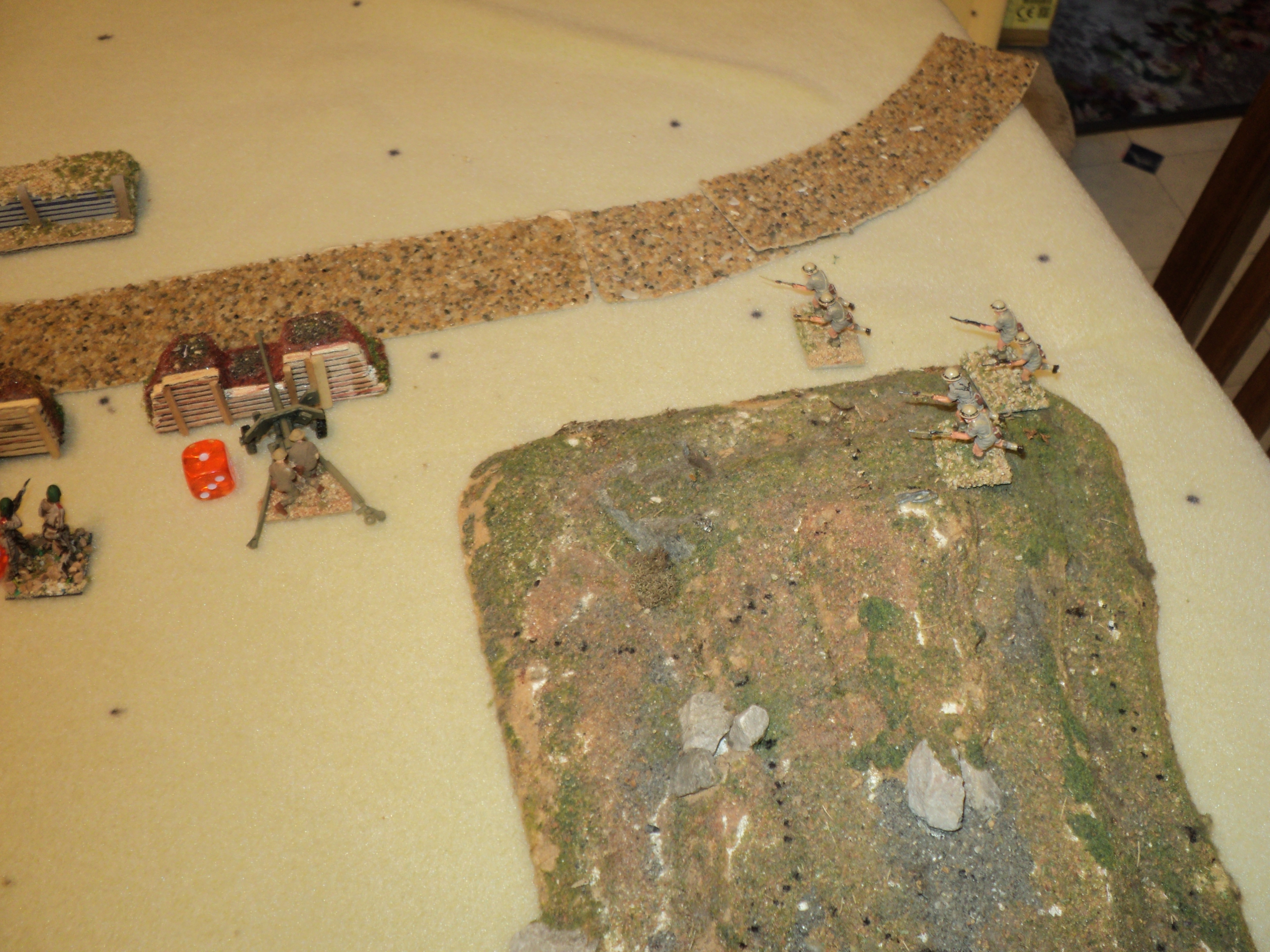
The Government artillery scored an early success, bringing accurate fire upon the trenches occupied by the rebel Nr 1 Company and causing several casualties (1SP = 1 stand). At the same time, 'C' Company Choklit Ghandi followed the road to bring the 6-pounder anti-tank position under fire. The guns having no transports - a chronic lack for the Revolutionaries - could defend themselves only with the small arms available to the crews for self defence. This minor attack was off to a flying start.


Much was expected of the main attack on the Government Forces' right wing. The Siliputti infantry, 'A' and 'C' Companies 'up' with the machine guns, and 'B' in immediate support, pushed towards the defended heights whereon the rebel Nr 3 Company was entrenched. To the left of Siliputti advanced the armour, 'A'and 'D' squadrons leading; 'C' squadron in close support. Facing them, the light, 2-pounder guns waited behind entrenchments, and Nr 2 Infantry watched from their corner of the town.

Now, Col Peenutbuttahjars had retained his armour directly behind the town, whence it could intervene wherever a major threat developed. Seeing how the assault was shaping, the Colonel at once ordered his armour to counter the enemy moves against his left flank. The campaign so far had worn down the armour of both sides, but the Rebels' had been harder to replace. They were reduced to just three weak squadrons (2SP apiece), totally perhaps half the size of a regular regiment. But the Government armour was lacking one squadron, they at least were more or less up to strength (3SP). Even so, the Government were to find that the boldly handled light tanks, which had continually outfought their opponents during the whole campaign, were not to go down easy.

Just as the Stuarts drove up, the rifles on the hill sharply repulsed the Siliputti attack just as it got fairly within range. The machine gun company was shot up and A Company reduced to about platoon strength (1SP remaining).  Overall, Siliputti had lost 5SP for no loss to the enemy. Not auspicious for the Government forces.  

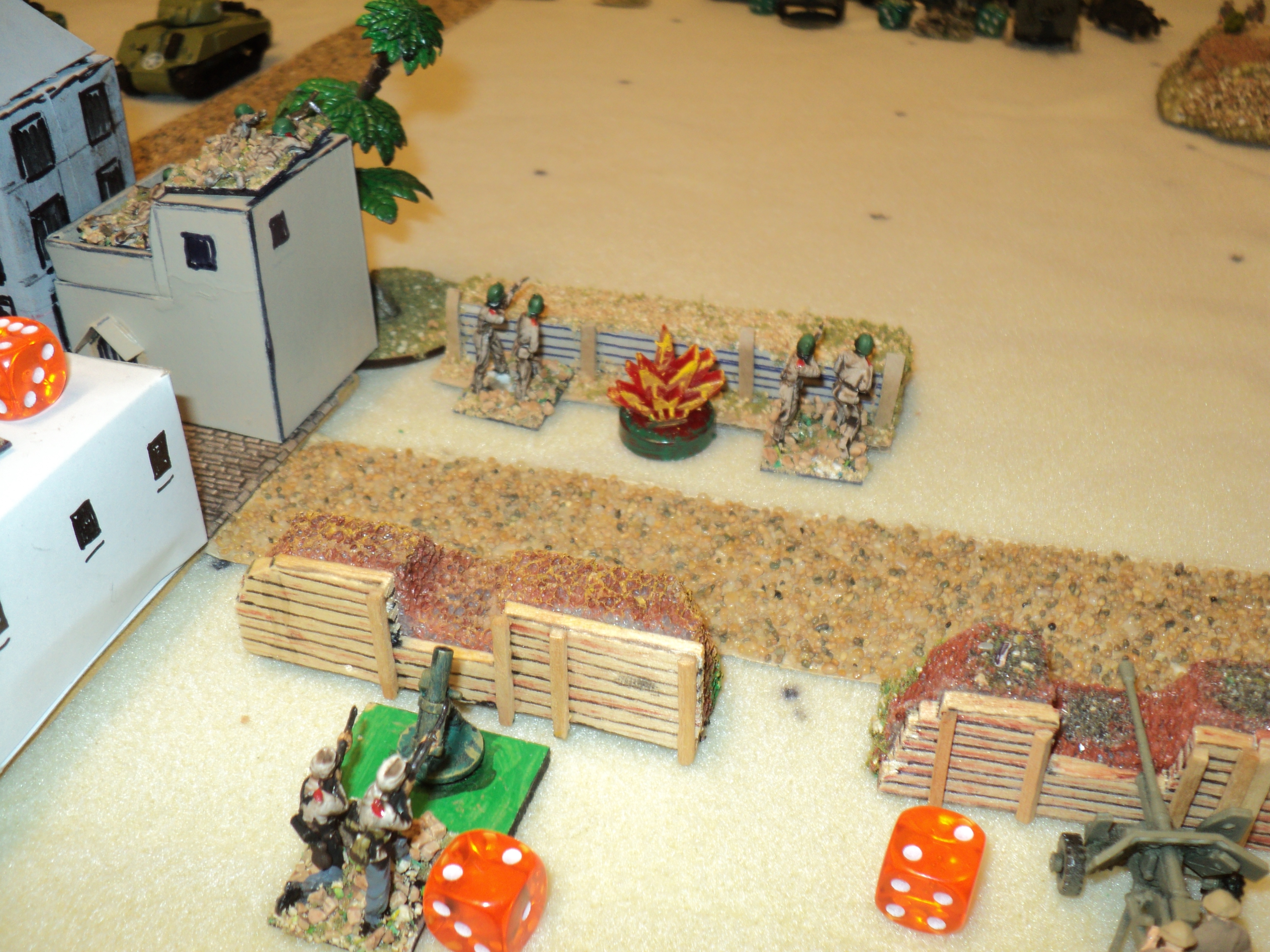
They were enjoying more success on their left. Mounting the high ground, C Company Choklit Ghandi brought the anti-tank gun position under close assault. The fighting was brisk and short. Half the gun crew was brought low, but their staunch defence threw back the Government infantry. The dice tell the story. Both rolled '6' on the 'to hit' dice, then rolled high on the effect. The guns being fixed had to take the SP loss (reducing it to the '1' shown in the pictures); I elected to pull the Government infantry back up the hill to bring the remaining guns under fire.


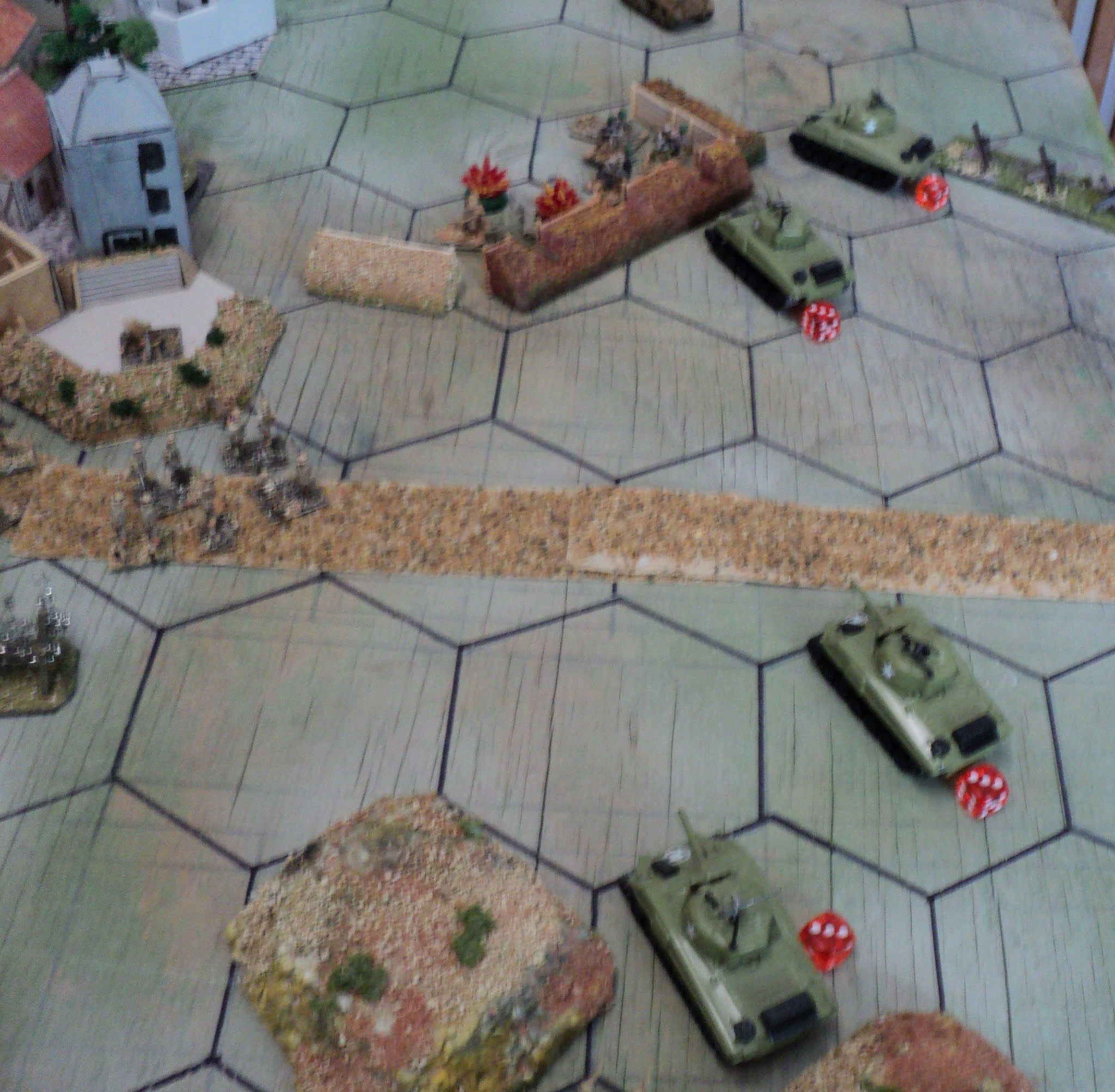
The situation on the south wing remained unpromising for government. Standing off to shoot up the 2-pounder anti-tank position, rather encouraged the rebel armour to advance. Meanwhile, the infantry had almost all been driven back almost behind the hill that formed their start line.


Forward came the Stuart light tanks of the Revolution - hastening to bring the enemy armour within range of their pop-gun 37mm cannon. The name of the commander of the light tanks has been lost to history, but would otherwise shone brightly this day. Outnumbered (3 to 2) and outgunned, the lights were, once more, not outfought. Almost at once 'A' Squadron found itself short two or three Shermans (1SP), burning or immobilised. The day was going badly, it seemed.


Not that the Government armour was too discouraged. Although never having established the expected ascendancy over the rebel tanks, they had at least kept themselves in the fight. They were rarely defeated outright.


The 2-pounders finally being knocked out, scene was set for the final showdown between the contending armour. Under cover of this fight, what was left of the Siliputti battalion once more tried the defence upon the heights facing them. 


The company-sized 'left hook' having been stalled, A and B companies of Choklit Ghandi were slowly closing in on the west face of the town. All day, the field guns had played upon defences on this end of the rebel position. The 6-pounders and mortar positions ground down, the former fieldworks were taken over by the rebel Nr 1 Rifle Company, itself badly depleted. The rebel machine gunners reoccupied the position formerly held by the rifles, and brought the Government C Company under fire. For all the losses the government forces had taken, the pressure was becoming intolerable. Nr 2 Company in the town had taken fearful losses from machine gun and artillery fire, its scant survivors falling back from the west face of the town.  But a few sharp words from Colonel Buttahjars was enough to drive them back again. Eventually the colonel himself would join the front line, determined upon, if the need arose, a final stand.


Both sides were running out of resources.  Under cover from the light armour counter-attack, Nr 3 Rifle Company abandoned their hilltop position, and made their best speed across to reinforce the town's garrison before the Government troops could force their way in. The effort cost the light armour several tanks - Nr 2 Squadron being effectively destroyed (both SP lost). The Revolutionary Colonel was determined, if the wings should be driven in, the hard core of his final stand would be the town itself. Let the Government dash itself to pieces upon that!


That Lt-Col Mugglethwaite declined to do. His small brigade group had almost exhausted itself, losses heavy amongst his infantry. But the Revolutionaries were in worse shape. No counter-attack was possible with what remained in hand, and the Government retained one weapon against which he had no counter: the field guns. 

It so happened that Government losses had slightly exceeded the BARFists' - 12SP to 10, but it was the latter army that reached its exhaustion point. Had the Government pressed its attacks, no doubt that one remaining SP loss to reach their own would have brought the battle to a halt anyhow.


The battle might be over, and the Revolutionaries remain undefeated in battle, the reality stared the Colonel and his commanders and staffs in the face:  the war itself was finished. The last stronghold gone, there was no longer any rallying point. The writing had been on the wall all those months ago when the BARFists had dashed themselves to pieces at Nawabisbad. After a council of war in a dimly lighted cellar in the middle of the town, the hard-core BARFist Revolutionaries slipped out of the town, and, trudging up the main road, disappeared among the hills at the head of the Maimajikwand Valley. Colonel Peenut Buttahjars had at least escaped Government retribution. 

The sun was well above the eastern horizon when Lieutenant-Colonel Ebeneser Mugglethwaite was made aware of the disappearance of the BARFist revolutionaries. He lost little time reoccupying the former rebel stronghold, and, with a few judicious arrests, restoring Government control. 

Of course, the Nawab Maibiwih Khan expressed his undiluted joy at the news. His seat as the nominal head of state of at least his portion of the Ruberian Raj remained secure, and kept him well placed once the Jewel in the Imperial Diadem had slipped from Imperial fingers. He could never be sure that the good Colonel Buttahjars and his Revolutionaries would have appreciated the political tightrope he had been walking all these years. No, it was well that the revolution had failed. The Nawab knew how to play the long game...

To follow: a post 'Table of Contents'.

Tuesday, October 19, 2021

Die Hard the Revolution

Government forces (18th Battalion) advancing on the left 
(northern) flank and ('D' and 'C'/17th up the road.
At last we draw near a turning point, or possibly the conclusion of the campaign in Tchagai, a revolt against the Nawab, and against the ruling Ruberian imperialism. This posting follows on from the second Battle of Khandibar, a decisive victory by the government forces that deprived the BARFist Revolution of its only seaport, and the vital Izumrud-Zeleniyan military equipment that they hoped to import. For the background story, please refer to the following: Long Live the Revolution: The War Against the Raj, and following posts.  

(Eventually I will post the Table of Contents in a panel beside this main column)
Machine gun platoon, anti-tank gun and
mortar positions - north flank.
If the defeat at Nawabisbad - just when the Revolution seemed on the brink of successfully taking over the country - was a source of exasperation for the Baluchistan Armed Revolutionary Front (BARF), the subsequent loss of the vital rail junction at Maibad, and the sea port of Khandibar proved depressing to the martial enthusiasm of their movement. Their ardour for freedom and change dampened, the scale of recruitment was diminishing as fast as the rates of desertion were growing. Colonel Peenut Buttahjars ordered a retreat to Maimajikwand, the capital of the provincial valley that was the cradle of Revolt.
'A' Company, 1st BARFist Volunteers.  'B' Coy
in the town
For his part, General Lord Redmond entrusted the hitherto unfortunate Lt-Col Mugglethwaite with the pursuit into the Maimajikwand Valley. Mugglethwaite had with him: 17th Choklit Ghandi and 18th Siliputti Infantry, 6th Bananarahmaputra Hussars (armoured regiment), and two batteries of 1st Tchagai Field Regiment. Reaching Maimajikwand a few days ahead of the pursuing forces, the BARFists turned at bay. Those few days' respite allowed time to prepare defences against the attack to come.
Rebel centre covered by barbed wire

This action, as for the whole 'Long Live the Revolution' campaign, was fought using Bob Cordery's Developing the Portable Wargame rule set, and the conventions, modified to 'fit' my 'hex' table, of his mini-campaign example of the same name. One of those conventions involved rolling for each force's Strength Points (SP), adding the dice score to a basic minimum. As my table is rather larger than Bob's standard one, I added 50% to the starting minima and added dice rolls with the results you will now see.
 
Rebel southern wing. The minefield and anti-tank
obstacles will force any eenemy right up against
the end of the BARFist line.
Revolutionaries, Defending:
Number of SPs: (16+2D6) + 50% = 24 + 3D6 = 24 + 11 (OK roll - about average) = 35SP 

Government, Attacking:
Number of SPs: (20+4D6) + 50% = 30 + 6D6 = 30 + 30 (what a roll!!) = 60SP(!)

That was a huge roll for the Government, and I think the first time anything of the sort happened so far in this whole affair.  As had become my habit in this campaign, I permitted the defending side half the difference in SPs 'worth' of defence works: field works and barbed wire to cover one hex at 1SP each, and minefields and fortifications at 2SP.  
A very effective salvo from the Government artillery!

Baluchistan (Brotherhood) Armed Revolutionary Front:
Commander: Col Buttahjars, staffs etc = 6SP
1st 'Volunteers of the Revolution' Brigade 
     4 Rifle Companies @ 4SP

     2 MG Platoons @ 2SP
     1 Mortar Platoon @ 2SP = 22SP
'Tulwars of the Revolution' Armoured Group
     1 Squadron Light Tanks (1xM3 Stuart) = 3SP
Fixed Anti-tank gun positions:
     1 6pr medium AT gun troop = 2SP

     1 2pr light AT gun troop = 2SP

Totals:
11 units, activation mean = 6
35 SP, exhaustion point = -12SP

This garrison was augmented by 4 stretches of barbed wire covering the approaches to the town from the west, 5 field works extending north and south outwards from the town, one fortified machinegun post, and a set of mined antitank obstacles far out from the south flank placed to draw any enemy trying to skirt around the place closer to the entrenchments.
... and the end of the BARFist 'C' Company, its 
remaining strength destroyed


Rajistan Government:

Commander: Lieutenant-Colonel E. Mugglethwaite = 6SP
17th Choklit Ghandhi Infantry 
     4 Rifle Companies (A-D) @ 4SP
     HQ Company, 1 Vickers Machine Gun @ 2SP = 18SP
18th Siliputti Infantry
     4 Rifle Companies (A-D) @ 4SP
     HQ Company, 1 x 3-inch Mortar (2SP) plus carrier (2SP) = 20SP
6th Bananarahmaputra Hussars 
     4 Squadrons (A-D) Sherman medium tanks @3SP = 12SP
1st Tchagai Artillery Regiment 
     2 Batteries, 25pr field guns @ 2SP = 4SP

Totals:
17 Units, activation mean = 9
60SP; exhaustion point = -20SP
18th Battalion taking a while to move up ...
Already the pictures will have conveyed something of the narrative. Mugglethwaite massed his armour on his extreme right (the southern flank), with the intention of sweeping around or over the field works there, into the rear of the town. The tanks were to be supported and joined by A, B, and HQ Companies of 17th Battalion. The remaining two rifle companies were to approach the town directly up the road, clear way some of the wire, then storm the eastern suburbs. For this attack, they were given the immediate support of the 25pr artillery.
'D' and 'C'/17th Bn about to clear away the wire...

This left the whole of 18th Battalion to attack the entrenchments north of the town.  

Though action developed rather more swiftly on the southern flank. the first contacts came in the centre.  There the town's precincts formed a salient - a species of bastion against attack - covered by barbed wire entanglements. As the 25pr artillery bombarded the defenders of this section of the line - 'C' Company of 1st Volunteers, 'C' and 'D' companies of 17th Choklit Ghandhi Battalion drew up to the wire.  they might have found the clearing of the wire difficult under fire, but the artillery support proved overwhelmingly effective (see the 'double sixes' in the pic earlier). The pounding proved too much, and the whole defending company dissolved and vanished from the line. 'C' Company was able to clear the wire unimpeded, and 'D' Company had to endure only a minor nuisance.

The wire cleared, they were able to penetrate the western suburbs where 'D' Company made contact with the rebel 'B' Company, and 'C' was able to bring under fire the rebel machine gun nest in the southwestern corner.

'D' and 'C' having cleared the wire find little 
to oppose their entry into the town

On the southern flank, the entrenched defenders came under fire from the machine guns of the whole of the 6th Armoured Regiment. The infantry - 'A' and 'B' Companies and the machineguns of 'HQ' company  - were rather slower moving up. A long-distance tank and anti-tank duel opened up, with the sole rebel tank squadron engaging the heavier Shermans with their popgun 37mms.  As the more dangeous weapon, the Shermans were inclined to concentrate their fire upon the 6pr AT guns, which, without the means to withdraw, were eventually destroyed.
6th Armoured rolling forward...

... and running up against strong defences.
With the focus of action in the south, the assault on the northern front developed in a more piecemeal fashion. After its success against the town's defenders, the artillery joined 18th Battalion's mortar fire against the entrenched position of 'A' Company 1st BARF Volunteers. Under cover of this barrage, 'D' Company of the 18th brought the enemy position - its defenders already somewhat depleted - under a close assault. 
Under cover of mortar fire 'D'/18th attempt s to
storm the BARFist entrenchments

'B'/17th moving up to aid 'C' Coy.
The close assault by 'C' Company against the fortified rebel machine guns allowed 'B' Company to come up and join the action, bypassing the remaining barbed wire. Meanwhile, the gunnery duel was going rather the Government's way, despite the rebel entrenchments. 
Tank vs anti-tank... At the moment the 
Rebel light tanks don't have the range!
The light tanks driven from the line, and the anti-tank guns overwhelmed, 'A' and 'B' squadrons tried to force the gap between the manned field works at the end of the rebel line, and the minefield a short distance south from it. This was precisely why Colonel Buttuhjars had ordered it placed there - to force the armour up close against his own 'D' Company. After all the early successes by the Government forces, they were to find what remained of the Revolution were not going to go out easy.
The 6pr guns overwhelmed, despite their protective 
fieldworks.
Just about all along the rebel line, now, the defenders were closely engaged: 'A' company - much reduced - under mortar fire as well as a close assault; 'B' Company in a duel with equal numbers in the town; the machine-gun nest under assault by two Government companies, and 'D' Company in a short-ranged duel with Government armour.  
Fighting at the edge of town.  Three companies 
of the Choklit Ghandhi Battalion held up

Could the Revolution yet hold out against such a seemingly overwhelming assault?

To be continued...


Saturday, April 24, 2021

Return to 'Long Live the Revolution'>

Readers may recall this series that were suspended after December 2019.  I never actually abandoned the thing, but I realised the Second Battle of Khandibar would take some setting up.  Serves me right for adding that complication to Bob Cordery's original concept.  

Here is a link to that last action: 'Return to the Station'

Following the successful recapture of the vital rail nexus at Maibad Station, something of a lull descended over the country, as both sides in the civil war (as it had become) felt the need to draw breath after such a whirlwind campaign so far. The government forces had just barely saved the Nawabate of Tchagai from the Revolution; following a tide of unbroken success, the Baluchistan Armed Revolutionary Front (BARF) were finding the ebb hard to arrest. Much hope they placed upon the arrival in the sea port of Khandibar of a consignment of weaponry from the Confederated Community of Cooperative Peoples (CCCP - KKKH in Cyrillic capitals), the arrival of which was not expected, after the Battle of Maibad Station, for several weeks yet.


18th Siliputti Rifles advancing to battle. In the distance,
22nd Punjanajoodi Infantry. Figures mostly Airfix
with some Matchbox.


As word of this anticipated weapons import gradually trickled through to the Nabob's intelligence network, it became clear that the Revolutionaries simply had to be deprived of the sole sea port in their possession. Major-General Lord Redmond at once led a powerful column south, entrusting the railway station's safety into the hands of the hitherto unfortunate Lt-Col Ebenezer Mugglethwaite, with the newly reconstituted 17th Choklit-Ghandi Battalion, two armoured squadrons and assorted support and LOC troops. Lord Redmond took with him (42 + 6D6 = 68SP):

Government Forces:
  • Lord redmond's staff, with Dingo scout car vehicles = 6SP
  • 18th Siliputti Rifles
    • 3 rifle companies @ 4SP
    • 1 machine gin platoon @ 2SP
    • 1 medium mortar platoon @ 2SP = 16SP
  • 22nd Punjanjoodi Infantry = 16SP
  • 31st Kashinkari Rifles = 16SP
  • 5th Aagravaa Dragoons
    • 2 squadrons, A and C, M4 Shermans @ 3SP = 6SP
  • Bty/ 1st Tchagai Artillery
    • 2 troops, 25pr field guns with Quad prime movers = 8SP
Totals:
20 Units, median = 10 (Average commander) 
68 Strength Points (good dice roll!), exhaustion point = -23SP


Meanwhile, a certain Major Sher Liwih Khann had been placed by the Revolutionary leadership in command of the BARFist garrison at Khandibar, with strict instructions to hold the place at all costs.  He was to await the arrival of the vital arms convoy already on its way from Archangelsk. This convoy was still days way, if not weeks, somewhere in the Mesogesean Sea, approaching Port Did, and the Sezu (or Taofik) Canal. He had to hand (30+3D6 = 43SP):


Revolutionary forces: 
  • Sher Liwik Khann, staff, hangers on, camp followers, assorted bandits and badmashes as well as genuine patriots, jeeps = 6SP
  • 6th BARFist Volunteers 
    • 3 Rifle Companies @ 4SP
    • 1 Mortar Platoon @2SP = 14SP
  • 7th Khandibar Volunteers 
    • 3 Rifle Companies @4SP
    • 1 Mortar Platoon @2SP = 14SP
  • A Sqn/ 2nd 'Tulwar of the Revolution' Armoured Regiment 
    • 1 M3 Stuart light tank =2SP
  • D Sqn/ 2nd 'Tulwar of the Revolution' Armoured
    • 1 M3 Grant Medium Tank (poor) =3SP
  • 2 fixed anti-tank posts with 6pr AT guns @2SP = 4SP 
Totals:
13 Units, median = 7 (Average commander)
43 Strength Points (another pretty good dice roll), exhaustion point = -15SP

The difference in SP being 25, the Revolutionaries received 13SP in augmentations to their defence, in the form of 2 minefields (@2SP), 3 barbed wire emplacements (@1SP), 4 field works (@1SP) and a fortification (2SP).


Now, before beginning the brief narrative - and in partial explanation why it is so brief - I should mention that, owing to a glitch in my note taking in preparation for this battle owing to an egregious staff error, the armour, detached eastwards along the coast for some reason, was not present on the battlefield as the Government attack began. By the time  I realised my mistake  the armour arrived, it was far too late to affect the outcome of the action. I could, of course, have let it go as though the Revolutionaries had rolled '8' on their 3 dice, instead of 13 - the probability of having done so, coincidentally enough, being precisely the same.

25pr field artillery in action...
The action opened with the rapid advance on foot of the 18th Siliputti and 22nd Punjanjoodi battalions sweeping forward, both with A and C Companies leading, supported by B Company and the mortars and machineguns of HQ Company.  The main immediate objective being the Central massif, C Coy Siliputti came in on the right of  Punjanjoodi, all supported by the 25-pounder gun battery, where Lord Redford had also parked his Brigade HQ, and the Punjanjoodi mortars and machine guns.  

... and on target!  A Coy, 7th Khandibar Volunteers
taking some stick...
The support from the machine guns didn't last long.  The Rebel mortars quickly found their range, and wiped them out in short order, but the attack carried on unabated.  
... and receiving the close attention of C Coy, 18th
Rifles and A Coy, 22nd Infantry...
The two company attack overran the fieldworks on the Massif, and drove the defenders quite off the feature and into plain in front of the town.
Central Massif overrun, Government troops attack 
Revolutionary positions beyond.

Meanwhile, to the west of the central Massif, two companies of Siliputti Infantry stormed the ridge on the other side of the pass.  The pass itself being mined and barbed wired, the approach was somewhat constricted (1 hex only), forcing the attack on a single company frontage.  The first attack was easily repulsed, but when it could be supported by the battalion's mortars, and machine guns from beyond the wire to the left flank, A Coy finally carried the high ground..  B Coy soon joined them there to consolidate the position, before pressing on into the coastal plain. 
The early attack on the western ridge repulsed, A 
and B Coys of 18th Rifles at last capture the heights...

Already the western half of the Revolutionary 
forward defences have been overrun or driven in.
The general picture was now the Rebels having lost the position upon the high ground along the entire left half of their front. So far they had had few opportunities of bringing up supports or to mount a counter-attack. For their part, the 31st Kashinkari Rifles hadn't passed beyond the wadi - then in spate from an overnight deluge. However, the two Sherman squadrons coming up the Maimajikwand road, though hardly engaged, tended to discourage 6th BARFist Volunteers on the right from offering much aid to their colleagues under close assault on the other flank.
The fortification that was home to a 6pr troop
has new occupiers...
A company of Government infantry forced the evacuation of the fortification covering the Maimajikwand pass from close by the town. The Rebels managed to extricate the guns, but then came under fire from the lost redoubt.  The reserve company from BARFist volunteers counter-attacked from the town, but were unable to make progress. Instead, they themselves were driven back into the place.
The belated arrival of Revolutionary armour 
is too late to retrieve their fortunes.
Already it was plain that the sea port could not be saved for the Revolution. Although somewhat depleted, the Siliputti Rifles overran the fieldworks that were home to a fixed troop of 6-pounder anti-tank guns, and pressing into the built up precincts along the coast. To the east, the revolutionary armour arrived too late, and too distant from the decisive sectors to change the course of the battle. A brief exchange as the Government Shermans nosed their way over the less steep slopes and crests of the coastal range led to the loss of a few tanks on both sides.
Revolutionary forces driven right back into the town.
Though facing sturdy and steady resistance, the victorious Government infantry began forcing their way into the town, clearing the railway station and  pushing on to the wharfs along the waterfront. Having reached that point, of a sudden, Revolutionary resistance slackened appreciably, as the local commander ordered the remnants of the garrison to pull out along the east coast road.  
Government attacks continue unabated.  The Rebels
fought gamely until the Government forces reached the 
waterfront docks, whereat the defenders melted 
away into the desert eastwards.  

The sea port captured, Lord Redmond lost no time in installing a garrison organised around 22nd Punjanjoodi Battalion, and set off with the rest of the Brigade, post haste, to rejoin the troops about Maibad Station, thence to resume the advance to Maimajikwand, the capital of the province - the vipers' nest as far as Lord Redmond was concerned - in which the Revolution began.