Showing posts with label 19th Century. Show all posts

Tuesday, August 13, 2024

Insurrection: The Gatonegro War of Independence


I discover that it was six years ago (!) that I began what was to be a 'campaign of battles' - a war of independence set somewhere in Latin America. Somehow, I became distracted, and never got back to the battles.  This, despite doing a fairish bit of on-line searching out the campaigns and battles of the real wars of Independence. 


Well, a couple of weeks ago, I played out what was based (supposedly) on the Battle of Maipu, April, 1818, between the Royalist Army and the insurrectionists styling themselves as 'Patriots'. This was the decisive action of the Chilean campaign of that year. As it turned out, 'Maipu' this Gatonegro battle was not, as the narrative of events will reveal.

After the early success at Arabispo, the insurrection caught popular fire, and the Reine de Oro had a serious rebellion on its hands.


Seeking to break the centre of the rebellion, the Royalists gathered what strength it could to confront the growing menace. For their part, the self-styled Patriots found recruits flocking to the nascent colours. When the clash came as the Royalist Army marched upon Maipu del Guano, they were to find themselves considerably outnumbered. Confident in the superior training of his army, General Mariano Osario drew up his force along a line centred upon rising ground close by Casa de la Espagne, a hamlet set among cherry orchards.

The Royalist Army comprised:
Commander: General Mariano Osario

1st Brigade: Colonel Ordonez
    Regiment Concepcion ... 28 figures
    Regiment Infante Don Carlos ... 28 figures
    Coy Sappers ... 7 figures
    Dragoons Ordonez ... 9 figures (under strength)
    Artillery ... 3 figures, 1 cannon
        Brigade totals: 63 foot, 9 horse, 3 artillery = 75 figures

2nd Brigade: Colonel Morta
    Regiment Arequipa ... 28 figures
    Regiment Burgos ... 28 figures
    Lancers Morta ... 9 figures (under strength)
    Artillery ... 3 figures, 1 cannon
        Brigade totals: 56 foot, 9 horse, 3 artillery = 68 figures

3rd Brigade: Colonel de Riviero
    Converged light and grenadier companies ... 28 figures
    Artillery ... 3 figures, 1 cannon
        Brigade totals: 28 foot, 3 gunners = 31 figures

Army totals: 147 foot, 18 horse, 9 artillery = 174 figures, 3 cannon

Marching to meet them, the Patriot Army comprised:
Commander: General Jose de San Martino

Division Las Heras:
    3 Regiments @ 19 figures = 57 figures
    Mounted grenadiers ... 12 figures
    Artillery ... 4 figures, 1 cannon
        Division totals: 57 foot, 12 horse, 4 artillery = 63 figures

Division Alvarez: 
    3 Regiments @ 19 figures = 57 figures
    Caballeros de los Andes horse ... 12 figures
    Artillery ... 4 figures, 1 cannon
        Division totals: 57 foot, 12 horse, 4 artillery = 63 figures

Division Quintana (Patricio Hernandez O'Hogg commanding):
    3 regiments @ 19 figures
    Escort Cavalry ... 6 figures
    Husares de la Muerte ... 6 figures 
    Artillery ... 6 figures, 2 cannon
        Division totals: 57 foot, 12 horse, 6 artillery = 65 figures

Army totals: 171 foot, 36 horse, 14 artillery = 221 figures, 4 cannon

A couple of points here:
1. My original order of battle had four Divisions, each with just two infantry regiments. A 'Reinforcement Division' under Bernardo O'Higgins would have been the fourth formation. I have no recollection as to why I changed it!

2. The considerable disparity in numbers I thought would be offset by the superior training and morale of the Royalist regulars. We'll see how that turned out.    
Regiment Concepcion's first volley.
Woeful: the pips scores count only on rolls of 4 or less... 

. 

Prospects to begin with seemed unpromising for the Royalists, drawn up in a single line with, apart from the insignificant sapper company, not a single reserve. By contrast, the Patriots began advancing with two of their Divisions, Las Heras on the left and Alvarez on the right. As the leading Divisions engaged the flanks, O'Hogg's Reserve marched onto the field, straight towards the centre of the Royalist line. 

Just about the first Royalist unit to give fire, Regiment Concepcion, let fly a woeful volley. Where it went no one knew - certainly not the intended target. Under my own combat system, at this moment, the 'Die Range' for shooting was 4 - that is to say, the pips scores counted only for dice rolls of 4 or less.  This is precisely the same as subtracting 2 from the raw pip score, but without the actual subtraction. The unit could reasonably have expected to score 6 or 7 hits (modified by my 'normalising' system, which would have yielded 4 or 5 casualties). 

This was more than matched by the Regiment Infante Don Carlos, whose valley shredded the 1st Regiment of Las Heras Division. Perhaps the powder had been left too long in the breech, and damp reduced the effectiveness of the first volley. 

At any rate, as the action became general along the front, Royalist fire became much more accurate and effective.  The Patriot columns came on, to form lines of battle to engage in a protracted firefight all along the front. And they were getting the worst of it.
Outnumbered, the Royalist Dragoons put the 
Patriot horse to the rout!

Hoping to sweep aside the dragoons guarding the Royalist right flank, Las Heras's mounted grenadiers were brought up on the extreme patriot left. The royalist horse didn't hesitate. Though outnumbered 4 to 3 (which actually made the combat equal given Royalist training) the Royalists gave rather better than they got, inflicted 5 casualties for 2, and sent the Patriot horse packing.
The height of the Patriot attack: all along the line.
So far losses have not been too serious...


The Patriots seemed to be doing better on the other flank. The Caballeros de los Andes horse braved Royalist gunfire to ride over the de Riviero's guns. Incoming musketry also caused Regiment Burgos to fall back a short distance although they maintained their good order, and continued to face the enemy.

That was pretty much all the success, as it transpired, that the Patriot Army was to show this day.  Accurate Royalist musketry cut Patriot infantry to ribbons. De Riviero redeemed the loss of his guin battery with a devastating counter-attack onto the Patriot right flank. Soon, all over the field, routed patriot foot and horse could be seen making their way to the rear.
It's all to no avail. Apart from forcing back Regiment Burgos,
and overrunning a battery, the Patriot Army has hardly dented 
the Royalist line. Several Patriot units have broken and are
fleeing in rout.

There was no doubt about this result: a devastating Royalist victory.

Somehow, I think I got the balance totally wrong. Such a one-sided result simply wasn't supposed to happen! I rather think this battlefield will be revisited, but with the 4 division, 8 regiment ORBAT for the Patriots, and their soldiery having the battlefield experience, next time around, to match the Royalist firepower...


Wednesday, February 8, 2023

Kavkaz Campaign - A Turning of the Tide?


During the week long pause in Turcowaz moves, the Trebizond command had not altogether been idle. Having taken the town of Zugdidi, and placed himself between the two Izumrud-Zeleniyan columns, Bashir Ed Din Pasha had created a strategic situation very favourable to Turcowaz, but at the same time his command was vulnerably placed. Much might depend upon what Abdul Abulbul Ameer did next. For his part, though, he was none too willing to attack a corps similar in strength to his own and ensconced among a tangle of hill country beyond the Tekhuri river. His dilatoriness - at least, so said Bashir Ed Din afterwards - did much to compromise the whole campaign. 


In the night of 19-20th June, the moon just past full, Count Ignatieff stole a march upon Abdul Ameer, abandoned his camp fires still burning, and marched off to Zugdidi. The same day, the Guards Legion having debarked where the road north met the coast, joined the battered Coastal Column west of the town. General-Leytenant Kutizedoff at once ordered a reconnaissance. Making contact with Kutizedoff's command beyond the town, Ignatieff ordered a reconnaissance of his own a day later. The day after that, 22 June, the Zeleniyans commenced their attack.

Zugdidi Battle Map - from the 
topographical engineer Major I.M. Poteranskii

The broad outlines of the position and Izumrud-Zeleniya plan might be gathered from the opening pictures and Igor M. Poteranskii's sketch map. Two of the Turcowaz Divisions, with 3rd Regiment from 1st Division, had fortified the town against attack from east and west.  Two regiments of 1st Division, with the machine gun company, fortified a ridge position covering the vital road south.  They were supported by field gun battalion positioned close to the road. The cavalry not being suited to defence remained by the south road (it doesn't appear in many of the pictures, but would have served only to cover a retreat).  
West side of Zugdidi: the Zeleniyan Coastal 
Column approaches...
The defenders comprised:

Turcowaz Trebizond Command:
Commander: Bashir Ed Din Pasha = 6SP

1st Division:

HQ: 1SP
1st Rifle Regiment = 3SP
2nd Rifle Rgt =2SP
3rd Rifle Rgt = 3SP
Total 1st Division = 9SP
Turcowaz: 1st Division and MGs facing east
and the Kavkaz Column


2nd Division:
HQ: 1SP
4th Rifle Rgt = 3SP
5th Rifle Rgt = 3SP
6th Rifle Rgt = 3SP
Total 2nd Division: 10SP
Turcowaz: 3rd Division garrisoning Zugdidi;
2nd Division behind earthworks on the 
far side of the town.


3rd Division:
HQ: 1SP
7th Rifle Rgt = 3SP
8th Rifle Rgt = 4SP
9th Rifle Rgt = 3SP
Total 3rd Division: 11SP

19th Cavalry: 2SP

Artillery/ Support Group:
I,II/1st (Field) Regiment = 3SP (2 Battalions)
III,IV/2nd (Medium) Regiment = 4SP (2 Battalions)
IX Machine-gun Company = 2SP
Total Support group: 9SP


Train: 3 units @ 2SP = 6SP (for want of table space, the trains were left off the table, and their unit and SP counts not included in the totals)

Totals Trebizond command:
19 Units, activations: 9/10/11 
47SP, Exhaustion Point -16SP, Rout Point -24SP
Note: Turcowaz had 9SP worth of defence works; 1 fortified redoubt, and 7 other field works.
This brings the SP up to 56.


Kavkaz Column on its start lines...
The attack involved the whole of the Izumrud-Zeleniyan army.

Overall Command: General-Leytenant Kutizedoff
= 6SP
Coastal Column:

1st Division: 
detached to Kavkaz Column

3rd Division: 

HQ: = 1SP
9th Infantry = 2SP
10th Infantry = 3SP
11th Infantry = 2SP
12th Infantry = 3SP
Total 3rd Division: 11SP

Guards Legion:

HQ: Count Ivan Skavinski-Skavar = 1SP
1st Guards (elite) = 4SP
2nd Guards (elite) = 4SP
50th Circassian Rifles (poor) = 4SP
9th Uhlan Light Horse (average) = 3SP
Total Guards Legion: 16SP

Cavalry::
1st Hussars = 2SP
2nd Hussars = 1SP
3rd Hussars = 1SP
4th Hussars = 1SP
Total cavalry: 5SP


Matelot Brigade Group:
Marine Regiment = 4SP
Machine Gun Company = 1SP
Naval Artillery = 1SP
Total Matelot Brigade: 6SP

Artillery:
I, II/1st  Field Regiment @ 2SP = 4SP

Train: 5 units @2SP = 10SP (off table, omitted from Unit and SP count)
The Izumrud-Zeleniya Coastal Column.


Kavkaz Column: Count N.P. Ignatieff (3SP)
1st Division (attached from Coastal Column)
HQ: 1SP
1st Grenadiers (elite) = 3SP
2nd Grenadiers (elite) = 2SP
3rd Grenadiers (elite) = 3SP
4th Grenadiers (elite) = 2SP
Total 1st Division: 11SP
Izumrud-Zeleniya: Grenadiers and Cossacks
make ready to attack the fortified ridge line.


2nd Division:
HQ: 1SP
5th Infantry = 2SP
6th Infantry = 3SP
7th Infantry = 2SP
8th Infantry (disbanded)
Total 2nd Division: 8SP
The depleted 2nd Division threatens the 
east side of town, defended by 3rd Turcowaz 
Division


Cavalry:
5th Cossack = 3SP
6th Cossack = 2SP
7th Cossack = 2SP
8th Cossack = 2SP
Total Cavalry: 9SP

Artillery:
1st Mountain Artillery = 1SP
2nd Mountain Artillery = 2SP

Train:
4 Units @2SP = 8SP (off table; omitted from unit and SP count) 

Totals Izumrud-Zeleniya: 
36 Units, activations 17/18/19.
82SP, Exhaustion Point -28SP, Rout Point -41SP

Note that all units are 'average' unless otherwise stated.

Turcowaz: elements of 2nd and 3rd Divisions
supported by the medium artillery regiment.

This has the makings of a lengthy narrative so I thought I would leave the 'after action report' for the next Kavkaz Campaign posting.

To be continued...


Monday, January 30, 2023

Kavkaz Campaign - The Sea is No One's Friend

Ship's Log, I-ZNS Tsarina Elizaveta light cruiser.
Tuesday, 22 June 1875, about 40 kilometres off Poti coast. Course due south, cruising speed 10 knots, in company with TB flotilla, 3 vessels. Weather clear, light winds from NW, barometer high, but falling.

7 Bells of the Morning Watch, sighted smoke due west of our position.  Altered course eight points to starboard to investigate. Sighting proved to be TNS Hamidiye, protected cruiser.  Kapitan-Leytenant Aleksandr Markovitch Ramius ordered the attack, increasing speed to 18 knots. Czarina Elizaveta at the larboard end of the line, the TBs to starboard, echeloned forward.

1 Bell of Forenoon Watch:
Hamidiye alters course to due south, then after a short interval, resumes its easterly course to close the range on Czarina Elizaveta.

2 Bells of the Forenoon Watch: Range closing. Enemy vessel fires his first salvo... 

First sighting...


As this action was fought the same day as 'Third Zugdidi', but was over fairly shortly, I thought after all that I would post this account first.  Fact is, I played it out after the big battle. This particular action I played using Bob Cordery's 'original' pre-dreadnought naval rules. These offer a very quick action, the only 'paperwork' required being to count 'hits' on the respective vessels. I also used the vessel 'stats' as tabled in the Balkan League book, rather than my own list of stats.  I 'll make some comment about that at the end of this narrative. 

The Ships:

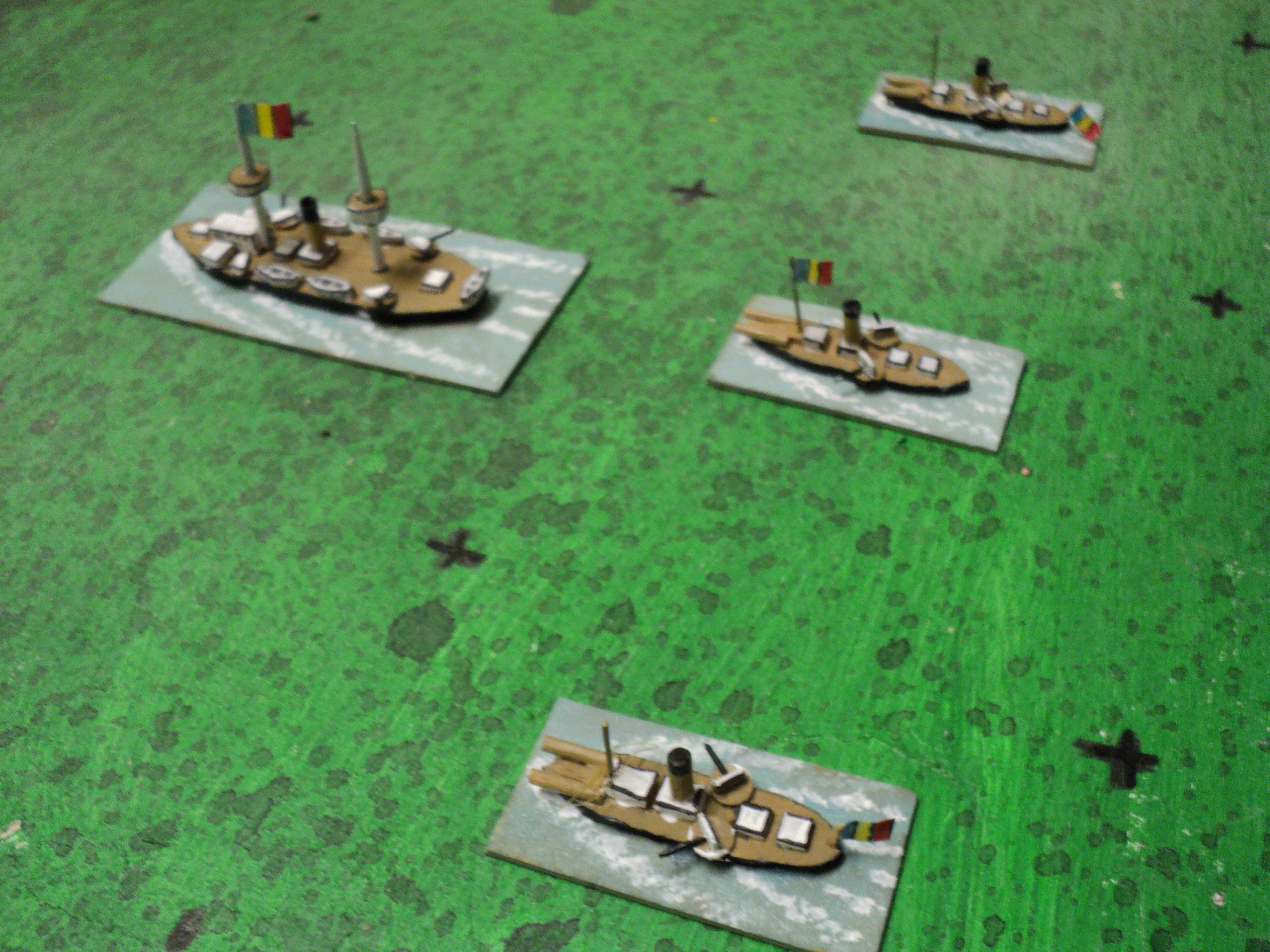
Protected cruiser Hamidiye.

Turcowaz:
Hamidiye, protected cruiser: 10FP,  Range/Dice - 4/5D6; Move 3.

Izumrud-Zeleniya flotilla, led by 
Tsarina Elizaveta.


Izumrud-Zeleniya:
Czarina Elizaveta, light cruiser: 8 Flotation Points (FP); Range/Dice - 3/4D6; Move - 3 squares.
TB1, Smeul, torpedo boat: 4FP; Range/Dice - 2/3D6; Move 4; 2 Torpedoes fixed bow.
TB2, Naluca, torpedo boat: 4FP; Range/Dice - 2/3D6; Move 4; 2 Torpedoes fixed bow.
TB3, Sborul, torpedo boat: 4FP; Range/Dice - 2/3D6; Move 4; 2 Torpedoes fixed bow.


Izumrud-Zeleniya form a concave 'cordon'.
With the respective sides on directly opposite courses, Czarina Elizaveta came within range of Hamidiye's main guns.  Fortunately, it required some time before Hamidiye got the range.
Adversaries on opposite courses...

Sharply altering course to larboard, Kapitan Ramius planned on crossing the enemy 'T' with his flagship, whilst the TBs came in upon the Hamidiye's beam. The plan was to use the torpedoes to best effect. Events didn't quite run as anticipated. Czarina Elizaveta crossed the enemy 'T' all right, but its pop-gun broadside failed to stop the latter's onset. Hamidiye slammed into Czarina Elizaveta's side.

'Ramming speed!'
The damage to Czarina Elizaveta, though severe, was as nothing compared with the following salvo from Hamidiye's forward primary and secondary guns. Badly damaged and in flames, Czarina Elizaveta turned to port, reversed its course, and staggered out of the battle.
After ramming, Hamidiye fires into 
Tsarina Elizaveta
So far, Hamidiye had taken little enough hurt, though the ramming had caused some hull damage. By now, though, the TBs, still considerably abaft Hamidiye's larboard beam, were now racing in. The cruiser could not hope to outrun the speedy small craft, but resolved to fight them off instead. Ship-Captain Hazik Nasan ordered the course reversed to due west. That might not have been the wisest decision.  

Perhaps this was occasioned by the incoming fire from the nearest torpedo boat,  TB3 - Sborul, which, the course having been altered to the south, had been placed in the lead of the line echeloned back from the larboard end. Her first salvo, at maximum range, not only found its target, but managed to put its shells where they could do maximum damage. At once Hamidiye was in real trouble.

Up until this point, Hamidiye had taken a hit from Czarina Elizaveta and lost a further flotation point (FP), self inflicted, from the ramming.  Reduced to 2 FPs, Czarina Elizaveta was forced to stagger out of the battle. But now Sborul, firing with 2 dice at extreme range (2 squares) rolled two sixes!  Four FPs at one blow! Hamidiye's return fire did some damage, but not enough.

As Hamidiye ploughed onward, TB3-Sborul came in under her stern whilst TB2-Naluca came in from abeam. TB1-Smeul was not yet quite where she could release its torpedo. Pressing in close, under a welter of incoming gunfire, the TBs soon launched a torpedo each. The torpedoes away, it was time, perhaps, to depart... if they could.

Czarina Elizaveta limps off, covered by TB attacks


Too late.  At short range, Hamidiye's gunfire was deadly and lethal.  TB2 and TB3, already both somewhat damaged, were last seen entering a maelstrom of exploding shells and water spouts. Neither emerged.

What of the torpedoes, then?  They were on their way, the range was short, nothing could stop them. That from TB3-Sborul struck under Hamidiye's stern, where it caused enough damage to have persuaded the cruiser to abandon the fight (3D6s yielded 1 point of damage).  The fatal blow came from TB2-Naluca.  The torpedo struck amidships, tore out a huge hole and tore into Hamidiye's vitals.  Three D6s yielded a 5 (-1 FP) and a 6! (-2FP). That was it.  Although it took long enough for the few survivors to be got off, Hamidiye at last slid beneath the waves to join the vessels she had killed and was killed by.
TNS Hamidiye's last moments...


You could call it a victory - and Izumrud-Zeleniya's Press Services certainly did - but it was a costly one.  Two torpedo boats sunk, and Czarina Elizaveta out of commission for months to come. But TNS Hamidiye had been the pride and joy of the Turcowaz navy - not for her size, but for the quality of its crew.

Some post-action comment.

There were a number of ways I could have played this. For one thing, this is the first action I played out on a square grid table instead of my hex grid. The other is that, contrary to my usual practice, I used Bob's technical stats instead of my own. To be sure, the Izumrud-Zeleniyan flotilla had a considerable measure of luck in this action - especially the 4FPs of damage right off TB3's first salvo of gunfire. That at once compromised Hamidiye's chances of survival.

Now, I haven't done any technical stats for the Izunrud-Zeleniya's vessels (actually 'Romanian'). But I rather think they would have been considerably less powerful than they were in this action. Looking up the 'historical' versions of these vessels, I find that Hamidiye was rather faster at top speed than any of it's opponents. The Turcowaz ship might well have been able to stand off out of their range, and shoot them to pieces. Methinks it would have gone hard for Izumrud-Zeleniya, had I chosen to use 'my' alternate stats and Hamidiye had found the convoy - especially had the troops still been aboard...

Aftermath.

The loss of Hamidiye put paid to Turcowaz naval operations in support of the Kavkaz campaign.  But their enemy hoped that something might yet be achieved with what remained of their flotilla. There was no question about Czarina Elizaveta's having to return to Sebastopol; the damage enough to compromise her seaworthiness. There remained, then, one merchant cruiser, Yevgeni Onegin,  and one torpedo boat.  

Not a lot to work with...

To be continued: Third Zugdidi.


Sunday, January 29, 2023

Kavkaz Campaign - The Turcowaz Complacent?


Third battle of Zugdidi. Izumrud-Zeleniya 
on their start lines.

Attentive readers of this campaign may recall the previous card driven move sequence that had terminated in a Joker being drawn (A Busy Week). A die roll (D6) indicated that the Special Event so signalled would apply to the Turcowaz.  What was the Special Event, then?  Another die roll (D6): a '1'.  Turcowaz were barred from moving for 4 turns of the cards.  This was pretty bad: two of the next four cards were red (Turcowaz), but it was what followed that really sent the ordure hurtling into the rotors. 

TNS Hamidiye


Observe:

16 June: Joker:  Turcowaz don't move for four turns of the cards; and the deck reshuffled.


16 June: J♦: ignore


17 June: 9♣: Having disembarked, the Landing Force (Guards Legion and Matelot Regiment) march towards Zugdidi.
Leaving the merchant cruiser Yevgeny Onegin  to guard the troop ships, the convoy escort continues due south to seek out a Turcowaz unit thought to in the offing. Henceforth called 'the flotilla', this force comprises Tsarina Elizaveta light cruiser and three torpedo boats, T1-3.


18 June:7♦: Ignore


19 June: 9♠: Under cover of lighted campfires, the Kavkaz column abandons Gakhomela position and marches to Zugdidi
Flotilla continues south patrol.
This ends the Special Event...


20 June: Q♣
: Landing Force marches toward Zugdidi, where it joins and becomes part of the Coastal Column. This formation carries out a reconnaissance of Zugdidi, preparatory to an attack to recover the place. The recce is moderately successful
Flotilla continues patrol south.


21 June: 7♠: Kavkaz column carries out reconnaissance of Zugdidi preparatory to attack from the east. The recce is moderately successful.
Flotilla encounters TNS Hamidiye some 30 nautical miles due west of Poti. They immediately pursue.


22 June K♣: At this point, though separated by the Zugdidi hex, it seemed reasonable to place the separate Izumrud-Zeleniya forces under one command. The combined forces begin their assault at daybreak.


Izumrud-Zeleniya Euxine Sea Flotilla:
I-ZNS Tsarina Elizaveta and torpedo boats.


Also 22 June:
At 2 Bells of the Forenoon Watch (0900 hours, the time was decided by die roll the hour after 6:00am.  2D6 - I rolled a 3) the opening salvos begin the sea battle of Poti... 


Saturday, January 28, 2023

Kavkaz Campaign - Disappointment at Gakhomela

Turcowaz camps laid out with 
field works
In the pause following the Izumrud-Zeleniya two-day retreat from Kutaisi, the Kavkaz Column and the Kars Command eyed each other across the small braided Tekhuri stream on the far side of which, nestled in a loop, lay the village of Gakhomela.  Successive reconnaissance operations by both sides proved only partially informative. But the week-long halt was partly owing to Count Ignatieff's concern for his vulnerable line of communications. 

To begin with, he could count on a line to Zugdidi, but the loss of that town loss left him with the road that skirted close to the right flank of the enemy immediately before him. Yet he dared not attack - not unless he was reinforced. That could come only from the Coastal Command of General-Leytenant M.M. Kutizedoff.  It was with remarkable promptitude that that commander sent the whole of his 1st Grenadier Division.  With it, Ignatieff undertook to push back Abdul Ameer - all the way back to Kutaisi, if possible. 

Izumrud-Zeleniyans on their start lines
The assault took some time to organise, not helped when news arrived during the night of 11-12 June that a Turcowaz assault had taken Zugdidi and forced Kutizedoff's command back up the coast road.  Now Ignatieff's corps was in a very parlous strategic position. However, for the moment the Turcowaz Trebizond Command seemed disinclined to move - it's own strategic position none too comfortable at that.
General view looking north

The country over which Ignatieff proposed to fight his 'Battle of Gakhomela' presented a stark contrast on either bank of the stream.  East of the river, where the Turcowaz  had laid out their camp, was low-lying and flat, dotted about with shallow meres and ponds.  West of the river was hill country, the more broken up as the road neared Zugdidi, two day's march away.  The forces available were respectively:
 

Izumrud-Zeleniya 

Kavkaz Corps HQ: General Ignatieff (Good)  6SP (Strength Points)

2nd Rifle Division:
    Div HQ: 1SP
    5th Rifle Rgt 2SP (Average) 
    6th, 7th Rifle Rgts @3SP (Average) = 6SP 
    8th Rifle Rgt (disbanded)
        Div Strength = 9SP

1st Grenadier Division (attached):
    Div HQ: 1SP
    1st, 2nd, 3rd Grenadier Rgt @3SP (Elite) = 9SP
    4th Grenadier Rgt 4SP (Elite)
        Div Strength = 14SP

2nd Light Cavalry Division:
    5th, 8th Lancers @ 2SP (Av) = 4SP
    6th, 7th Lancers @ 3SP (Av) = 6SP
        Div Strength = 10SP

2nd Mountain Artillery Regiment:
    I Battalion 1SP (Av)
    II Battalion 2SP (Av)

Trains:
    1st, 2nd, 5th Medium and 1st, 2nd Pack Transport @1SP = 5SP

Total Units: 21.  Median 11(+1 for 'Good' Commander);  Activate 11/12/13
Army Strength Points: 47SP, Exhaustion: -16, Rout: -24

Turcowaz

Kars command HQ: Abdul Abulbul Ameer (Average) 6SP 

4th Division:
 
    Div HQ: 1SP
    37th Infantry Regiment = 2SP (Poor)
    38th, 39th, 40th Infantry @ 3SP (Poor) = 9SP
        Div Strength = 12SP

5th Division:
    Div HQ: 1SP
    41st, 42nd, 43rd Infantry @ 3SP (Poor) = 9SP
    44th Infantry = 4SP (Poor)
        Div Strength = 14SP

6th Division: (off table)
    Div HQ: 1SP
    45th, 46th, 47th Infantry @ 2SP (Poor) = 6SP
    48th Infantry = 3SP (Poor)
        Div Strength = 10SP

X Machine Gun Unit = 1SP (Av)

Cavalry Brigade:
    22nd, 23rd Cavalry @2SP (Av) = 4SP

Artillery:
    V, VI Mountain Artillery @ 2SP (Av) = 4SP

Trains: 
    102, 103 Medium; 113, 114 Pack @1SP (Poor) = 4SP

Total Units: 25. Median 13; Activate 12/13/14
Army Strength Points: 55SP, Exhaustion: -19, Rout: -28

Contemporary sketch of the battlefield

Before continuing the narrative, I should mention that these events had largely been brought about by the card draws (see earlier posting). The battlefield itself was drawn from a Google Map area in roughly the right location in Georgia.  I ought perhaps to mention, though, that I got the road map hideously wrong.  Too bad: we're stuck with it now.  The above map shows Ignatieff's broad plan: 

Left: 3rd Division to take the water mill hamlet then push on to the field work beyond.  
Centre: 1st Division to cross via fords and the bridge towards the wood and field works north of the mere.  
Right: Cavalry, having crossed the southmost ford during the night, to engage the Turcowaz line south of the mere.

Turcowaz machine guns.

That he proposed to attack a force numerically stronger, Count Ignatieff was only too aware, not helped by the enemy making use of the week-long halt to lay out field works to protect his camp lines.  
Attack on the north flank.  The defenders outnumber 
their assailants.


The Third division's attack began well enough, carrying the water mill hamlet in short order and chasing the garrison back to the field works some distance beyond. Following up, the Division found itself attempting to storm fortifications against a numerically stronger enemy - not a good portent.

Cavalry attacking the southern flank 
earthworks
The cavalry on the other wing undertook to take out the fortifications there. Having crossed a footbridge overnight, they were prompt to the attack at dawn. Closing in on a line of fieldworks, the horsemen used their lances to good effect, but during the cut and thrust of bayonet and lance, they could discern heavy reinforcements coming up through the wood behind. The Turcowaz 6th Division had been camping some distance behind the visible tents (i.e. immediately off-table) and was harrying up to join the action.
High hopes were placed upon the 1st Division's thrust towards the Turcowaz centre. Almost immediately things started to go wrong Coming under direct gunfire as they splashed across the fords, their advance became disjointed, not helped by the early demise of General-Major Ya.Ya. Diebitch. Caught by a shellburst in the middle of the stream, Diebitch was killed outright.

(What was happening was the Grenadiers were receiving 'retreat' results, and I didn't want to be too generous about converting them to 'kills'. So all along their line the push became a series of two steps forward and one back - a real mess. Then almost the first time the fate of the General Officer Commanding 1st Division had to be determined, he rolled a 12 - immediately fatal.  Ya. Ya. stand for Yakov Yakovitch.) 
 
Attacks have become disjointed
 and piecemeal
This was not to say that the Izumrud-Zeleniya had nothing to show for their attacks. On both wings they were handing out a few licks as well as taking them. Considering the protection their targets enjoyed from their field works, the artillery support proved fairly effective, knocking out some of the enemy artillery and machine guns.
The Izumrud cavalry heavily overmatched for numbers.


All the same, by the time the Grenadiers were approaching the woods that, astride the highway, were their first objective, it was already plain that too much was being asked of the Kavkaz Column. General Ignatiev sounded the recall, the Green tide receded, and, apart from the water mill hamlet, the Zrleniyans fell back across the river.


There they awaited the Turcowaz attack, but that was not forthcoming. So ended an action that turned out to be little more than an affair of outposts.
Somewhat surprisingly, losses were fairly similar on both sides, and amounted to a few hundreds. In the following tot up of losses, the only difference was the Strength Point represented by the deceased General - 6SP lost to Turcowaz, 7SP to Izumrud-Zeleniya. As I classed the battle as more-or-less drawn, the rallying of stragglers yielded a net loss to both sides of 3SP.  Of course, a replacement had to be found to command 1st Division - Colonel S. Yu. Malenkin of 1st Regiment being assigned. 
1st Division straggling into the attack, their 
lines ragged from artillery and machine gun fire

This was one of those battles that, from time to time, I get the balance entirely wrong. I had hoped that the qualitative superiority of the Izumrud-Zeleniyan regulars over the Turcowaz rabble would answer for the latter's superior numbers. But then, considering that the armies had been facing each other in this locality for some time, it seemed reasonable to suppose that they would both have built up some protection for their encampments at the very least.  
The situation moments before 
Count Ignatieff sounded the recall.


Readers might recall from the last paragraphs of a couple of postings back that the campaign card draw sequence had ended after this action with a joker. The result affected the Turcowaz (diced for), and led (a die roll of '1') to its paralysis for four card draws (their colour being immaterial). The sequel will be detailed next time, but we'll hint at the possibilities here.

Following this action, the Turcowaz settled down to await the Izumrud-Zeleiyan retreat up the Fort Ghori road. However, that night, the light of the campfires in the hills above the Tekhuri Stream showed no sign of the enemy moving. It was not until well into the following morning that Abdul Ameer was advised that the enemy had stolen away. And it was not until later in the week that they heard distant heavy gunfire and he discovered where they had gone...

To be continued...

Postscript.
I will admit right here that I made a right mess of this battle. Carried out with brain, the attack might have been feasible, given the greater range of the Zeleniya rifles. The infantry could have stood off out of musketry range and subjected the defenders to unanswerable rifle fire. The defenders might have been induced to come out of their earthworks, with who knows what result? Never mind, sometimes these things come to try us.


Wednesday, October 26, 2022

Kavkaz Campaign - Battle of Khashuri


If Count Nikolai Pavlovitch Ignatiev was disconcerted to find a powerful enemy before him, he gave no indication of it to his subordinates, but confidently offered battle. However, he did order the hasty construction of field works - enough to cover his infantry and guns. Prompt upon the morning of 21 May 1875, the Turcowaz array surged forward, their right flank rather outpacing their centre and left...

The forces engaged were as follow.  

Turcowaz: Kars Command
Army Command, Staff and HQ: Abdul Abulbul Ameer (Average) 6SP


4th Division: HQ (3SP elite), 37th, 38th, 39th, 40th Regiment @ 4SP (poor) = 19SP
5th Division: HQ (3SP elite), 41st, 42nd, 43rd, 44th Regiment @ 4SP (poor) = 19SP
6th Division: HQ (3SP elite), 45th, 46th, 47th, 48th Regiment @ 4SP (poor) = 19SP
X Machinegun Battalion = 2SP (average)
2nd Cavalry Brigade: 21st, 22nd, 23rd Cavalry @ 2SP = 6SP
V, VI/ 3rd Mountain Artillery @ 2SP (average) = 4SP
101st, 102nd Medium Transport Battalion @ 1SP /2CP (carrying capacity) = 2SP/4CP
113th, 114th Pack Transport Battalion @ 1SP /2CP = 2SP/ 4CP

Totals: 
26 units, median = 13.  Units activated per turn = 12/13/14 
79 Strength Points (SP): Army Exhaustion Point -27SP; Rout Point -40SP 

Izumrud-Zeleniya Kavkaz Corps

Граф Никола́й Па́влович Игна́тьев

Corps HQ: General-Major Graf N. P. Ignatieff  (Good*) = 6SP

2nd Rifle Division: 
     HQ (3SP elite), 5th, 6th, 7th, 8th Regiments (Average) @4SP = 19SP
2nd Light Cavalry Division: 
     5th, 6th, 7th, 8th Regiments (Average) @3SP = 12SP
2nd Mountain Artillery Regiment:
      I, II Battalions (Average) @2SP = 4SP
Train: 
     5th Medium Transport; 1st, 2nd Pack Transport columns (Poor) @1SP/2CP = 3SP/6CP

Totals:
15 Units; Median = 8. Units activated per turn = 8/9/10 ('Good' Commander)
44 SP: Army Exhaustion point -15SP; Rout Point -22SP


Some notes:
1. I've taken this commander from G. MacD. Fraser's portrayal of the Russian diplomat and plenipotentiary in his Flashman books (Flashman at the Charge, Flashman and the Great Game).  In my world, he fulfils a similar role, but more as a military man on the fringes of the Czar's empire.
2.  Although the cavalry are grouped as a Division, they have no Divisional HQ as such, the units (stands) operating more or less independently.
3.  The infantry of Izumrud-Zeleniya were armed with rifles; the Turcowaz Bashi-Bazouks with muskets. The superiority of the rifles' range rarely, if ever, came into play, and even then with only trivial results. 
4.  There is a slight change to the Turcowaz and Zeleniyan transport columns. I'm not 100% sure yet what the carrying capacity really signifies - I have a bit of an idea, and will sort that as I go along.
5.  The artillery and MG transports (limbers), being integral to the artillery units, don't have a separate SP or CP allocation.
6.  The existence of the transport columns will actually contribute towards the flexibility of these forces, as in general, they are not likely to want to move unless and until the army wishes to withdraw from the field. 
7.  After considerable thought I've settled upon subcommanders (commanders of Divisions, say) at 3SP each. Like the Army command this is nominal and goes to Army morale, and not to the fighting ability of the element. 


I think the above map will help orient the reader as to events - I find it helps in interpreting the photographs. The Izumrud-Zeleniyan left flank was thrown forward to cover the river crossings at the bridge ('Вуди Бридж' - 'Woody Bridge' it became known as) and the farm. The cover afforded therein were augmented by earthworks, as were the positions of the remaining foot units. Sixth Rifle regiment covered the main Tbilisi highway approaches to the town, whilst the 5th occupied a tongue of woodland to the south. Between the two, the mountain artillery Ist Battalion covered the road and the fields directly to their front. The cavalry, split into equal halves, covered the flanks. Ignatieff was uncomfortably aware that his line was rather thin, and he lacked reserves, apart, perhaps, from the small brigade of cavalry standing on the ridge far to the left.

Abdul's battle on the right.

For his part, the Turcowaz commander tended to mass on his right flank, his early main effort directed to the river crossings where he hoped to seize or carry the farm and the woods on the far bank. Two whole Divisions, backed by V Artillery Battalion, were entrusted with this task. The early probing assaults brusquely swatted back, the Turcowaz began pressing between the defended strongpoints, eventually surrounding both on three sides.


Three regiments of Turcowaz 5th Division attacked the farm from three sides, 42nd directly across the river, 41st and 43rd from right and left. Meanwhile, the lead regiment of 6th Division, the 45th, had by now attempted to storm the village, to be sharply driven off by the garrison. As that unit fell back down the road, the 44th from 5th Division took up the attack on the town. 

Outnumbered three to one, the 7th (Zeleniya) Rifles were soon enough chivvied out of the farm, and out of the woods behind almost immediately afterward. They fell back to where the minor north road exited the town. The 7th could congratulate themselves that they had at least exacted a steep toll for the 5th Division's passage over the river - 4SP, for just one of its own.

With less room to coordinate its bridge assault, 4th Division was, to begin with, finding to going a deal tougher. The capture of the farm made things easier, and within a short time the lead elements of 4th Division had pushed forward alongside 41st Regiment, to face the Zeleniyan light cavalry on the ridge. The 7th Light Cavalry came to the aid of 8th Rifle Regiment's withdrawal, but even with the close support of II Artillery Battalion, the Zeleniyan line was being strained to the limit.

The strain was to increase. The 44th Bashi-Bazouk Infantry had meanwhile forced their way into the undefended northeastern quarter of the town, there to fetch up on the flank of the battered 7th Regiment. Once more the 7th was forced to fall back. The town itself had meanwhile fallen (of which more anon), and it seemed plain the battle was already lost. 

The Turcowaz have taken the town, and the 
Izumrud-Zeleniya corps driven back


The battle was indeed lost - certainly in this part of the field. The further withdrawal of 7th Rifles as far as the entrenched gun line has pretty much unhinged the Zeleniya ridge position. Covered by cavalry counter attacks, the Zeleniyans pulled out: the guns first, the infantry and then the cavalry. Putting some distance between themselves and the oncoming enemy (they won a vital initiative roll) the Zeleniyan left flank quit the field.


The Battle in the Centre.


The 45th Regiment having been driven back from the face of the town, defended by 6th Rifles with the Division Commander, General-Major I.I. Bondarevsky, the cudgels were taken up by the following Regiment, the 46th. The 44th of 5th Division also struck the place, and found an undefended quarter, with the result already related.

It took a rather long time for the 47th and 48th Regiments to close up upon the right of the Zeleniyan line - a problem for the 46th, assailed in flank by defenders' gunfire.


All the same, at fearful cost the 46th successfully broke into the town. In the running fight through the streets, General Bondarevsky was felled by a musket shot, and 6th Rifles finally driven out the western end of the town. (In writing up the foregoing, it occurred to me that it might have been a good idea to place the defending elements astride two squares. The defence is more difficult, as more attackers could be brought to bear, but it does to some extent obviate the flank attacks that proved the undoing of 7th Rifles).


As the town fighting raged on, 47th Infantry closed upon the enemy mountain guns. The momentum of the wild Bashi-Bazouk charge could not be stopped, even with Count Ignatieff directing the defence. Already weakened by some accurate Turcowaz gunfire early in the action, the surviving half of Ist Artillery battalion fell back to the road. The Bashi-Bazouks followed up. Despite the presence of a road, the artillery were caught tangled in the trees of the wood through which it it passed. Few were the survivors who fled the scene, and half the battalions guns were left on the field.


This victory left 47th Bashi-Bazouk Infantry badly depleted (1SP left). The 48th still being some distance to the rear - barely within musket-shot, withal, that left the 47th somewhat isolated. The 5th Rifles were not going top let this opportunity go by. A sudden increase in the volume of rifle and musket fire from the town encouraged the 5th Rifles as much as it discouraged the 47th. 

The artillery having been destroyed, pretty much, Graf Ignatieff joined the defeated 6th Rifles. Delivering himself of a blisteringly short speech, he led the fired-up 6th into a counterattack into the village. It was at once successful, recovering the southwestern quarter. Although both 46 and 47th were then to hold for a time against the powerful counter-offensive, their depleted ranks were too far outnumbered by the Zeleniyans. The 6th bayoneted the 46th out of the town, whilst the 5th recaptured the gun position, though there were no artillery to reoccupy it.   

So few were the remnants of the two regiments that fled the place, Abdul Abulbul Ameer after the battle seriously considered disbanding 46th and 47th Regiments both. But before their demise they had both performed very well...
The recapture of the town, a glorious success in itself, did not constitute a victory in the battle as a whole. It really bought valuable time that the trains could be withdrawn safely before the army began its retreat. The retreat proceeded apace, covered by 5th Rifles, occupying and holding the town.
...


Left - The Cavalry Battle:

The Turcowaz light cavalry brigade, comprising three rather weak Mamluk regiments (good {average} fighters, but 2SP cavalry), seeming about the equal of the Zeleniyan cavalry facing them (2 units only, average, but 3SP each), both sides seemed eager to try conclusions. The result turned out to be some desultory skirmishing and general milling around, with not much result. Neither could fling back the other side in order to fall upon the enemy flank.


It was true that late in the day, one of the Turcowaz light cavalry units (21st Mumluk) was destroyed, but 5th and 6th Zeleniyan light horse each lost a strength point. Honours even, then. 


Once it became clear that the battle at large was lost, the Zeleniyan Horse drew back to the ridge line behind them at about the moment the 5th and 6th Rifles were winning their counter assaults around the town. Then, with one more bound, they formed a loose line southwest of the town. The remaining picture tell the story.


This was an undoubted Turcowaz victory - the success of the Izumrud-Zeleniya counterattacks around the town notwithstanding. The Zeleniyan Corps had reached its exhaustion point - or very close to it - and the Turcowaz, whatever their losses were, were still full of vim and vigour.  

A mistake, here.  The Mamluk Horse showing 1SP ought to have been
eliminated.  I'd taken the counter-die away to remind me...

It turned out that Turcowaz losses actually exceeded the Izumrud-Zeleniyan - some 19SP against 15SP.  But against that calculation had to be set the guns the Turcowaz captured or destroyed.  Now, I like to translate SP into numbers as they might be 'in the real world'.  Readers who might recall the Blackland War may remember that as a very sizeable series of operations - a war of nations.  This is something rather smaller. As, apart from Army Command, the numbers of figures per element (except artillery which we'll count as 2 figures, and transports and command elements as 1 apiece) equals the strength points of the element, it is a simple matter to count up the figures.  One figure represent 500 troops; one gun element represents 1000 men and 40 guns: 

Izumrud-Zeleniya:
44SP -> 37 figures ~ 18,500 troops
Artillery: 4SP ~ 2000 men and 80 guns
Turcowaz: 
79SP -> 68 figures ~ 34,000 troops.
Artillery: 4SP ~ 2000 men and 80 guns.


Battle losses in SP are halved in the reportage of men and guns lost, so the 19SPs lost to the Turcowaz comes to 9.5SPs ~ 4,750 officers and men. Rounding the SPs returns 10SPs to the army against the 19 lost - a net campaign loss of 9 figures.

The Izumrud-Zeleniya situation is a tad more complicated. They lost 15SP. Battle casualties are reported as 3,750. Eight (7.5SP rounded up) SPs are returned to the Army. However, 3 of those SPs were lost when General Bondarevsky bit the dust. Not only that, but 2SPs were lost to the artillery. The 8SP to be returned will have to be allocated:

3SP to replace the 2nd Division Commander
2SP to replace 4SP infantry lost
2SP to replace 4SP cavalry lost
1SP to replace 2 Artillery lost.

In effect, on top of the 3,750 battle casualties, Count Ignatieff's corps lost 20 of their guns.  


Abdul Abulbul Ameer enjoyed his evening hookah smoke with a certain sense of satisfaction: a victory to begin the campaign was always a good augury...

To be continued: After the battle...