Showing posts with label In Darkest Aithiops. Show all posts

Tuesday, August 24, 2021

In Darkest Aithiops - the Corsairs of the Coast

The Oportonovo garrison stand in readiness as
the Corsairs approach through the brush

It seemed to Capitao Ferdinand da Gama, the Commandant of Oportonovo,  that no sooner had his town seen off one emergency, than another followed hard on its heels.   The m'Butu raid had been driven off without too much difficulty, but had led to the loss of half his specialist artillerymen.  It would take time to train up more.  The Corsairs of the Coast were not going to give him that time.

The campaign system Paul and I are using is derived directly from Bob Cordery's simple 'generator' laid out in the Portable Colonial Wargame.  This is card driven, with one colour (RED) being assigned to the Azeitonian colonists, and the other (BLACK) to the three 'native' peoples: the indigene m'Butu, the Touaouin denizens of the desert, and the Corsairs of Zanzingabar.  In effect this is supposed to be colonists' story, with the three 'native' peoples the three OPFOR.  However, I find I'm telling the story from the 'natives' point of view.  What that green rectangle at the confluence of the Limpopo River and Kofi Creek portends (see map), I don't actually know.  Is a force of troops marching on the trail, or Azeitona river boats, or...?

Situation after 10 days of campaigning.


The run of successes that brought the Azeitonians to the Kachinga market town was due to a lengthy string of red cards, interrupted by a single black. But since then, the 'natives' had several useful, if shorter, strings of black cards. Barra Kuta had put some distance between himself and the Azeitonians at Kachinga; the sub-Chief, Yavuyavu had not only sped back to Rutintutin Kraal, but chased away a patrol and conducted a raid upon the small outpost town, Oportonovo, and now, here are the Corsairs.

Meanwhile, Coronel Relaxado's expedition was busy arranging matters to his satisfaction in Kachinga, and preparing a further advance up the north branch of the Limpopo River. At the same time he had cause to worry about the presence of a band of m'Butu some 15 miles to the south of his conquest, talk of the Touaouin at a similar distance from Bonbasa, and unsettling rumours coming up from the coastal settlements. Altogether his position was not as comfortable as he would have liked.

During this while, the other 'native' peoples had also had a chance to move. Though still some distance off, the Touaouin were from the north leisurely descending the Bootbustin Trail towards Bombasa. But the rumour of Corsair activity suddenly came reality.  The draw of the cards permitted a sudden descent from the north by sea. The original plan was to strike the colonial capital, Vertiginus, but a change of mind of the Wazir Yezdi, commanding in person, brought the fleet past that place to the coast just north of Oportonovo. Fact was, I was a bit concerned that what might be found at the larger settlement would be too large a morsel to chew, and figured that the smaller place would be a more promising target. This, by the way, before I discovered (in my role as Yavuyavu) that the garrison there was a deal larger than I had anticipated.  

Dawn broke, and the garrison drew up in a defence based upon the stockade and the stout administration building with its stone walls. After the losses of the day before, da Gama could count on some 170 regulars and civilian militia, 40 cavalry and a rifled artillery piece with a reduced crew.

Oportonovo Garrison:

Command: Commandant, Capitao Ferdinand da Gama = 6SP
1 regular infantry, rifles, average = 5SP
1 regular infantry, rifles, average = 4SP
2 civilian militia, rifles, poor @4SP = 8SP
1 regular cavalry, rifles, average = 3SP
1 regular cavalry, rifles, average = 1SP
1 artillery rifled field gun, average = 1SP

Totals:
8 units, median = 4
28 SP, exhaustion point, -10SP

Having landed his fighting men on the beach north of the town, Wazir led them down the coast - some 360 men armed with swords and smoothbore muskets, and 40 more dragging a couple of 8-pounder ship's cannon to serve as medium smoothbore field artillery.  As the landing force set out, he ordered the fleet, led by two gunboats to keep pace along the sea coast.  


Corsairs of the Coast:

Command: Wazir Yezdi = 6SP
9 corsair pirate bands, smoothbore musket, average @4SP = 36SP
2 smoothbore medium artillery @2SP = 4SP
1 Sail gunboat Sakuu (Skua) 5SP/FP; CC=5SP (carrying capacity)
1 Sail gunboat Ghaq (Cormorant) 4SP/FP; CC=4SP
4 Sail transports Baje, Alcatris, Alnuewris, Alkhurnasat (Pelican, Albatross, Seagull and Tern)
    @3SP = 12SP; CC@8SP = 32SP

Totals:
18 units, median = 9
67 SP (21FP), exhaustion point, -23SP 

By mid-morning the whole force was lining up in the brush and scrub north of the town, the guns being hauled up by the good road.  The garrison watched with trepidation as a pair of sailboats ghosted into the bay.  Although by then a considerable sea breeze had arisen, and the tide was still on the make, there was no real danger of their becoming embayed on a lee shore. It was a fine day, with not a whisper of  foul weather in the offing.

Corsair gunboats, Ghaq and the xebec 
rigged Sakuu.


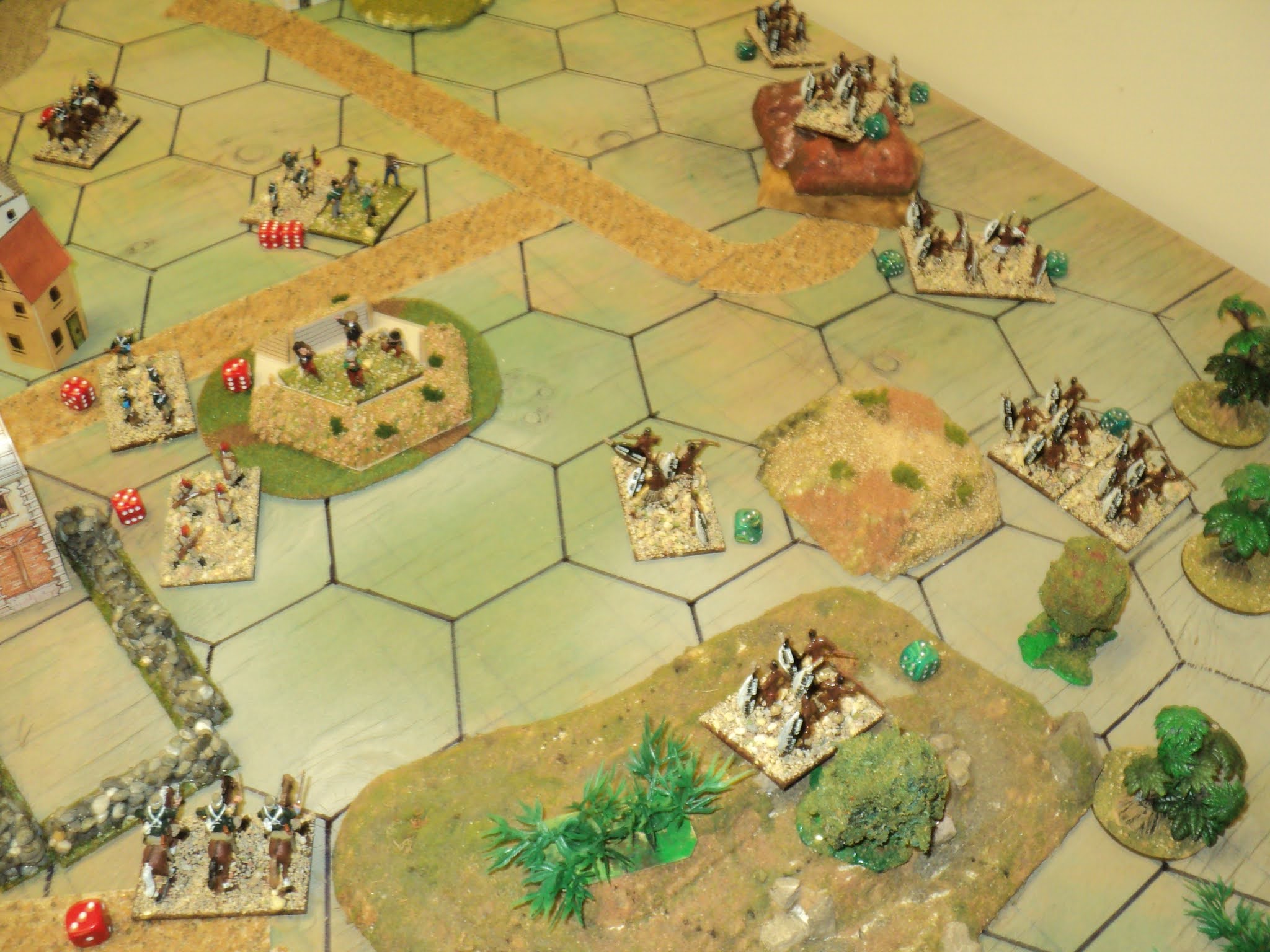
As his men arrived, the Wazir wasted no time in ordering the attack - not even waiting for the trailing 'field' gun to come up. The main target was the stockade, where Capitao da Gama led the defence, but the Wazir also ordered the attack upon the strong looking building on the other side of the road. As his fighters closed in, the gunboats opened up with their cannon. Their practice could not have been better - their first broadsides at once scoring telling hits (both rolled 'sixes' to hit in their first salvos!).  The gunboats, by the way, counted the same as the single guns on land, it being supposed that the quantitative difference would be offset by the qualitative - a none-too-large seagoing vessel not being the steadiest of gun platforms. All the same, the Corsair gunnery was superb, and remained so all day.
Corsair ships' cannon serving as medium artillery

The lead artillery were also effective, but suddenly found themselves under a telling rifle fire from the stone building.  Hastily they drew the piece back out of range, redeploying at the edge of the scrub, and making way for the second gun to drop into action on the road.  That, too, had its hazards, as a lucky shell burst from the undermanned Azeitonian cannon felled a good half its crew (minus 1 from 2SP).
The first attacks go in...
A band of 40 men approaching the town along a low ridge to the north west of the stone building were driven back a short distance by rifle fire from the building itself and from the cavalry guarding that flank.  The main effort, however was against the stockade, supported effectively by the gunboats.  The leading wave of fewer than 50 men was soon brought up to near on 200. Some scrambled to secure a foothold within the fieldworks, whilst many contented themselves with pouring in a steady volume of musketry.  Outnumbered five to one, the stockade garrison were barely hanging on as losses mounted on both sides.
Corsair fighters hurrying into the fray


It could not be said that the Corsair attack was a model of coordination.  Throughout the morning more corsair fighters drifted in from the scrubby bush land, to join the fun.  
Gunboats make good practice against the stockade

As the pressure mounted upon the stockade, soon just ten men (1SP)  remained with the commandant, still grimly fighting off the assailants. A  depleted platoon of regulars - maybe 20 men joined them just before an overlapping group of corsairs could leap over an unmanned section of earthworks. The commandant himself bore a charmed life, not a scratch or bruise upon his person. The Wazir himself was equally lucky on more than one occasion. Having installed his person with one of the guns, the occasional counter-battery from the town placed that person in some danger of his life and limb.


Desperate fighting at the stockade;
the corsairs storm the stone building
The corsairs' confidence grew with the unexpected capture of the stone building. The galling fore from the corsair artillery and the musketry from the nearby ridge, were too much for its garrison to endure. Twenty survivors evacuated the place. A band of thirty corsairs entered, and promptly began to fire upon the buildings and troops visible in the cemetery beyond.  

The stockade garrison's handful of survivors flee
as Capitao da Gama falls into the hands of the corsairs

This really was the beginning of the end. Although the corsairs in the open were taking considerable losses, it was becoming plain that, against this foe, the Colonist garrison was simply not strong enough.  A band of corsairs burst into the southern end of the stockade, chasing out the scant remnants of the regular platoon. Surrounded, the civilian militia defending the north end finally succumbed. Still the gallant commandant wielded a stout sword, but as more corsairs swarmed over the earthworks, he had perforce to surrender.
Azeitona defence of Oportonovo about to 
collapse

The stockade in corsair hands...
This 'surrender' seemed to me the only solution, but we brought it about this way.  The rest of the stockade defenders having fled or been put to the sword, the Capitao had been left, unwounded, on his own, enemies to his front and rear.  Paul and I agreed that he could have one round of fighting.  If he was hit, he was wounded or killed, but if he forced a retreat on one of the enemy, he would be held to have cut his way out of the press and escaped.  From memory, though he might have 'taken an enemy with him', he neither escaped nor was killed.  So, a prisoner he remained in the hands of the corsairs.

By this time, the town's garrison had long since passed its exhaustion point in losses. Although they had given as good as they had received, even discounting the sea-going transports (only one of which arrived during the battle), but including the gunboats, the corsairs' losses fell  short of their exhaustion point.  
End of the battle.

Overall losses were: 

Azeitona:
Capitao da Gama MIA/POW 6SP
Infantry: 14SP
Artillery: 1SP (gun silenced)
Note that in determining returns and replacements, the Commandant's 6SP is not included, as really an ad hoc command figure (unlike Colonel Relaxado, Great Chief  Barra Kuta, or Wazir Yezdi).  So the Azeitona garrison find 5SP permanently lost; 5 replaced after a certain interval (one of these may be artillery); and 5 return immediately after the battle as stragglers, lightly wounded, knocked out  etc.

So the battle casualties are 'estimated' to be some 100 men plus the commandant himself.

Corsairs: 
Musketeers: 15SP
Artillery: 2 SP
Returns: 6 permanently lost (1 of them artillery); 5 replaced after a certain interval; 6 return immediately: 5 musketeers and 1 gunner.

So the Corsair battle casualties came to about 110 men. 

Having driven the garrison to the southern end of the town, the Corsairs turned their attention to taking as much booty and other prizes a relatively small and new settlement might yield.  During the discussion about this, I suggested that the non-combatant townsfolk might have been taken to the jungle fringes in the hex south of the town, and even suggested a 'man of his hands' to command this little troupe. Then I looked at the map. The hex south of the town is ocean, where the coastline trends westward. But in hex-1912, there would have been the recently encountered band of m'Butu. So the non-combatants might have come in for some attention after all.

Nevertheless, the pickings were bound to be fairly slender, apart from a few trinkets recovered from the church, an interesting safe from the admin building, some invaluable military equipment - especially rifles and ammunition - and a few persons that one way or another might liven up the slave markets of Zanzingabar. The commandant himself might well be worth something in ransom... 

* * *

Meanwhile, back in Kachinga, Coronel Relaxado decided to resolve at least one of the worries that had been exercising him.  Gathering together as much force as he could risk, he set out southward.  That m'Butu band at Getmai had to be eliminated, and that right soon...

* * * 

To be continued... The Battle of Getmai Drift.


Tuesday, August 17, 2021

InDarkest Aithiops - Oportonovo


The colonial seaport of Oportonovo

The account of the 'Jellyfish's' attack on Oportonovo is soon told, but first, let's lay out the situation.  I suggested that the m'Butu had achieved at least a partial surprise, arriving hard on the heels of the fleeing patrol, with just enough pause to carry out a quick reconnaissance.  The garrison, it transpired, was stronger than Yavuyavu expected and hoped, but he trusted they were sufficiently unready to offer reasonable prospects of a successful assault.

Together, Paul and I decided that all three fortified strongpoints would contain one element. He chose the gun to be in the southern redoubt; the other housed a militia platoon and the stockade some regulars.  To simulate the rest of the garrison scattered about the town, Paul rolled for each stand 3 D6s, two to determine, counting from the north end of the table (his right), how far along the table; and the third counting in from the edge. This determined their initial placement. This meant a fair likelihood of a stand being placed in the ocean.  I suggested that that would indicate a platoon that required as many turns as their distance from the beach to assemble and be available for action. 

Yavuyavu masses his army


As it transpired, none were so affected; all were ready for action!  However, one platoon found itself around the northernmost house.  That was to place them far from the action, at least to begin with.  Captain da Gama himself was down at the beach at the bottom of the street leading from the Church - Rua da Igreja.


The gun redoubt overrun
Having observed the garrison's dispositions, Yavuyavu massed his 300 warriors in the bush at the south end of the town - and charged.  Straight for the redoubts they ran, striking first the gun-armed fort - the 'gun redoubt'. Yavuyavu's lack of personal streamlining kept him well clear of the leading ranks, but he soon joined in the fighting. Soon the earthworks were covered with struggling soldiers and warriors, spears, bayonets and swords flashing in the sun.  Unable to hold their redoubt, the gunners managed to haul their gun clear, but the rapidly following warriors soon caught them in the open and put to the spear whoever stayed to protect the piece.

Assault upon the militia redoubt

Soon after, the fighting overlapped onto the second redoubt, where the frightened civilian militia found themselves hard put to keep the warriors off.  By this time a cavalry platoon and another militia band, coming up from the beach, were entering the fray.  The cavalry charged the group that had just overrun the gun, and soon became locked in a close quarter melee.

Overview as militia and cavalry join in
Meanwhile, the town's Commandant, Capitao Ferdinand da Gama, had been for a moment undecided whether to take his stand at the stockade, or to throw himself at once into the action.  Making up his mind, he joined the band of militia close by some houses and directed their rifle fire into the masses surging up to the militia held redoubt.
Capitao Ferdinand da Gama takes command

Colonial cavalry almost surrounded
Shortly thereafter, just as the first cavalry troop broke out of their melee, badly depleted, the second arrived between the stone wall of the cemetery and some rising ground, whence they poured a galling fire into the flank of the warband frontally assaulting the redoubt.  The defence was now becoming better organised, and the m'Butu had already taken heavy losses.  Then Yavuyavu himself took a rifle ball that broke his left collarbone.  The assault at once began to flag, the fall of a few more warriors (one more strength point) finally discouraged the m'Butu.  More fell as they faded back into the bush, and out into the farmland bordering the jungle.   
Second cavalry troop opens fire into the warriors'
flank

The m'Butu had been beaten off - quite comfortably as it seemed in retrospect.  Yet the Commandant had experienced several moments of anxiety with the loss of the redoubt and his artillery, and the loss of a cavalry troop and the second redoubt apparently imminent.  For his part, Yavuyavu accepted the outcome with his usual equanimity.  He'd given himself a little exercise, though his collarbone ached and would have to be reset soon, and he'd given the Azeitonians a fright.

The losses amounted to:
Azeitonians:
5SP: 1 militia, 2 cavalry, 2 gunners.
Reconciliation:
2SP return at once as lightly hurt - 1 infantry, 1 artillery
1SP return after 2D6 RED turns after this one (i.e. 7 turns) - 1 cavalry - count as battle casualties
2SP dead or severely wounded (1 cavalry, 1 gunners)  - count as battle casualties.
Cavalry or Artillery returns may instead be substituted by infantry.

So the Azeitonians lost maybe 30 men to the attack (mostly cavalry and gunners, with a few infantry scratched and bruised)

m'Butu:

14SP: 2 from Yavuyavu, 12 from warrior bands.
Reconciliation: 
4SP return at once as scratched and bruised 
4SP return as recruits/ reinforcements 2D6 BLACK turns after this one (i.e. 10 turns)  - count as battle casualties
4SP dead or severely wounded - count as battle casualties

The m'Butu battle losses amount to 80 men.

What of the 2 SP lost from Yavuyavu?  I'm inclined to the view that as a subordinate command that loss went to the morale of the m'Butu and brought them within 1 of their exhaustion point at 13SP lost.  Perhaps (if he reappears during this campaign) he will recover his full strength after the 10 BLACK turns following this.

The m'Butu pull out, having lost too many 
warriors
Just as the colonists stood about congratulating themselves upon their victory, burying the dead and tending the wounded, a farm boy mounted bareback upon a horse lathered with sweat, raced into the town from the Vertiginus north road.  He galloped up to the Commandant. Without salute or preamble, he spoke up.

The last few shots of the day bring down the last
few warriors in the field

'Ships!' he gasped, 'The sea's full of sails!  Men with muskets and swords and cannons are coming ashore in hundreds!  They're heading this way!  And fast!'
Aghast, the Commandant stared into the eyes of the tired young messenger.
'Corsairs!' he breathed.

To be continued: The Corsairs of the Coast.

In Darkest Aithiops: The Narrative Resumes...

Overall situation developing during the week
 following the battles along the Limpopo Trail.

Following the capture of the important native cosmopolitan market town of Kachinga, the Azeitonian colonists settled down rather to organise its governance.  For the time being, Tenente-Coronel Relaxado was inclined to leave things pretty much as they were, with any taxation, tribute or other levies that went formerly to the m'Butu overlords now accruing to the Colony's fisc.  On the amount, the colonel was inclined to take the town's merchants' word for it, provided it seemed credible, with just enough of dickering to establish he was one with whom it was not well to trifle.  Meanwhile, he set about preparations for the continued march westward.  For the moment, the slight and occasional rumours of movements of some desert tribes to the northwest, and the even more tenuous hints of something going on along the coast up north, did little to perturb the colonel's thoughts from his future programme.  Those Diamond Mountains, seemingly just a few miles off, exerted a fascination impervious to minor distractions.

Staggering southward from Kachinga with the shattered remains of his army, the Great Chieftain, Barra Kuta counted himself lucky there was no pursuit.  A couple of days later, he halted his retreat close by the Limpopo South Branch river ford at Getmai.  There they remained for the next few days.  Meanwhile, a few warriors were drifting in to his capital from the southern regions of his lands, and a few more were coming of age.  He might yet build up a credible force.

But what of his other tribesmen?  What had happened to the reinforcement from the jungle kraals that the Great Chief had hoped would arrive in time to have made a difference in the battle on the Limpopo trail?  Nothing had been heard at all from that band - not before that battle, and not in the week since.  Had he been betrayed?  Was his sub-Chief, Yavuyavu, plotting to undermine him?

It transpired that this force had taken longer to gather together than had been anticipated.  The sub-Chief of the jungle kraals was one Yavuyavu - 'the Jellyfish' - so named for the manner in which his corpulence rather belied the sharp readiness of his spear.  Wily, ready for any fight than did not require a great distance to reach, Yavuyavu's loyalty to the Great Chief was commensurate with his laziness: he was quite content with the heights of authority he had already attained. 

Having gathered nearly 300 warriors at the 'village with no name', he was about to set off when they heard,  muffled by distance and the jungle, the gunfire of the battle along the trail, a good five miles distant.  Contemplating whether to continue on, Yavuyavu received word that a band of colonists had approached  Rutintutin Kraal.  Numbers were obscure - only a patrol had been seen - but there was reason to suppose there were more in the offing.  The puzzle was why the colonists had not yet attacked.  Only the barest minimum - 40 warriors (1 stand) - had been left by way of a garrison.  

That at once decided Yavuyavu's course of action.  In all haste, he marched his little force down to the Kraal, entered the place undetected, quickly laid his plans.  A reconnaissance soon established that the colonials were not in force at all - just 40 men.  The m'Butu surged out of the gates.

Now, much of this had been decided by the card draws for activation.  As I was focusing upon the m'Butu, not a lot of activity was to be had from the desert Touaouin, nor the coastal corsairs, but there was enough spare for the occasional twitch.  Once Barra Kuta had got clear to Getmai, and there was no pursuit, then the other sizeable force - some seven stands of warriors plus Yavuyavu's - received my attention.  A reasonable string of Black activations got him to the Kraal without detection (Paul, as the Azeitonians, didn't get the chance to try another recon roll).  Another led to the sequel - a m'Butu raid against the Azeitonian colony.
The seaport of Oportonovo, its garrison scattered 
about just as the westward patrol warns of the 
approach of m'Butu tribesmen.
As eight stands (the 40-strong village garrison was now incorporated in Yavuyavu's force) plus command surged out of the village, the single Azeitonian patrol hastily fled before them.  

Now, I had hoped to make this an episode in the overall campaign, but using The Men Who Would Be Kings game system published by Osprey.   This would have used one of the scenarios (E: 'Run to the hills', or G: 'It's awfully quiet out there...').  This is a kind of 'uber-skirmish' level game, which, for the purposes of this campaign I would have chosen a '1 figure = 1 man' scale.  

The Azeitonian patrol/ recon force would have comprised three 12-man regular or irregular units (sections) for an 18-point field force commanded by a subaltern, possibly with an heroic NCO included.  The units would simply have been made up of stands were are already using: 9 stands for 36 rifle-armed figures (possibly plus command).

The m'Butu engaged would have represented two and a half stands (out of eight) - six 16-man units for a 24-point field force: 96 figures, all spear armed, and probably counting as 'fierce' or 'veteran'.  It would have been commanded by one of Yavuyavu's lieutenants, with perhaps an heroic warrior leading one of the 16-man groups.

Now, were we to suppose that the Azeitonians were all run to earth and put to the spear, the total loss would have been 1 stand at 4 SP.  I daresay that the m'Butu losses would have been similar, if not greater, but still pretty minor in the overall scheme of things..  

Unfortunately, Paul was somewhat indisposed at the time, and as I hadn't fully worked out the scenario and force details, felt sure the thing would be too one-sided to be worthwhile.  I didn't press the matter then, not being too chipper myself .  Too bad.  But I still think it would have added something to the whole campaign narrative.  Maybe the opportunity will arise another time.  
The garrison scattered about. For explanation, see
next posting
At any rate, the colonist picket watching hastened back to the main camp, whereat, taking only their weapons and such items that would not slow them down, the main force ran as fast as they could down the trail.  Hot on their heels trod the m'Butu, with many a mocking hoot and holler.  Not content with chasing the Azeitonians away, Yavuyavu determined to have a slap at the still infant settlement of Oportonovo, scene of a sizeable action a year or so before.
Over 300 m'Butu tribesmen massed in the bush 
southwest of the Oportonovo settlement


Arriving at the jungle fringes overlooking the town, the patrol having escaped with hardly the loss of a man, Yavayavu undertook a quick reconnaissance.  The strength of the local garrison was rather in excess of what he had hoped.  Yavuyavu rolled a '6' - a very effective reconnassance - revealing 4 infantry and 2 cavalry units, plus a gun maybe 250 officers and men - 7 units overall, at 25 strength points, not counting the Commandant's personal retinue.  His own army comprised just 320 warriors.  But, as he put it to one of his lieutenants, a certain Njia Ndefu ('Long Trail'): 'We are here and the enemy is there, and there we must strike him.'  Robert E. Lee could not have expressed it better.

Before listing the respective forces, I should mention that whenever there is a battle that doesn't involve the main commanders as delineated at the beginning of the campaign narrative, there will be a command stand of 6SP created that is not part of the campaign order of battle.  It does not count towards unit or SP count in reconnaissance reports.  So I was told: 7 units, rather than 8.  A character will be created for that ad hoc command.  This is I think justified as the 6SP is nominal and goes toward army cohesion, morale and maybe to add a little pep to an individual unit; it is not in itself a fighting stand. So although the four campaign powers each begin with one command (e.g m'Butu's Barra Kuta, or Azeitona's Colonel Relaxado) others may emerge to become characters in the narrative.  We have introduced Yavuyavu, 'The Jellyfish'. You may remember Capitao Ferdinand da Gama, who commanded the Oportonovo garrison just over a year ago...

The scattered garrison rallying together to
resist the m'Butu attack.

The Forces:

Azeitona Garrison:
Command: Capitao Ferdinand da Gama (average) = 6SP
2 regular infantry stands (rifle-armed, average) @ 4SP = 8SP
1 town civilian militia (rifle-armed, poor) = 4SP
1 town civilian militia (rifle-armed, poor) = 5SP (Paul had a spare SP that had to go somewhere)
2 regular cavalry (rifle armed, average) @3SP = 6SP
1 rifled field artillery = 2SP

Totals: 
8 units, median = 4
31SP, exhaustion point -11SP

m'Butu Raiding Party:
Command: Chief Yavuyavu, 'The Jellyfish' (average) = 6SP
8 warrior stands (assegai, average) @ 4SP = 32SP

Totals: 
9 units, median = 5
38SP, exhaustion point -13SP

The m'Butu overrun the southern redoubt, forcing 
its garrison to flee, dragging their gun.


His simple plan laid, his little army about him, 'The Jellyfish' ordered the charge...

To be continued: Yavuyavu's raid.

Wednesday, June 9, 2021

In Darkest Aithiops - Great Zimbabwe

The Limpopo River market town, Kachinga...
Tenente-Coronel Colonel Joao Pablo Relaxado was surprised and taken aback at the first sight of the place within which the remnants of the m'Butu army sought refuge. Whatever lay within this town - Kachinga, he was to discover its name to be - this was no zareba or palisade-surrounded settlement but obviously a sizeable town, enveloped by regular walls of masonry.

'Who knew the Romans were here before us?' a member of Relaxado's staff was heard to murmur. Only whispers - largely dismissed as fantasy - had previously been heard, back in Vertiginus, of a 'great Zimbabwe' somewhere upriver. It was no creation of the Romans, but rather the cooperative labour  and time spent by the several and disparate peoples who made up the townsfolk.

Although this place fell within Barra Kuta's realm - for which privilege they paid a none-so-very onerous tribute - it was not especially a m'Butu town. Barra Kuta might have made it his capital, but for its vulnerable - and from his point of view, remote - position on the very fringe of his kingdom. It was the equivalent of a sea-port, lying at the point at the confluence of the navigable branches of the Limpopo, and the midpoint at which several trails met. The place outrivalled in importance even the great market town upriver on the northern branch, Bombasa.
The Azeitonian Armed Expedition approaches...

The Colonel quickly set aside his momentary awe - a sentiment not likely to last long when a colonialist set eyes upon indigenous artifacts not made of gold - and bethought himself to storm the place at once, practically off the march, and 'bounce' the m'Butu out before they could organise a defence. The walls, though strongly built, were not so high they they could not be scaled with the resources to hand (how to slide out from under a narrative difficulty!). Relaxado could already see the commercial potential for this place integrated into New Azeitonia, simply as and where it was, but for the addition of an administrator and a few colonists: a market town and river port.  Giving strict instructions that whatever buildings and unarmed people found in the town were to be spared all harm - under pain of dire, excruciating (probably literally) and likely to be fatal penalties - he ordered the attack.
The colonists envelop the landward sides of 
the town.

My original plan was that in fact this place, though sizeable, would be defended by thorn hedges and palisades. But I suddenly bethought myself of the Usborne Roman Fort that I had built years ago, and never used. Why not? thought I. There is no especial reason that the indigenes of the region could not have constructed such a place - or even that it was not the construct of a cooperative enterprise. Mentioning this to Karen, she referred me to the Great Zimbabwe. Of course, we also have the Great Wall of Morobad by way of wargames campaign precedents!
 
The Great Zimbabwe (Wikipedia)

So, some special rules had to be devised for the storming of the town. First, I figured that the guns available to the colonists would be too light to make much impression on the walls, but could be used against the defenders lining them. However, the gates being wooden could be breached by gunfire (a 6 being required). Using whatever means came to hand, the attackers could scale the walls, requiring an unmodified 6 to effect an opposed lodgment; a 5 or 6 unopposed. If the gates were breached, however, they could be stormed as though there were no obstacle. I hoped, then, to make the emprise tough, but by no means impossible.

And then I went and gave the colonists a big hand by forgetting that, when combined with the 8SP (strength points) garrison, the 37SP m'Butu that had survived the battles along the Limpopo Trail would garrison the place with 45SP. So 37SP of m'Butu were left to defend the place:

m'Butu Garrison:
Commander: Barra Kuta (Brilliant Commander) = 6SP
2 Warrior Bands, smoothbore musket, average, @ 4SP = 8SP
5 Warrior Bands, assegai (spear), average, @ 4SP = 20SP
1 Warrior Band, assegai (spear), average = 3SP
Totals:
9 units, median = 5 + 1 (Brilliant commander) = 6
37 SP, exhaustion point = -13SP

Initial assaults against the south wall

Unfortunately, my information of the composition of the Azeitonia expedition is rather less exact.  This is the approximate force:

Azeitonian Armed Expedition
Commander: Lt-Col Relaxado, Average, = 6SP
7 Rifle armed platoons, average, @ 3SP = 21SP
7 Rifle armed platoons, average, @ 4SP = 28SP
1 Bush Fighting Militia, poor, @ 4SP = 4SP
1 Cavalry Troop, average = 4SP
1 Machinegun (Gardner) platoon, average, = 2SP
1 Field gun battery, average = 2SP
1 Gunboat = 8SP/FP (flotation point)
1 Transport = 4SP/FP

Totals:
21 Units, median = 11
79 SP, exhaustion point = -27
Azeitonians thrown back from the south wall.


Colonel Relaxado was not one to wait around too long to attack. Opening up a bombardment of the eastern ramparts with the gun aboard the gunboat and machine guns, the Azeitonians approached the east-facing wall with some deliberation, whilst part of the army, together with the field artillery fetched a hook around to the south face. Once offered a clear sight of the wooden doors to the gatehouse in this part of the wall, the field guns formed battery and opened fire.

Blessed with few firearms, and those few effective at only short range, the m'Butu manning the walls could only wait until the attackers got close, but even with the protection of the walls, the incoming was a deal thicker and potentially more lethal than the outgoing. Time was of the essence for the attackers, who were, as soon as they were prepared, ordered to storm the walls. These walls were of no great height, and were scaled by the few ladders and ropes eked out from the boats, brushwood piled against the walls, lifting men up upon the shoulders where they could just reach the crenellations, and finding handholds where the masonry was loose.  

The first attacks against the south face were quickly repulsed, the assailants driven back from the walls.  The attackers against the east face, although maintaining their pressure, were also finding it difficult to effect a lodgment. Casualties began to mount.  Undiscouraged, the Azeitonian regulars and legionaries returned to the fray. Just as one platoon burst through the splintered remains of the south gate, the platoon to their left surged over the walls, driving the m'Butu into the town.

Attackers carry the gatehouse and the southwest
curtain wall.
Now, the interior of the town featured a clear space under the walls surrounding the built up area.  This meant that the attackers, having crossed the walls, counted as being in the open if attacking anyone within the built up area. The m'Butu were therefore able to counterattack with advantage. They succeeded momentarily to drive some colonists back over the wall. But the town gate remained in Azeitonian hands.

Meanwhile, the pressure on the east face, beginning to the left of the East Gate (southern end) soon extended to the other side of it. There the defenders were thinner, having to reinforce betimes the southern end of the line. The Azeitonians succeeded in battering their way over the walls and driving the defenders into the town. Such success that the defenders achieved in recovering the ground was as quickly wiped out as the attackers, with vaster resources, came back as strongly as before.
Close of action with m'Butu about to fade back 
into the streets, the assailants having effected 
lodgments in the southern and northeast 
quarters.

At last, the southern wall completely overrun but for the Southeast Tower, and the northeastern quarter also forced into the town, the m'Butu gave up the fight. The afternoon sun was close to setting. Having reached their exhaustion point, they fought on for a little longer just to hold, but with counter-action now out of the question, it was clear that the numbers the enemy had would lead to much higher casualty rate among the defenders. Quickly arranging a delegation of townsfolk (a master politician to achieve that amid the chaos of an urban battle!) to approach the Azeitonian commander, the Chieftain-King signalled his men to evacuate the town to the west, grab what floating craft they could along the riverbank and make off upriver. There was no effective pursuit.

All things considered, Barra Kuta was inclined to think that matters could have gone a lot worse than they had.  True, he'd lost the town. And a lot of people over the last few days. No surprises there, but he had made the Whitefella pay heavily for the town at least. In fact, the Azeitonians had lost 20SP in the assault; the m'Butu 13SP in defence. But in fighting for it, Barra Kuta had established a moral proprietorship should ever the opportunity arise that he might recover the place.

It had been a dearly bought success for the Azeitonian expedition, but the Colonel was not altogether displeased with the outcome. Although the soldiery could only with difficulty be restrained from the victor's right to sack a fortified place taken by storm, Col Relaxado had no desire whatever to alienate the local population, especially as they would be required soon at least partially to make way for entrepreneurial Azeitonian colonists. He could see a great future for this place, one to rival the coastal town of Vertiginus. It would not do to begin with a sack, a massacre and a conflagration.

Despite the disparity of losses in this battle, so far the scale of SP lost or recovered during the course of the campaign so far goes like this:

Azeitonia: 
12 SP permanently lost
12 SP to be returned as rehabilitated wounded or new recruits
12 SP returned as slightly hurt or stragglers

m'Butu:
19 SP permanently lost
19 SP to be returned as rehabilitated wounded or new warriors come of age
19 SP returned as slightly wounded or stragglers.

I've still not decided upon the return of the temporary losses. Paul reckons the first ones are due back by now. Seems a bit soon for mine... All the same, the m'Butu remain yet a formidable force in being...

To be continued.


Tuesday, May 18, 2021

A Dark Day in Darkest Aithiops...

This posting is a hard one to write. Did you ever have a day - or even a sequence of events - that started bad, and you knew it was going to start bad, but it carried on bad - unrelentingly bad - and ended bad? Observe the use of the adjective in place of the adverb. Ever had one of those? Chief-King Barra Kuta did. Did he what!


Lt.Col Relaxado's first distant glimpse of the fabulous 
Montanhas Diamantes - Diamond Mountains.
(Picture by Paul 'Jacko' Jackson)

Following his repulse from the Azeitonian column at the edge of the jungle, he drew his army off up the Limpopo River trail towards the market town, Kachinga, which lay at the confluence of the north and south branches of the Great Grey-Green Greasy Limpopo River. Perhaps the wound received at the battle had impaired the Chief's faculties, or left him tired.  The retreat was slow and as early as noon the next day, the colonialists caught up with the m'Butu on the road. It was probably as bad a stretch of country as could be imagined to face a foe superior in numbers, firepower, technology - and even had an edge in mobility. Here the country was flat - several casual undulations of ground, and hardly any scrub, brush or trees in sight. There was no question but to accept a hopeless battle - and hope for the best.


This was one of those occasions that crops up in a campaign in which the outcome of a battle is certain, right from the get go.  It then becomes a matter of how bad it's going to be. The first battle had ended the Azeitonian run of activation cards (Red), but the m'Butu drew one Black card only, a number, which gave it one grid area of movement for one force.  Barra Kuta's army drew back along the road one space. Back to the Red cards: n, K, n, n, n. Unlike the number cards, the King allowed 5 (!) activations, which could be used all by one force, or shared among as many as 5 forces.  

Now, rather than make the moves card by card, I proposed drawing the cards as 'strings', ending when the colour string ended by the appearance of a card of the other colour.  At a slight reduction of the 'fog of war', it does speed up proceedings. But nine activations -  no wonder Tenente-Coronel Relaxado's expeditionary force ran down the m'Butu.  


Meanwhile, far to the south, a secondary colonial force penetrated the jungle west of Oportonovo, following a trail that soon led to a small, palisaded kraal. A reconnaissance indicated the presence of a small garrison (1 warrior stand). The Azeitonians declined for the moment to press the matter.  Meanwhile, the garrison, alerted to the presence of the enemy, were for the moment unable to determine their strength (having to wait for an activation card to carry out the recon).


Events were developing far more quickly along the Limpopo trail. Chief Barra Kuta threw out his line in much the same formation as he had to begin the earlier battle. As the Azeitonians approached in a broad column, he hoped that by enveloping its open flank he might do something to offset the disparity in numbers. There was no question of defending. He had to carry the fight to the enemy.

It did not go well.  

The m'Butu army comprised 11 warrior stands plus the Great Man's entourage - 12 units in all: 50 Strength points all up; exhaustion point 17. As Barra Kuta counted as a brilliant commander, he might activate 6,7, or 8 stands per turn. 

The Colonists were far more powerful, though their cavalry had been halved by the previous day's action. Their strength points had been reduced by 10 to 82, exhaustion point 28. He had available 20 units - 1 cavalry and one infantry stand lost, plus a couple reduced to 3 SPs, - so, the Colonel counting as an average commander, could activate 9,10 or 11 units per turn.

m'Butu advancing  to close quarters...


Now, to the ground.  As my table is rather larger than uses for examples of Bob Cordery's terrain generation method, I made certain adaptations.  
Second Battle of the Limpopo - terrain 
generation

Now, the river and the road/ trail, were a given. The river was placed first, but the road could wait upon the rest of the terrain. This was flat grassland, so any rises in the ground were merely casual undulations - enough to create dead ground.  

Hills:

  • Rolled for number of hills, 2D6 + 1D3 gave us 10 hills.  
  • Rolled 2D6 and counted down the left hand edge for the starting row.
  • Rolled 4D6 and counted along the horizontal rows 'ploughman's fashion'. 
  • When a hill was located, rolled to determine whether it was part of a larger hill (5 or 6 confirming)
  • If part of a larger hill rolled 1D6 and, counting from the upper right counted the hexes clockwise to locate the next part
  • Then or otherwise, rolled 4D6 and continued, until all 10 hills were located.

The large rise at the upper left seems somewhat to exaggerate the size of that rise.  It began as a 2-hex hill, but another appeared right beside it, to extend its size.

Patches of bush/ scrub:
The method was the same.  This time the 2D6 + 1D3 roll gave us 1+1+1 = 3 such patches.  You can see the extent to which the Fates, the Gods, Karma, and Providence had it in for the m'Butu, eh?  Man, what a miserable piece of country when you have nothing - nothing at all - going for you!

Hamlets/ Villages:
To determine whether there were any, I figured that, as this was a fairly sparsely populated country, I'd stay with 'the book' on this.  The D6 - 3 roll was a '2', so there was no habitations.  

The Road/ Trail:
I simply laid down close by the river as seemed sensible.

The battle:

Figuring that to close with the enemy (if they could not retreat betimes) would be better than to stand about to be shot to pieces, the m'Butu advanced rapidly to close the distance. Losing several SPs in the process, they found they could do little better in the close quarter fighting. They were completely outfought all day. Unfortunately I failed to take any pictures of the actual fighting, but an after picture might at least partially tell the story.

...m'Butu retreating, much reduced.

The attack failing to make the least impression, the m'Butu fell back, close to their exhaustion point. Nor was that withdrawal to remain unmolested. Although they managed to put some distance between themselves and the enemy, not a few could not get beyond rifle and artillery range. And the colonists' shooting this day was desperately accurate.

This was a terrible defeat for the m'Butu - a massacre, withal. As the m'Butu dragged themselves from the field they mourned (well, I did) the loss of 20 Strength Points. The Azeitonians had lost precisely two.

Now the battle losses, as before stated are divided in 3 - 
  • one-third permanently lost as killed and seriously wounded
  • one-third will be replaced after a number of campaign turns (roll 1D6) as recruits or recovered
  • one-third are returned immediately.
Rather than dice for the remainders, I find it simpler to form the losses into a species of palindrome.  The single remainder goes to the delayed replacement; two remaining will go to 1 permanently lost and the other immediately replaced.

The net effect of this 'battle' was that the Azeitonians lost exactly one SP.  The m'Butu lost 7 outright, 6 to be returned later, and 7 returned immediately - a loss for the moment of 13SPs, on top of the 16 lost the day before. That there would be 14SPs available some time in the future was small consolation to Barra Kuta.

At this point in the campaign, recall that the Azeitonians still had 4 campaign moves to play. Strictly speaking, they could probably carry out a recon, then attack along the road, drive the m'Butu into Kachinga Town, to finish the outstanding moves with a reconnaissance. It would simply have been a pressed home pursuit of a defeated enemy. The drawback to this would have been that, handling the m'Butu, I would simply have refused battle, and drawn off the remnants of the army.

So Paul and I negotiated the subsequent events, allowing the m'Butu to retreat all the way into Kachinga. That saved the Azeitonians a campaign move, which meant that they could, after a successful recon, end the sequence with a battle. To make absolutely certain this was to be a great day for the Azeitonians - and an utterly miserable one for the m'Butu - their recon roll was a '6'. Of course it was. One suspects a local entrepreneur in this market town wished early to ingratiate himself to these enterprising strangers...

Chief Barra Kuta had left a small garrison in the place, 2 warrior stands (8 SPs). Added to what was left of his field force, brought the m'Butu strength up to 45SP, as follows:

Chief Barra Kuta (brilliant commander) plus entourage = 6SP
6 Warrior units, spear @4SP = 24SP
3 Warrior units, musket @4SP = 12SP
1 Warrior unit, spear = 3SP

Totals:
11 units, median = 6 + 1 (Brilliant commander) = 7.
45 Strength points (37 [main army] + 8 [garrison]); exhaustion point = 15.

To be continued: The Assault on Kachinga.


Thursday, May 6, 2021

In Darkest Aithops - The m'Butuland Expedition: Battle of Limpopo Bend

Something of an encounter battle, both sides advance
the m'Butu perhaps more eagerly...

 As the Azeitonian expeditionary force began to leave the jungle along the Limpopo River trail, they entered a region of scrubland as they approached the great bend in the river.  There awaited the m'Butu army.  Given time, Chief Barra Kuta might perhaps have refused battle, though where he could find a favourable battlefield east of Kachinga Town, might have been problematic, to say the least.  For the moment he could at least count on some superiority in mobility, especially in that final tongue of jungle forest that reached, seemingly, for the road.  But where the regular forces of the Azeitonians might have some difficulty negotiating a patch of scrub, the m'Butu's looser formations could pass through with ease.  

(Note: Although scrub patches offered cover for those within and concealment for those behind, the natives could walk though as if they weren't there.  With one exception, the colonists had to take one turn to enter such a patch.  The exception for the Azeitonians was a bunch of bush-fighting volunteers, who, for celerity of movement through hard country were to be the equal of the m'Butu.  I forgot to remind Paul of this - just this moment remembered it in fact - so I don't know whether that Militia group were these fellows or not).

For their part, a m'Butu regiment - amabutho Wa Nnabe - lay in wait within the jungle, ready to leap upon the flank of the column whilst the remainder of the army - the impi ya masoshe - awaited the enemy in the scrub.  
Campaign area.  The red lightning denotes where the battle
takes place, not far from the great river bend that gives
the battle its name.

Taking no chances, the Colonel brought his forces in a solid body, close by the road and the river.  However, one troop of horse - 'A' troop - rode forward of the main column to reconnoitre, and perhaps to spring any ambush.  Sure enough, the m'Butu responded, a band of about 40 warriors charging around a patch of scrub to engage at close quarters.  Though getting the better of the first clash, the cavalry quickly found themselves in trouble.

'A' Troop runs into warriors coming the other way...
Within moments, a second band burst through the scrub to join their comrades.  To the horror of their fellow soldiery, still barely within rifle range, they saw their lone troop surrounded by five times their numbers.  There was no hacking their way out; the troop died where they stood.  But the losses among the m'Butu were severe enough: 5 SP lost to kill off a 4SP stand.
'A' Troop surrounded by 5 times their numbers.
But the m'Butu are taking heavy losses.
It was probably fortunate that, apart from artillery and machinegun fire, the Azeitonian column was unable effectively to come to the rescue of the doomed 'A' Troop.  The leading units met the warriors' attack in a coordinated line. The m'Butu surged forward in a somewhat ragged line to engage the Colonialists in close combat with assegai and short ranged musketry from Wa Tusi.  Although successfully inflicting losses and driving back parts of the Colonists' line. the m'Butu were taking rather heavier punishment.  Barra Kuta himself took a hit bad enough to knock him back (rolling '11' in the effect dice for Army commander with the band that received incoming rifle fire).
'A' Troop finally overrun, as the m'Butu close with 
the colonialist column.
The action spread along the front as more m'Butu surged out of the jungle.  This brought more of the colonists into the fight - not quite the hoped-for effect, as the warriors found it hard to bring numbers against isolated bodies of troops.  Although the m'Butu were exacting a toll of casualties, they were rather getting the worse of it.  Meanwhile, the river boats continued chunking upriver, where their gunfire, aided by the artillery in the road, chased a native band out of a riverside patch of bushes, and cleared the open ground a considerable distance from the trail.  
Coordinating bush fighting ain't easy, even for the locals. 

Early attacks repulsed, the m'Butu pull back...
The main action going against the m'Butu, Chief Barra Kuta, blood streaming from a shoulder wound, called his men to give back.  This was no rout - rather a coiling back to draw the enemy on.  Fading back into the scrub and jungle, the m'Butu successfully placed some distance between themselves and the enemy.
...putting themselves as much as possible out
of rifle range.


The river boats advance...
They were not yet done; of that Col. Relaxado was persuaded.  This was the snake coiling for a strike.  On the other hand, there was nothing to be gained by standing still.  If the expedition was to go ahead, the column must advance.  The gun boat led the transport thrashing upriver behind the m'Butu flank.  Once past the riverside brush, the Solenta transport unloaded its cargo of rifle-armed sailors.  Greatly daring, the nearest m'Butu band charged alone through a hail of machinegun fire and chopped down several seamen before themselves finally being scattered.
The Azeitonian column yet to lurch into motion


Sailors disembark,.  The covering gunboat's machine guns
fail to discourage the m'Butu from attacking
This bold, self sacrificing action served to cover the gradual m'Butu withdrawal on the river flank, but, as the colonists slowly followed up, they merely kept their distance out of rifle range.  
General overview of the battlefield late in the action
As time passed, it became clear to Barra Kuta that his army had maybe one more counter-attack left in it.  As the Azeitonian left drew near to the jungle, where the Chief had placed himself in the position most crucial, several bands charged out of the undergrowth and threw themselves upon the lead element that had strayed perhaps too unwarily, and too close.  Or perhaps The Colonel had cannily hoped to draw the warriors out of hiding.
Final counter-attack of the m'Butu.
However it was, the m'Butu did some damage, and received some themselves - enough for them to call it a day.  Thereafter, the warriors made use of their celerity of movement to distance themselves from pursuit, and draw off from the field.
(Poor photo) the m'Butu withdraw 
alogether form the action.
This action was never going to have any other result but an Azeitonian victory.  They had the numbers; they had the firepower; they had the support weapons.  All the same, the m'Butu had given a good account of themselves.  Of 660 warriors who entered the battle, some 160 were killed and wounded.  The Azeitonians had some 900 or more troops, rifles against the few muskets the M'Butu possessed, artillery, machine guns and a gun-armed riverboat.  All the same, they could congratulate themselves upon a fine start to the campaign - the early victory being easy enough to feel this was a great adventure, and hard-fought enough (100 k + w, and no one would soon forget the fate of 'A' Troop) to bring a thrill of jingoistic pride.

(In game terms, the m'Butu had lost 24SP, a little over their 'exhaustion point', the threshold being reached during the final counter-attack.  Of these 8SP are immediately returned to the army (stragglers, grazed and the like; 8 are returned to the army after 1D6 turns (I call them recruits rather than, say, recovered wounded); 8 are lost permanently.  The latter 16 count as battle casualties; at 1SP representing 10 men - 160 men lost.  The Azeitonians lost 15SP up front, they being split 5, 5 and 5.  Ten SPs lost for the moment, the histories will relate how they lost 100 men in the expedition's first fight).

The early pull back enabled the m'Butu to put a few kilometres distance between themselves and the Azeitonians before halting.  Perhaps this made them complacent.  For their dilatoriness subsequently, they were to be asked a high price to pay.  That is to say, the Black card that terminated the Azeitonian moves proved to a string of one only: the Reds that followed went number, king, number, number, number before the next Black card turned up.  This was a fine portent for the colonists' expedition into m'Butuland; and an ill omen for Barra Kuta's realm...

A word on the figures, terrain and the rule set(s) used.


All the figures in this action, apart from the machine gun and the boats, were from Paul's ('Jacko's') collection - ESCI and HaT.  The boats were my scratch-builds, the transport from the fleet I made originally for American Civil War riverine operations about 25 years ago, and the gunboat specifically for this campaign.  The machine gun aboard O Ra Desvairado was a HaT Gardner gun.  The name of the gunboat, by the way, was a nod to the late George Macdonald Fraser: an incarnation of La Grenouille Frenetique, or, in English, the Frantic Frog, that features in The Pyrates.

The Campaign and Battle rule sets were from Bob Cordery's Portable Colonial Wargame - the latter being The Gatling's Jammed... 

To be continued...