Showing posts with label Gatonegro War of Independence.. Show all posts

Tuesday, August 13, 2024

Insurrection: The Gatonegro War of Independence


I discover that it was six years ago (!) that I began what was to be a 'campaign of battles' - a war of independence set somewhere in Latin America. Somehow, I became distracted, and never got back to the battles.  This, despite doing a fairish bit of on-line searching out the campaigns and battles of the real wars of Independence. 


Well, a couple of weeks ago, I played out what was based (supposedly) on the Battle of Maipu, April, 1818, between the Royalist Army and the insurrectionists styling themselves as 'Patriots'. This was the decisive action of the Chilean campaign of that year. As it turned out, 'Maipu' this Gatonegro battle was not, as the narrative of events will reveal.

After the early success at Arabispo, the insurrection caught popular fire, and the Reine de Oro had a serious rebellion on its hands.


Seeking to break the centre of the rebellion, the Royalists gathered what strength it could to confront the growing menace. For their part, the self-styled Patriots found recruits flocking to the nascent colours. When the clash came as the Royalist Army marched upon Maipu del Guano, they were to find themselves considerably outnumbered. Confident in the superior training of his army, General Mariano Osario drew up his force along a line centred upon rising ground close by Casa de la Espagne, a hamlet set among cherry orchards.

The Royalist Army comprised:
Commander: General Mariano Osario

1st Brigade: Colonel Ordonez
    Regiment Concepcion ... 28 figures
    Regiment Infante Don Carlos ... 28 figures
    Coy Sappers ... 7 figures
    Dragoons Ordonez ... 9 figures (under strength)
    Artillery ... 3 figures, 1 cannon
        Brigade totals: 63 foot, 9 horse, 3 artillery = 75 figures

2nd Brigade: Colonel Morta
    Regiment Arequipa ... 28 figures
    Regiment Burgos ... 28 figures
    Lancers Morta ... 9 figures (under strength)
    Artillery ... 3 figures, 1 cannon
        Brigade totals: 56 foot, 9 horse, 3 artillery = 68 figures

3rd Brigade: Colonel de Riviero
    Converged light and grenadier companies ... 28 figures
    Artillery ... 3 figures, 1 cannon
        Brigade totals: 28 foot, 3 gunners = 31 figures

Army totals: 147 foot, 18 horse, 9 artillery = 174 figures, 3 cannon

Marching to meet them, the Patriot Army comprised:
Commander: General Jose de San Martino

Division Las Heras:
    3 Regiments @ 19 figures = 57 figures
    Mounted grenadiers ... 12 figures
    Artillery ... 4 figures, 1 cannon
        Division totals: 57 foot, 12 horse, 4 artillery = 63 figures

Division Alvarez: 
    3 Regiments @ 19 figures = 57 figures
    Caballeros de los Andes horse ... 12 figures
    Artillery ... 4 figures, 1 cannon
        Division totals: 57 foot, 12 horse, 4 artillery = 63 figures

Division Quintana (Patricio Hernandez O'Hogg commanding):
    3 regiments @ 19 figures
    Escort Cavalry ... 6 figures
    Husares de la Muerte ... 6 figures 
    Artillery ... 6 figures, 2 cannon
        Division totals: 57 foot, 12 horse, 6 artillery = 65 figures

Army totals: 171 foot, 36 horse, 14 artillery = 221 figures, 4 cannon

A couple of points here:
1. My original order of battle had four Divisions, each with just two infantry regiments. A 'Reinforcement Division' under Bernardo O'Higgins would have been the fourth formation. I have no recollection as to why I changed it!

2. The considerable disparity in numbers I thought would be offset by the superior training and morale of the Royalist regulars. We'll see how that turned out.    
Regiment Concepcion's first volley.
Woeful: the pips scores count only on rolls of 4 or less... 


Prospects to begin with seemed unpromising for the Royalists, drawn up in a single line with, apart from the insignificant sapper company, not a single reserve. By contrast, the Patriots began advancing with two of their Divisions, Las Heras on the left and Alvarez on the right. As the leading Divisions engaged the flanks, O'Hogg's Reserve marched onto the field, straight towards the centre of the Royalist line. 

Just about the first Royalist unit to give fire, Regiment Concepcion, let fly a woeful volley. Where it went no one knew - certainly not the intended target. Under my own combat system, at this moment, the 'Die Range' for shooting was 4 - that is to say, the pips scores counted only for dice rolls of 4 or less.  This is precisely the same as subtracting 2 from the raw pip score, but without the actual subtraction. The unit could reasonably have expected to score 6 or 7 hits (modified by my 'normalising' system, which would have yielded 4 or 5 casualties). 

This was more than matched by the Regiment Infante Don Carlos, whose valley shredded the 1st Regiment of Las Heras Division. Perhaps the powder had been left too long in the breech, and damp reduced the effectiveness of the first volley. 

At any rate, as the action became general along the front, Royalist fire became much more accurate and effective.  The Patriot columns came on, to form lines of battle to engage in a protracted firefight all along the front. And they were getting the worst of it.
Outnumbered, the Royalist Dragoons put the 
Patriot horse to the rout!

Hoping to sweep aside the dragoons guarding the Royalist right flank, Las Heras's mounted grenadiers were brought up on the extreme patriot left. The royalist horse didn't hesitate. Though outnumbered 4 to 3 (which actually made the combat equal given Royalist training) the Royalists gave rather better than they got, inflicted 5 casualties for 2, and sent the Patriot horse packing.
The height of the Patriot attack: all along the line.
So far losses have not been too serious...


The Patriots seemed to be doing better on the other flank. The Caballeros de los Andes horse braved Royalist gunfire to ride over the de Riviero's guns. Incoming musketry also caused Regiment Burgos to fall back a short distance although they maintained their good order, and continued to face the enemy.

That was pretty much all the success, as it transpired, that the Patriot Army was to show this day.  Accurate Royalist musketry cut Patriot infantry to ribbons. De Riviero redeemed the loss of his guin battery with a devastating counter-attack onto the Patriot right flank. Soon, all over the field, routed patriot foot and horse could be seen making their way to the rear.
It's all to no avail. Apart from forcing back Regiment Burgos,
and overrunning a battery, the Patriot Army has hardly dented 
the Royalist line. Several Patriot units have broken and are
fleeing in rout.

There was no doubt about this result: a devastating Royalist victory.

Somehow, I think I got the balance totally wrong. Such a one-sided result simply wasn't supposed to happen! I rather think this battlefield will be revisited, but with the 4 division, 8 regiment ORBAT for the Patriots, and their soldiery having the battlefield experience, next time around, to match the Royalist firepower...


Sunday, June 10, 2018

'Now... that reminds me...'


French approach.  The Dragoons have taken some losses from
guerrilla fire as they passed through the town.  13th Light
undertake to clear the place of insurgents. The weakened
11th Dragoons are further discomfited by the Maria-Luisa Hussars...
A comment upon my recent posting anent the Gatonegro War of Independence put me in mind of amnother wargames battle, fought long ago between armies of disparate training and durability.  The thing was set in Spain, and based upon one of Charles S. Grant's Tabletop Teasers: 'Peninsular Conflict'.  I notice now, looking at the original, that I inverted the whole thing, a little trick my memory sometimes plays with me!

The premise is that poorly trained and led, motivated only by resistance against an occupying power, the Spanish armies were time and again defeated by the French.  Early in the Peninsular War,  smallish French forces  were able to take on and beat much larger Spanish armies.  Such is the myth, anyhow, but a fine instance of that must have been General Joseph Souham's victory over twice his numbers at Vich (Vic) Catalonia early in 1810. Of course, one tends to forget the outcomes of the actions at Baylen, Tamames and Alcaniz...

This scenario had the French responding to rumours of a Spanish force approaching an important town somewhere in northern Spain.  The report read by General Montenez indicated the town itself  - El Viscostello - was a hotbed of guerrilla activity.  Off marched the French general, with his Division, with attached horse and guns. His aim was to capture and seal off the passes through the high ridges west of the town.
Late morning: the action develops.  French ordre mixte clears
the northern ridge and part of the central, but at some cost.
Spanish right hand Brigade counter-attacks...
 His Army comprised:

Army of Catalonia, Momtenez's Division:
GOC General de Division Alexandre Montenez.

13me Legere ..... 27 figures (3 HQ gigures and 24 'shooting' figures)
17me Ligne  ...... 27 figures
30me Ligne ........27 figure
51me Ligne ........27 figures
61me Ligne ........27 figures
11me Dragons ... 12 figures
9me Hussards .... 12 figures
Cannon ...............  8 figures and 2 cannon.

Totals: 167 figures and 2 guns.

Now, this had been somewhat adapted from the Teaser scenario, and took on board the author's suggestion - in view of the heavy defeat of the French in his enactment - the addition of a further unit to the original numbers.


Early afternoon:  French advancing steadily on the right, but
are very lucky to hold on their left when a desperate change by
9th Hussars flings back two Spanish battalions.
 At the time, my friend 'Jacko' was building a Spanish army, in plastics I think, with 18-figure battalions.  This led to a fair bit of calculation and Maffs to arrive at the Army of the Left-Right-Centre led by General Don Diego del Huevos y Bacon as follows:

Early morning: the 13th Light infantry beginning clearing operations. 
Two companies clear the north side fairly quickly, and on the south side,
 the guerrilleros are soon driven into the orange groves.  But the pursuit
among the trees leads to losses heavy enough that 13th Light
 had to give up the chase.  They fall back to the buildings
 lining the main street streets.  Two guerrilla figures remain.

Army of the Left-Right-Centre:
GOC General Don Diego del Huevos y Bacon

1. Navarre infantry  ....... 18 figures
2. Cordoba Infantry ........18 figures
3. Zaragoza Infantry .......18 figures
4. Leon Infantry ..............18 figures
5. Rey Infantry ................18 figures
6. Aragon Infantry ..........18 figures
7. Soria Infantry ..............18 figures
8. Guadualaxara Infantry..18 figures
9. Estremadura Infantry ...18 figures
10. Maria Luisa Hussars ..12 figures
11. Artillery ...................... 8 figures and 2 cannon

Totals: 182 figures plus 2 guns.


In addition to this considerable force, there were in the town a small force of guerrilleros, to the number ten.  The town itself comprised 12 buildings, 6 on the north side of the main street; 6 on the south.  Orange groves fringed the southern outskirts.  The location of each guerrilla fighter was determined by a die throw: odds/evens to determine north/south side; and the pip count determining which building.  The modified picture above and to the right shows the distribution, and the French effort to hunt them down: 3 guerrillas on the north side; 7 on the south.

The qualitative difference between the armies was intended to make up the difference in numerical strength.  The 24 shooting figures of the French battalions was double that of the 16 shooting figures of the Spanish.  The former were more durable into the bargain, being classed as 'Experienced' against the Spanish 'Raw'.  However, the guerrilleros, acting in small independent groups, were not subject to morale checks at all.  Combat between them and their light infantry adversaries was conducted in a different manner - more in the way of a 'skirmish' action among individual figures.  The result was startling, to say the least.  The 13th Light infantry were never to enter the main action this day!

Late afternoon:  A Spanish counter-attack throws the French
briefly onto the defensive, and even recaptures the centre
ridge for a time.  French pressure on both flanks eventually
throws back the Spanish army.  Half an hour before last
 light, the Cocobanana and Saramiles passes are both
in French hands,
Leading the French column, on a dim dawning of 19 February, 1810, the 9th Hussars passed through the town safely enough.  But by the time the leading troopers of the 11th Dragoons passed through,  the insurgents in the town had been alerted and were ready for action.  Pistol, musket and blunderbuss fire erupted from upper windows and balconies, emptying many a saddle.  Carrying on through the town. the Dragoons formed up west of the town.  It was up to the light infantry of the 13th Legere to clear the town.  As the volume of fire indicated that the majority of the insurgents were on the southern side of town, just two companies were detailed to clear the north side; and the remainder of the battalion to deal to the south side. 

As commander of the French, I had hoped that, after clearing the town of insurgents, the light infantry would become available for action in the battle for the ridges.  It was not to be, but the French were victorious - fortunately so - in the tough, hard-fought near-run affair that ensued.

Apart from the map captions, I won't go into the rest of the action: it's ancient history.  But, by a remarkable coincidence, something very similar was to occur during the early months of the Gatonegro War of Independence...

Friday, June 8, 2018

Tinkering...

New accommodations for the Army of Ursaminor.
 Not a whale of a lot happening on the war games front chez moi.  One gets these blah phases, especially with the onset of winter, in which the motivation to do much of anything is lacking.  I ought to be doing a heck of a lot more with this blog spot.  It is not as if I haven't things to write or to show.  But I have been doing a bit of painting and a bit of trying to rationalise, sort out and accommodate my inventory of stuff.  One friend has been the beneficiary of a small cull of unpainted plastic Napoleonic and 7YW figures.  Seemed fair: he's sent stuff my way from time to time.
Four horsed regiments; four manufacturers: Italieri carabiniers;
Revell Dragoons, Airfix hussars, ESCI lancers.
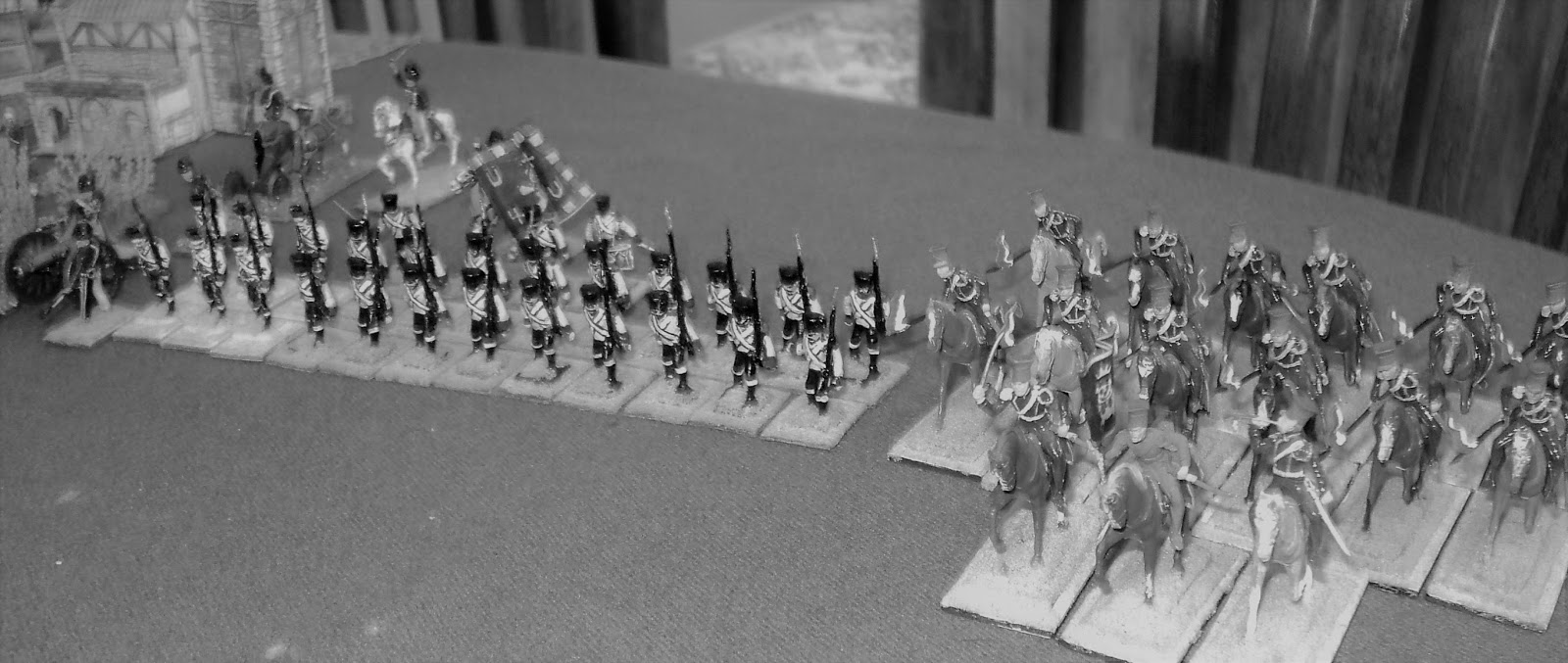
 I also found these laminated cardboard drawer file thingies.  A good size and height for my plastic figures.  Pictured is the army I built about 20 years ago for my daughter.  Recent readers might recognise it as the Royalist/Loyalist side in my recent narratives on the Gatonegro War of Independence.
Ursaminor infantry until recently. 4 Line, 1 Grenadier, and
1 Jager battalion.  There's supposed to be an extra Grenadier
battalion HQ in there somewhere...
Several years ago I got hold of a job lot of Airfix French artillery figures, with enough of the included marching infantry to form almost two further battalions.  Then four more arrived to make up the numbers.  For some reason I'd find one lot (the 34) or the other (the 4), never quite remembering whether or not I had the other lot, never quite being able to recall what happened to them, until recently.  That's what happens when you happen to be fossicking around for something and run across what you weren't looking for.

Ursaminor artillery, a militia battalion, and two new Line
battalions plus a new Grenadier Bn HQ.
Finally and at last, I've got them together, with some Airfix AWI British Grenadier figures, to form the 5th and 6th Regiments of the Army of Ursaminor (or the Estrada and Friol Infantry of the Royalist Army in Gatonegro).  It was time to desist with the teddy bear motif (sorry - Ursus Theodorus or displayed), in favour of simpler designs - Azure with two bendlets or for the 5th, and Chequey gules and or for the 6th.  Standing in front of the brown-jacketed militia unit is the HQ for the Guadix Grenadiers (drawn from the grenadier companies of 4th - 6th Regiments).  It took me three goes to get a satisfactory lozengy vert and argent flag for that HQ.
Trying out simpler flag designs ... 
The distinctive blue coats of 5th Regiment were due to most of those figures having been semi-painted when I got them.  The crowns of the shakos having been painted red, they became all red.  And 6th Regiment got grey shakos.  Sixth Regiment also got the 2 extra figures to become a 30-figure, rather than the establishment 28-figure unit.

The whole army (excluding the militia) comprises 225 foot, 60 horse and 18 artillerymen - 303 figures, with 4 cannon.  I'll need to find some suitable Brigade or Division commanders as well.


Wednesday, May 2, 2018

Insurrection - First Battle

Where we left the narrative last time.  The lancers are seeking
out the Insurrectionist right flank.
The first battle of the insurrection in Gatonegro could scarcely have been less sophisticated in its execution, but there was no denying its ferocity. As dawn broke over the dusty, scrubby plain south of Arabispo town, the Royalist lookouts could discern the steady approach of what looked uncommon like an army: uniformed and regimented, and even well enough armed. The insurrections were advancing in line, too, not something might expect of hastily trained troops.  (Fact is, it only crossed my mind later that the insurrectionists might have adopted columnar tactics.  On the other hand, the Yankee revolutionaries were not noted for tactics of that type...)
The view from behind Royalist lines.
The Insurrectionists approached with Buzbar and Carryon brigades side by side. The leading four battalions were arrayed in order, from the right flank, 3rd, 9th, 5th and 10th; the second line comprised 4th and 6th Battalions. Sufficiently well equipped with muskets though they were, they were altogether lacking in horse and guns. Heavily outnumbered as he was, Don Lardo faced the oncoming rebellion with confidence in his well-balanced forces and the training of his troops.
A rather fuzzy pic of the Lancers overrunning the rebel
3rd Battalion.
So confident was he withal, that, retaining his militia to garrison the town, he advanced to meet the enemy. A point to be made here is that for this action I used 'priority' chits, rather than the 'median' system used in the previous action. There being a total of 14 units and command staffs (figures) on the table, the chits were numbered 1 to 14, and each turn shuffled and randomly distributed among the units.  
Carnage of the Insurrectionist right flank - 3rd Battalion
overrun; 9th Cazadores decimated.


4th Battalion await their turn to join
 the fight
This proved rather unfortunate for the Insurrectionists' right flank. The Royalist Lancia d'Esci drawing a high number on the first move swung off slightly towards the open right flank of the enemy line. The following turn, they drew low, and promptly flung themselves upon the line of 3rd Battalion. Had the infantry drawn a low number, no doubt they would have formed square. Whether we put it down to lack of training, lack or awareness or simply surprise - the infantry were completely overwhelmed. The pitiful remnants fled incontinently from the field. Just two lancer figures were lost.
..
Action on the Insurrectionist right
With their blood up, and encouraged by their victory, the lancers plunged on, their target the reserve 4th Battalion some distance further on.
Action on the Insurrectionist left.
In the meantime, a savage firefight had developed in the centre. On their own, the 4th del Grado Regiment would probably have been outmatched by two Insurrectionist battalions, the firepower even, but numbers favouring the latter. But the Royalists had their artillery, and that made a big difference. They were also helped, as the rebels closed the range, by 5th Insurrectionist Battalion straying within range of some of the Loyalist militia in the town.
The fight was made the bloodier by the eagerness with which 4th del Grado closed the range. Ninth Cazadores soon broke, leaving a good half its numbers strewn about the field. The 5th Fusiliers were left desperately hanging on, until the 6th could intervene. That intervention brought new life into the Insurrectionists' main attack. It proved decisive.
On the extreme left of the Insurrectionist line, 10th Cazadores found themselves in a firefight with a company of loyalist militia, who had barricaded the main street of the town. Getting somewhat the better of this action, the Insurrectionists began to think about a direct assault, to unseat the defenders.
Loyalist militia defending the town.
Events had developed apace on the other wing. Emboldened by their easy victory over 3rd Battalion, the lancers surged on, to sweep into the line of 4th Battalion. Once again it was determined by the priority dice that the infantry would fail to form square betimes. All the same, the sketchily trained infantry gave a creditable account of themselves, and emptied many a saddle in the charge and in the melee.  It was to no avail, though. Having taken much the heavier losses in the melee, 4th Battalion soon followed their comrades of the 3rd from the field.
Both sides nearing the end of their tether - but,
less able to sustain the losses the Royalists
seem to be in worse case.

That victory proved to be the Royalist high point of the action. The collapse followed quickly after. Though 4th del Grado had carved great chunks out of two Insurrectionist battalions, the attack by another - the 6th - was the decisive moment of the battle. Fewer than half its numbers remaining with the colours, the Royalist regulars began to fall back in disorder. His lancers having not more than one charge left in them - if that - and the militia looking a bit battered as well, Don Lardo ordered the retreat to be sounded.   

The Insurrections had won.
4th del Grado Infantry about to collapse and fall back,
taking the rest of the Royalist Army with them.
This was a very quick action - maybe three or four turns, not more. But you will see by the state of the stricken field it was no light affair for the troops involved. Of the Royalist forces, 4th del Grado lost 15 from 28, the lancers 6 from 15 and the militia 5 from 19 - a total of 26 out of 67 figures.
10th Cazadores about to storm the town.  The Loyalist
defenders would quit the place before they came to blows.
Not having the details by individual units, I can only estimate Insurrectionist losses at about 40-odd.  Greater numbers, and hardly surprising given the disparity in combat effectiveness, but heavy as they were they were proportionately less than the Royalists'.  The Insurrectionist Army had been blooded (as well as bloodied), and, having won their victory, gained in confidence.  They began to think of themselves as veterans...

Fairly deliberately unbalanced - certainly asymmetrical - I was surprised in the event just how near a thing this battle turned out to be.  Having said that, I'll probably have just one more action with the Insurrectionists counting as 'militia', after which they will be ungraded to 'line' status, They will also, of course, have acquired some artillery and horsed troops meanwhile... Oh, yes: and numbers...

To be continued...

Tuesday, May 1, 2018

Insurrection - opening moves.

Morning of the battle. Royalist flying column arrayed about the
town; the insurrectionists drawn up to attack.
Continuing the theme of the Gatonegro War of Independence, we hark back to the opening moves of the colonists and native rebellion against the oppressive rule of the Reine de Oro. The very name 'de Oro' derived from the vast treasures extorted and looted from the colony; with no appreciable benefit - not even defence against hostile natives (they having been effectively exterminated) - being returned by the 'Mother Country'.
Insurrectionist army: two brigades of 3 battalions. 
No artillery; no cavalry, they are entirely reliant upon
numbers and righteous rage.
The Europeian Imperial Wars of the early 19th Century impacted severely upon the Reine de Oro; that seat of Empire had been forced somewhat to relax its imperial grip, whilst yet increasing its demands upon the wealth of the colony. Grumblings in Gatonegro grew to dissent, then to frank disobedience and finally to outright defiance. The spark was finally touched off at Arabispo, where a wagon convoy had paused whilst carrying treasure to the seaport and capital, Gatorado. The attempt to hinder the convoy's journey in the morning of March 20th descended swiftly into attacks upon the few convoy guards, a massacre of townspeople, and  the discovery that during the fracas,  some enterprising townspeople and visiting peons had made off with a considerable portion of the treasure. Two of the score of wagons had vanished, and the pile of loot had appreciably diminished in at least a couple more.
Royalist regulars.  In monochrome it is less fuzzy that
it was in colour!

Of course, the Gatonegrin  Vice-Regent could not be seen to tolerate such effrontery, and despatched a flying column to clamp his Imperial authority upon the town. Under General Don Lardo Bigboy y Pantalunas, a flying column set out for the week's march to Arabispo.  This column comprised;

Royalist Flying Column

General Officer commanding and Staff: Don Lardo Bigboy y Pantalunas.
4th del Gardo Infantry Regiment (4 officers and 24 men)
1st Lancia d'Esci (3 officers and 12 troopers)
Battery Imperial Artillery (1 x 6pr piece plus 4 of a crew)

On the way, this force picked up and included in its numbers:

1st Gatonegro Loyalist Militia (3 officers and 16 men).

Total, including the commander, 67 figures (at 1:20, call it 1,340 officers and men).  The regulars count as regular except the grenadier company (6 figures) counting as elite.  The Gatonegro loyalists count as 'Militia'.


Loyalist militia stand ready to defend the town.
Unbeknownst to Imperial authority, however, the seeds of insurrection had been sown long before the Arabispo incident. The Deputy-Mayor and Town Treasurer, one Jose de San Bartolomeo, had clandestinely been recruiting and pulling together an enthusiastic, if very amateur and sketchily trained, force of insurrectionists. Meticulous in organisation as he was with the Public Accounts, San Bartolomeo organised his little army into battalions and brigades. Though lacking on horse and guns, the 2000-plus strong force he has recruited he hoped would give a good account of itself, if presented with an opportunity.
Opening moves, with the insurrectionists surging towards the town/
Already they have reason to apprehend the moves of the
Royalist lancers...

This militia might never had been called out, had Don Lardo and his troops behaved with sufficient restraint upon their arrival in the Arabispo district. Launched more than reluctantly from his sybaritic existence in the Capital, Don Lardo was inclined to vent his resentment upon the townsfolk and local peasantry. Already exasperated, the local people grew desperate.  Within the week, San Bartolomeo determined upon calling out his militia to evict Don Lardo and his men from the town.  This militia comprised:

San Bartolomeo Militia (later dubbed 'The Patriot Army')

Commanded by Deputy Mayor Jose de San Bartolomeo
Brigade Henrico (Colonel Henrico Buzbar):
     3rd Fusilier Battalion
     4th Fusilier Battalion
     9th Cazadores Battalion
Brigade Miguel (Brigade-General Jose Miguel Carryon)
     5th Fusilier Battalion
     6th Fusilier Battalion
     10th Cazadores Battalion
(All six battalions comprise 3 officers and 16 men, all counting as 'militia'.  The whole, including generals, 117 figures [say, 2340 all ranks at the 1:20 ratio]).

To be continued:

Friday, April 27, 2018

Ciudad Ministerio de Hacienda - the Battle.

The Patriot Army about to spring their surprise upon the Royalists.

The stage having been set, and the prologue recited (previous posting), it behoves me to make some preliminary remarks about this action, and the troops involved. I also want to talk about 'play balance' in this scenario as adapted for this action.

The five Patriot battalions comprise two 8-figure companies plus 3-figure HQ element, are classed as 'militia' ('poor' in Developing Portable Wargames speak), and get 1 die per 8 figures shooting. The three Royalist Regiments comprise one elite grenadier, and three line infantry companies, with a 4-figure HQ element. Each company received one die shooting.

Two or three moves into the action.  The early exchanges
favour the Patriots.
In effect, that meant the Royalist infantry firepower was 20% greater than the Patriot. But in numbers, (not counting HQ elements)  the Royalists had 10% fewer in the firing line. To test the firepower balance, I conducted a 'paper battle'  as follows. 

Patriot                                                                 Royalist
Reduce Royalists by 1/6 of own strength            Reduce Patriots by 1/5 of own strength

80 - (1/5 of 72) = 80 - 14 = 66                             72 - (1/6 of 80) = 72 - 13 = 59
66 - (1/5 of 59) = 66 - 12 = 54                             59 - (1/6 of 66) = 59 - 11 = 48
54 - (1/5 of 48) = 54 - 10 = 44                             48 - (1/6 of 54) = 48 - 9 = 39
44 - (1/5 of 39) = 44 - 8 =   36                             39 - (1/6 of 44) = 39 - 7 = 32
36 - (1/5 of 32) = 36 - 6 = 30                               32 - (1/6 of 36) = 32 - 6 = 26
At this point both sides (adding in the HQ elements) have been reduced in the same turn. 

The point of this exercise was to demonstrate, in rather heuristic terms, that the infantry of both sides was evenly balanced.

Action becoming general on Jamon y Huevos's front.
The real difference, then, was the extra gun and the small cavalry squadron in the Royalist Army.  I hoped that the Patriots' first move (surprise) and the distribution of the movement 'cards' (actually decided by die roll) would balance those units.  They were as follows

Force                     Number of units      Die Roll 1-2                3-4                5-6
Royalist                 7                                                3                   4                   5

Patriot Main          5                                                2                   3                   4
Patriot Detached   3                                                1                   2                   3

This should confer a considerable advantage to the Patriots if the were lucky on their unit activation rolls.

Patriot flank attack developing slowly, but promisingly.
So what did the Patriots do on their first turn?  Rolled 'one'. Both commands. I'd say you wouldn't read about it, but you're reading about it here. So from Lopez's command, one unit - 10th Cazadores (a rather splendid nomenclature for a militia unit) - lurched out of the wood to the left rear of 1st Avocado  Regiment. Two battalions of the main body surged out of the scrub to the Royalist front.  
Mutual carnage: the Royalist Avocado Infantry, and Patriot
9th and 4th Battalions in a stand-up drag-out firefight.
For their part, the Royalists also rolled a 'one' for their first move. That mattered rather less. Avocado Infantry advanced to meet the enemy to their front, which took it considerably out of the range of 10th Cazadores' muskets. Less its grenadier battalion in the town, the 4th del Gardo Infantry wheeled to face the irruption of Lopez's command.
Things go wrong in Lopez's command (rolling 'low' activation dice.
Although the Patriots got the better of the initial stages of the firefight against 1st Avocado, the superior firepower of the Royalists, supported as they were by the gun battery and eventually the del Gardo grenadiers, soon restored the balance. The major part of the battle comprised the clawing and mauling fight between Avocado and the 4th and 9th Patriot battalions. Meanwhile, 4th del Gardo soon engaged 10th Cazadores before its companion unit, 6th Battalion could intervene effectively.


Somewhat surprisingly, the relatively untrained Patriot infantry stood up to the punishing firefight like veterans, steadfastly refusing to break whilst they had fight still in them. I use the 'old school' 50% rule in which a unit so reduces must withdraw from the fight.  However, tests of morale - I wasn't using a Strength Point system - were frequent events, on both side. Using a system vaguely similar to that of Terrible Swift Sword, low die rolls are what one hopes for here. At one point, having taken more than 40% casualties, 9th Cazadores rolled the '1' it needed to stay in the battle. Taking further losses, the unit routed next turn.  

By that time, the 4th were also near breaking, but their failure of morale led merely to a withdrawal in good order, facing the enemy.  


Fourth del Gardo Infantry was lucky to strike the 10th Cazadores momentarily unsupported. In the interests of getting into action quickly, the 6th Infantry burst straight out of the brushwood without wheeling. Even advancing past the 10th, that placed del Gardo out of arc, with the Avocado infantry far out of range. That might not have been so bad, but the subsequent 'low' activation dice indicated some paralysis in 6th Battalion command. When the shattered remnants of the 10th fled back into the undergrowth, Lopez at once recalled the 6th. Although del Gardo had taken some losses, it was unlikely that the 6th, though fresh, could win unaided a firefight with equal numbers of regulars.
Patriot 10th Battalion crushed before the 6th can help.
The main action was over as well. Little more than half its numbers still in the fight, Avocado Infantry drew back to its original position flanking the ridge beside the town. Ninth Cazadores had routed; nothing more could be demanded of 4th Infantry; which left the relatively fresh 3rd Battalion alone, staring down the levelled barrels of the advancing, hitherto unengaged 2nd Ballesteros Infantry. Lucky to have still a force in being, General Jamon y Huevos called the retreat. On this day at least, the Royalists could wear the laurels.
Close of the action.  Avocado Infantry have pulled out the
fight, but Ballesteros is about to take up the cudgels.  Patriot remnants
in retreat
At the time, this seemed such a one-sided battle (the respective losses were roughly 30-odd Patriot to maybe 16-18 Royalist), I thought I must have got the balance wrong. But the fact was that in no turn did the Patriots manage to roll two 'high dice' for unit activation, but they did roll two 'low-dice', once on the very first turn. That tended towards the Patriots coming into action piecemeal.  Another 'low' roll in Lopez's command left 10th Cazadores unsupported at a crucial moment. Even so, the Royalist were able to bring Ballesteros Infantry into action only as the battle was drawing to a close. The artillery on the Royalist far right never got into the fight at all. I reckon that with better luck on the first turn activation, the Patriots stood a good chance of rolling up the Royalist line.

Next time:  Battle of Arabispo, the opening action of the Gatonegro War of Independence.

Wednesday, April 18, 2018

Something Revolutionary...


... Or, if you prefer, 'revolting'.  Somewhat inspired - if that is the word I'm groping for, by a range of ideas concerning revolts, rebellion and insurrection  that have appeared in several blogs, I thought I might essay something of the same.  Not wanting to develop whole new armies I can not possibly accommodate, I was going to use my Napoleonics, when it struck me that I had two 'imaginations' Napoleonic-style armies that had been under-employed.

At first I was thinking of Bob Cordery's campaign idea from his Developing the Portable Wargame book.  I might still do that, but another idea presented itself.  A recent blog article referred to a Battlecry scenario based on the ACW Chancellorsville operation of May, 1863.  So, there you have it.

The action comes from the early days of the Gatonegro War of Independence for the Latin American Empire of the Reina de Oro.  The early revolt had not gone well, the Patriot Army of Gatonegro being brought to book holed up behind the Rio Blanco.  Strong as the position was, the Royalist commander, General Orispo, betook himself with half his army in a species of manoeuvre sur les derrieres around the rebel right flank and into their rear.  Had he at once attacked with the enemy so sandwiched, the revolt might well have ended then and there.  Instead, he hesitated, and began rather to hope that the rebel commander, Genl Jamon y Huevos would simply up stakes and retreat.  The Royalists might even catch them on the march.
The Patriot commander had no such idea in mind.  Figuring that 'two can play that game, he left a  single battalion of 3rd Brigade (5th) together with the bulk of his artillery to face the Royalist flanking force, then concentrated about the small town Ciudad Ministerio de Hacienda (which name, by the way, translates, more or less, as Chancellorsville).  Leaving General Don Luis Lolobargia Lopez with the two battalions of 3rd Brigade, Huevos made a flank march of his own, cut the South road and advanced upon the Royalists.  
Made somewhat aware of movement to the south, the Royalists turned to face the threat, unaware that a significant force lay in the brushwood country to the northeast.  As dawn broke over the dusty landscape on 1 May, 1818. The woods around Ciudad de Hacieda woke to the shrieked Rebel battlecries, the rattle of musketry and boom of cannon...
This game is to be played on a free board using my own Corsican Ogre rule set, but with some tweaks for solo play.  The forces are:

 Royalist Army:

General Orlando Orispo (1 figure)
1st (Avocado) Battalion (28 figures)
2nd (Ballesteros) Battalion (28 figures)
4th (del Gardo) Battalion (28 figures - 6 grenadiers plus subaltern detached to garrison the town)
Squadron Lancia d'Esci (7 figures)
2 sections 6pr artillery (2 guns, 8 figures).

Total: 100 figures: 1 General/staff, 84 infantry, 7 cavalry, 8 gunners. 


 Patriot Army:

General Marco Jamon y Huevos (1 figure)
2nd Brigade:
     3rd, 4th Infanteria, 9th Cazadores (each 19 figures)
     section 6pr artillery ( 4 figures and 1 gun)
3rd Brigade: General Don Luis Lolobargia Lopez  (1 figure)
     6th Infanteria, 10th Cazadores (each 19 figures)

Total: 101 figures: 2 Generals/staffs, 95 infantry, 4 gunners.
Though the numbers are equal, the forces are qualitatively very different.  The better trained Royalist regular infantry, though fewer in number, have the greater firepower.  The Patriots, however, get to move first. The move generation system in which the number of units allowed to move is half plus or minus one for each army, will apply separately to the separate Patriot commands.  The Royalist Army counts 3 infantry, the cavalry, the 2 guns and the commander as 7 units, so will move 3,4 or 5 units per turn.  Of the Patriot Army, Huevos will move 2,3 or 4 units, Arieaga will move 1, 2 or 3 units.  This does not apply to shooting, which is automatic for any units with targets in range.
The cannon, gunners and Royalist Infantry are Airfix French all from the artillery set, except the grenadiers which are AWI British Grenadiers.  The Lancers are ESCI (you guessed that, didn't you?), and the Patriot foot are I think Revell.