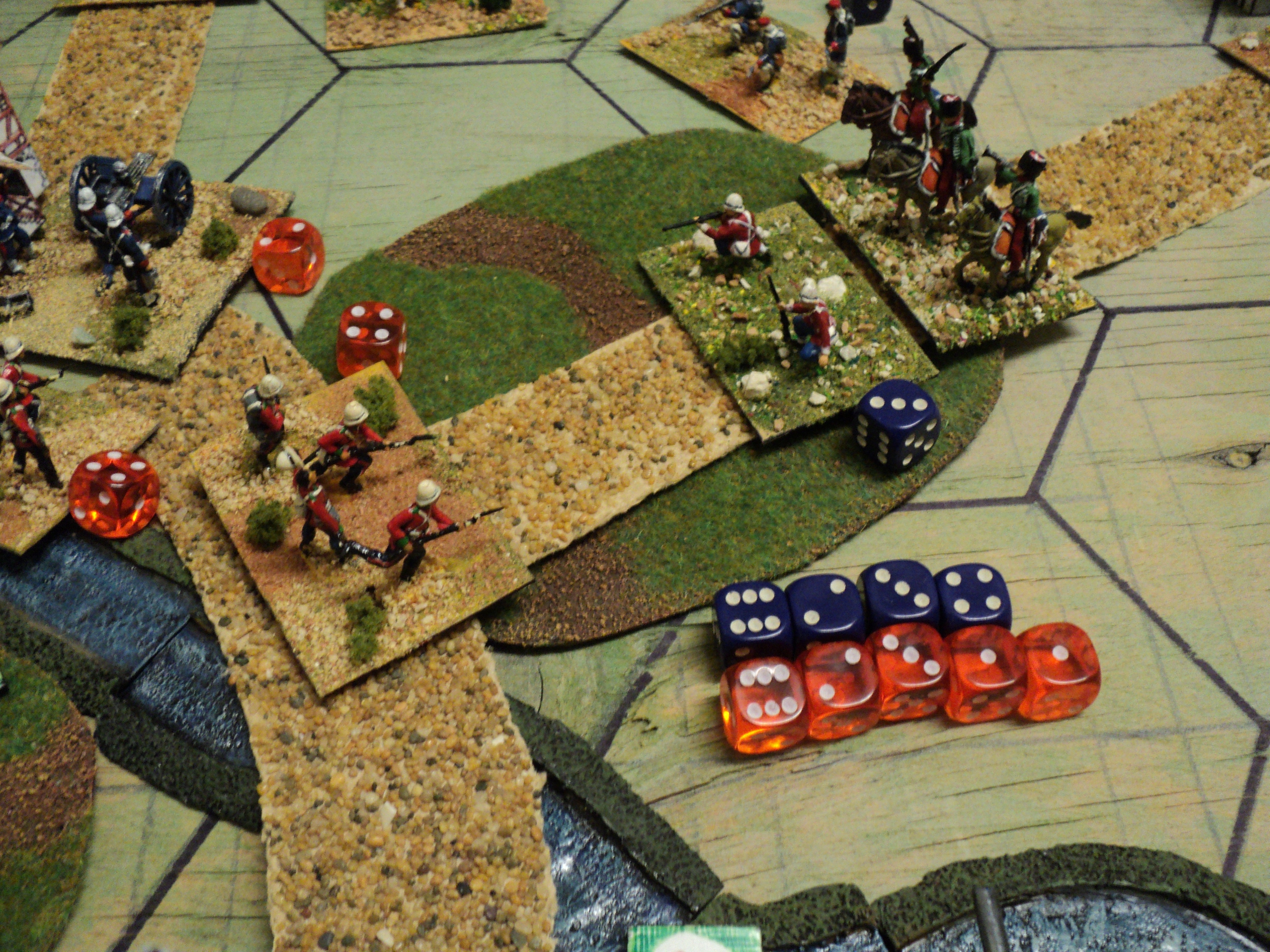
Cambridge Examiner. 17 September. Daybreak.
"The day has begun as it ended last evening, with Cerulean Cavalry pushing up the Ashdon road from Haverhill, and encountering our cavalry. Fifth Dragoons set them at once to the rightabout, the depleted remnants of 2nd Cavalry Brigade fled through the town, and now the enemy horse are quite without their artillery. What remained of their horse guns were overrun, captured or destroyed by our horse.
"After this second victory, the enemy horse retreated behind the Stour River on the Brinkley road. It is very doubtful that we'll be seeing much more of them in this quarter."
Cambridge Examiner. 17 September. Ashdon. Mid-morning.
"With reason to anticipate a renewal of an enemy advance from Haverhill by Cerulean infantry, Col Briggs has brought his command bask to about a mile or so east of Ashdon. There he has formed a line for dismounted defence, covering the village and also the diverting of General Rawlinson's Division onto the Radminster road. The enemy appear to be developing a threat from the region of Stoke-by-Clare and Birdbrook. This, Rawlinson has set out to meet.
Cambridge Examiner. 17 September. Great Abingdon. Morning.
"Placing 11th Brigade with the machinegun company within the town's precincts, Major-Genl d'Oyly Snow has deployed his other two brigades on either flank: the 10th to the right upon the elevated country to the southeast; the 12th on the left, their line stretching almost as far as the Gogs heights. We can see the enemy approaching down the Fulbourn and West Wrattling roads. The GoC 4th Division is confident of holding his line."

Haverhill. 17 September. Mid-morning.
"Scouts and refugee stragglers report the approach of two brigades of Cerulean Infantry from Brinkley, towards Haverhill. It seems that Col Briggs's line will be tested by late morning or early afternoon by the weight of much of the enemy 2nd Division - 5th and 6th Brigades with artillery support. Some apprehension awaits the outcome."
Haverhill. 10 A.M. - 12 M."Rather than await the enemy onslaught, Col Briggs, in the temerarious manner that seems with him to have become habitual, ordered his line to advance to meet the enemy on the road just emerging from Haverhill village. Catching the enemy columns before they could properly deploy, 4th Light Brigade smote the enemy a blow that left more than half the command dead, wounded or prisoners. Such was the enemy's resistance, however, that 4th Light themselves did not come off unscathed. But the enemy have been given, in this part of the battlefield at least, something to think upon."
Editorial Comment. Morning, 17 September."Col Briggs and his troopers have covered themselves in glory this day. In less than 24 hours, they have won signal victories in three separate actions along the Ashdon-Haverhill road, sent 3 enemy brigades packing, and overrun a Division's park of artillery. If the rest of the army could have achieved half as much in the time, the Cerulean invasion will have been ignominiously thrown back."
Cambridge Examiner. Haverhill. 17 September, 12M-2P.M."The Cerulean invaders seem hard to discourage. Repulsed three times, here they come again, the fresh 6th Brigade leading, the battered 5th in support, and behind them the Divisional artillery.
"This time, the attack appears to have been better coordinated. The Light Brigade, somewhat worn after its earlier engagements, has been driven back with heavy loss. Following up, the enemy infantry reached the Divisional gun line. Firing over open sights and fuzes set at zero, the horse guns exacted a heavy toll before at last being overrun. Staggered by such resistance, the enemy tide once more began to recede.
Following up this hard-fought repulse, the Dragoon Brigade struck the left front of the retreating enemy, whilst the battered Light Brigade ventured a mounted frontal counter-assault of their own. Such was the impetuosity of this counter-blow, that only shreds the two enemy brigades staggered back into Haverhill...
... but those remnants put up such a stout resistance at the edge of the town that the Light Brigade, having totally exhausted its strength, finally had to retire from the field to regroup. Even so, it was not to be the end of the fight for the cavalry."
Haverhill. 3P.M.- 6P.M. Late Afternoon - Evening."Colonel Briggs leading the charge, 5th Dragoon Brigade thundered into Haverhill, scattered the last vestiges of enemy resistance there, and tried to bounce their way across the Brinkley Bridge to come at the enemy field guns beyond. Unable to force the bridge, the dragoons abandoned their counter-attack just as the sun was setting. In the gloaming Col Briggs was seen in the forefront of battle, a shell exploding beneath his horse. Abandoning the town the dragoons drew back at their leisure towards Ashdon. With due care, they carried the body of their commander with them."
Editorial Comment: Colonel Briggs.
"It is with sadness that we mourn the loss of possibly the most promising junior field commander of cavalry our Army had to show. That such a one, not having yet reached a general's rank, should have been placed in command of a Division bespeaks not only of that soldier's capacity and record, but also of the recognition and trust accorded him by his superiors in rank. He first came to notice during the various adventures of our forces in Aethiops and Rajistan, and, having recorded already an illustrious career, had yet a glittering future before him. This nation could ill have afforded such a loss."
East Anglia Evening Standard. 17 September. Breaking: "It seems that Colonel Briggs was not killed or mortally wounded, as reported, in the late afternoon affray at Haverhill, although he was indeed seriously injured. His troopers gallantly bore him away from the town, whence he received preliminary first aid at the Divisional field station behind Ashdon, before being carried off to the military hospital that has been established near Whittlesford. Reports indicate that the good Colonel is likely to live, and within weeks ought to be able to resume his soldierly duties. We join the nation in expressing its joy at this good news."
Cambridge Examiner. 17 September. Ashdon-Radminster-Birdbrook. All day.
"Enemy cavalry observed approaching Radminster, General Grierson directed Rawlinson to take his whole command in that direction, secure Radminster, then to push on to Birdbrook and Stoke-by-Clare. The plan, as vouchsafed to this correspondent, was push in the enemy flank, envelop the enemy left, and roll up the whole twenty miles or so of enemy front.
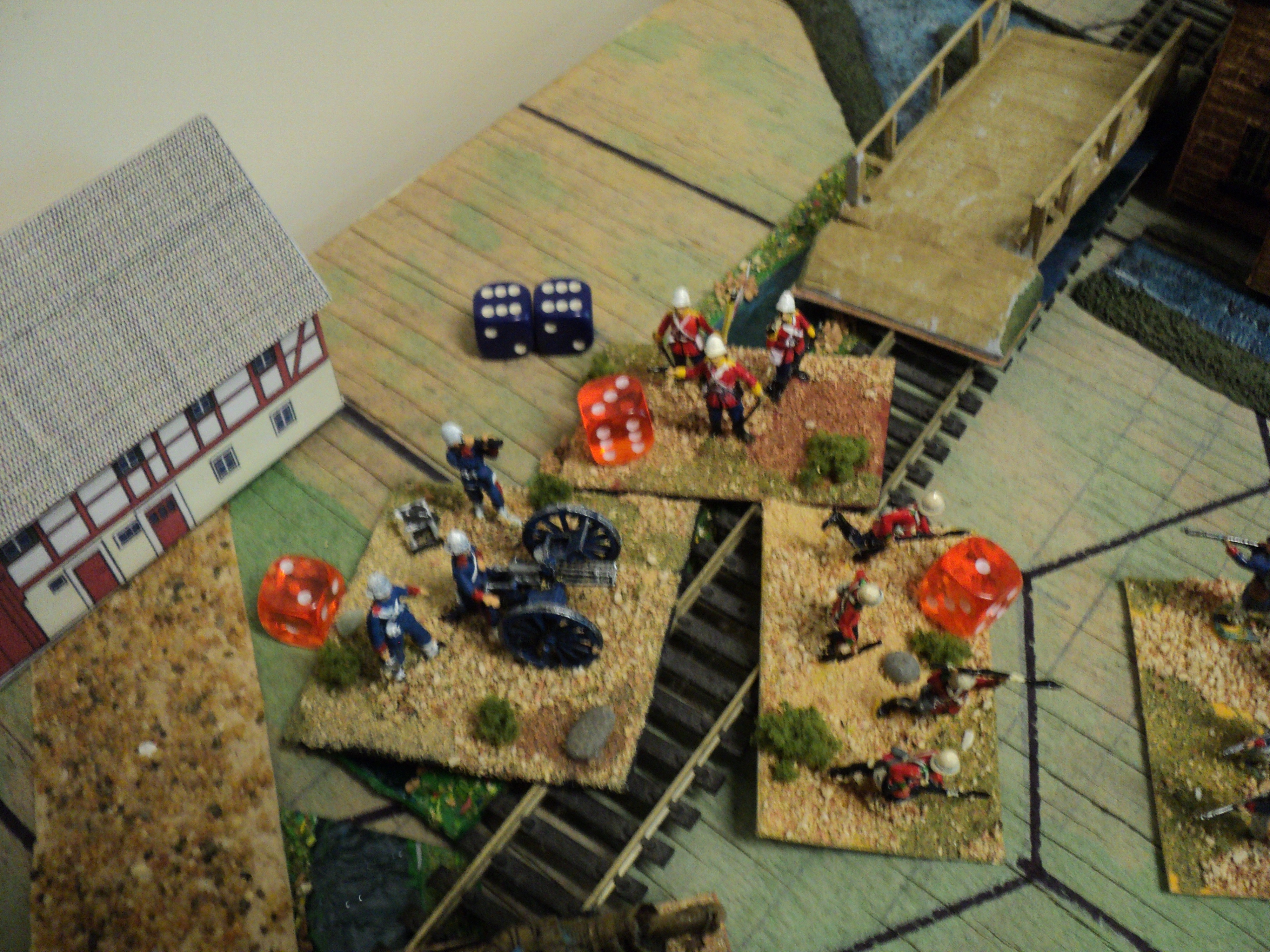
"In the face of the Division's march, the enemy screen, identified as elements of 3rd Cavalry Brigade, fell back alacritously to Birdbrook village. Our 3rd Division followed up with equal vigour - possibly too hastily, withal, for 8th Brigade, pushing rather ahead of the 7th (Highland) on their left, ran into a body of Cerulean infantry on the road outside Birdbrook. Supported by the Gatling company as they were, 8th Brigade soon heard the sound of enemy Gardner guns that had been attached to the enemy 4th Brigade.
"Indications are that 8th Brigade ran into something of an ambush, as, although the impetuosity of our advance reached and carried the machine gun line, the exorbitant cost left barely a quarter of the Brigade's infantry under immediate command. Repulsed, and about to fall back, the men fought off a mounted cavalry charge, but the damage to 8th Brigade, according to sources close to General Rawlinson, suggest a considerable blunting of the Division's striking power.

"Falling back towards Radminster, 8th Brigade was pursued by the enemy. Administering a sharp rebuff to 3rd Cavalry Brigade cost the 8th all cohesion among its infantry (
reduced to 0SP), though the gallant Gatling gunners continued to maintain a line.
"As night drew in, 3rd Division's front was but 2 miles east of Radminster. The Highland Brigade (7th) was brought across to relieve the 8th, whilst the latter formation rallied and reformed during the night hours."
Editorial Comment."The rashness of 8th Brigade may have gone a long way towards undoing the great work carried on by Briggs's cavalry. It is disappointing to learn of such heavy losses among our men, even though the enemy are several cavalry and machine guns the fewer. General Rawlinson is probably wise not to relieve the Brigade commander of his post. His failure was not due to want of conduct, but perhaps an excess of it. Sins of commission are more deserving of forgiveness than lapses into omission. Whilst the battle is yet unresolved, perhaps the Brigadier will be afforded an opportunity for redemption. Let us hope so."
Cambridge Examiner. 17 September. Great Abingdon. Morning.
"The first contact of the morning on the front of 4th Division, apart from some ineffectual gunfire from the enemy's heavy artillery, arrived in the form of a probe by the enemy 1st Cavalry against the 10th Brigade, on the right of the Divisional line. This probe soon escalated into a assault that drove in the 10th's forward defence screen and sent the whole brigade tumbling across the Chanta river.
"Over-elated by their unexpected success, the enemy cavalry pressed on towards the town of Great-Abingdon itself - where they were devastated by the steady rifle and machine-gun firepower of 11th Brigade. Within the hour, 1st Cavalry Brigade was reduced to a scattering of fugitives fleeing the field, all cohesion gone, and out of action for the rest of the day.

"Yet their rout carried for the Cerulean invaders the seeds of victory. No sooner had the cavalry been seen off, than 11th Brigade came under attack from almost the whole of the enemy 1st Division. Tenth Brigade attempted to relieve the pressure by recrossing the river without opposition, and reoccupying the ground from which they were driven. But it was too late. So determined was the enemy attack, that barely half 11th brigade survived to be driven from the town, fortunate, perhaps, to have saved their machine guns. These were at some point moved across to the as yet unassailed 12th Brigade, whilst the Divisional artillery was brought up to reinforce the garrison.

"That move availed them little, as by noon, they had returned to the west bank of the Granta stream along with the survivors of 11th Brigade.
"On the wings of victory, the enemy commander, Major-General Sam Lomax, turned his attention to what remained of our bridgehead across the Granta. Clearly the formation he commands, the enemy 1st Division, is highly skilled in attack, for, within two hours, its troops had hustled 12th Brigade across the stream, half its strength left behind
hors de combat or prisoners of war. Again, they were lucky to save their machine guns.
"Lomax was not prepared to let matters rest there. Turning his attention to his left, he brought 10th Brigade under attack, supported by the Army's heavy guns, and drove them back. This time, the 10th crossed the river into Linton, covering General Grierson's HQ and our own heavy ordnance. Counter-battery against the enemy artillery reserve had barely any effect in assisting the infantry of 4th Division."
"Probably Grierson would have been wise to have brought his HQ and guns back to Bartlow, but, report has it, he opined that from Bartlow his guns would be out of range of targets he wished to reach, and his link with 4th Division was already tenuous enough."

Editorial Comment:
"This day has been a dark one for the Cinnabar Royal Army, the brilliance of the Cavalry's success failing to relieve the gloom cast by our repulse at Birdbrook and our abandoning of Great Abingdon. The injury to Colonel Briggs alone is enough to dim that shining light.
"Wherefore these failures? It seems that the rash advance by 8th Brigade put the whole 2nd Division plan at hazard, the other brigades of which were scarcely engaged. But what happened to 4th Division came as a great surprise, defeated across its whole front. Whether this was due to a failure of command or of the fighting soldier, no doubt a Court of Enquiry shall determine, but one is mindful of General Bonaparte's dictum: 'There are no bad troops; just bad colonels.'
Thrown back onto the defensive, no doubt our troops and their commanders will be preparing to meet the enemy onslaught tomorrow..."
East Anglia Evening Standard. 17th September. Dusk.
"The guns have fallen silent, as our army rearranges the lines and beds down for the night. No doubt much the same thing is happening on the 'other side of the hill'. Two miles east of Radminster, 7th Brigade has relieved the 8th astride the Stoke road, reinforced by the Divisional machine-gun company. Ninth Brigade stands in the centre, whilst the 8th, reduced to half its original strength, prolongs the Division's line towards the Ashdon-Haverhill highway.

"That road and railroad are themselves commanded by the weary Cavalry - the Dragoon Brigade dismounted astride the road backed by the horse guns; the Light Brigade in reserve behind 8th Brigade, preparing for mounted action. Both formations have been much reduced by the day's actions, though all agree that they would not trade those losses for those they inflicted upon the enemy.
"We are told that General Grierson is maintaining his rather exposed HQ position at Linton, covered by 10th Brigade and the heavy guns, in order to maintain some sort of link, however tenuous, with 4th Division. Major-General d'Oyly Snow's command, less 10th Brigade, has been withdrawn a couple of miles behind Great Abingdon and the River Granta. There seems to be a good four-mile gap between 10th Brigade and the rest of 4th Division.
"Despite the misfortunes of the day, the troops seem to be in good spirits, and their steady demeanour bespeaks a determination to reverse the outcome tomorrow."
"The occasional refugee or straggler arriving across no man's land during the evening indicate some activity among the enemy units overnight. The Cavalry, we are told, has concentrated for the first time, and that about Stoke-by-Clare. Second Division appears to have gathered about Brinkley or West Wrattling, and First Division in and about Great Abingdon. What these reported moves portend - supposing the reports to be reliable - we shall know, I dare say, at daybreak tomorrow."
To Be Continued...


.jpg)
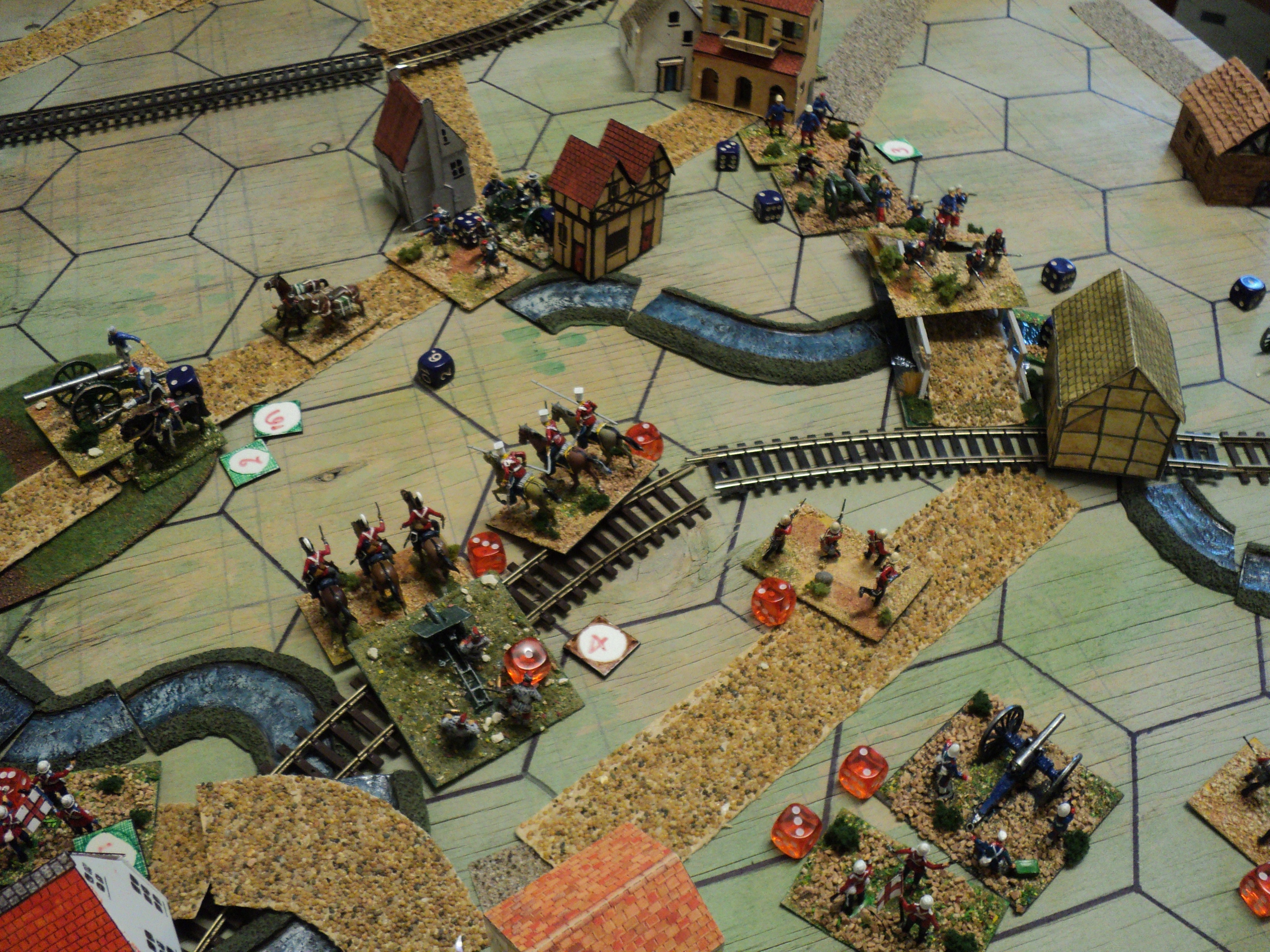


.jpg)




.jpg) Birdbrook. Noon.
Birdbrook. Noon.