Wednesday, December 19, 2012

Ulrichstein Campaign: Battle of Zaltpig, Part 3.

Whilst the Electoral forces seemed to be carrying all before them to the west of Zaltpig town, the lonely Pandour company garrisoning Stumpy, far to the north, was coming under increasing pressure in its own private battle. During the course of the day, the Pandours would face up to six times its own numbers.  With nearest friends at least half a mile off, their sense of isolation was complete.

The village of Stumpy.  The Pandour garrison in firefight
with the rebel 7th Jagers.  Tenth battalion moving up
prepare to storm across the bridge.
Getting the worse of the firefight against this garrison, the Jagers' call for help was answered by a column of 10th Battalion, which dashed over the bridge and into the hamlet. At once the roar of battle intensified, as the rebel column, narrowed owing to the defile through which it had to pass was met in  the barricaded village street by a half-company of Pandours. 
The village of Stumpy.  The 10th Battalion assault.


Having reinforced the attack on Stumpy, General Arnim of 3rd Brigade directed the other two battalions, 5th and 6th, to swing to their right to join 2nd Brigade's 9th Battalion in enveloping the right flank of the main Electoral army. However, Marshal Noailles felt the moment propitious to countermand the order to 6th Battalion, and directed that unit also towards Stumpy. Time would tell if that decision was a wise one.  
The Rebel left.   In the distance the fight against Pandour
skirmishers and Winterfeldt Infantry.
  Ninth Battalion of 2nd Brigade, and  5th Bn or 3rd Brigade
move up to envelop the Electoral flank.  In the foreground,
6th Battalion has been diverted towards Stumpy.


What led the Rebel commander to it?  His right and centre were still under intense pressure, losses had vastly exceeded his opponent's, the enemy was gaining ground, albeit slowly; yet he gave an air of confidence that assuaged the agitated anxiety of his largely civilian staff.
The rebel centre.  The Electoral forces make
slow progress, but are advancing yet.  But Winterfeldt
in particular is beginning to look very tired.  Standing on
the hill near the gun battery, Marshal Noailles found this
encouraging.
The fact was, the Electoral army was showing signs of tiring.  The smaller fighter, it was running out of stamina.  Having driven back 11th battalion, and almost destroyed the 8th that took 11th's place; having helped see off the gun battery to its left front, Winterfeldt still found itself beset by two battalions from the Rebels' 2nd Brigade and the return of the 11th.  The Pandour Company, too, was feeling the gunfire to its right.  And not far off the last battalion of 2nd Brigade (the 9th) could be seen drawing closer.

The rebel centre.  The remains of 1st Battery making off
with its guns.  The electoral infantry are doing well enough,
but are becoming aware of the approach of  fresh
enemy troops on their right.
To the south, Diericke Fusiliers had just about destroyed the enemy's 1st Battalion, and saw off the counter-attack by 2nd Battalion in almost as brusque a fashion.  Yet it seemed to the Electoral troops that their efforts to advance were being stymied by numberless hordes of armed rebels coming the other way. The cavalry were even more frustrated. At last the 1st Squadron of Prittwitz Cavalry was forced to give way. As the heavies fell back to the river, the lead squadron of the Black Hussars surged up the slope hoping to catch the rebel troopers still disordered. In this they were not quite successful...
The rebel right.  The unequal firefight between Diericke Fusiliers
and 2nd battalion ends with the rout of the latter.  Meanwhile the
cavalry fight rages on undecided.


In the circumstance, Marshal Noailles thought it very desirable that Stumpy hamlet be taken, lest the enemy, breaking off the action, established himself firmly on the far bank of the Binge.  There he might remain a menace to the rebel cause sufficient to induce him to leave behind a force to contain him when he set off to try conclusions with the Imperialists.  If he could, he was going to take his whole army.  That meant having to eliminate from the reckoning, at least for the time being, this whole Electoral corps.
Stumpy village.  The hand-to-hand fight in the street.
 The garrison see off their assailants, but are themselves
forced to abandon the village.
It was as well 6th Battalion was marching to support the 10th. The latter unit stormed across the bridge whilst the Jager poured in a supporting musketry. In rushing the bridge, the 10th lost some 40 men (2 figures), not enough to stop them closing right up to the barricades. Yet the half-company detailed to defend the barricades had little difficulty in seeing off the enemy. Though giving as good as good as they received in the hand-to-hand struggle (20 men, or 1 figure each), the rebel morale cracked (having lost 60 men overall in the encounter), and 10th Battalion fled back to the west bank.

Stumpy village.  As the Jagers swarm through, 6th battalion
follow up.  There will be no recapture of the place.
For the Pandours, however, it was all too much. Having themselves lost 40 men (2 figures) to the Jagers' supporting fire and a further 20 (1 figure) the fight in the street - a third of the 180 men they began with, the Pandours incontinently abandoned the village. At once the Jagers could been seen swarming through the main street, the enemy 6th Battalion not far behind.
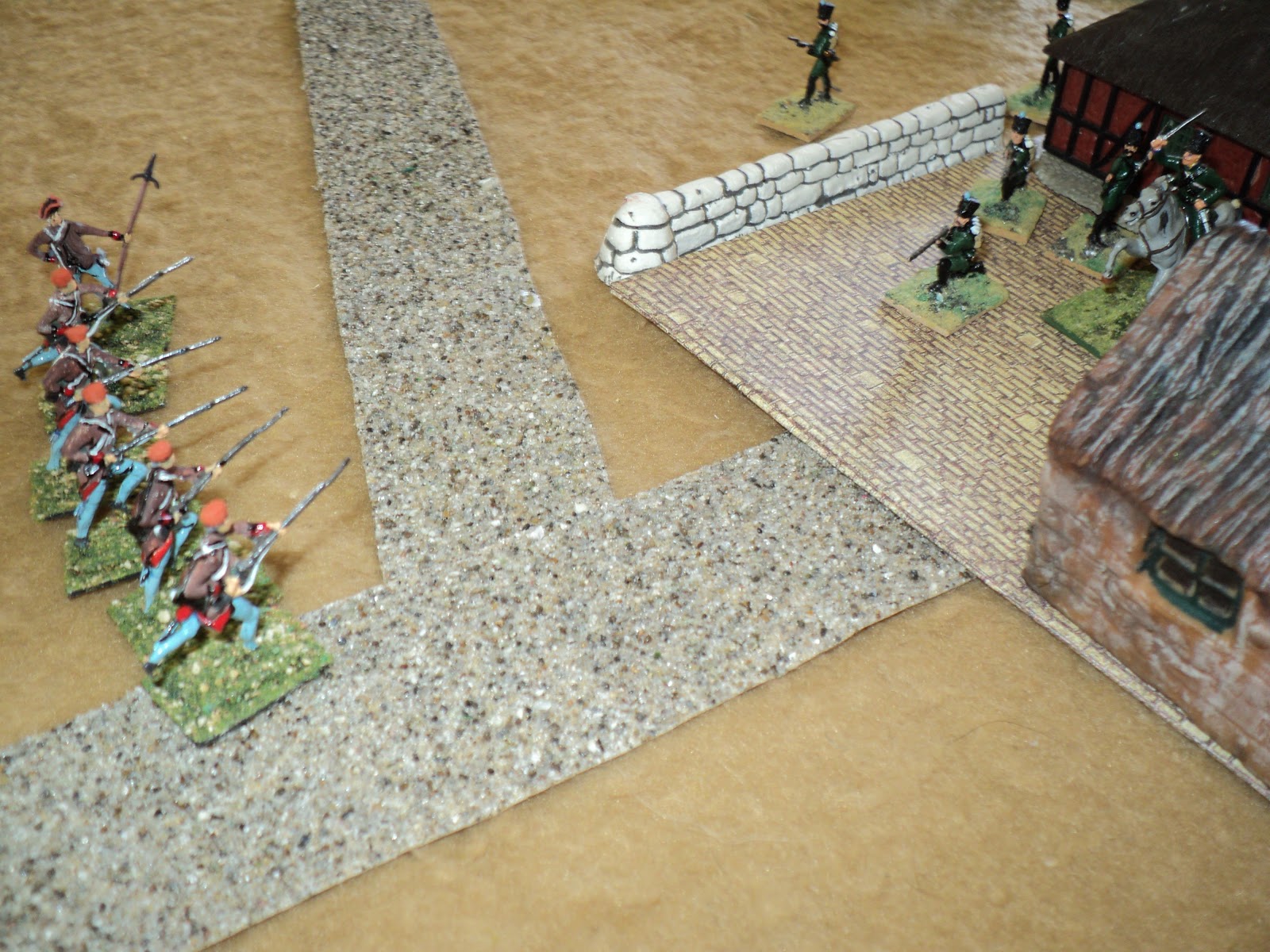
Stumpy village. Though forced out of the hamlet,
  the Pandours remain perky enough to present a bold front to
the superior enemy numbers.


Although the fall of Stumpy was no serious matter - indeed, General Plodt had counted upon the enemy's devoting a considerable proportion of his strength in carrying the place - nevertheless it seemed to signal a change in the fortune of battle. For all the damage wreaked upon the rebel battalions, more and fresh troops were coming up and taking the fight to the Electoral forces. Themselves weakened by earlier encounters, the latter were finding it harder each time to fling them back so peremptorily. Under gun and musketry fire, their right flank in the air and approached by strong enemy forces, the decimated Pandour company fell back to the river line. Few rallied to the trumpet call at the end of the day.
The view from the east bank of the Binge.  The situation
does not look very encouraging for General Plodt.  
The Pandour company has fallen back to the river
with terrible losses (80%).
Despite the enfilading gunfire from across the stream, 9th Battalion  is
pushing resolutely forward to engage the Winterfeldt right flank.
Yet, further to the south (just out of the picture at left) 2nd battalion went the way of the 1st, and for the moment it seemed that perhaps the Electoral troops were on the verge of destroying the rebel right, and securing a famous victory. Although the survivors of 11th Battalion had rallied betimes and were once more in the fight against Winterfeldt, they were pretty much all that was left amid the wreckage of 1st Brigade.  As for the rebel Horse, they were down to their last reserves, and had not only the Electoral cavalry still to face, but also the victorious Diericke Fusiliers...

To be concluded...

Sunday, December 16, 2012

Ulrichstein Campaign: Zaltpig, Part 2

 The above sketch map depicts the opening action of the particularly sanguinary battle of Zaltpig.  East is at the top of the sketch.  Having formed up in lines upon the west bank of the Binge River, the Altmark-Uberheim troops found themselves almost at once assailed by the first line of rebels.
The knowledgeable reader will no doubt have observed in this map, if not in the earlier pictures, a marked similarity to the field of Paltzig, fought in Prussia in 1759.  This is no coincidence.  In  my thinking about what sort of action to be fought, this 'scenario' came to mind...
The cavalry fight begins, with honours even.  However,
the Rebel Cuirassier squadron panics and breaks.
 Upon the ridge south of the town, the rebels gave as good as they got, the hussars in particular fighting their heavier and better trained opponents to a standstill.  Yet the Rebel heavies gave way to a needless panic, broke, and fled to the rear.  The second squadron was quickly on hand to take up the fight, but not so quickly that the Electoral Horse were unable to rally betimes.  Meanwhile, the hussars' fight continued on.
(Readers will also note that the cavalry action on the ridge turned into a protracted affair.  For the sake of interest, I elected to fight the action using squadrons (two per regiment) as the tactical unit.  The narrowness of the front, which could accommodate just two squadrons at a time, and the time it took to bring reserves up, meant that instances were rare in which squadrons were caught still disordered from the previous combat.  I'm inclined to think that maybe that was indeed how cavalry actions were conducted.)
The cuirassiers' 2nd Squadron takes up the fight.
 The infantry fight became at once a vicious close range duel in which casualties on both side mounted at a rate to concern both commanders.

Heavy losses on both sides
 Having with the help of the gun battery to their left considerable losses to the Diericke Fusiliers, 1st (Lobrau) Battalion lost at least as heavily in the first moments.  But confused and bewildered by the smoke and noise of battle, their effectiveness fell away, blazing away aimlessly into the murk.  Not so the Fusiliers, whose musketry continued with horrible effect, reaping a deadly harvest among the brown-coats, and taking a toll upon the rebel gunners as well.
First (Lobrau) Battalion in a deadly duel with
Diericke Fusiliers.
 In the centre, 11th battalion had fallen back with heavy loss in the face of Winterfeldt's disciplined platoon fire.  Quickly advancing to fill the gap, 8th Battalion received a rough welcome to battle, losing perhaps 60 men  (i.e. 3 figures) before firing a shot.  Fortunately their high morale kept them in the line.
11th Battalion having fallen back, 8th Battalion comes under
heavy fire as it tries to plug the gap in the rebel line.


The lead battalion of 2nd Brigade, the 3rd, were finding the Pandours difficult targets to hit, and were also barely maintaining themselves in the fight.  Fortunately, it was the effective canister fire from the 2nd gun battery to their left rear that evened up the fight.
3rd battalion barely holding its own against the swarming
Pandours.  The 2nd Field coy sustains them in the
unequal fight.
 The Electoral guns, on the other hand, might have been better employed on the west side of the river.  Where they stood, they gave little enough assistance to the infantry on the far bank.   But General Plodt had had to apprehend the possibility of a rebel envelopment from the north, where he had only the Pandour company in the Stumpy village to oppose a crossing.  
A rare 'hit' by the Electoral guns.

The guns remained where they were to cover Zaltpig town and its river crossings from the north.


The garrison at Stumpy: a company of Pandours in a popping
musketry contest against 7th Jager.


There the Pandours were actually doing quite well for the time being, firing from the cover of the buildings, wall and fences, and making life difficult for the Jager Battalion, despite the latter's two to one odds.


 In the centre, the electoral infantry continued to edge forward as the rebel line crumbled before them.  For the next hour it seemed to Marshal Noailles that the ratio of losses were showing a worrying trend in his opponents' favour (In fact, the second (23-8) and third (20-6) bounds of shooting cost the Rebel Army three times the losses the Electoral Army was taking, and they were heavy losses, too: more than two battalions' worth).  


 His troops were feeling it, too.  The leading Hussar squadron broke and fled the field,  and the pitiful remnants of the once-proud 1st Battalion made off as best they could under fire.  The rebel gun battery that had done much to support 1st Brigade, suddenly found the enemy had pushed right up the muzzles of their cannon.  Gunners began to fall at an alarming rate.  Just barely in time, the remaining gunners hitched up the guns and made off.


  Yet for all that, the rebels continued to maintain a front on the south flank.  The Cavalry commander, General Maxim Trumpeter, flung in the reserve squadrons.  Not yet were the Prittwitz  Cuirassiers able to advance off the hill.  Second Battalion also took up the fight 1st Battalion had begun so well but failed to maintain.  Though taking heavy losses almost at once, they were to frustrate the Diericke Fusiliers for another half-hour.
To be continued...

Ulrichstein Campaign: The Rebels clash with the Army of the Elector.

Marshall Noailles's sketch map of the strategic
situation in Northern Ulrichstein in early March 1739.
As the the forces of the Herzogtum marched south to face, and with luck, perhaps to stop or at least delay, the Imperial Army, the main Rebel forces - the Army of the Republicke of Godde - went east to try conclusions with the corps of Altmark-Uberheim troops at Seehausen.  For his part, the Electoral General Plodt chose not to wait, but directed his army west towards the seat and sole possession of the 'Republicke', the town of Zerbst.  The sooner the revolt could be defeated, the sooner his troops could go home.

Rebel army
 Owing to the heavy traffic that had been allowed to continue between Zerbst and Seehausen, both sides had a fairly exact appreciation of the troops available to each other.  In raw numbers the rebels were fielding double Electoral strength, and double the guns, too.  But the lack of training was a source of worry to Marshall Noailles.  The numbers of Electoral horse almost matched his own.  He would have to hope that his relatively unskilled horsemen count account for themselves sufficiently well largely to neutralise that threat.  For the rest, he would place his reliance upon his great superiority in foot and guns.
Electoral Corps

General Plodt, for his part, was aware that the superb discipline and training of his troops would multiply his slender numbers.  The question remained, however: by how much? As his Army marched west, a mere 2700 (135 figures) strong, he sought out a position in which to make a stand. But time was enemy to both sides in this campaign. Although in ordinary circumstances he would wait for the enemy to come to him, such a policy could not prevail in a hostile country in which anyone he met could prove an enemy.  Further, there was the danger that the Rebels could slip away, and with a day's start, strike at the Imperial Army before he could intervene effectively. Besides, his Master the Kurfurst expected him to show aggression, and to carry the fight to his opponent...
The general situation as the battle of Zaltpig opens.  The view looks
from behind the Rebel left flank towards the south-east.
Approaching the small river town of  Zaltpig, Plodt saw a chance where an attack might succeed.   To the offer of battle along the swampy Binge River, Marshal Noailles deployed in two lines of infantry facing eastwards along a line of ridges, with all his cavalry on the southern flank plain. His Jager Battalion - the 7th - swarmed over the north end of the ridge toward the Stumpy Hamlet river bridge.  Within the Hamlet lay a company of Pandours, forming a kind of prolongation of the Electoral line, or perhaps a species of flank guard.
Action about to be joined on the south flank
General Plodt had indeed refused his centre, leaving his battery firing over the river from an eminence north of Zaltpig itself. For the rest, his horse and foot were marching as quickly as they might over the town's river bridges. Plodt's purpose was not passive defence. His battle line forming before the rebels could effectively intervene, he planned to crush the enemy right,  and roll up the line from the south. If his cavalry threw back the enemy, well and good, but he would be satisfied with neutralising the rebel horse to let his infantry tackle the 'rolling up.'

A cavalry fight and opening volleys: the blood letting
begins.
So eager were both sides to come to grips, battle was quickly joined. Prittwitz cavalry clashed with the leading squadrons of the rebel 1st Cavalry and 3rd Hussars on the ridge south of the town. The cavalry fight would rage there for the rest of the action in charge and counter-charge, both sides feeding their reserves into the fight. Meanwhile, the Lobrau heroes of 1st Battalion drew so close to the line of the Diericke Fusiliers, that their respective first volleys blasted in each other's faces. Considering the numbers, the Rebel battalion delivered almost as thorough a mauling as it received.  Both sides stood fast through the carnage of the first few moments, though it seemed clear to observers, 1st Battalion couldn't possibly stand much more of it, even supposing the Fusiliers could.
Rebel 3rd and 11th Battalions engage the Pandours and
Winterfeldt Infantry.  The rebel guns offer more effective
support than their counterparts east of the river.
With the immediate support of their 1st Field Company, the leading Rebel battalions, 1st, 11th and 3rd were all able pretty much to hold their own.  The Electoral 1st (Winterfeldt) Infantry had, in its hurry to reach its position, been forced to 'march by the left flank; that is, with its Grenadier Company at the rear.  Lacking space to deploy fully, half the Grenadier company had to be left out of the line - a marked diminution of its firepower.  
(Actually, this was an absent-minded error, but if the unit had been deployed along the river line to induce the rebels to deploy, then in the interests of speed its marching by the left would have been altogether appropriate).
Nor was the Electoral gunnery from across the river much help to their infantry.

General action along the southern half of the rebel front.
So far they are giving a very good account of
themselves.  But though 11th Battalion's volley
(9 hits) is damaging, Winterfeldt's 13 hits
proves devastating...
In a trice, the action spread along the front from the cavalry fight in the south through to the Rebel centre.  The Electoral regulars advanced steadily into the teeth of Rebel musketry and gunfire seeking to break the smaller and less trained rebel battalions and squadrons. The 2nd Company of the Pandour Battalion, having crossed through the swamps, fell into action on the Winterfeldt flank to keep off the rebel 3rd Battalion. For their part, once in action, the rebels found themselves in a desperate struggle just to hang on.

11th Battalion's opening volley was damaging enough, but the blistering reply decimated the rebels. Leaving over 40% of their number littering the field, the Battalion fell back - in surprisingly good order - leaving a gap in the line.
The opening cavalry fight.  The early honours are evenly shared...
This was to become a battle of marked ferocity, much of it fought at close ranges, and with casualties heavy on both sides. Could the Altmark-Uberheim corps gain a victory against overwhelming odds and bring the Rebellion at once to a close?  Or would the rebels crush the Electoral corps, and free its troops to settle accounts once and for all with the Imperial Army? The issue would remain long in doubt...


 To be continued...

Thursday, December 13, 2012

Ulrichstein Campaign: Battle of Schlangewasser


His attempt to penetrate the Rechburg cavalry screen having failed, the Imperialist commander Baron  Glockenspiel was not unduly disappointed.  It had been a 'try-on' - risking a minor defeat in order to gain intelligence of enemy whereabouts, but also to gain some time.  The rebuff he had received did nothing to slow down the advance of his Corps.  Only one day later he ran into the Rechburger army, drawn up waiting across the Zerbst road.

Count Raunchfester had chosen a fine defensive position.  The road north swung slightly eastward to avoid and loop around a bluff beneath which flowed the wide but shallow stream, the Schlangewasser.  The Gimmeitor-Oels Infantry Regiment could be seen spanning the gap between the rising ground on either side of the road, but Glockenspiel knew for certain that here was where the Rechburgers had determined to take a stand.  He decided that he would cross the river on both sides of central ridge, but also have Alt-Colloredo Infantry scale the bluffs at the same time.  The hope was that by so doing the Rechburgers could not concentrate for a blow against an  Imperialist wing isolated by the difficult river crossing.

 In this Glockenspiel had at least in part divined Raunchfester's intent.  The Count was hoping that the difficulty of forcing this position would give the Imperialists pause, and that they would await reinforcements. Who knew when they would arrive?  Having discovered thereby the Imperialist strength, he could fall back towards Zerbst and there join up with  the rebel army newly victorious (he hoped) over the electoral army to the east.
Whilst setting this game up for a solo game, I was visited by a friend, Brent Burnett-Jones, who ended up pretty much playing the Rechburger side.  I had just about decided upon the Rechburg dispositions, when Brent suggested how he would set up. My response was 'Why not?  Let's give it a go!'  It wasn't too dissimilar to what I had in mind, as it happened.
 As the Imperialists closed up upon the stream, the Rechburg artillery tried long shots against the Nadasti Hussars screening the right front of the Imperialist advance, drawing first blood as a file of troopers was bowled over. 


 The difficulties of the river crossing soon presented themselves.  As it swept beneath the bluffs, the river formed an awkward angle, so that Alt-Colloredo Infantry tended to mask the guns intending to protect the crossing.  Surging forward from behind the ridge crest, Ewige-Blumenkraft Infantry delivered an effective volley across the river.  The grenadier company Alt Colloredo had to fall back to enable the guns to fire.  That fire proved sufficiently effective.  Eighty men the poorer (4 figures) the Rechburg infantry fell back behind the crest.  The Imperialists, however, were loath to follow.

On the right, the regiments of Arenburg and Hildberghausen were finding the river crossing disrupted by the presence of the bridge forming an angle.  Both regiments had to drop a company out of the line, and the Rechburg artillery was taking a steady toll  upon the Hildberghausen infantry.  The latter, however continued to advance under heavy fire, its morale still high.
My rule set tests morale only if 10+% losses are incurred in one turn.  The losses to Hildberghausen, though heavy, were rather more gradual, only twice forcing a morale check, both passed comfortably.
 On the other flank, the Trautmannsdorf Cuirassiers quickly crossed the stream and awaited the arrival of the Dragoons.  During this time, the Imperialists more than half expected an immediate counter-attack by the  Rechburg horse, but their intent, it transpired, was to draw the Imperialists further on.
 That the intended trap failed was due to the Trautmannsdorf Cuirassiers' headlong charge that broke the spring.  To keep off the Uhlans, the Cuirassiers' right hand troop swung off to the right, where they faced nearly treble their numbers.  The remaining troopers smashed into their Rechburg counterparts, and exacted within moments a fearful vengeance for their defeat of the Khevenhuller Dragoons the day before.  However, in combat against the Uhlans, numbers proved decisive, and scarce a quarter of First Troop survived.

Contrary to the day before, this time numbers did make a difference.  The Cuirassiers got one die with a Die Range of 4; the lighter Uhlans, 2 dice with a Die Range of 3.  The Cuirassiers rolled a 5 - too high, so no hits.  The Uhlans rolled 3,4 the 3 counting 3 hits, the 4, nothing.  Three hits resolved into 3 casualties, and a heavy defeat for the lone troop of Heavies.

 However, with the Imperialist Dragoons following up rapidly, the Rechburg horse were driven back.  The Klutzenputz Cavalry rallied for a second encounter with the Imperialist Cuirassiers, and even got slightly the better of it, but the cost was too great.  Reduced to less than half their original numbers, the Rechburg heavy horse fled the field.  In the meantime, Raunchfester had ordered Ewige-Blumenkraft Infantry to pull back and drive off the Imperialist horse.  Khevenhuller Dragoons came under a galling flanking fire as they pursued the hastily withdrawing Uhlans, but it was clear that the Imperialists on this flank were well established on the Rechburg side of the stream.


 The Ewige-Blumenkraft infantry having disappeared behind the crest of the ridge, the Imperialist foot felt emboldened to try crossing the stream and scaling the bluffs.  Steep as they were, this took some time.  The detached company of Arenburg infantry was brought across to help, but the commander of Alt-Colloredo decided it were better to hurry on ahead with his grenadier company rather than wait for the rest of the regiment to reach the top of the bluff.


 On the right, the infantry were still making progress but the Rechburg artillery was exacting a fearful toll in payment for the river crossing.  Hildberghausen, still manfully engaged in an unequal duel with the guns, was approaching the end of its tether, having incurred well over 40% casualties.  Fortunately, the supporting Rechburg infantry, when tickled up by the Imperialist guns, had proved more sensitive to artillery fire, and fallen back to the farm some distance to their rear.  Left isolated, Rechburg gunners began to fall to Imperialist fire. 
 It was high time for them to quit the scene as well.  As the day closed the Imperialists had forced their way across the stream along the entire front, in the teeth of a most determined and deadly resistance.    The last action of the day cost the Imperialists further needless losses, serious enough as they already were.   Ewige-Blumenkraft Infantry having intervened as best they could into the cavalry fight on the western flank, found itself in a parlous case, with enemy dragoons between them and safety, Imperialist hussars to their front, and Imperialist infantry coming over the ridge behind them.  The grenadier company from Gimmeitor-Oels was contesting the Imperialists there but could not be expected to do so for long.
But the hot-headed hussar commander ordered the charge.  The hussars didn't even make contact.  Even at long range, the infantry fire emptied too many saddles for the hussars to stomach, the morale check was an abject failure, whereat the horsemen incontinently fled (the only failure by the Imperialists all day, apart from one that forced Hildberghausen to halt and enter the firefight with the enemy guns).

All the same, it was the signal for the Rechburg corps to abandon the field.  The battle ended with the Rechburgers making off, the Imperialists resting upon the hard-won battle ground.  There was no pursuit.


Both sides claimed the victory.  Both sides had good reason.  Baron Glockenspiel might have waited a couple more days until the Archduke Piccolo arrived in which case the Rechburgers would have been forced back with ease.  But what might two days cost?  Count Raunchfester having thrown down the gauntlet, the Baron had no hesitation in picking it up and taking the fight to his opponent.

But if driving the defenders from their position is one criterion for victory, the butcher's bill is another.  The fact remained that the Rechburgers had given the Imperialists a thorough mauling all across the front.  Nadasti Hussars had been reduced to a mere squadron; Hilberghausen Infantry had endured casualties approaching 50%, and overall the Imperialists admitted losses (53 figures), more than double their opponents (24 figures). 

Although these are the battle losses, my own campaign rules suggest that the lost figures represent as much stragglers, lightly injured, men helping wounded to the rear, the usual 'non-casualty' casualty, as dead and wounded.  Who holds the field of battle at the end of the day gets back half his losses in figures; the side that retreats receives back one-third, with one-sixth counting as captured.  So the Imperialists' net loss becomes 26 figures, the Rechburgers lose 16, of which 4 are POWs.  Naturally there will come a time when prisoners of war will be exchanged under cartel - a further hedge against the rapid attrition suffered by wargames armies on campaign!

This was not an attrition rate that could be long sustained by the Imperialist Army.  Yet the result was one that would concern the Rebel cause not a little.  The Imperialists had lost only the time taken to win the field - not the day or two the Rebel Alliance hoped to gain.

Meanwhile, ferocious though the action at Schlangewasser had been, during its few moments of quiet, both sides could hear, far to the east, murmuring thunder of gunfire.  How was Antoine Noailles's 'Army of the Republicke' faring?

More anon...

Tuesday, December 11, 2012

Ulrichstein Campaign resumes...

As the first day of March, 1739, dawned fine and clear, both sides of the conflict - Rebels and Imperialists, together with their respective allies, at once lurched into motion.  For the Rebels, camped about Zerbst - the only town in their possession - the situation was fraught with danger.  An Electoral Corps was established to the east at Seehausen on the Elbow River.  Their numbers were established as not much larger than the Rechburg Allied contingent, but it could not be ignored.  More worrying was the presence to the south of the Imperialists in much larger numbers.  Baron Glockenspiel stood at Bernburg with the army to had been victorious the previous year, and the redoubtable Archduke Piccolo, further off at Ulrichsburg, would no doubt be joining his colleague very shortly.

The dilemma that faced Marshal Antoine Noailles, the Rebel army commander, was not easy to resolve.  His numbers overall were fewer than the Imperialists', and the quality of his rebel troops was inferior into the bargain. The alliance of Rechburg regulars did not fully compensate for these disadvantages. But he did have one edge: the central position.  He could strike at the enemy separated.  Clearly it would be folly to leave one road unguarded whilst marching towards one enemy column; yet it were equally foolish to split his forces evenly.  He had to mass against the one and leave a holding force to face the other.
Cavalry clash at Dichtwald on the Bernburg-Zerbst road.  Imperialist
Dragoons and Hussars in the foreground.
Ideally, if he could strike at Glockenspiel before the Archduke joined him, he could then turn upon Plodt's corps, drive that back, and try conclusions finally against the Imperialists combined.   But it was more than likely Glockenspiel would refuse action until Piccolo joined him.  Reluctantly, Noailles shelved that scheme.  That left an immediate strike at the Electoral corps.  For this he would take his entire Rebel Army, and leave the small Rechburg contingent to delay the Imperialists for the few days required to smash Plodt's force and retrace his steps betimes.  At the Council of War in the last days of February, Marshal Noailles had thrashed out his scheme, argued down the dissenters, and found a ready ally in Count Raunchfester.

Rechburg Heavies: Klutzenputz Cavalry.  First Squadron
Schaggenstein Uhlans covers their left; 2nd Squadron lurks
behind Dichtwald to strike in flank any Inperialist horse who
make it past the Heavies.

The leading squadrons charge and countercharge.
Meanwhile, the Archduke sent to Glockenspiel to advance without waiting for him, and endeavour if he could to develop the strength and intentions of the rebels.  True, much had been learned from Catholic sympathisers in Zerbst, just as he had no doubt that the rebels knew much about his own forces from Protestant sympathisers in the south.  He had been in occasional touch with General Plodt over the last weeks, but that independent commander seemed to have his own agenda - or that of his Master the Elector. Fortunately, that inscrutable commander seemed keen to advance upon Zerbst and bring a speedy end to the rebellion.  For his own part, knowing that Glockenspiel's Horse comprised lights and mediums, Piccolo send on ahead one of his three Heavy regiments, the 21st Trautmannsdorf Cuirassiers, whilst his own corps set off after it.
On his own initiative, Glockenspiel at once marched forth.  So from the first day of March, the whole north of Ulrichstein was astir with marching armies.
Rechburg Horse get much the better
of the first clash: 8 'hits' to 1
Eight 'hits' become 6 Imperialist casualties;
Rechburg loses 1 Uhlan
The first clash occurred upon the morning of the third, as the respective cavalry contingents made contact.  Feeling he could afford the risks involved, Glockenspiel ordered his horse to drive in the enemy picquets, grand guards and squadrons right back onto the main body.  It soon became clear that he had to deal with Rechburg regulars.  The Imperialists had the numbers; the Rechburgers the weight.  In charge and countercharge the lighter Imperialist horse could make no headway, and were heavily mauled in the attempt.  Though one Rechburg squadron fled, and the Imperialists drew off in surprisingly good order, the effort had been a failure, at a cost of more than double Rechburg losses.
The Imperialist 2nd Squadrons
 counter-charge the now disordered
 Rechburg 1st Squadrons.
They score 8 hits to 6,
But this translates to 4 Rechburg
 casualties to 5 Imperialist. 


Imperialist troops fall back.
 One Uhlan squadron
 can beseen fleeing in the distance,
but the rest of the Rechburg
horse are standing fast.
Sharp though the rebuff was, Glockenspiel bore it with his usual sangfroid.  To gain something, he had risked little enough.  During the evening of the following day, the Cuirassiers despatched by Piccolo joined Glockenspiel's corps, and the advance resumed the next morning.  It was not long before the Rechburg commander revealed his hand.  As the Imperialist columns approached the small sinuous stream, Schlangewasser, they could see beyond the blue coats of Gimmeitor-Oels regiment drawn up across the road.
Fourth March:  the Imperialists find the Rechburgers
astride the road...

Meanwhile, from far to the east, came the faint rumblings of a cannonade.  It seemed that Marshal Noailles had run into the Electoral corps as well...

To be continued...

Wednesday, December 5, 2012

The Ulrichstein Rebellion: bloodied, but unbowed... ....

My apologies to readers who have had to endure a considerable wait for this instalment to appear.  The article was finished a week ago, but I needed some pictures...  In the meantime my thanks go out to recent additions to my list of followers, the latest four being Geordie (an exiled fog), Mini Mike, Grenzer John and Tim Gow.

THE STORY RESUMES... That the troops of Rechburg crossed in numbers rather fewer than the "Herzog's whole power', showed merely that Rumour was a jade given more to exaggeration than to lying.  Planning indeed to intervene in far greater strength, the Herzog Paulus found his schemes upset by a ticklish situation that had suddenly erupted upon the Herzogtum's border with Bergatonia.  In this, he fancied he discerned the Emperor's long reach, picking at the scab of the running sore that characterised relations between Rechburg and Bergatonia.  Choleric and suspicious, Prince Rupprecht required little goading into violent action, and less persuasion if he thought the goad was being applied by the Herzog's hand.  The gradual onset of bodily decrepitude was not affecting the mind of Emperor Violoncello, withal, nor his habitual exploitation of any and all opportunities to improve the chances of success of any of his enterprises.  The Herzog's suspicion was right on the money, for all the good it did him.
Ewige-Blumenkraft and Gimmeitor-Oels
Infantry in the service of the Herzogtum von Rechburg.

But it was the precipitate, and as he saw it, premature advance by the rebels that gave Herzog Paulus cause to fulminate so explosively upon receipt of the news that his Ministers feared an apoplexy.  At length calming down, he limited the help he was prepared to invest in the Ulrichstein affair, given that the return was likely to be less tangible than he had earlier counted upon.  The Emperor's belief that the Herzog hoped to profit territorially from the unhappiness in Ulrichstein was founded in his sure knowledge of Paulus's ambition, and that to gain much, the Herzog was prepared to invest much.  But limited likely returns drew much less enthusiasm from the cautious Duke.  No poker player, he!

Ewige-Blumenkraft Infantry displaying its new flag. The golden double-headed raptor
symbolises Herzog Paulus's soon to be announced title of Defender of the Pure Faith.
Antoine Noailles was marching too soon; Antoine Noailles would (probably) suffer a terrible defeat; Antoine Noailles would have much to answer for.  So thought the Herzog.  It seemed likely the rebellion was doomed.  Yet His Grace well knew that if he was ever going to realise much influence in Ulrichstein, he would have to make a credible gesture of some kind.  So, rather sooner than he had intended, a small column of horse, foot and guns, under command of General Count Sigurd von Raunchfester, crossed the Ulrichstein border on the very morning the rebels were stopped cold at Lobrau.

The Rechburg contingent, small enough in all conscience, comprised the following:

GOC General Count Sigurd von Raunchfester
Ewige-Blumenkraft Infantry ... 36 figs (720 foot)
Gimmeitor-Oels Infantry ... 36 figures (720 foot)
Count von Klutzenputz Cavalry ... 16 figures (320 troopers)
Schaggenstein Uhlans ... 16 figures (320 troopers)
1st Field Company, Rechburg Artillery ... 10 figures, 2 guns (200 men, 8 pieces)
Flags of the Rechburg Infantry (in my world of Europeia).
 The mid blue and madder red belong to the Ewige-Blumenkraft and
Gimmeitor-Oels Infantry respectively. Barely visible in the
 central shield is the cypher of Herzog Paulus.
These were made using the Microsoft  'Paint' software.
No great field force, it is true - just 114 figures and 2 guns (2280 men and 8 guns), yet with it, Count Raunchfester hoped to salvage something from the rebellion that seemed to him headed for disaster.  Things were not promising.  This was despite the exaggerated news  of Rechburg's intervention causing Baron Glockenspiel's Imperialists to pause, a delay prolonged by a lengthy spell of bad weather that kept the Imperial Army movebound for the time being.  Somewhere to the south behind them it was rumoured that the Archduke Piccolo was marching to join the baron's corps; with what force could only be conjectured.  Finally, messengers from the east relayed the unwelcome tidings that the Kurfurst Phoenix of Altmark-Uberheim had, in answer the Emperor's call,  marched into Seehausen and pressed into the place a sizeable garrison.  Reportedly under one of the Kurfurst's more deliberate commanders, this force was thought to comprise:
General Plodt's infantry.  From nearest camera:
49th Diericke Fusiliers. 1st Winterfeldt Infantry,
 Blankenstein Pandour Regiment.

GOC Helmut Plodt 
Winterfeldt Infantry ...36 figs (720)
Diericke Fusiliers...32 figs (640)
Blankenstein Pandour Regiment...19 figs (380)
Prittwitz Cavalry... 19 figs (380)
von Ruesch (Black) Hussars ... 19 figs (380)
Field Company Altmark Artillery  10 figs, 2 guns..(200. 8 guns)

Total Altmark-Uberheim:
87 foot figs, 38 horse, 10 artillery 2 guns - 135 figs and 2 guns
(1740 foot, 760 horse, 200 artillery - 2700 with 8 guns)

Truth be told, although Noailles, the other rebel leaders, and their sponsoring merchants welcomed the intervention and help from Rechburg, they were equally inclined to hold the Herzog's motives more than a little suspect.  They sought some kind of independence from Ulrichsburg; an end to tithes (which really amounted to a secular tax of his Protestant subjects so far as His Most Catholic Excellency the Bishop was concerned); freedom from the Excise Tax for the merchant classes (which amounted to the freedom to impose their own excise taxes); and if possible the creation of a 'Holy Republicke of Godde' in Ulrichstein.  If the whole country could not be brought into this republic, then secession of the Protestant cities would have been an acceptable 'lesser solution' to the problem.

That the Herzog aspired to to the royal status of 'Koenig' was not only an open secret throughout Europeia, but also tended to undermine the widespread respect that was due to his otherwise upright and open character.  We have already seen that his generosity was contingent upon his ambition.   What the rebel leaders did not want was to tranfer their subjugation from 'His Excellency' to 'His Grace', even if the latter was a co-religionist.  For one thing, they would have been subject to the Rechburg excise regime, and it seemed likely that their riverine mercantile importance would fall into decline compared with the maritime commerce among Rechburg's seaports.  For descendants of Gascon and Huguenot refugee merchants and exiled shipping magnates, such an outcome was not to be borne.
Altmark-Uberheim Horse travelling through thick country:
The Black Hussars, and the von Prittwitz Cavalry.
Pandours scour the woodlands against any ambush.

Such was the motive behind the apparently premature advance of Antoine Noailles's army.  Its success would have gained for its leaders a great deal.  It was the magnitude rather than the fact of its failure that threatened to bring the uprising at once to an end.

Reaching Zerbst shortly after dark, Count Raunchfester very soon heard of the Ulrichstein rebels' sorry defeat at Lobrau.  By nightfall the few well mounted of the fugitives from that battle began arriving in the town.   There the Rechburg Count quickly arranged, after due consultation with the town's governing body, for the remnants of Noailles's force to be rounded up for reabsorbtion into a reconstituted insurrectionist army.  Over the next few days the survivors of the defeat trickled in, until at last, accompanied by the I Battalion -  almost the only unit still in good order - a weary and dishevelled Antoine Noailles reported his return.

His failure brought upon his head no particular blame, but rather continued confidence and resolution among the rebel leadership.  They had known the risks.  They remained prepared to accept them.  That Count Raunchfester refrained for his part from even the mildest rebuke was not mere tact, but policy.  However limited the Herzog's contribution, he certainly wished for its success.

For the time being, it was the weather that proved the salvation of the uprising.  Within a day of the Lobrau action, the heavens opened and brought all military movement to a halt.  Late as the season was, it came as little surprise to anyone that the quick succession of storms of rain, hail, sleet and snow put a final term to the campaign of 1738.
Antoine Noailles's dilemma:  whom to attack first?
As the Imperialist commanders accepted the inevitable delays with as much philosophical patience as they could muster, they brought up recruits to replace their losses.  Archduke Piccolo kept his troops about Ulrichstein, partly to ease the supply situation, but also in hopes that the rebels would never really discover his strength.

The two Imperial corps comprised:
GOC Marshal Baron von Glockenspiel (at Bernburg)
Hildberghausen Infantry  ... 36 figs
Alt Colloredo Infantry ... 36 figs
Baden-Durlach Infantry ... 36 figs
Khevenhuller Dragoons ... 19 figs
Nadasty Hussars ... 19 figs
1st Field Company ... 10 figs, 2 guns

GOC-in-C Archduke Piccolo (at Ulrichsburg)
Line Infantry ... 36 figs
Esterhazy Infantry ... 36 figs
1st Feldjagerkorps ... 19 figs
Trautmannsdorf Cavalry ... 19 figs
Birkenfeld Cavalry ... 19 figs
Anhalt-Zerbst Cavalry ... 19 figs
2nd Field Coy ... 10 figs and 2 guns.

Total by Imperial troops (Trockenbeeren-Auslese)
199 foot figs, 95 horsed, 20 artillery - 314 figs with 4 guns
(3980 foot, 1900 horse, 600 artillery - 6280 troops with 16 guns.

Meanwhile, His Excellency had been buying up and gathering what corn he could to accompany the army and supply the shortages he knew the northern cities continued to endure.  That a large proportion were in the event eaten up by the Imperial troops was due simply to the exigencies of the situation.  At least the town and countryfolk about Ulrichsburg and Bernburg did not starve.

The Uprising had its reprieve, and made the most of it.  Such volunteers that presented themselves were welcomed into the army, most criminals took the offer of freedom in exchange for military service, and the merchants' gold brought in mercenaries from far and wide.  In a breathtaking piece of effrontery, the captain of the merchant vessel Passepartout, calling in at Seehausen carrying a large consignment of uniforms of Britannican make destined for Jotun-Erbsten, made over the entire cargo to the rebel cause.  Under the very noses of the Electoral troops occupying the place - the Elector had ordered that normal commerce be allowed as much as possible to continue - bales of uniforms were smuggled into local warehouses, and thence in small consignments over several weeks up the road to Zerbst.  The outraged howls from Britannica and Jotun-Erbsten were silenced partly by gold, but mostly be the feigned ignorance of all parties as to the fate and whereabouts of Passepartout and her cargo.  It was true, however, that a certain Scaramouche vessel, under a master with a different name, flying a different flag, and carrying a different rig, drew suspicion on account of its similarity to the infamous but lost Passepartout.  The vessel disappeared into the North Sea and no trace of her was otherwise ever found.

Now uniformly attired  - only 1st Battalion, on account of its fine performance at Lobrau were allowed to retain their brown coats - the Rebel army began to assume the likeness of a regular army.  But Marshal Noailles  and the other commanders knew that their army remained a uniformed rabble.  The mercenaries knew their trade, but as no formed body of such troops ever arrived, even the units thus raised presented far less cohesion than desired.  It had to be hoped that the Rechburg contingent would supply the solid kernel the Army badly needed.

Ulrichstein Rebel Army: GOC-in-C Marshal Antoine Noailles
1st brigade:  Marshal-General Ritter von Rancke
1st, 2nd, 8th, 11th Battalions e@ 19 figs .... Total 76 figs (1520 foot)

2nd Brigade:  Colonel Maximilien Grandmarnier
3rd, 4th, 9th Battalions e@ 19 figs .... Total 57 figs (1140 foot)

3rd Brigade:  General Arnim von Arnim
5th, 6th, 10th Battalions e@ 19 figs ...Total 57 figs (1140 foot)

Cavalry Brigade:  General Maxim Trumpeter
1st, 2nd Cavalry; 3rd Hussars e@ 15 figs .... Total 45 figs (900 horse)

Army Troops:
7th (Jager) Battalion: @ 19 figs 
1st, 2nd Field Company @ 10 figs, 2 guns ... Total 39 figs, 4 guns. (780 all ranks; 16 pieces)

Total Rebel Force;
209 foot figs, 45 horse, 20 gunners - 274 with 4 guns
(4180 foot, 900 horse, 400 artillery - 5480 with 16 guns)

Together with their Rechburg allies, the Rebels could field a respectable force of 7760 troops with 24 guns (i.e.338 figures and 6 guns).  But against them, the Imperialists could bring greater numbers, and better trained.

As January ice and snow thawed into February's glutenous mud and gelatinous mire, training went apace within the towns' plazas throughout the Bishopric.  February dried out into March, and the first bright sunny day that promised more to come.  At once the armies were on the move.  Lying at Zerbst, Antoine and his generals had discussed all winter how to respond to the superior strength arrayed against them. But how?  That was the question.

We'll supply their decision next time.