|
| A Division of Infantry with the bases (finally!) flocked. The flags are all hand drawn or painted. |
 |
| Overhead view. The small Zouave d'Afriques unit was fashioned from Airfix French foreign Legion figures, with plasticene turbans. |
 |
| A third photo from sheer self-indulgence. The small bunch of mounted troops are CSA cavalry officers and replacements. |
 |
| A powerful CSA brigade of three regiments and two battalions. The Louisiana Tigers are in the centre of the line. |
In the picture to the right and below, the nearer 'Army of Northern Virginia' flags were also drawn on paper and coloured with felt pins. The 'Stainless Flag' of the farther units were painted on foil - milk-bottle-top again. I have considered replacing them, but haven't had the heart.
Meanwhile I have been researching the 1862 Valley Campaign as part of my project to 'try out' Don Featherstone's 'Stonewall Jackson in the Shenandoah Valley' campaign. A couple of changes I wanted to make. The first was that as the single Confederate army was identical in size and composition to the three Union columns, it seemed to me unlikely that General Jackson could afford more than two battles, or three if he managed in all of them to attack much smaller forces. It seemed to me more realistic if the Army of the Shenandoah were rather larger than each of the columns facing it, but that overall the Union numbers combined - should they ever combine - would be too much to cope with.
 |
| That nearest unit could stand a bit of paint. The product of a recent reorganisation of this brigade. |
I also felt that the thing might be more ...erm ... verisimilitudinous ... if there were a Union garrison stationed at Harper's Ferry, at the confluence of the Shenandoah and Potomac Rivers, and the small army of Brig-Genl Edward 'Allegheny' Johnson stationed in the southwest corner of the campaign area. These forces were to have 'walk on' or maybe 'walk off' parts to play in the unfolding events.
 |
| Research materials: my copies of Battles and Leaders of the Civil War, and Col. G.F.R. Henderson's biography of Stonewall Jackson (1898/1919). |
 |
| Some of the troops who received flocking of their bases this last week. Actually the guys in the north-west box were flocked probably 20-odd years ago. But still, that's 6 Union regiments in the other Union box, and a whole 10-regiment CSA Diviiosn in the CSA boxes. |
There was something else, though. Where did Mr Featherstone place his columns at the outset of the campaign? Where were their starting points? Paul - 'Jacko' of the blogspot 'Painting Little Soldiers' - was good enough to lend me his copy of John Curry's edition of Donald Featherstone's Wargaming Campaigns. Very enlightening it was, and all. Apart from the pictured Battles and Leaders, I had the National Geographic maps of the ACW, a SPI article, and Terry Wise's little ACW volume Battles for Wargamers, and Mark M. Boatner's handy, if somewhat flawed, Civil War Dictionary. All these helped with the decision making.
The original concept had the three Union columns placed a fair proximity at the foot of the Valley, at Martinsburg, Harper's Ferry and Winchester. The latter formed the apex of a triangle pointing straight up the valley. Jackson's army was encamped at the head of the valley, at Staunton. 'The Don' had also pitted Generals Phil Sheridan, Crook and Ricketts against the Stonewall, a bit of historic licence presumably to avoid someone having to take the role of Nathaniel P. 'Confederate Commissary' Banks, Fremont and Shields! Of course, one might equally well attempt the campaign 'Old Jubilee (Genl Jubal A, Early) in the Shenandoah Valley'.
 |
| The flags here were all painted on tinfoil or other thin metal I could find. Milk bottle tops from the days of glass milk bottles were useful sources ... |
Fun read as the following narrative was, I felt that I really had to go more with history, and the situation as it stood in April 1862. So my column commanders were to be placed as follows: Fremont at the outset in the west, at or about Franklin: Shields off the map to east of Ashby or Manassas Gap, and our pal, Genl N.P. Banks waiting ...tremulously? ... nonchalantly? ... at Strasburg. The Kernstown battle was a month back, and Stonewall Jackson himself, having dealt his blow at McDowell with his own Division, has just rejoined General R.S. Ewell. The combined Army of the Shenandoah begins the narrative at Harrisonburg. Game on.
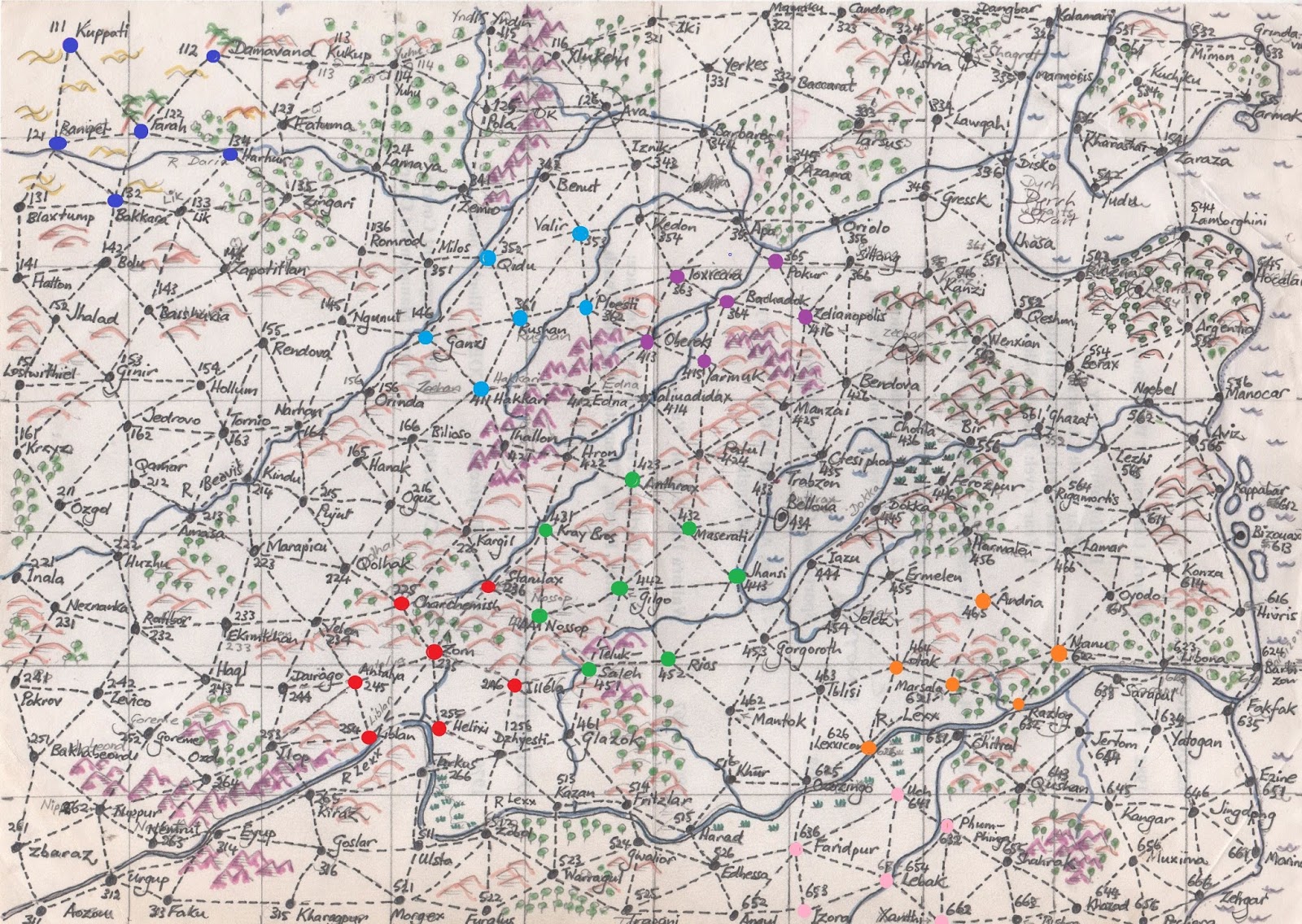
For the rest, my hex map indicates something like 14 hexes spanning the 30-mile distance by road between Harper's Ferry and Winchester. So the map scale is roughly 2 miles the hex. That distance the hard marching Confederates could cover, if they needed to, in about 24 hours. It is clear, then, there would have to be at least two and possibly three or four 'campaign turns' for each daily period of daylight. Possibly a single 'night march' turn ought also to be considered, though I find it hard to administer these well. Obviously the night marchers will need to catch up on rest. When will that be taken? On balance we might as well ignore night marches, though it might be possible to send courier messages overnight.
 |
| Slightly different painting styles shown on the right of the picture. The right-most unit began life as part of the Airfix Wagon Train box. These days I would, after some alterations to the firearms, painted these as Louisiana Tigers with straw hats. |
These 'campaign moves' will equate to a number of 'battle-' or 'game-moves' as Don Featherstone termed them. Now, his rule set allowed 8 game-moves for the period of daylight. That seems to me a little bit on the short side, and it probably not so surprising that according to the 'Featherstone' campaign narrative, Jackson's whole army could not quite in that time force Brig-Genl Getty's 'Division' from its dogged tenure of the Manassas Gap passes. This, even at five-to-two odds.
 |
| A unit painted and based flocked a long, long time ago. |
The ground scale for my own Bluebellies and Graybacks rule set is 1:900 - that is 1-inch to 25 yards, or 1mm per yard. That suggests to me a time scale of 1:30, which indicates 24 30-minute turns to represent a 12-hour period of daylight. As it happens, though, I have scaled down the armies somewhat, as the last posting's Orders of Battle will indicate. A 12-game-move day seems pretty reasonable. Using the Featherstone movement rates translated from his squares to my 'hexes' yields the following.
Two campaign turns represents one day - a morning turn and an afternoon turn. Each turn, therefore, equals 6 game-moves. It is necessary to be aware this in the event of calculating the ETA of any troops 'marching to the guns'.
Infantry - 4 hexes per campaign turn.
Mounted - 6 hexes per turn
Artillery - 4 hexes per turn
Confederate Forces:
Infantry - 6 hexes per turn
Mounted - 6 hexes per turn
Artillery - 6 hexes per turn.
These are all 'road' moves. Cross country moves are halved, mountains are impassible. If weather were to be brought in ( a decision by no means yet made) then the black outlined roads (such as the Valley Turnpike), being Macadamized, are all-weather roads. The others become quagmires after one campaign move of rain and reduce movement to cross-country speed if the rain continues for a second or more consecutive campaign moves.
Depending on wind direction (rolled for when there is any such prospect) forces within a campaign turn (a half-day;s march) might hear the sounds of distant battle. Its reaction - do nothing, send some troops, march the whole force - should be diced for.
 |
| 6 Union regiments, bases newly flocked. The flags they had formerly been issued having become tatty, I replaced them about two years ago. These new flags are a bit rough, but they'll do. |
The objectives of this campaign are interesting, especially from the Confederate side. Historically the Army of the Valley existed to create a 'threat in being' to Washington DC. As such it was to draw upon itself the attention of as many Union troops as it could, consistent with its maintaining itself in the theatre. Shortly before this campaign narrative begins, Jackson's 6000-strong Division had brought into the area 40,000 Federals. This led to CSA General Ewell's reinforcements being sent in.
So the Confederate objective is to remain in the theatre for as long as it can, whilst keeping the Union forces occupied. To achieve this it must keep the Union columns separate as much as possible. The Confederate supply base and recruit assembly area is Staunton, The main Union supply and recruit assembly base is Harper's Ferry. The Union objective is, if they can't destroy the Army of the Valley, is to drive it out of the Shenandoah Valley altogether.