Friday, February 10, 2017

Stonewall in the Valley 10: Battle of Passage Creek concluded/

Situation on the southern wing - the Confederate right.
Kust visible on the extreme right can be seen dismounted elements
of Col Munford's cavalry

The arrival of the three Confederates Brigades of Taliaferro, Trimble and Taylor on the left and centre of the field tended rather to shunt Winder's 'Stonewall' Brigade off to the right, facing Barnett's barn and the nearby woods and hill.  Fortunately, Munford's 2nd Virginia Cavalry, accompanied by Captain Chew's 'flying' artillery joined them there (this determined by dice rolls).  Whilst Chew's rifled guns engaged the Union horse and artillery on the hill, 27th Virginia Infantry rallied and rejoined the rest of the Brigade, and Munford's cavalry dismounted, formed a skirmish line, and plunged into the woods behind Turvey's place (just visible in the above picture).  Although Ashby's cavalry had arrived in the centre, Jackson directed them to support General Winder.
...
33rd Virginia and 21st North Carolina in action.


Heavy blows delivered and received.

Meanwhile, on the rest of the embattled front, events seemed to be turning in favour of the Union.  Both sides seemed to be wilting under the deadly fire, to the extent that on both, the morale and endurance of five regiments came into question.  For all ten units, a dice roll would determine how they would respond to events. The Union rolls, north to south went: 3,3,4,5,2. The last was a failure, but only enough to stop that unit advancing as it had been doing.


The Confederate rolls were much less fortunate.  Again north to south, they went 4, 1, 1, 2, 1 - disaster!  In the woods on the extreme left, 23rd Virginia stood up to the strain well enough, but 37th Virginia, and almost the whole of Trimble's Brigade, were driven back.  The advance of 21st North Carolina was halted, but 21st Georgia fell back, and 15th Alabama, whose enthusiasm in closely engaging the enemy more than made up for their early morning failure, once more suddenly broke apart and fled in confusion.
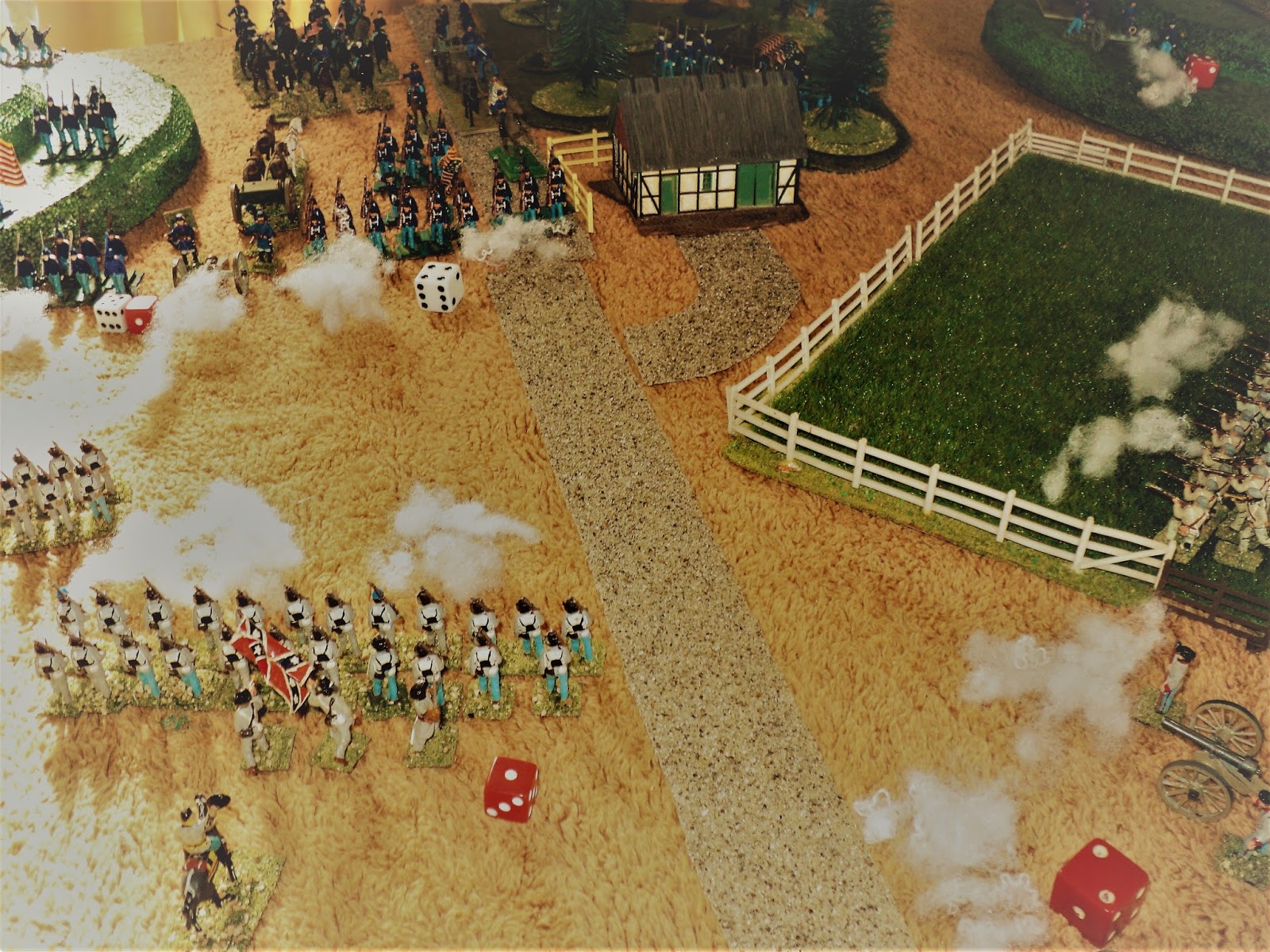
Musketry and gunnery duels in the centre.
'Stonewall' Brigade in action.  Reinforcement appearing
in the picture.

Having shaken themselves out into a semblance of order, the Stonewall Brigade resumed its advance, 27th Virginia into Barnett's field, whilst 5th Virginia engaged the Union battery on the hill to the right. Coming under return gunfire, 5th Virginia were taking heavy losses - in fact little more than 50% of the men remained with the colours at the close of the action.  Yet that gallant regiment stood its ground and returned a musketry so effective as eventually to silence the battery altogether.  

The Union horse alongside the battery never really got the chance to redress matters.  A popping fire of carbines from the woods to the left front revealed the presence of dismounted rebel cavalrymen; 33rd Virginia, alongside Chew's battery, supported the 5th from its right rear, and a large body of horsemen, distant as yet, were rapidly approaching from the right front.  In the face of such a variety of threats, a kind of paralysis seized the Union cavalry.


In fact at about this time, I considered calling the battle, as it was already clear to me that the decisive action was going to happen on the Confederate right.  But Union successes so far mitigated against such a decision.  I felt that General Shields would see the battle going pretty well, and would stay with it.


It would be a costly decision.  Though their first attacks had been checked, if not altogether repulsed, the Confederates had plenty of reserves.  The 6th and 7th Louisiana of Taylor's Brigade soon took up the cudgels dropped by Trimble's Brigade.  Having recovered its aplomb, 10th Virginia also rejoined the 23rd in the railroad woods, where their combined firepower gradually overcame that of 5th Ohio.


In the midst of the roar of battle, as he stood on horseback closely observing the action, General Shields was struck by a Minie ball that flung him out of the saddle.  The wound was mortal (determined by die roll, ranging from '1' - slight, requiring dressing but able to remain in command - to '6' - immediately fatal; I rolled a '5').  As Shields was carried from the field, Brigadier Kimball took over direction of the battle.

(In my combat system, dice rolls for firing determine the number of 'hits' on the target, which are then resolved into 'casualties' (dead, wounded, missing, straggled, skedaddled, and carrying wounded to the rear, and what have you).  In resolving hits into casualties, if double-6s appear, regimental officers are laid low, which can affect the unit's cohesion in subsequent 'reaction' tests.  But triple-6s affect any General officer who happens to be standing within 5cm of the target unit.  So it happened here.)

It was not long before 23rd Virginia felt itself sufficiently emboldened to emerge from the woods to engage 5th Ohio more closely.  The 10th had rejoined the firefight, and the 5th Ohio, in front of them was feeling the heat.
Taliaferro's Brigade pressing back the Union right.

General Shields takes a hit.

In the centre the firefight continued - a real battle of attrition, though for neither commander was this a desirable proceeding. General Jackson in particular had to be acutely aware that somewhere less than a week's march distant, General Fremont's Mountain Department Army was at large and unchecked. It would not do to be forced out of the Shenandoah valley because the last couple of days had so weakened his army it could not face Fremont's column.


Cavalry battle on the ridge.

Developments on the southern wing were more to the liking of 'Old Blue Light' Jackson.  As the Stonewall Brigade began pressing, Ashby's cavalry (7th Virginia) nerved themselves to charge the 1st Rhode Island on the hill.  Under cover of the charge, Col. Munford's dismounted troopers emerged from the woods and began to climb the slopes flanking the Union horse. 
Collapse of the thinly held Union left.

Although the Federals had the slope of the Confederates, the latter had the numbers.  As it happened, the latter exacted a full revenge for its misfortunes earlier in the day and routed the Rhode Islanders right off the hill.  Sorely depleted, the survivors of Battery L, 1st Ohio Artillery also made off.  
7th West Virginia comes until heavy pressure.

This left a vacuum on the Union right flank, guarded only by the woods back of Barnett's barn, where 7th West Virginia was conducting a lone fight against 5th and 27th Virginia.  Within the cover of the woods, the West Virginians were able for over an hour to hold their own despite the slight numerical superiority of their opponents.  The hill once cleared brought in 33rd Virginia and the dismounted troopers of 2nd Virginia Cavalry over and around the heights onto the West Virginians' left flank.

As General Trimble rallies a broken unit, the Union centre
 breaks of the action under cover of a cavalry charge.
The writing on the wall must have been abundantly clear to General Kimball by now.  The early successes on his right and centre were beginning to become undone, as rebel reserves joined in the fight, and their fire began to be felt.  True, the Union had reserves also, but as holes began to appear in their turn in the Union lines, they were soon used up.  
Taylor's Brigade (6th and 7th La) about to storm the Union
defended hill.  Sixth La is looking very depleted, but
morale remained strong.
It did not help the Union cause that Brigadier Trimble had reorganised his Brigade fairly quickly after his earlier reverses.  To be sure, the North Carolinians and Georgians had never lost their good order despite being driven back.  For their part, 15th Alabama pulled itself together a deal more rapidly than it had earlier in the day.  In sum, therefore, Trimble's Brigade was ready one more to try conclusions.
Rallied CSA regiments ready to try a second round...


Charge of 1st Maine Cavalry

The crumbling Union line no longer had that luxury.  As losses mounted, cohesion became more difficult to maintain.  Tyler's, and then Kimball's, Brigades began to be edged back as the Confederates stepped up the pressure. Suddenly the 5th Ohio infantry broke and scattered, signalling an imminent collapse of the Union right.  In desperation 1st Maine Cavalry - part of Col Knipe's column that had remained on this wing to support Tyler - flung themselves upon the Confederate line.  

Although with pistol and sabre they lowered a few rebel infantry, the latter had emptied too many saddles during the charge itself, for the Union horsemen to hope to impose more than a brief delay.  The survivors joined the growing exodus from the field.


The fatal charge of 1st W. Va. Cavalry
That general retreat spread to the centre as General Kimball acknowledged that the game was up, and it was time to preserve what he could of his command.  Hoping to catch the Confederates on the hop, he flung in the West Virginia cavalry against the line of Confederate artillery astride the ride near Barnett's field.  Had the Napoleon battery not had taken earlier losses the execution by the CSA guns would have been catastrophic (the horse would have taken eleven hits) but as the battery was down to 3 crew figures, the 'Die Range' was only 5, to the roll of '6' was a 'miss'.  The '5' rolled by the companion battery was within the  'Die Range' for rifled guns firing canister at point blank range. That was bad enough for the cavalry, who didn't even close, but made off hurriedly down the road.
Respective losses to 1st Me Cav and
23rd Va.
The afternoon was now far advanced, perhaps two hours of daylight remained as Shields's - now Kimball's - command quit the field.  Losses had been heavy on both sides, but, as the battle progressed, the fortunes though favourable to the Union to begin with, had swung decisively and irreversibly in favour of the Confederacy. 
Crumbling Union defence line...

There was no pursuit.  The Army of the Shenandoah had had a hard twenty-four hours, and in the process had thrown back two of the Union columns sent to drive them from the Valley.  It was enough that the rebels could reach the southern turnoff and restore their lines of communication.  For their part, the Federals would not reach Front Royal until the following morning.  Nor would they stop there.  Desiring to return to his parent Division, Col Knipe drew his command back to Cedarville.  For his part, perhaps shaken by the day's events, and the loss of General Shields, on the morrow Kimball took his Division back to the Blue Ridge Mountains, though the Manassas Gap and stopped only upon reaching Piedmont town late in the afternoon.

Of the movements of the Army of the Shenandoah, we'll have to wait for the next instalment of Stonewall in the Valley.

To be continued...


Saturday, February 4, 2017

'Measuring' shooting ranges on a gridded board.


This posting interrupts my Stonewall in the Valley narrative momentarily, to report on something I have been thinking about off and on.  That narrative will continue: the posting has some of the pictures. I have found more to add, and then there is the text to write up
.  

In the meantime, I have been reading a fairish bit, off and on, about the merits and problems associated with gridded war games playing surfaces.  The problem with square fields is geometric. Chess players will have encountered this, especially in end games in which Kings are playing a prominent role.  A White pawn at 'a3', scampering to promote to queen at 'a8', will get run down by a King at 'f3'.  In the 'long' Algebraic notation:


White        Black:
1. a3-a4      Kf3-e4
2  a4-a5      Ke4-d5
3. a5-a6      Kd5-c6
4. a6-a7      Kc6-b7
5. a7-a8=Q Kb7xa8.
An online chess game in progress.  I have the Black pieces,
and (in the picture)  am about to lose my h7-pawn.
 It's all part of a Cunning Plan.

The distance from a1-a8 (orthogonal) is effectively the same as from h1-a8 - along the long light-square diagonal.  For war games, that simply won't do.  But how to Solve that geometric anomaly? Short answer: hexes or offset squares.  But they have their own idiosyncrasies, to do with the number of available directions from a given point, to wit: six.  I would much prefer that there be eight!

A Neil Thomas scenario translated to my chessboard.
Not a success: the rule set needs adapting to this format.

One method I have thought quite a bit about is to measure the distance from the centre of the object square to the centre of the target square and round to the nearest whole number.  The 8x8 'table below does that.  Take the chessboard convention and regard the bottom left hand corner (where the 'Firing Unit' is) as 'a1', to top LH corner as 'a8' and the bottom RH corner as 'h1' we see that the distance between diagonally opposite corners is a little under 50% longer than orthogonally opposite corners.

Firing Ranges Ready Reckoner

7
7
8
8
9
9
9
10
6
6
7
7
8
8
8
9
5
5
6
6
7
7
8
9
4
4
5
5
6
7
8
9
3
3
4
4
5
6
7
8
2
2
3
4
5
6
7
8
1
1
2
3
4
5
6
7
Firing
Unit
1
2
3
4
5
6
7

Not only can this grid quickly determine firing ranges, it could be used for movement allocation as well.  If such moves involve passage through delaying terrain, you simply count off the delay and carry on to the destination square.

 Movement Allowance Ready Reckoner:
14
15
16
17
18
19
20
21
12
13
14
15
16
17
18
20
10
11
12
13
14
15
17
19
8
9
10
11
12
14
16
18
6
7
8
9
11
13
15
17
4
5
6
8
10
12
14
16
2
3
5
7
9
11
13
15
Move
Unit
2
4
6
8
10
12
14


I have considered allocation movement allowances along the lines of 2 'movement points' orthogonally, and 3 'MPs' diagonally, and to treat ranges in the same way.  Such a system is still a trifle generous concerning diagonals, but is a big improvement on the 'chessboard' convention.

Doubling up on movement allowances is no real hardship.  Likely enough the odd numbers that appear on this grid won't have any significance as is, but it does allow for some very fine tuning! Not only small differences in vehicular speed, say, but one might allow a single MP delay for negotiating minor inconveniences of feature - moving up an easy slope, say, or slightly rough going. Heavier penalties on movement might be enacted for difficult going.

My gridded up small games board.  10x10 4-inch squares.

I chose 4-inch squares so that my big cats could fit comfortably
within the squares (leaving aside the long guns.  The cluster of
buildings represents a 4-inch square town...

The grids I have included here are good for an 8x8 grid.  Just recently I gridded up a piece of 5-ply flooring board into 10x10 4-inch squares.  I was inclined to keep the house-like pentagonal shape and added a further dozen squares on the 'gable'.  Normally unused, I can see the odd scenario in which they might add a little something.  As the board width is about 42 inches, I gave a little extra depth along each side square.  These can still count as normal squares, but could equally well represent reserve zones in some games.


As I have been reading a friend's copy of Neil Thomas's One Hour Wargames book, I am working out ways to translate his ideas onto this gridded set up.  I might be forced to extend my 'Ready Reckoners' to a 10x10 grid...


Tuesday, January 31, 2017

Stonewall in the Valley 9 - Battle of Passage Creek.


Leading elements of Trimble's Brigade come to the
aid of the Stonewall Brigade.
As General 'Stonewall' Jackson's Army surged onto the field like an incoming wave, the preliminaries were over, and the stage set for a major action. The previous evening's combat, the early morning pursuit, and the clash between the 'Stonewall' Brigade and Col Knipe's column - these were but skirmishes compared with what was to come. For, marching up behind his little force, Colonel Knipe knew, General Shields's whole command would soon be with him.
The Army of the Valley having broken off its pursuit of General Banks, retraces
its steps to aid General Winder.

The Confederate Army of the Valley comprised:
Commander:  Major-General Thos. J. (Stonewall) Jackson
Jackson's Division:
   Winder's (Stonewall) Brigade:
        5, 27, 33 Va - somewhat reduced in numbers from the 73 figures with which they began the morning;
        Poague's and Cutshaw's batteries attached

    Taliaferro's Brigade: 
        10 Va (27 figures); 23 Va (27); 37 Va (26) - Total 80 figures

Ewell's Division:
    Trimble's Brigade: 
        15 Ala (26), 21 Ga (26), 21 N.C. (21) - Total 73 figures
        Raines's Battery (4 figures, 1 gun)
    Taylor's Brigade: 
        La Tigers (18), 6 La(25), 7 La(22) - Total 65 figures
        Lusk's Battery (4 figures, 1 gun)

Cavalry:
        2 Va Cav (Munford, 21 figures), 7 Va Cav (Ashby, 20 figures)
        Chew's Flying Artillery (4 figures, 1 gun)
Overall strength: 352 figures (less Winder's losses), 5 guns (3 S/B, 2 rifled)

Kimball's Brigade, of General Shields's
Union Division, arrives from Front Royal

Tyler's Brigade enters the fight, covered by
1st Maine Cavalry.

Now, the arrival of these troops was programmed by sector, north (near the Manassas Gap Railway), centre (close by the Front Royal road), and south (near Turvey's shack and walled fields). Where each brigade and cavalry regiment arrived was determined by a die roll. Further, just 6 units - regiments, battalions or batteries - would be arriving in any one turn. The result was that Trimble's Brigade, including its attached artillery, arrived behind it's lead regiment (15th Alabama) in the centre, along with Ashby's cavalry and Chew's battery. Taliaferro's Brigade, followed by Taylor's, came in on the northern flank.  This tended to nudge the Stonewall brigade towards the right - the southern - wing, where they were joined by Munford's cavalry.


General Jackson's orders were simple: advance, and drive back or destroy any enemy encountered. The fact was, his situation was not a comfortable one, for it was beyond the ridges in front of him that his line of communication lay. That line had to be cleared before the end of the day, and already the sun was nearing its zenith. 


Kimball's Brigade shaking out into line formations
about Barnett's barn.

The Confederates were still pouring onto the field when the first elements of Shields's column arrived, and General Shields himself took over command of the battlefield. Colonel Knipe had begun the day with 73 figures of all arms, and a rifled battery (1 gun). To these Shields added:


Shields's Division:

   Kimball's Brigade:
        14 Indiana (27), 4 Ohio (27), 8 Ohio (27), 7 W. Va (27)
   Tyler's Brigade


        5 Ohio (27), 7 Ohio (27), 29 Ohio (27), 66 Ohio (27)
   Cavalry:
        1 Rhode Island Cav (15); 1 W. Va Cav (15)
   Artillery:
        H/1 Ohio Artillery (4); L/1 Ohio Artillery (4), I/1 New York Artillery (4).
Overall strength (not counting Knipe's column): 258 figures, 3 guns.

Including Knipe's command at the beginning of the day  raises the numbers to 331 and 4 guns.  Fewer than the Confederates, it's true, but all units began the day fresh.  (There were 683 figures, plus 8 formation commanders, altogether - a fairish number to field on a 6ft x 4ft table, eh?)


The approaching clash...
Just as the Confederates had been, the Union forces were in turn subjected to programming where they arrived: north, centre or south, and a maximum of 6 units the turn. Wouldn't you know it, they practically mirrored their opponents. Kimball's Brigade arrived in the centre and Tyler's on their right. First West Virginia Cavalry came up behind Kimball, along with two of the gun batteries. Only 1st Rhode Island Cavalry and a battery of Napoleon guns seized the ridge beyond the woods south of Barnett's barn.
10th and 23rd Virginia lining Railroad Wood.  Both have kept back
a proportion of their numbers to 'fit' onto the available frontage.
Beginning with the first clashes in the centre, a dogged firefight rippled along the front northwards as the action became more general. Soon both sides were tearing great gouges in each other's lines. In the railroad wood, 23rs and 10th Virginia found the front too narrow to deploy their full strengths, and both held back a quarter in reserve. Things didn't go well to begin their duel against the Ohioans who came up against them, neither. Despite their cover, the Confederates got the worse of the initial encounter. Tenth Virginia fell back into the woods, leaving the 23rd to sustain the fight unaided. It took over an hour to persuade the 10th to return to the fight.  
The view eastwards from behind Talliaferro's
Brigade. The Louisiana Tigers in support of
the Virginians in the forest.
Thirty-seventh Virginia soon also found the action too warm for their comfort, and drew back, though in better order than the 10th. Surging up behind them, the Louisiana Brigade quickly took up the quarrel.  There was to be no respite for the Federals.
Warm work: a savage firefight all along the line.
Throughout the sustained musketry, the Confederates continued to try to press forward, but against the gallingly accurate fire from the Union infantry, it was tough going.  The Confederate left and centre had no decisive edge in numbers, and it was not clear who was getting the better of the punishing exchanges of musketry and gunfire. Third Wisconsin, of Knipe's command, broke and ran before they could be properly supported by Kimball's Brigade, but that scarcely made any difference. 
6th and 7th Louisiana swarm over the hill to support
Taliaferro and Trimble.


What is happening on the Confederate right? The Union
positions seems to be thinly held: One cavalry battalion and one battery...


Whilst that mutual hammering went on, the Confederate commander turned his attention to the more sparsely populated, and so far quiescent, southern flank. Could something decisive be achieved there?


To be continued...