Sunday, November 8, 2015

Ancient/Mediaeval war Games: Playtesting Paul Little's rule set.

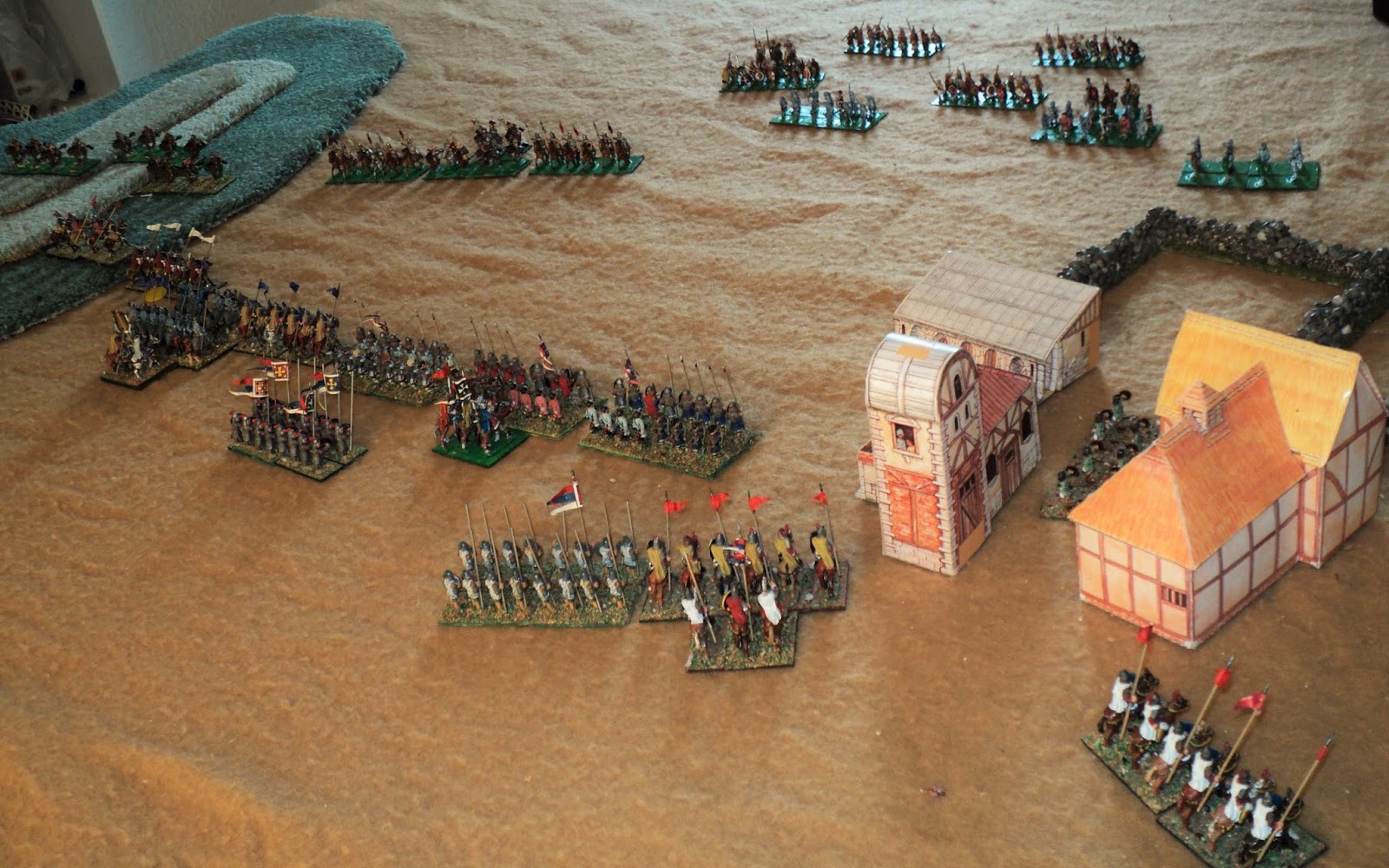
Byzantine vs Bulgars.  Bulgars (on the right) seize the initiative
and advance rapidly into action.
Lately I have been trying out Paul Liddle's simple rules for Ancient/Mediaeval battles.  Not having seen action for a long, long time, my Byzantines and Bulgars were keen to 'have at it'.  I thought I'd make it a fairly sizeable action.  In the photos to come you will observe that some of my Bulgars are lacking in 'finish'.  My apologies for that.
Scene from behind the Byzantines, facing southwest.
The armies were;

Early Bulgar (c.1000AD):

Commanders Tsar Attila, Boili Atalik and Boili Attaboi:

3 units heavy horse archers
4 units light horse archers
4 units spear heavy infantry
2 units archer medium infantry
1 unit javelin light infantry

14 units total; Byzantine objective: destroy at least 7.

Bulgar horse on their right flank.

Byzantine (c.1000AD)

Commanders: Emperor Dementius, George Maniakes, Dimetrios Psychopathes.


1 unit lance/bow kataphraktoi (elite Cataphracts)
2 units lance/bow Tagmatic kavallarioi (Heavy Cavalry)
2 units lance/bow Thematic kavallarioi (Medium Cavalry)
1 unit lance/bow prokoursatores (Light Cavalry)
1 unit Varangians (elite spear Heavy Infantry)
3 units skutatoi (spear/bow Heavy Infantry)
1 unit peltastoi (spear Medium Infantry)
1 unit sphendonistai (slinger Light Infantry)

12 units total; Bulgar objective: destroy at least 6.

Byzantine centre and left.  The Varangians and peltastoi
have been kept in reserve.

The observant reader will see that most of the units on both sides are armed with bows.  The only other missiles are the slings and javelins of the respective light infantry.  The Byzantines had two and the Bulgars four units not so armed, all of them foot.


Looking down the Byzantine
line from left to right(south to north)

Action:

Without going into a lengthy narrative, the action went like this. The Bulgars seized the early initiative (i.e. won the die roll to see who moved first), and scored some damaging hits on the Byzantine horse on the left flank, including on the cataphracts.  

The exchange of horse archery has disordered both sides...

As the picture below indicates, the Bulgar advance was somewhat impetuous, but I was figuring to get in a few blows with the faster moving archers, so that the spears could eventually close against some damaged opposition.
Bulgars hurrying into action hoping to get in the first strikes.
The village of Marsople anchored the Byzantine right flank.  The slingers advanced through it, whilst a medium cavalry unit passed by on the north side (i.e. to the left of it from the Bulgar (camera) point of view).
Slingers have seized the village, which will serve
to anchor the Byzantine right flank.
The pictures below show that as the horse closed on the southern flank, the Byzantines had already taken some damage.  The Emperor probably should have stayed with the cataphracts, for they succumbed fairly soon.  Neither side seems able to rally their wavering units (I think the Bulgars had one and the Byzantines no successful rallying rolls all day).  Worse for the Byzantines was that their flanking Prokoursatores were being enveloped by the enemy light horse.
The Byzantine cavalry are getting the worse of their
scrap with their Bulgar counterparts. The nearest Bulgar
unit seems to have recovered its morale, before
Attaboi moved to help against the cataphracts.
On the other hand, in the centre, although the plan was for the Bulgar bowmen to inflict some damage before the 'push of pike', they were getting decidedly the worst of it.
General view.  The Byzantine foot have outshot the
Bulgar archers, and the Tagmatic horse damaged
one of the spear units as well.  Not looking
 so good for the Bulgars in the centre, then.
As the battle seemed to be shaping, so it continued.  Once the cataphracts disappeared, the Byzantine left flank horse gradually crumbled away, and only the intervention of the Varangian spearmen from the reserve line kept up a semblance of a line in that sector.  In the centre, though, it was the Byzantines who gained the upper hand, and in favour of whom the balance tilted more and more until the Bulgarian foot collapsed 
So close was the fighting overall, that the issue remained in doubt until the very end, when the destruction of two units in one turn decided the battle in Byzantine favour: 8 Bulgar units destroyed for 5 Byzantine.  
Now you see 'em...

Comment:


...now you don't:  the cataphracts overwhelmed...
One of the things I had to get used to was the 'conkers' IGoUGo system.  I have run across it before in some of the Games Workshop's games (specifically, Space Crusade) .  Such a system takes a little getting used to, especially in the type of open ended war games such as this.  

The system favours aggression, that's for sure: get stuck in, and get in your first licks.  That's the caper.
...followed by a Bulgar heavy and a light horse unit, the latter
despite the flank attack striking into the prokoursatores' flank.
Let me illustrate by oversimplifying a bit.  Forget about the 'wavering' rule for a minute, and imagine that a hit immediately eliminated the enemy.  Imagine, too, two equally matched units, RED and BLUE, facing off.  


Byzantines close in for melee action.  There was probably no real
to do this, as distant shooting seems equally effective.
For no better reason than I mentioned it first, RED moves into close combat and strikes the first blow.
It has to roll 9 with 2D6 - a 28% chance of immediate victory.  But if it misses, then BLUE will get to strike in his turn, with the same probability.  So it will continue until one or the other is eliminated, or something terminates the action.
General view.  Byzantine left flank crumbling -
not looking too good!

Now, let us go back to the beginning: who has the advantage?  Obviously it is RED, who gets the first strike, and if necessary, the third, fifth and so on.  Blue gets the right of reply only if he survives each time.   

Given a fight to the finish, the probability that RED will win works out at a whisker over 58% (odds of 29:21 in RED's favour).  That is a significant margin.  This imbalance does not necessarily invalidate the combat system.  Rather it encourages aggression for one thing, places a premium on missilery for another, and, I suspect, might also place a premium on tactical manoeuvre. That last will have to be tried.


Prokoursatores struck, front and flank.


A couple of points might be worth looking into.


1. Breaking off.

There are no rules that might allow a faster moving opponent to break off a close action. Whether this is desirable I'm not sure, but during the course if this, and a subsequent, battle, it occurred to me that lighter troops that get themselves into trouble might want to try a break clear.  The jury is still out on this one.

General melee in the Bulgar right-centre.  Whilst engaged to
its front with heavy Byzantine horse, Tsar Atila's horse has been
hit in the flank by a unit of skutatoi led by George Maniakes.
To the rescue comes Attaboi's horse, striking the skutatoi in
the flank.

2. Retrograde moves.

This goes to evades and, if it is deemed a good idea, breaking off moves.  Now, units are permitted a 'free' turning/pivot/swivel move at the end of their standard move.  Evading units probably ought to be allowed this turn at the beginning of their move, ending their evasive move facing away from the danger being evaded.  In fact, light troops should probably be allowed to make this pivot at any time during their move.  The impact on the mobility of light troops would make them formidable opponents.

I am wondering what their facing should be at the end of the evade move: towards the enemy, or in the direction of movement.  I assumed the latter, which went rather badly for a couple of Bulgar light horse units in a second battle (of which, more in another posting).  One evaded at a crawl, and the Byzantines had enough movement remaining promptly to catch them, hack their rear, and ride them down.  The other ended up being chivvied and chased to the table edge, and was also eventually caught and eliminated. 


Having survived the flank attack, in its turn
 the skutatoi turn to face Ataboi's cavalry.

Peltastoi about to intervene in the indecisive action on
the Bulgar right.

3.  Missilery vs Melee.

During this action, I allowed bow armed units to close to hand to hand without really considering the desirability to do so. Byzantine skutatoi don't really need to close: their best tactic is to stand off and let the non-bow-armed enemy come to them.

Where it got tricky was with bow armed horse on both sides.  I could equally well have had one or both sides stand off and shoot it out. The question is whether there ought to be some differential in the effect of shooting and melee. One possibility that crosses my mind is that instead of destroying a 'wavering' mounted unit, a second 'waver' result from shooting causes it to flee, if it can.  This 'fleeing move' might be adjudicated in the same way as an evade move.


Kavallarioi charge Bulgar light horse, whilst the light infantry stand off.
I forgot the Bulgar 'psiloi were javelin armed, to that
the slingers should not be carrying a 'waver' marker.

4. Ordinary movement.

One thing I didn't really pick up on was just how flexible, or proscribed, the system of movement is supposed to be. I tended to allow wheels and whatnot, simply measuring the outside of the wheel.  It did occur to me that the author intended that all movement be in the direction faced, with a pivot at the end, if desired. Your comments, Paul?
Bulgar centre begins to crumble...

5. Turning to face.

In a few instances, melees developed into a kind of 'staircase' arrangement when successive flank attacks and counter-attacks failed to achieve a decisive result.  I assumed that in such circumstances, a unit, in its own turn, could - possibly should - abandon its flank attack, and face the enemy to its own flank.  If so, ought this move be optional or mandatory?
... whilst the Bulgar light horse begin to envelop the Byzantine left.
I could have handled this a lot better, with the horse
archers fetching a much deeper sweep into the Byzantine rear.
I also assumed that in the even of a frontal attack combined with a flank attack, both attacks were adjudicated separately, which seemed to me reasonable. Two bites of the cherry.  The chances of scoring at least one 'waver' result in such circumstances is about 70%, and there is about a 16% chance of wiping out the target unit in one go.  Oddly enough, both sides proved on the day to be a lot more resilient than these probabilities would indicate.
Bulgar reserve spearmen enter the fray.

Bulgar javelinmen in trouble - left in the lurch be evading
horse archers...

Bulgar centre showing signs of cracking.

Byzantine left has practically vanished, with the Varangians
holding the place formerly held by four horsed units.

Varangians see off Bulgar heavy horse, just as they
are hit in flank by the lights.  One Bulgar
unit stands ready for a rear attack.

Thinks looking bleak for the Bulgar spearmen.

Peltastoi victorious!

Spear unit destroyed before the flank attack can come in...

Bulgar javelinmen shrug off attack from front and flank...

End of the action.  Bulgar centre collapses altogether, before
the same could happen to the Byzantine left.  Close call
 for the Byzantines, who win, 8-5.
That was my first play test, and it has to be said, the thing went with a swing.

Saturday, November 7, 2015

Holding Action (2) - Conclusion

CSA forces being edged back from the creek.
As Union pressure mounted, the Confederate defenders found themselves being edged back from the creek edge.  26 S.C. and 6 Ala had already retired and were heading towards Torkville and the road north.  18th S.C. also fell back into the village itself and begin lining the fences and out-buildings along the outskirts.  They were able to prepare some kind of defence before the 15th Ky could follow up.
126 N.Y. fording the river to the north bank.  
Meanwhile, the 126 N.Y. was wading the Dolenz river to support the Pennsylvania cavalry already nearing the road.
General action along the creek front.  66th Ohio clinging
 under heavy fire to its bridgehead position.
66th Ohio having forced a crossing at the east bridge were finding it difficult, despite musket and gunfire support from across the creek, to maintain its bridgehead position.  Opposing them, the relatively fresh 11th Alabama and the 20pr Parrotts of the Columbia Artillery were exacting a heavy toll.

Cobb's Georgia Legion in action.
General overview of the battlefield.  

Much depended upon what could be achieved by 27th Penna Cav.  Could they sweep aside the Confederate horse facing them?  Given the narrowness of the valley floor on the north bank of the river ('edge of the world' explained by steep wooded slopes just off the north table edge), Colonel Scoones had split his troops in two. Retaining just less than half under command for mounted action, he ordered the remainder to line the south bank and dismount. As the New Yorkers swept into the attack, they had to endure a popping flanking fire that emptied several saddles. But it was not enough to equalise the mounted contest.

Outnumbered though they were, the Confederates rose magnificently to the occasion. Counter-charging vigorously they brusquely flung back the Union horse, who 'stood not upon the order of their going' but hastily made off.  Surprisingly, perhaps, given the drubbing they had received, the latter's withdrawal from the fray was far from the rout of a demoralised foe, but remained well in hand until they reformed behind the New York infantry.


(What happened was one of those low-probability outcomes that makes war games such fun... and just a little crazy.  The situation was in fact very dangerous for the Confederates.  Had they lost this action, the rest of Zebedee's command might well have become trapped on the 'island'.  In the close combat the 13 Union figures surviving the flanking fire received 3 combat dice at a Die Range of 4 [they ought to have got a fourth at a DR=1 for the odd figure, but I was running a convention that ignored the odd figure remaining from the 4-man volley groups - not that in the event it would have made any difference!]. 


The Confederates' ten figures got two dice at DR=4, and a remainder at DR=2.  Rolled the Union first: three sixes!  In my games, sixes aren't always good rolls (I like to mix things up a bit). Confederates' turn: the 4-man volley groups each rolled the maximum: fours!  The part-volley-group... another six... and a miss.  Astonishing.  And then what happened?  The 8 hits translated into a mere 3 casualties - not rare, but a fairly uncommon result.  All the same it was enough to send the Union horse packing. 

The subsequent morale check by the Union, having lost over 30% of their strength was a 50-50 proposition, but they passed (I think they rolled another 6 actually).  So, although their withdrawal was forced, they could do so in good order. 

15th Kentucky attempts to carry Torkville by storm.

By this time 15th Kentucky had organised themselves into a column, and stormed across the west bridge and into the village.  The mutual close range mauling there finished the Kentuckians in this battle, but the South Carolinians also decided they had had enough.  The Union infantry fled back across the bridge, holding up its supporting artillery and the 29th Ohio in the process.
CSA reduced to a shortened perimeter.  But there is some respite: the attacks upon
the village and the north bridge have been repulsed ... for now.
As the action drew to a close, it was becoming a race to bring off as much of Zebedee's command as may be extracted via the bottleneck of the north bridge, before the pressure from the advancing Union caused a traffic jam, or 126 N.Y. infantry sealed off the exit.  

29th Ohio following up the only partially successful attack
by 15th Kentucky.  The US Regular cavalry has crossed
 the east bridge.

The Confederates gained more time by throwing 66th Ohio back across the east bridge, whereat Zebedee ordered a general withdrawal.   He pulled 11th Alabama close by the village by way of a rearguard, and reversed the dismounted cavalry's front to assist. Meanwhile, the approaching New York infantry had formed line and were preparing to push aside the cavalry facing them.  

General withdrawal across the sole escape route.

It would be a near thing.

At this point, I called the game, though it could have been played out.  Most of the CSA would certainly have escaped, but it might have been touch and go if either - let alone both - 11th Alabama or the dismounted cavalry could have escaped.  


But the reason for calling the game was that the action was already shaping as a clear cut victory for the Union.


11th Alabama still holding the village, assisted
by dismounted cavalry.
The reason is this.  My rule set, based upon my ground and consequent time scales (TS = square root of GS) calls for 24 turns to represent a 12 hour period of daylight.  Even if I supposed the action did not open until mid-morning, eighteen moves was proving more than sufficient for the Union to complete its task.  At the point the game was called, barely half that - certainly no more than ten moves - had elapsed.  The Union would not have required a further 8 turns to fulfil their mission of clearing the road and advancing north.  So although the Federals had received a bloody nose in this action, the Confederates had taken an even worse knock (relatively speaking: both sides lost exactly  49 figures (counting, on the Union side, General Cayce as one of them)).  

both bridges across the Nesmith Creek are now in Union hands
and victory is assured.
The Union had won a fine victory: cleared the road north, and could resume its close pursuit of the retreating Confederate Army.

Friday, October 30, 2015

Holding Action (2) - continued.


Union cavalry patrol (top centre) finds a ford over the river...
Continuing from last time, a Union force under Brig-Gen Justin Cayce has been ordered to clear the road north in pursuit of a retreating Rebel army.  Approaching the village of Torkville, lying within the confluence of Nesmith Creek and the Dolenz River, they found a Confederate rearguard ready to contest their further advance.
Confederates open fire at long range as the Union troops approach.
The dice are explained in the text.

Advancing straight up the main road, 15th Kentucky was the first to feel the weight of Rebel fire.

(At this point I left the dice on table to illustrate my method of shooting.  As the Kentuckians had moved, they were not able to return fire - not yet. 


Both 18th S.C. and the Palmetto Battery (12pr Smoothbores) were shooting at the same target, their fire has to be adjudicated together, not severally.  At just beyond canister range, the artillery die range is 4 (DR=4).  Infantry: 4-man volley groups are firing at 'long' range, the 3rd of 4 range bands, so their DR=2.  Die Range defines the maximum dice scores that count; any higher roll is ignored. 

In this case Palmetto Battery scores the maximum: 4.  A 5 or 6 would have missed.  Eighteenth South Carolina rolls 6 dice, with the scores you see in the picture: 1,1,2,5,6,6.  Only the ones and twos count, for a total of 4 hits.  Added to the artillery, this means 8 hits scored on 15th Kentucky. 


Union troops close up to the creek.

This is very good shooting, but 8 hits do not mean 8 casualties.  Instead of saving rolls, I use a method vaguely similar to Charles Grant's from The War Game.  The hits are grouped into eights, plus any remainder.  In this case all 8 hits form one 'hit group'.  As many dice were rolled, as you see in the bottom right of the picture above.  For clarity I have laid the scores out in rows.  Four rows: four casualties.  What we are doing is counting the distinct scores and ignoring duplicates (one poor fellow took three hits).  A group of eight does guarantee there will be duplicates, as the maximum 'casualties' will be 6.  But I chose 8-hit groups (instead of 6-hit) to make 6 casualties from a given 'hit group' more likely, but also to 'smooth out' the 'discontinuity' where there are more than 8 (or 16) hits on a target.


Having taken more than 10% of its 27-figure strength in losses, the morale of 15th Kentucky is called into question.  At this point, no modification is called for, Kentucky just have to beat a roll of '1'. They roll a '4', indicating their morale remained high.  In view of their subsequent performance, they must have been a determined bunch!


Action has become general all along the line.
I will continue the narrative as an action with just occasional diversions into game mechanics.

Advancing into the teeth of heavy Confederate fire, 15th Kentucky were soon giving back as good as they were getting. Battery A/ 10th US Artillery soon joined in. As the remainder of Cayce's troops drew up to the line of Nesmith Creek, the action spread from west to east, and became general all along the line.  Sixth Alabama was quickly drawn out of reserve to support 26th S.C. contesting the east bridge crossing.


Sinister developments on the Confederate left flank, as a
Battery of Napoleon cannon take up an enfilade position.
Outnumbered as they were, the Rebels were feeling the heat badly enough, but sinister developments were taking place, appropriately enough, beyond their left flank, across the creek.  A patrol from 8th US Cavalry had discovered a ford across the Dolenz River, close by the Nesmith Creek branch.  As the Regulars called in their patrols, 27th Pennsylvania Cavalry were despatched post haste to effect a crossing there. Following them marched the 126th New York infantry.  By this time, the Napoleons of 12th Vermont Artillery were unlimbering to enfilade the battle line of 6th Alabama.

15th Kentucky fighting back hard!
Meanwhile, 18th S.C. was not finding 15th Ky so easy to contain, the contest becoming a dire battle of attrition.  In the above picture, both units, already reduced to 4 whole and 1 part volley group, roll 4 dice plus a 'fraction' (for each figure less than 4, the DR is reduced by 1).  The Confederates roll a miserable 1 hit, the Union a very creditable 7!  I don't recall whether at this range the DR was 2 or 3, but given the actual dice rolls it scarcely matters.  At any rate, 1 hit is 1 casualty; 7 hits (the 'part' die roll counted) ... rather more! The South Carolinians are not having things all their own way!
If 18th South Carolina's shooting was dismal in the previous
picture, 66th Ohio's is even worse!  29th Ohio, to their left,
performs rather better...
Although the Palmetto battery was helping all it could, the counter-battery from the rifled guns across the stream was becoming more than a nuisance.  It was not long before the guns had perforce to limver up and make off.  Meanwhile, the shooting by 66th Ohio in the above picture was about as effectual as that of 18th S.C. was being: a mere 1 hit from 6 rolls. (At 'long' range, with DR=2, the Statistical Expectation would be 3 hits. Theoretically you could get as many as 12, but that likelihood is almost vanishingly small: 46,655 to 1 against (gotta have my Mr Spock moment).  Still, you have seen what 15th Kentucky managed with 4 and a bit dice!

In view of the developing menace beyond the Confederate left, Cobb's Legion was ordered to deal with the approaching Union cavalry.  To do so, Lt-Col Scoones split his command in two.  Detailing half his command to dismount and line the south bank of the river, he led the remainder across the bridge.  He hoped that the combination of mounted and dismounted action would throw back the Union horse, and keep the north road open.

Cobb's Legion prepares to deal with the distant Union
cavalry approaching along the north bank.


General Justin Cayce takes a hit!
It was about this juncture that the Union suffered a minor calamity: the wounding of General Cayce. In determining actual losses from hits received, multiple sixes appearing denotes the casualty is an officer i.e. must come from the HQ element.  This can have an effect on command and possibly control.  In this instance, 5 hits were registered on 66th Ohio.  Rolling the 5 gave the scores you see in the picture below: 3 casualties.  Now, a triple six signifies that any general with or within 5cm (2 inches) of the unit becomes a casualty.  So, poor General Cayce is out of the action.  To determine the severity of the wound, I rolled a 3 - moderately severe and incapacitating injury.  For this particular action, this loss had no significance, but it ought (a) to have led to a morale check for 66th Ohio (3 casualties - over 10% - in effect although in fact it lost just 2 figures) and (b) placed all units temporarily 'out of command'.

Cobb's Legion splits in two: 10 figures to face the 15-strong
Pennsylvanians, the remaining 13 figures line the south bank
 preparing for dismounted action.
Under mounting pressure, the bridge defenders began to give back.  26th S.C. soon fell back in confusion, and before 11th Alabama, the reserve unit, could intervene, 66th Ohio was surging across the bridge to form a line beyond.
Supported by musketry from 66th Ohio, 29th Ohio storm
across the east bridge.
The firefight between 6th Alabama and 5th Ohio was decided in favour of the former.  Having lost more than half their strength, the Ohioans fell back in only fairish order (50% loss forced a retreat, and a morale roll.  The morale roll happened to be good, so they retired still in hand, facing the enemy.  They counted as 'used up' and will remained henceforth out of the action). This success was costing 6th Alabama dear.  Finding the galling flank fire from the Union guns firing down the length of their line too much to cope with as well, they faded back, though still under command, into the woods behind them.  Although intending to continue fighting from its cover, they didn't stay there long, and eventually continued their move towards the north bridge.  
Under heavy fire, 66th Ohio form line and establish
 a precarious bridgehead.
Union pressure at the bridges gradually forced the Confederates to relinquish their defensive grip. First, the Palmetto battery, pounded by counter-battery fire from the Union artillery on the opposite bank, had limbered up and made off through the village.  Shortly afterwards they could be seen crossing the north bridge, just behind the cavalry action that was then developing on the north bank.
The depleted Palmetto Artillery retire across the bridge as
27th Pa. Cav. run the gauntlet of carbine fire in its
attempt to clear the road.
Together with the 20pr Parrotts of the Montgomery Artillery, 11th Alabama were holding off 66th Ohio, though both were finding it hard to sustain the mutual mauling (both were having to take morale rolls, which by some miracle both were passing.  The only unit so far to fail its morale had been the 26th S.C. which had since rallied and had been ordered to lead the general withdrawal from the field).
The Confederates have been driven from the banks of the creek.
18th Georgia is holding the village; 26 N.C. is beginning its withdrawal
from the action
Eighteenth S.C. had fallen back to the southern edge of the hamlet, where they hoped to use the cover of its fences and outbuildings to hold the further advance of the Federals up the main road.  It was becoming clear that the whole rearguard position was becoming untenable.  It remained for General Zebedee to bring off his command in good order, whilst continuing to impose a delay upon the assailants.  A great deal depended upon the success of the cavalry action developing close by his escape route across the north bridge.
126th New York crosses the ford.  
The fight for the 29th Ohio's bridgehead.
The Union seems to be making good progress!
Following up the Union cavalry, 126th New York was splashing across the ford and would soon be up with their mounted comrades.  Behind 66th Ohio, the US regular cavalry was making ready to cross the east bridge, and up the main road, 15th Kentucky, still enthusiastic despite its losses so far, were about to storm across the west bridge, and into the village.   
We'll leave the matter there, for now, with the Confederates, in danger of being cut off, under severe pressure everywhere, and having to face fresh US troops about to enter the fray.  Added to that, not half the day had yet elapsed.  Nightfall was still a long, long way off...

To be concluded...