Saturday, November 26, 2016

Stonewall in the Valley - After Don Featherstone.


..
CSA Cavalry.  At last I have finished reorganizing
paint touch ups, and flocking on my mounted troops
at least.
..
Stonewall in the Valley - campaign map.
The following 4 are each quadrant. 
Another ACW campaign I have long had in mind was based upon a idea mentioned in Don Featherstone's book War Games Campaigns.  This was 'Stonewall in the Valley', in which Stonewall Jackson commanded a force of ten infantry regiments, with horse and guns, operating in the Shenandoah River valley.  The Union Army had three identically similar corps operating in the same area, setting about to trap the Confederates or to drive them from the Valley altogether.

The only advantages that the CSA enjoyed were their central position at the outset, their celerity of movement (Stonewall's 'foot cavalry'), and the secrecy of Jackson's plans (one dummy and one real army).

I have always liked the concept, but felt that the numerical disadvantages could not be overcome by what amounted to greater mobility, as once battle was joined, any Union corps was the equal of the sole Confederate one.  As it transpired, the Featherstone (CSA)  - Tony Bath (USA) campaign lasted two battles: a costly rearguard action in (I think) the Blue Ridge Mountains' Manassas Gap, in which Jackson's corps took most of the day to overcome a 4-regiment blocking force; and a final battle at Front Royal, won by the Union.    As Tony Bath remarked in his book Setting Up a Wargames Campaign, Jackson was after that 'not in much shape to continue'.

It seems to me the idea has promise, though.  Retaining the celerity of movement and the 'dummy' force, I thought that if Stonewall's Army of the Valley was larger than any single Union column, but was outnumbered overall in the theatre by two to one, we might get an even, tough, sort of campaign.
..
NW
Here is a suggested Order of Battle, using my own organisations:

Confederate Army of the Valley:

Maj-General T.J. Jackson

Jackson's Division:

   'Stonewall' Brigade (Winder):  3 x 27-figure regiments
   Taliaferro Brigade: 3 x 27-figure regiments
   Artillery: Poague's and Cutshaw's light batteries (2 guns each)

Ewell's Division:

   Trimble's Brigade: 3 x 27-figure regiments
   Taylor's Brigade: 2 x 27-figure regiments
                               1 x 23-figure battalion (Louisiana Tigers)
   Artillery:  Lusk's and Raines's light batteries (2 guns each)


Steuart's Cavalry Brigade:

   Munford's Regiment (2nd Va) @ 23 figures
   Ashby's Regiment (7th Va) @ 23 figures:
   Chew's flying battery (1 gun only, 4 gunners)

Totals: 320 infantry, 46 cavalry and 40 gunners with 9 cannon.

(Optional: but only if the Union includes the optional Harper's Ferry Garrison)
Army of the North-West (elements): B-Genl E.  (Alleghany) Johnson:

  Brigade; 2x27-figure regiments
  Artillery: 1 light battery of 2 cannon and 9 gunners
May operate only on the westernmost North-South road.  If forced off it, will disband.
NE


Union Army:  

Banks's Command (ex II Army Corps): Maj-Genl N. P. Banks

   Division B-G A.S. Williams:
      Brigade: Col Donnelly: 4x27-figure regiments
      Brigade: Lt-Col G.H. Gordon: 4x27-figure regiments
   Cavalry Brigade: B-Gen J.P. Hatch: 2x15-figure Battalions
   Artillery: 2 light batteries each with 3 cannon and 13 gunners.


Mountain District: Maj-Genl J.C Fremont

   Brigade:  B-Genl Julius Stahel: 4x27-figure regiments
   Brigade:  B-Genl H. Bohlen: 4 x 27-figure regiments
   Cavalry Brigade: B-Genl G.B. Bayard: 2x15-figure battalions
   Artillery: 2 light batteries each with 3 cannon and 13 gunners.

Shields's Command (ex V Army Corps): B-Genl J. Shields

   Brigade: B-Genl J. Kimball: 4x27-figure regiments
   Brigade: B-Genl Erastus B. Tyler: 4x27-figure regiments
   Cavalry: Major D.B Nelson: 2x15-figure battalions
   Artillery: 2 light batteries each with 3 cannon and 13 gunners.

Totals for each column: 216 Infantry, 30 cavalry and 26 gunners with 6 cannon.

Total overall: 648 Infantry, 90 cavalry and 78 gunners with 18 cannon.

(Optional, only if CSA includes the detachment of The Army of the North-West):

Harper's Ferry Garrison: B-Genl Saxton
   Brigade: 3x27-figure regiments
   Cavalry: 1x15-figure battalion
   Artillery: 1 light battery with 3 cannon and 13 gunners.
For defence of Harper's Ferry only, and may not be drawn on to replace losses to the field armies.  If Harper's Ferry falls to the Confederates, this garrison will disband.
..
SW
It seems to me 'Stonewall Jackson' would still have his work cut out even with his foot and guns moving at 'cavalry speed' on the map, and with a 'dummy' army.  The latter might tend to discourage detachments, but they ought to be allowed.  Even so, there can be only one 'ghost' force on the map.
..
SE


This is solo playable, I think. It is the presence of Stonewall Jackson's force that is diced for - 50-50. If evens, there he is with his army.  If odd, there he is not, and it is the other 'reported' command that is the real one.  

If the CSA does make detachments, then those detachments aren't diced for.  Whatever force accompanies Stonewall Jackson himself  is the indeterminate one.  To take a possible example: Jackson leaves Ewell's Division with one cavalry regiment near Port Republic, and heads off with the rest to strike a quick blow elsewhere.  But here the solo player has to determine two plausible courses of action, and then make sensible Union responses bearing in mind either force could be the real threat. One course of action is that Jackson takes his Division off the McDowell to deal with a threat developing in that region.  The other is that he takes a quick march up the Shenandoah South Fork valley to seize or capture Front Royal and the river crossings there. That threatens to cut off Banks's column where it stands at Strasburg. Two widely divergent blows. Which is the real one?  Bear in mind that the Union commander knows also there is a Confederate presence at Port Republic.  He will also 'know' that Jackson has split his army.

Confederate cavalry Division of 4 23-figure regiments.
Mainly Airfix '7th Cavalry' figures, with a few Atlantic
The real march is determined only by enemy 'contact' with one or other of the columns, and the die rolled to reveal a real force, or 'false intelligence'.  But the Union might be allowed the option to try to refuse battle.  As Jackson's troops are the faster moving, this can not be achieved indefinitely if they decide to pursue,  Action may be delayed one day (or one campaign move) whilst the Union conducts a retreat, possibly (though not compulsorily) pursued by the Rebs.  Nor can the Union dig in if they do choose to retreat before being forced into battle.
My CSA cavalry en masse.  

If the Union refuses battle, the Reb force is not yet diced for whether it is real or rumour.  This happens only if, and after, the Army of the Valley force pursues to force a battle.  If the CSA force proves to be a 'ghost' the narrative would probably run that in the course of its headlong retreat, the Union force in question realised there was no real pursuit.

My Union cavalry Division of 6 15-figure battalions...
waiting for the flocking to dry.  Airfix '7th cavalry' figures.

All the same, a retreat even of a single campaign move might draw an exposed CSA force nearer to a friendly column that could be in a position to 'march to the guns', say.  Delaying battle for half a day might also give the Confederates less time (12 'afternoon' battle moves) to effect a decisive result.

These preliminary thoughts suggest that, though limited - there would have to be a time limit for the Union to bring this operation to a victorious conclusion - this might prove to be an interesting and challenging campaign.

Sunday, November 20, 2016

War of the Spanish Succession - Work in Progress

Three line infantry, one cuirassier and one dragoon
regiment, and the four generals, all in various stages of
recruitment and training...  All figures are
Wargames Factory.


Hoffman- von Diesbach Grenadiers in line.
The battalions are differenced by the colour of their
weskits: red (Hoffman) and blue (von Diebach).

A bit of a 'filler' posting this, but it has been a while since I've said anything about this particular project.  So here a few pictures of my Wargames Factory figures assembled and in the process of being painted as an Imperial Army of 1702-1715. 

The Army comprises:

General Officer Commanding
Two General Officers of Foot
One General Officer of Horse

Foot:

Hoffman-von Diesbach Grenadier (19/39)
Alt-Heister Infantry (4)
Brandenburg-Bayreuth Infantry (9)
De Wendt Infantry (11)
Holstein Ploen Infantry (21)
Kreichbaum Infantry (27)
Osnabruck Infantry (32)
252 Foot.

Horse:

Darmstadt Cuirassiers
Lobkowitz Cuirassiers
Lyrnburg-Styrum Dragoons.
72 Horse.

Guns:

Two batteries each of 2 cannon and 8 gunners.
16 Gunners.

Total: 344 Figures.

Why Imperial?  I pretty much figured most would go for British or Anglo-Dutch, or French.  But I also liked the idea of helmeted cuirassiers wielding pistols, so two of my 24-figure Horse regiments are heavies, the remaining one are dragoons.
Hoffmann-von Diesbach grenadiers again.  The flags
don't really belong, but I wasn't going to let it go to waste!

Of the seven infantry regiments, six are line infantry, the other being a 'provisional' grenadier regiment. All 36-figure units may be split into 18-figure battalions, each with Foot officer, flag, drummer, and 15 fusiliers.

One grenadier, and three of the line infantry regiments;
one cuirassier and the 4 guns.

As you can see from this, I haven't been doing one unit at a time but poking around whichever one takes my fancy at the time.  I paint the bases - usually green, but sometimes black or brown - before flocking them.  They will be done last.
De Wendt Infantry. looking rather dark.  Some highlighting
indicated here, methinks.


Monday, November 7, 2016

More on Campaigns.

Sixcubia West

Sixcubia East
In my previous posting I mentioned an open ended campaign in which Kingdoms were chosen at random from a map comprising 216 cities.  I have since discovered that I had made an enlarged version of the same map, which I have printed here.

Thinking about the responses to that posting has led me to a fair bit of thinking, hence the delay in producing this..

The first thing to note is that movement of armies in many campaigns is from 'area; to 'area', be those areas provinces, say, or a field of squares or hexagons superimposed upon the map. In others, such as upon the maps pictured here, the movement is from point to point.

Broadly speaking there is no topological difference between area-to-area and point-to-point movement.  Consider Chess. Chessman move from square to square on a field of 64 squares.  You could still play exactly the same game 'point-to-point', that is to say, on the corners.  Indeed, Chinese chess is played in precisely that manner, as is Go.
Chinese Chess opening set up.  Note that the pieces are placed
on the points - the corners - of the squares, not the square areas.

The advantage of 'area to area' move is that it is easier to locate playing pieces - especially multiple pieces - on an area than it is upon a point.  On the other hand, point to point moves can be made more flexible, for example, if you measure distances along connective routes.  In this posting I will touch upon that type of campaign.

In the Fantasy/Fictitious campaign of the 216 cities - let's call it Sixcubia, because my imagination is slow today - the moves are point-to-point, the distance between adjacent cities held to be pretty much constant throughout the whole 'continent'.  There are all kinds of ways one might conduct such a campaign - from something played solely on the map in the manner of Diplomacy or The Warlord/Apocalyse, to a more elaborate system, but with abstract armies and battles similar to Shogun
or the computer game Civilization III.  I was planning to enlarge on this specific campaign only to a limited extent, but I'll leave that to a future posting.

Instead I will talk about map-movement campaigns designed to bring about table-top battles. Readers of Charles Grant's The War Game will recognise some of this, as will two readers of this blog who have participated in least one such campaign.

We begin with a Napoleonic campaign I ran and played in some 25 years ago.  This was a three way campaign in which the French, commanded by Napoleon, had to defend Paris against an invasion by an Anglo-Russian force from the north, and an Austrian from the east.  Given that no one's Napoleonic collection was then very large, the premise was a limited campaign seeking a quick decision.

Napoleonic campaign: Map 1.


The narrative ran that within months after Waterloo, a desperate band of Old Guardsmen aboard a fast schooner descended upon St Helena and spirited away their Emperor.  Returning to France to a hero's welcome, Napoleon at once began recruiting an army.  An appalled Europe was caught completely unprepared, but small forces were gathered in the hope that by a quick thrust to Paris, even a small force might yet achieve the third overthrow of the Corsican Tyrant.

Napoleonic Campaign: Map 2.

To give some idea of the small sizes of the forces involved for this undertaking, as Archduke Charles, I had 190-odd figures, and even that number was reached only by adding a 36-figure contingent of Black Brunswickers.  The 'Duke of Wellington's' force was slightly larger - maybe 230-240 figures - and included Russians: two foot and one uhlan regiment.   For his part, Napoleon had an army of perhaps 360 figures, about a quarter of which were gathered around Soissons (F6 in the maps), the rest in and about Paris itself (C9).  The numbers being so small, for narrative purposes, each figure represented 100, though nominally, for the rule set we were using (mine) the scale is actually 1:25. The Anglo-Russians opened the campaign from Valenciennes (G1), the Austrians, from memory, in St Dizier (L10).


Napoleonic Campaign: Map 3
This campaign used Charles Grant's technique of movement being measured along roads, and the presence of troop movements being announced by the presence within a given square at the end of, or a square having been entered during the course of, the half-day campaign move.  Squares exited during the move were not announced unless it was also entered during the same move - that is, the square was passed through.  This applied mainly to cavalry moves.
Once opposing forces entered the same square, then a sub-square would be added to the call.  The entire intelligence received was this list of squares - until the same sub-square was read out by opposing forces, whereupon both sides had to reveal what was there.  Instead of 4 campaign moves per day, I limited it to a morning and afternoon moves. I think from memory I allowed night moves, but they required that within 48 hours the troops take day-move for rest.  The margin was to allow a battle to be fought, it being presumed that a night march might be made for that purpose.  I don't actually recall any night moves being made, though.

Early on there was some fierce skirmishing between the Allied and French light horse in the north, with honours fairly even, as both sides endeavoured to penetrate the enemy cavalry screens.  As they involved small numbers of cavalry, they were conducted by die rolls.  The fourth such action took place near Soissons, where the Russian uhlans found and destroyed a French supply depot. 

Things were more subdued on the Austrian front, both sides avoiding costly skirmishing.  With just twenty horse figures - eleven cuirassiers and nine uhlans - I was not inclined to be profligate with them!  At one point, pickets on both sides got caught, trapped, on a lateral road somewhere southwest of Chalons-sur-Marne, when the enemy sealed off the T-junctions to their rear.  Neither wishing to try 'conclusions to the death' that a fight would have amounted to, we negotiated the situation that allowed both sides to escape.
napoleonic campaign: Map 4.


I won't go into a lengthy narrative of the campaign.  The first clash took place at Rheims between the Austrian Corps and what seemed at first an isolated French column that turned out to have large reinforcements arriving from the north.  The Austrians tried again later, and successfully stormed the town.  Napoleon by this time was fully involved with the Anglo Russians.  In a series of three battles at Craonne (H6), St Gobain (F4) and Verberie (D6), Napoleon gave as good as he got, but with Austrians advancing into his right rear, was unable fully to commit to an all out drive to throw Wellington's Army back.  In fact, at one point the Austrians were looking forward to a battle at Pierrefonds (E6), but the French there slipped away.  The final action found all three armies in a big battle at Louvres and Dammartin (C8).  Napoleon just barely held the ill-coordinated Allied attack, whereat a tot-up of the armies at this point showed that all three had reached the point of exhaustion that would put them out of the fight.  What happen was that I discovered that my own Austrians had passed the exhaustion mark, but out of curiosity asked for the status of the other two.  They were in like case!

In effect, Napoleon had won.  Sort of.

A page from the Southern Sortie narrative of the 1816
Napoleonic campaign of 1991.  I've touched up the campaign
map for ... I hope ... added clarity...
Successfully reaching a conclusion - if an indecisive one - this late winter/early spring campaign made a fine prequel to a much larger summer campaign had we wished.  It is entirely feasible, my Austrian Army having trebled its size since then, and having acquired a British and a Prussian one.
..

Not long after this, I  based a 'Second ACW' campaign, using similar ideas, on the premise that Gen. Geo. McClellan narrowly defeated Abe Lincoln in the presidential election of 1864, whereat an armistice was drawn up at the end of 1864, and Peace signed in January 1865.   However,  the evacuation of some of the occupied regions, particularly in Tennessee, was carried out in dilatory fashion, under the cover of which escapee slaves and even 'free men of colour' migrated in their thousands across the borders into Kentucky and Ohio.
ACW 2 Campaign: Tennessee Campaign.


It wasn't long before Southern sabres once more began rattling; protests to Washington fell on receptive enough ears, but orders thence to the army commanders were apt to be grudgingly obeyed, with all kinds of reasons and excused adduced.  The War that broke out towards the end of March, 1865, was limited solely to the state of Tennessee itself, with the Union main Army HQ still at Nashville, the Confederate army having just recently set up an HQ at Chattanooga. Smaller forces of both sides were operating along the banks of the Mississippi River, and in the Knoxville area...

One of the enlarged sectors.  The roads are drawn without curves
 such as to make measurements easier.


Although there were several battles fought, the really big one at Pulaski on 7 May 1865 (I8 in the above map) was the harbinger of the campaign's demise.  The Confederates having seized the place, they set about building fortifications that stretched from the Duck River across the northern face of the town, before turning southward to present a front protecting the right flank.  My Union Army turned up with 23 regiments facing 17 and attempted to storm the Confederate lines. Although we penetrated  the centre and then the salient where the rebel trench-line bent southwards, at neither point could the break-in be exploited into a break-out.  A fresh brigade arriving off the march from Wartrace Depot struck the open south flank of the trench line only moments before Secesh reinforcements arrived betimes to stall that attack.

..
Battle of Pulaski - the biggest and toughest fight of the
campaign

Far from defeated, the Union sat down and invited the Confederates to try their hand, which they declined to do.  A lull ensued in this part of the world whilst the Union dug in and both sides recast their plans.  I think the South tried to build up their army by train from the east, but had to negotiate the flank guards I had left in that direction. They would have brushed them aside easily enough but it would have meant some delay, and the Union would have received some warning. 
..

Tantallon: the battle that never happened.  As
troops arrive during the course of the day,
 their actual arrival times would  have been
diced for, varying by one or two game
moves  either side of their ETA.

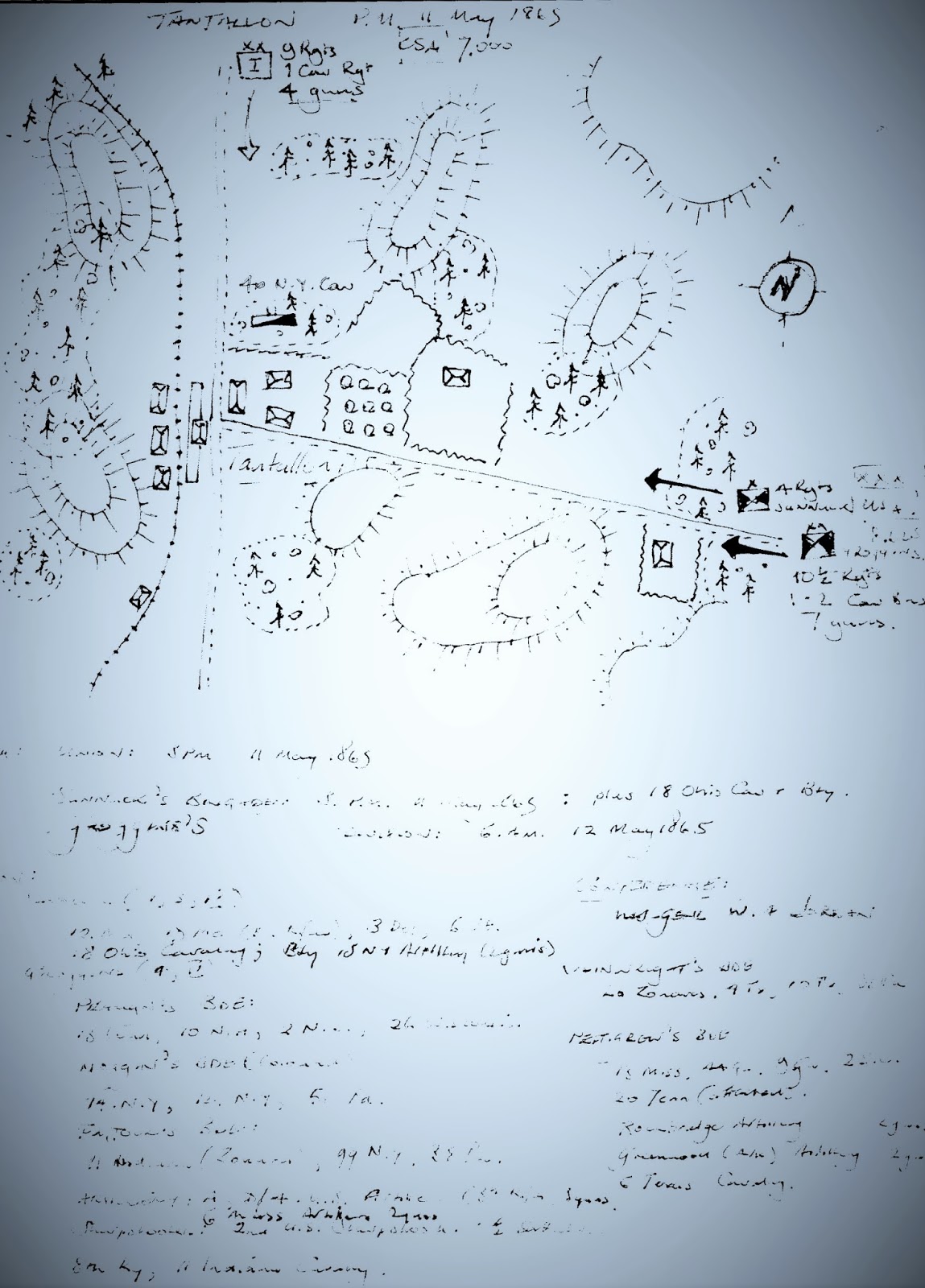
May 9 saw a couple of slight affairs at Middleton (I8) close by the Mississippi border, and another at Wartrace Depot, between sizeable forces, but which were abandoned after little more than light skirmishing.   The campaign itself was abandoned, rather unfortunately, on May 11, before the interesting looking action at Tantallon could be fought out.  There a retreating force of some 7000 Confederates under General Jordan were marching towards the town from the north, whilst a larger Union   force (over 8,000) was racing westwards towards the same place.  In the town itself stood the battalion of 40th New York Cavalry, whilst a gap had developed between Sunnuck's Brigade of Knott's (Union) Division, and the Division of Major-General J. Pierpont Groggins, which was not due to arrive until the 12th.  The Confederates would have to break through in about three hours (the action opening at 3pm) or else have a real fight on its hands the following day.  As Jordan's and Sunnucks were expected to arrive at the town at 3pm, much depended upon the celerity of movement of both sides whether indeed there would be a battle at all, or the Confederates would pass by under the noses of the Union forces approaching.  I have just rolled a couple of dice to see what might have happened.  The CSA rolled a 2, which indicated considerable celerity of movement; whilst the USA rolled a 3.  So the Confederates would arrive a half hour (one battle move) earlier than the Union brigade.  It seems fairly likely the CSA might have brushed aside the lone cavalry battalion in front of them and slipped by without a battle after all...

I won't go into the immediate reasons for the campaign's demise, but I wasn't altogether sorry.  This style of campaign is probably not suited to a large number of players if one of them happens to be a major participant. But the fact was, it was somewhat under-prepared, to the extent I was never very happy with it.  It lasted several - at least a half dozen combats - though only one reached the 1100-odd figures of the Pulaski battle.  But the Tantallon action, had it occurred, an gone to a second day, would have employed well over 600 figures.
Source of details for my Stonewall in the Valley
Campaign map.


During the course of this campaign, there were some naval or combined operations going on along the Mississippi River.  The Confederates had forced the surrender or abandonment of a couple of forts, a cottonclad vessel had run the guns of a Union fort, and got away with both guns knocked out, and, its funnel riddled with holes, a 3-knot reduction in speed.   According to my campaign notes, the Union fleet had orders on the 11th May to chase the Rebel fleet out of B3, which suggests a naval action might have been imminent not far south of New Madrid.

Running such a large campaign (in terms of toys available) I would never again play in it at the same time.  That was a mistake, but the sort one has to make in order to learn from it.  What works for a two or three player campaign won't for a 6-player.  

Another ACW campaign I have long had in mind was based upon a idea mentioned in Don Featherstone's book War Games Campaigns.  This was 'Stonewall in the Valley', in which Stonewall Jackson commanded a force of ten infantry regiments, with horse and guns, operating in the Shenandoah River valley.  The Union Army had three identically similar corps operating in the same area, setting about to trap the Confederates or to drive them from the Valley altogether.

Stonewall in the Valley - Campaign Map.
More on that, next time...

Wednesday, October 19, 2016

Campaign Ideas.

Some time ago I made some mention about making a series of postings about campaign ideas. Campaigns can vary from operations lasting a few days, to entire wars.  I like entire wars.  The whole thing places the battles into a broader context, a bigger story, in which the fate of nations hangs in the balance.  The map of Poictesme above suggests a Mediaeval time from 1200 to 1500, say.  But this one I haven't really thought much about.  It is included because I found it printed on the back of another map I shall be including in a future posting on this topic.

In this part of the world, the most successful campaign game was played about 16 years ago, and involved several battles using the DBM rule set.  Called Condotta, it had two strata of players: the rulers who ran the city states, and the generals - condottiere - whom the states hired, and who conducted the battles. The details of the campaign are still extant on line:

Condotta!
Condotta Introduction and Campaign Map

Movement was from province to province in attempts to conquer or to defend them.  Armies comprised homegrown militia and mercenaries, which, of course, had to be paid for from the States' treasuries. As the City Council of Florence, I was none too chuffed about our early military disasters and, after the defection or death - don't remember which - of our field commander, sent a representative (myself) to conduct the battles.   We managed partially to restore our fortunes, but only partially.  Being a largely infantry army, our defeats tended to be disastrous - expensive in men and the treasure required to find replacements.  Lacking a sufficient cavalry, we could not profit much from our victories to visit wholesale destruction upon the enemy.  Our treasury was looking pretty sorry after that last battle, too.  I didn't think we could continue employing the Swiss pikemen for much longer.  I did regret bidding too little for the Illyrian light horse (I think it was) too.

The Florentine City Council sure had plenty to worry about!


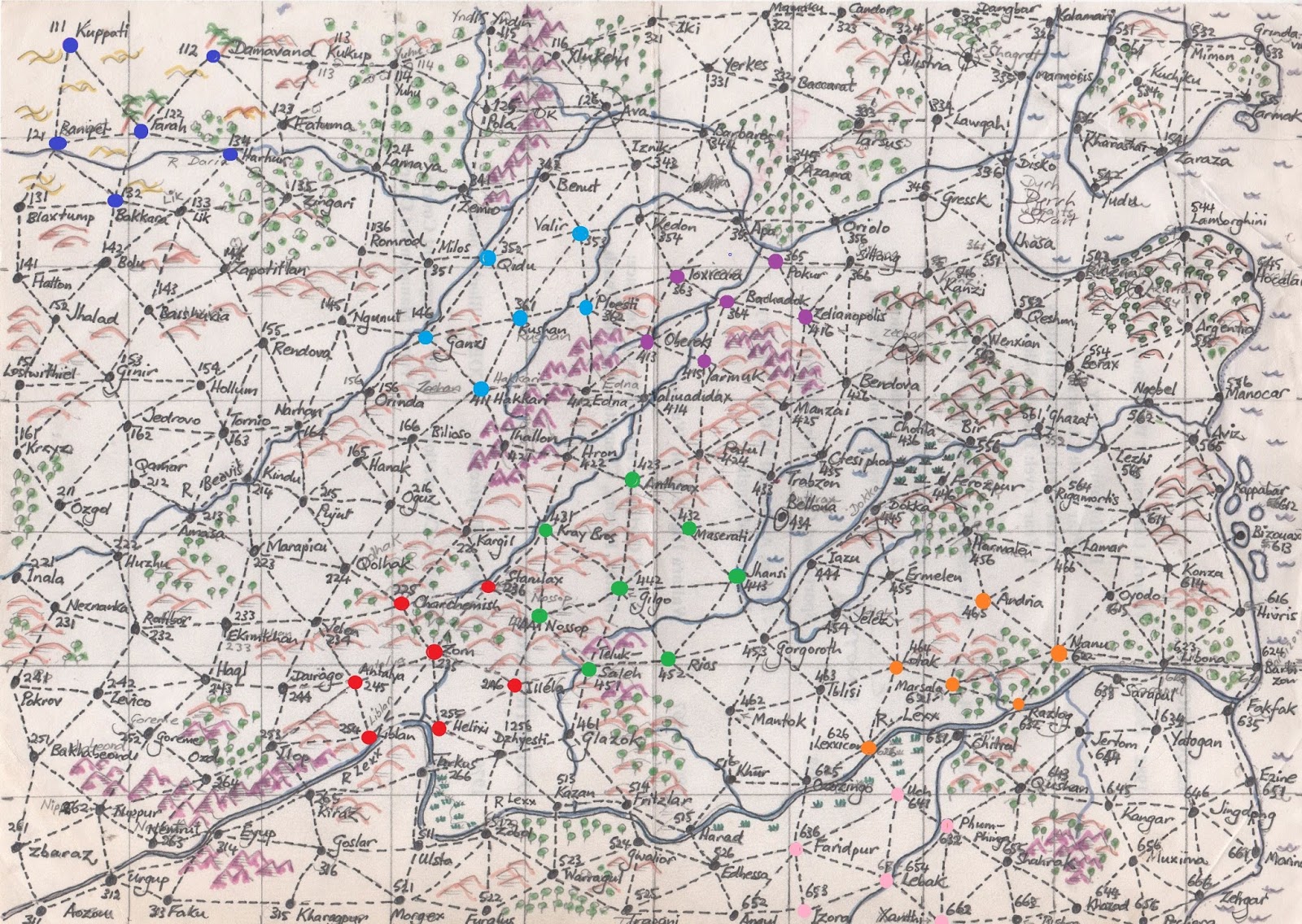
For an earlier period, using any rules at all, I bethought myself of this ambitious idea.  Consider a map comprising 216 cities, all identified by a 3-digit number, the digits all being 1 to 6.  Then a number of players roll for their capital cities.  This capital and the cities one road stage from the capital form the player's realm.  In the following map the 'players' (imaginary) have rolled Red-White-Green dice as follows:

Terra Cognita - 216 numbered cities.
(I think there is a 217th with no number...)
RED - 235 - Capital Zorn
LIGHT ORANGE - 621 - Capital Marsala
GREEN - 441.  As that left two cities in dispute, the capital was moved one road stage away, 442 - Capital Gilgo
LIGHT BLUE - 361 - Capital Rushan 
DARK BLUE - 146 already claimed; reroll 122 - Capital Farah
PURPLE - 364 - Capital Bachadok
PINK - 654 - Capital Muxima

That left GREEN with the most powerful kingdom - 8 cities; RED has 7 and all the rest 6.


Terra Cognita and its Seven Realms.  The cities one road stage from the
capitals rolled for constitute the core realms.  The realms expand
from there.


With just 45 of the 216 cities occupied, there is plenty of room for expansion, but at the same time, all except DARK BLUE has a proximate neighbour to worry about.  

Depending on what rule set you're using, each city state points up an army from which are assigned garrisons, city fortifications (I suggest the Capital only, always fortified, is not 'paid' for out of the Army Points allocation you're using), and field armies.  If using,say DBM or DBA big battles, a initial 800 Army Points might go:

200 army points - garrisons.  All towns must have a garrison of at least one non-skirmishing foot element. The Capital has a standing garrison of at least 100 of those AP
200 army points - fortifications (supposing they are to be included in this campaign).
400 army points - field army.  These may be split into smaller field armies of no less than 100 AP, including baggage trains or camps.

Field army maintenance, battle losses and other 'wastage'  might be replenished from a 'treasury' based upon what cities you hold. Gilgo would have an edge, there, with a slightly bigger income than the rest.  But that realm is surrounded in the centre of the Terra Cognita by four none-too-distant neighbours.  'Wastage' really means allocating a garrison for newly acquired cities.  The size of the income might have to be determined by trial and error, but a starting point might be 200 Army Points from the capital, and 100 from each of the other cities.

My first idea, when developing this map, was for an 'Ancients' and/or 'Mediaeval' campaign, using the DBM or, at a pinch WRG 7th Edition rule sets.  But it seems to me that it could equally well go with DBA, HotT (Hordes of the Things), Fantasy... or even the 'Renaissance' - pike and shot - period, so called.  Horse and Musket - why not?  

More on this in another posting.


Friday, October 14, 2016

Dilettante

War of the Spanish Succession, work in progress:
 Two  Imperialist36-figure infantry regiments 
Yep: once more my sadly neglected blog-spot has been left idle while I do other things.  As ever, I have also allowed myself to drift from one topic to another.  About three weeks ago I bethought myself to do something about all those War of the Spanish Succession figures I started buying about 5 years back.  All the figures are hard plastic, Wargames Factory.
Five of my infantry units, all undercoated, and 3 of my
four cannon. Some further progress on the Alt Heisier (white)
 and de Wendt (grey) Infantry.
 Nearly all of them had been assembled by this time; just one infantry regiment remained.  What I have now are
4 General Officer/Staff figures;
4 Cannon each with 4 crew figures;
6 x 36-figure line infantry regiments;
1 x 36-figure grenadier 'regiment';
2 x 24-figure cavalry regiments;
1 x 24-figure dragoon regiment.
Same box: different view.
 The infantry regiments I designed such that they can be split easily into 18-figure battalions.
I Battalion: Officer with sword, flag, drummer, 15 soldiers
II Battalion:  Officer with spontoon or half-pike, other flag, other drummer, 15 more soldiers.

The Grenadier 'Regiment' is a decision I somewhat regret, but it is too late now.  Better might have been to make 4 figures in each of the 7 regiments grenadiers, which could have been 'syphoned' off to form a 28-figure over-strength battalion; leaving 32-figure regiments each of 16-figure battalions.

I had originally intended to base the infantry on 15mm frontage per figure, in pairs, with some individuals.  However, I was persuaded to place them on 20mm frontages instead.  That did mean redoing one unit.  Fortunately it was just the one unit!
Close up of de Wendt Infantry.  Quite a bit of work
yet to be done, but they are starting to look like something.
The Army is based, more or less, on the Imperialists of Prince Eugene of Savoy.  I have had to make some uniform guesses, and the grenadier unit will have to be 'generic' - they'll probably receive grey or maybe white uniform coats.  The Military Commission is as yet undecided about that.  The units depicted are those for which I could provide a flag from downloadable sources.  Rather regrettably, the units with which I could associate  three pairs of flags all had grey coats, and two had pink differencing: Regiment de Wendt and Regiment Holstein-Ploen. The other was the Kreichbaum Infantry.

A page of the uniform information I
managed to pick up on line.
Downloaded flags after I have played around with them using
Microsoft 'Paint' feature - a very useful tool.  The quartered flag at
bottom left I created for the Brandenburg-Bayreuth Infantry
based on other information.

Alt Heisier Infantry.  Almost finished...
The fourth pair of flags - the top left and middle in the above picture - I could not associate with a line infantry unit, but rather than waste them, the Grenadiers will receive them.  I call it historic licence. Another source seemed to indicate that one of the flags carried by the blue-coated Brandenburg-Bayreuth Infantry was quartered azure and gules.  It seemed to me a fairly simple task to copy one of the plain flags, quarter it and fill colours.  The fill is by no means homogeneous except for a band along the upper edge, but I don't reckon on doing anything about that.  More annoying is that the pale lemon colour of the 'plain' flags printed out white.  I'll probably leave them that way...
Holstein Ploen Infantry.  Last night I did some outlining of |
details.  Some of these fellows are wanting their swords, too.
In a recent visit, Jacko (Paul Jackson of the Painting Little Soldiers blog) had something to say about the bright green coats of the Osnabruck Infantry.  I admit that this outfit has a certain ... erm ... chromatic 'presence'.  But on a war games table, a green-coated unit needs to stand out!  Jacko was generous enough to provide me with the spray paint with which to undercoat the units that missed out when my own ran out.
Osnabruck Infantry.  The 'reversed' uniforms of the drummers is
entirely conjectural.  
The red coats of the drummers was entirely conjectural, and a convention I have generally ignored in my other 'Horse and Musket' armies.  I've not been consistent, neither.  In contemplating the musicians of Holstein in pink coats, I could scarce repress a shudder.  The grey guys stay grey.

Next time, I'll talk about the Cavalry.

Sunday, September 4, 2016

What I did spy at the Bring-n-Buy

For my Army Men project.  The carrier becomes an
artillery tractor.

Every year at the local Bring-and-Buy down at the Woolston Club, I find something of interest. More, indeed, than I spend, but I find I am becoming accustomed to resisting some kinds of temptation. Last year, I spent just twenty-eight dollars, for which I came away with some Napoleonic French Horse grenadiers which were to become my representative unit for my Imperial Guard Heavy Cavalry; and eight palm trees suitable for my Army Men project.  That was enough to satisfy me then.

Lone star Armoured car.
This year I spent more, on a wide range of ... topics, shall we say?  In no particular order overall, we'll begin with these three items for my Army Men project.  The 'Lone Star' armoured car (obviously based on the WW2 'Humber' models) was a find.  Had there been more of those, I certainly would have snapped them up. The 'Lone star' bren carrier I bought specifically as a tractor for the Britains field piece.  These were a bit pricy at $10 the time, which is one of the reasons why I didn't buy more of the 'carriers' at least.  I certainly gave a bit of thought to that!
Britains field piece and Lone Star carrier.

37mm AA on a SdKfz7 half track.  Work needed doing to repair
the cab, and to remount the gun assembly.

Definitely a mixed bag at Tony's table: a couple of metal German 15cm howitzers, to be assembled, plus this interesting item.  It was somewhat damaged: the AA gun assembly had come adrift, and I had no idea what had happened to the cab.  The control panel that was in place I tore out and replaced, then fitted the cab seats.  Finally, over all went the cab tilt.  The end result isn't quite right, I suspect, but it is now a presentable enough piece.


The Leopard Company of the Tchagai Army has just had
an augmentation to its strength...
I think it was from here, too,  that I picked up my third Leopard tank for the Nabob of Tchagai.  The model was OK, but the tracks needed repairs and straightening, and one of the road wheels was threatening to go its own way.  Repairs completed. Fifteen dollars - and a wee bit of time later - spent at this table.

British 2-pr Anti-tank gun (Zvezda).  
The 'spare' travelling carriage for the 2pr gun.
The next fascinating item I have long felt was a serious deficiency in available plastic kits if you wanted to do the Western desert: the British 2pr anti-tank gun.  It took the Russians to come up with one, and a superb piece it is.  I've made it up here as an Art of Tactic game piece, but as I haven't glued it to the base, I can as easily detach it for other games.  That the thing pretty much fits together without glue, I find very impressive. Actually I did glue a couple of small bits, as being too fiddly otherwise for my clumsy fingers. I don't have a copy of the Art of Tactic, and would be interested to hear news and readers' opinions of that game system.
The wheels I shoved onto the spare trail.  I get the impression that as one need not for the most part use glue in assembling the model, you could uplift the gun from its deployed carriage, and place it upon this one for the gun in travel mode.  Wouldn't it be great if Zvezda (or someone else for that matter) produced a CMP or Bedford portee for the thing?
Tropical foliage.  I painted the grey leaves green and
applied a thin acrylic wash overall, then mounted them
upon more stable bases.

Impulse buy here, seeing this bunch of tropical ferns (?) going for $4 I think.  I've based them on more stable circular wooden bases I had spare, and re-glued some of the pieces that had come adrift.  I good deal of the stems and foliage was grey rather than green.  These I painted the upper surfaces and some of the undersides a brightish green a slightly darker shade than the already green ones, which (of course) I left.  Then over all I applied a very watery black acrylic wash.  The result is what you see here.  With the heaps of aquarium plastic greenery mosses and what have you, I reckon I can create a suitably wild, scrubby jungle, swamp or thick brushwood terrain...
A couple of logistic elements for my Napoleonic armies.
If these had been the only items I had bought all day,
I would have been well content.
Coming last in this article, but the first thing to catch my eye were these two interesting items. Always on the lookout for anything that can fulfil the role of logistics elements for my Napoleonic Big Battles project, I just had to snap these chappies up.  The long caisson could be French or possibly Russian; and the grey limber and ammo chest and gunners' carriage look to be Prussian. When a item leaps up, grabs you by the throat and says "Buy me!" - well, you gotta do what a man's gotta do, eh?  Altogether, a very satisfactory day's haul, having spent just over 70 bucks, even if several of the items required a little bit of work.  


The final items aren't from the B-and-B at all, but from Paul, a.k.a. 'Jacko' of the 'paintinglittlesoldiers' blog spot.   Having several Napoleonic cannon surplus to requirements, and knowing I was thinking of acquiring more, he left seven with me before giving me a lift to the Club. Thanks, Jacko, for a great day out!  

'Jacko' very generously left these cannon, from his own
collection, with me.  French and Prussian, by the look...