Sunday, January 2, 2011

Diversions...


A recent posting on the Old School Wargamers' group has been the inspiration behind this posting. 'Uncle Thor' was looking for someone to playtest his table top play concept OMOG - One Man, One Gun , intended to be packaged with his Toy Soldier Art.

Natuurally intrigued, I went off to explore what was meant by 'Toy Soldier Art'. It was an eye-opener. I had never come across before quite what this guy was about. Although he doesn't say specifically, the philosophy behind the whole idea is to find virtue in even quite crude and cheap figures (emphasis very much on 2-3" figures); to use your painting skills to supply deficiencies in the figure and or its equipament; and for the play: to use whatever you have available. Teacups, cutlery, books - anything at all - can be used to provide terrain. Mind you, he can supply soldiers and terrain...

My first thought was for several plastic 19th century figures I have waiting for the decision whether to go the Horse Foot Guns direction, or something a bit more Little Wars. It appeared very quickly that I had too many of these figures for OMOG to be a goer, though I did ask for the 19th Century download.

It was not until then I bethought me of some half-forgotten figures stashed away somewhere, and quickly fished out. Way back when my daughter was 3, she had spotted a pack of soldiery that she thought Dad (me) might like for his 'wargamings'. Actually, I quite liked what was in the bag: musketeers and grenadier figures, some artillery, a mounted and a couple of foot officers, a cannon with the wheels the wrong way around (easily sorted), a siege mortar(!) and a gun emplacement. The whole could be arrayed on a (rather crudely) printed plastic play mat.

Seeing what Thor had to say concerning Toy Soldier Art, I felt I had shortchanged these figures, and have spent much of the last 3 days transforming them into something like Toy Soldiers. At least, I hope I have. Here's a bunch of pics. What do you reckon?


These redcoats I had figured on as British Grenadiers, but I am told that the guys in black plastic were supposed to be 'Hessians'. It had crossed my mind to repaint some as Germans of one sort or another, but I stayed with the Brits. Black plastic, by the way, ain't easy to paint...

Now, the whole idea of OMOG is very small scale - what we call 'skirmish games'. As these pics show, there's plenty to work with, and even if the Mortar won't see much action, it would make a fine objective for a trench raid in a Yorktown scenario.


Of course, with these inexpensive (cheap) buys, you get some naff poses. I'm sure that no one with a view to longterm battlefield survival would have wielded their bayoneted muskets in quite the overhead manner shown here. Particularly odd are the Grenadiers standing - well, staggering, really - firing. I'm prepared to suppose that even well braced for the impact, one can not avoid reeling with the recoil. But I would have preferred the 'pre-discharge' pose... One thing is for sure - you can see how easy it would be to shoot over your target's head!


Here are a few 'situational' pics with which to end this posting...


Small patrols meet whilst scouring the swamp flanking the main positions. No doubt after a very brief exchange of shots, both sides will fade back into the undergrowth and report ...


This Mortar Emplacement is rather close to enemy trench lines... The picquet on guard watch anxiously alert for the enemy to try a surprise raid on the emplacement.

Thor identified these soldiers as BMC, possibly also sold under an 'Americana' name. Some of the BMC moulds fetched up in China (I noticed that my figures have CHINA imprinted under the base). BMC originally produced French and 'Hessians' as well as Continentals and British, and had playsets for other conflicts: ranging from the Alamo, San Juan Hill, Iwo Jima. I suspect the set Ursula bought me might have been intended as Yorktown...

Crude they might be, and yet they are quite engaging once painted up. I hadn't appreciated that until now. Nor had I any idea what to do with these fellows. Soon, I daresay they will be locked in combat on our kitchen table...

Meawhile, check out http://thortrains.net/toysoldierart/ ...

Monday, December 13, 2010

Siege/Garrison Guns

An army just isn't complete without some of the more specialist troops: Pioneers, Engineers, bridging train, siege train...

Having some brass cannon and the wheels from Airfix Ancient Britons chariotry, I bethought myself to construct a company of heavy artillery for sieges and/or city defence. Rather than duplicate for each army such a company that would seldom be required, this troop is intended to be generic.

As I do have a zillion Airfix RHA figures, I can at least create the train personnel for each nation! At that, many of them will no doubt make fine pioneers as well...

Infantry of Altmark-Uberheim

At last! The infantry of the Electorate of Altmark-Uberheim is complete - or very nearly so. Way back in February, I showed pics of the early stages of this project.

Progress was steay until june, but then, partly owing to a discouraging cock-up, partly through loss of motivation (and other things taking up much of my time), the thing hung fire until just over a week ago. And now, at last, we can unveil the foot troops ready at the behest of Kurfurst Draco zu Spitzensparken to go forth conquering and to conquer. Well, try, anyway.


Lined up on part of my little work-table are:
To the right and nearest camera, the 49th (Sers) Fusiliers;
Beyond, 15th (Garde) lead a battalion of Pandours in the service of Altmark-Uberheim;
At centre picture, we look down the line of 22nd (Prinz Moritz von Anhalt) Infantry; and behind them is the 25th (Ramin) Infantry Regiment.

The other half of the table is covered almost completely by the other 5 battalions of the Electoral Army:

From nearest, the Regiments are:
- 1st (Winterfeldt) Infantry;
- 18th (Prinz von Preussen) Infantry - Prinz Heinrich von Brandenberg-Prussia not too proud to be inhaber of one of Altmark-Uberheim's fine infantry...
- 4th (Kalnein) Infantry
- 2nd (Kanitz) Infantry
- 10th (Knobloch) Infantry.

A couple more views..

Friday, December 3, 2010

Peninsular War Campaign...

For the last few weeks, a bunch of Christchurch wargamers, sinking their identities into various well-known personages of the Peninsular war, have been engaged in a struggle for power over the Iberian Peninsula. The last three posts have described some of the action in that campaign.

Here's the cast of characters:
Marshal Massena, Prince of Essling: Ion (Me)
Marshal Soult, Duke of Dalmatia: Andrew Taylor
General the Duke of Wellington: Colin Foster
Marshal Beresford (Commanding the Portuguese): Ross Fraser
Anybody and everybody Spanish not friendly to France: Paul Jackson
God of War (Mars) - or maybe Goddess of Battles (Bellona): Barry Taylor

Of course, each character has a number of other non-players (NPCs) under command. Messena commands the Armee du Nord, broadly speaking active in Old Castile, Estremadura, the area around Madrid, and Portugal. Under Massena's command are Marshal Ney (VI Corps), General Reille (II Corps - soon to be taken over by Marshal Bessieres) and Genl Junot (VIII Corps). One has the sense of being spread rather thin!

This is partly due to the scaling down of the armies. Any any given time the French Empire had committed something like 250,000 to 300,000 to this theatre. We are making do with forces representing maybe a fifth or a quarter of those numbers. Clearly the whole Peninsula has been scaled down, as has the time scale (though each Campaign move is called a week).

Much of the early action has taken place in Marshal Soult's extended bailiwick: Zaragoza surrendered; Genl Suchet successfully stormed Barcelona; the confused and scrambling combat at Castalla was followed up by the pursuing French successfully forcing a river crossing at Xativa.

There has been little fighting in the northwest, though that seems likely shortly to change. Gathering under VI Corps command as large a force as he dared - in view of the vulnerability of his lines of communication and the need for garrisons to hold down the countryside - Massena undertook to carry out the orders that had been issued direct from Paris: take Portugal. Marching by way of Almeida, Guarda and Covilha, Massena penetrated as far as Abrantes, whereat his scouts reported the presence of large Anglo-Portuguese forces - perhaps 15,000 troops, more than half of whom were British - upon the hills on the far bank of the Tevo River.

With a force little more than what the enemy seemed able to assemble, Massena declined to attack, but offered battle where he stood. The Iron Duke mysteriously drew off most of his force south to Santarem, but Messena refused to be drawn. A quick strike by Marshal Ney towards Fatima yielded no results; and at the end of March Massena began gradually to pull back northwards.

There were two reasons for this. Faced by a strong enemy force whilst isolated at the end of an exiguous line of communication was not a situation that Messena felt could be long endured (yes, I know: Massena did indeed endure such a situation during the winter of 1810-11, but I wasn't going to have with that!). Somehow a better opportunity needed to be sought. But equally compelling was news of an Anglo-Iberian landing somewhere near Gijon, on the Biscay coast. The reported numbers of Allied troops involved suggested this was no mere raid, but a serious effort to (re)conquer Old Castile. Could II Corps meet this threat? A worrying situation to be sure, yet those that knew him began to discern a faint gleam in the Marshal's eye. Dispatch riders with heavy escorts rode off in numbers with orders to the various commanders throughout Northern Spain. The game was afoot!

Meanwhile, General Junot has been conducting an offensive of his own in barren Estremadura. It has been a lonely journey - hardly a Spaniard has been encountered in the entire province, though there was rumour of enemy light cavalry moves south of the Rio Guardiana. At last, approaching Badajoz, VIII Corps has run into a small brigade strength Spanish corps that seems ready to defend a river crossing - a single bridge with nary a ford by which to bypass the defile. A small action seems imminent in that remote part of the world.

Action looks likely in northern Portugal as well. Forced to abandon Viseu, Massena is planning a strike in that direction in the hope of bringing on an action. It seems fairly clear to him that he can not much longer retain a foothold in Portugal, but, perhaps to avert Imperial wrath in Paris, he wishes at least to cross swords before moving back into Spain. Besides which, the Guarda crossroads is a fine point upon which to strike out at foes coming from different directions, whilst at the same time not an easy place to get past if the Allies want to carry the war into Spain. The strategic value of such a point is not lightly to be given up!

On the other hand, there remain those enemy troops in Old Castile that require attention...

Friday, November 19, 2010

Barcelona Falls!

Such were the headlines that blazoned the Moniteur at the beginning of April, 1810. Zaragoza had surrendered at discretion, but the determined garrison of Barcelona, despite two breaches being torn out of the crumbling city walls, were determined to defend the city to the last...
003

A view of Barcelona in more peaceful times...

The map shows the city of Barcelona, flanked by the Citadel to the east, and Fort Joie hard by the town to the southwest. Heavy siege batteries in both places were still active. Though those at Fort Jouy was largely masked by the city walls against an attacker coming from the north, the Citadel guns could reach two-thirds to three-quarters across the north face. That left a fairly narrow corridor through which the assaulting columns could advance, safe from the heavy ordnance in the outlying works.

However, as these were served solely by artillery, the French commander, General Suchet, decided to take the city by storm, leaving the more heavily fortified fortifications to 'wither on the vine'. He had available some 5000 infantry, a single battery of 8pr guns, and 1200 light horse. Besides the single battery company in the Citadel and in Fort Jouy, General Giron, commanding the garrison, had just 2200 poorly trained volunteers and militia, and a company of 8 light guns.

Storming the town
006
General Suchet opened the ball with a powerful attack in depth upon a narrow front. Supposing (rightly) that the breaches had been mined, he elected to storm the wall beside the major breach near the North-West tower, ignoring completely the minor breach in the centre of the north face as too hazardous to approach under the flanking fire from the Citadel.

Gen. Giron declined to defend the walls, instead placing a garrison in each of the Western, Central and Eastern Districts. A fourth small volunteer battalion he kept in reserve hard by the Eastern District, behind the light guns placed to enfilade any attacker who crossed the walls. The maze of streets in Western District, just behind the major breach, proved to be extremely tough to attack, and although the first to come under assault, it's defenders held out for a very long time.
Fall of the Central District
007
A battalion sized attack cleared the Central District surprisingly quickly, though only after a stiff fight. This left the flanking Districts isolated from each other. Rearranging his forces, Giron flung his Eastern District garrison in a spirited counterattack that, to everyone's surprise, recovered the lost ground.
Spanish counterattack recovers the Central District (briefly)
010
Before this unexpected success be consolidated, a renewed French attack flung the Spanish out again. With the scattering of this battalion, Giron was forced to deploy his last battalion in defence of the Eastern District.
It was shortly after that that the Westen district finally succumbed.
With two-thirds of the city in his grip, Suchet prepared with care his attack on the District remaining in Spanish hands. Left with a single small battalion of volunteer militia (400 men - 4 stands), Giron determined to fight to the last. The other three battalions had scattered among the streets and alleys of Barcelona; his guns had been overrun. It was a brave 400 that stood to meet the final assault.
The final assault
011

It was a fitting climax to the day's action. Four battalion columns stormed into the Eastern District, and were met by a withering storm of musketry. Losses mounted sharply on both sides; nearly half the Spanish defenders fell, but took an even heavier toll upon their assailants. Appalled, the French fell back to regroup.

Before they could renew the attack, however, a ragged Spanish militia officer approached with a flag of surrender. General Giron had been severely wounded, and, for their bravery, the scant remnants of the defenders had had enough.

The French were jubilant. Barcelona was theirs.

Action at Castalla - 2

To resume the pictorial narrative, we begin with a general view looking north. Close to, the regular light infantry wait patiently for the attack by enemy horse and foot. Though safe enough for the moment in their orchard, thay can contibute very little to their beleaguered comrades in the town.
016
In the middle distance, three Spanish battalion columns prepare for an assault to drive the French out of the town, and hence leaving the way clear for McCullagh's command to break free.
017
Alas for the Spanish, the assault fails to achieve more than a slight weakening of the French garrison at the price of heavy losses. One attacking battalion breaks and flees out of the town (purple bead).
020
The second attempt to clear Castalla of Frenchmen. The defenders hang on grimly. But each assault weakens the garrison. It can not hold forever.
021
Apparently endless Spanish columns, hastening to the fray.
022
1st Ultonia and 2nd Alicante, having chased the French light infantry out of their orchard and across the small stream between groves, are surprised when the latter turn upon their pursuers. Slightly ahead of their comrades, 2nd Alicante bear the brunt of telling French musketry, losing two stands.
023
Can artillery blast the French out of Castalla?
026
Attack upon the light infantry defending the east orchard. Though taking losses, the French throw back their opponents with ease.
028
Delaborde arrives witgh his Division. Now McCullagh is in trouble, caught for the moment between fires. As for 1st Ultonia and 2nd Alicante, even if their comrades escape with the guns, these two battalions are doomed... unless they scatter and the survivors nake for the hills...
029
The 'lost battery' approaches the town ... still firmly held by the French garrison.
031
At last success! A third assault pitchforks the much reduced garrison out of Castalla. One company rejoining its parent battalion in the castle; the 200 (2 stands) remaining of their sister battalion falls back south of the castle. The road now lies open.
032
The general advance of Delaborde's Division. But it's too late. The enemy are able to make good their escape.
In this, the first action of the campaign, the Spanish took much heavier losses than did the French, but they could claim a solid strategic success: they saved the guns.

Thursday, November 18, 2010

Peninsula Campaign...

For the last several weeks, now, I have sunk my identity into one Marshal Messena, commanding the 'Armee du Nord' in Spain and Portugal. The year is 1810, the campaign began in March, and April is about to begin.


My co-commander is Marshal Soult (Andrew Taylor - Armee du Sud). Arrayed against us are the Spanish armies of the Supreme Junta (Paul Jackson) whilst the role of the Iron Duke is of course played by an expatriate Brit, Colin Foster. Overseeing proceedings as Deity of one's choice, is Barry Taylor.


Now, so far not much real action has taken place in the North of Spain. Massena gathered together an army to invade Portugal and made it as far as Abrantes before deciding that further progress was unlikely to be achieved except at ruinous cost. Things have reached something of an impasse there, for the time being.


There seems to have been some activity on the Biscay coast, with rumours of a large-scale Allied landing, but this body of enemy troops seems to have disappeared into the hills of Old Castile.


Meanwhile, Marshal Soult's forces, extending from Cordova as far north as the east end of the Pyrenees, have been rather more active: Zaragoza has surrendered, and Barcelona invested. But the first real action came at Castalla, not far south of Valencia.


Combat at Castalla

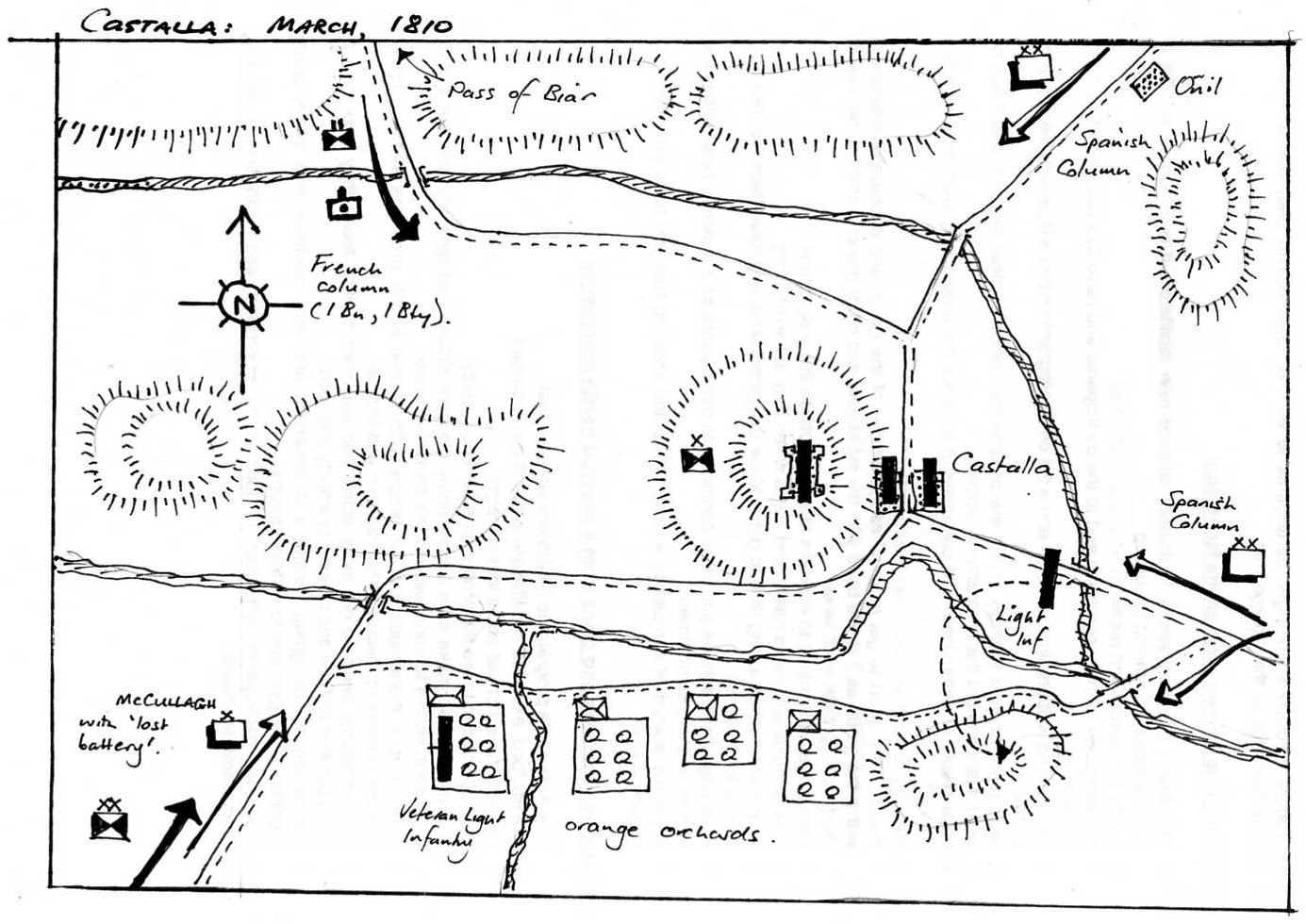
The French occupation of Castalla town and its nearby castle proved something of an embarrassment for ther Spanish, as a brigade sized column under General McCullagh suddenly found itself stranded on the Jumilla road with and its sole line of retreat cut. A French Division, approaching up the road from the southwest, threatened to squeeze McCullagh into surrender. Accompanying this Spanish Brigade was one of their few heavy batteries. That, they could ill-afford to lose. Accordingly, Spanish columns at Xativa and Alicante were ordered to Castalla, with strict instructions to open the road through the town and effect the escape of McCullagh's command.


Meanwhile, the local French commander found himself approached from three different directions with only the infantry of his brigade to defend the place. He had neither horse nor guns. Northwest beyond the Pass of Biar, however, approaching along the Almarna road, a battalion of veteran infantry was escorting a battery of 12pr guns, a welcome reinforcement for the action that followed.


Rather than going into a full narrative of events - better done elsewhere - I shall give a brief summary with accompanying pictures.

Looking north towards Onil, with Castalla to the left. Spanish troops advance from north and southeast. The French regular light infantry contest the advance of horse foot and guns in the foreground (reducing the battery to 6 guns), whilst in the middle distance, the Spanish close in upon the town.
Some distance south west of Castalla, the Veteran Light infantry observe from the cover of an orange grove the approach of McCullagh's command , marching to escape...
Having arrived through the Pass of Biar some distance behind its escorting infantry, French 12pr cannon - their sole artillery in this action - scores a brilliant opening salvo. Ten D6s to roll, sixes to hit: 5 hits. Two hits eliminate a stand, so the 6-stand unit is reduced to 4, with a hit registered on one of the surviving stands. All things considered, the Spanish light horse stood up well to this punishment, but it meant the French artillery were henceforth safe from attack.
McCullagh's command, arrivibng on the field. Two battalions are dispatched to deal with the nuisance light infantry in the orchard that lies a short distance from the road.
The Spanish assault upon the east face of Castalla with three battalion columns is at once successful. The 4 companies defending that part of the town are driven across the main street into the western half. There, they were much harder to evict.

T0 be continued...