Monday, February 17, 2020

Carnage at Elchingen

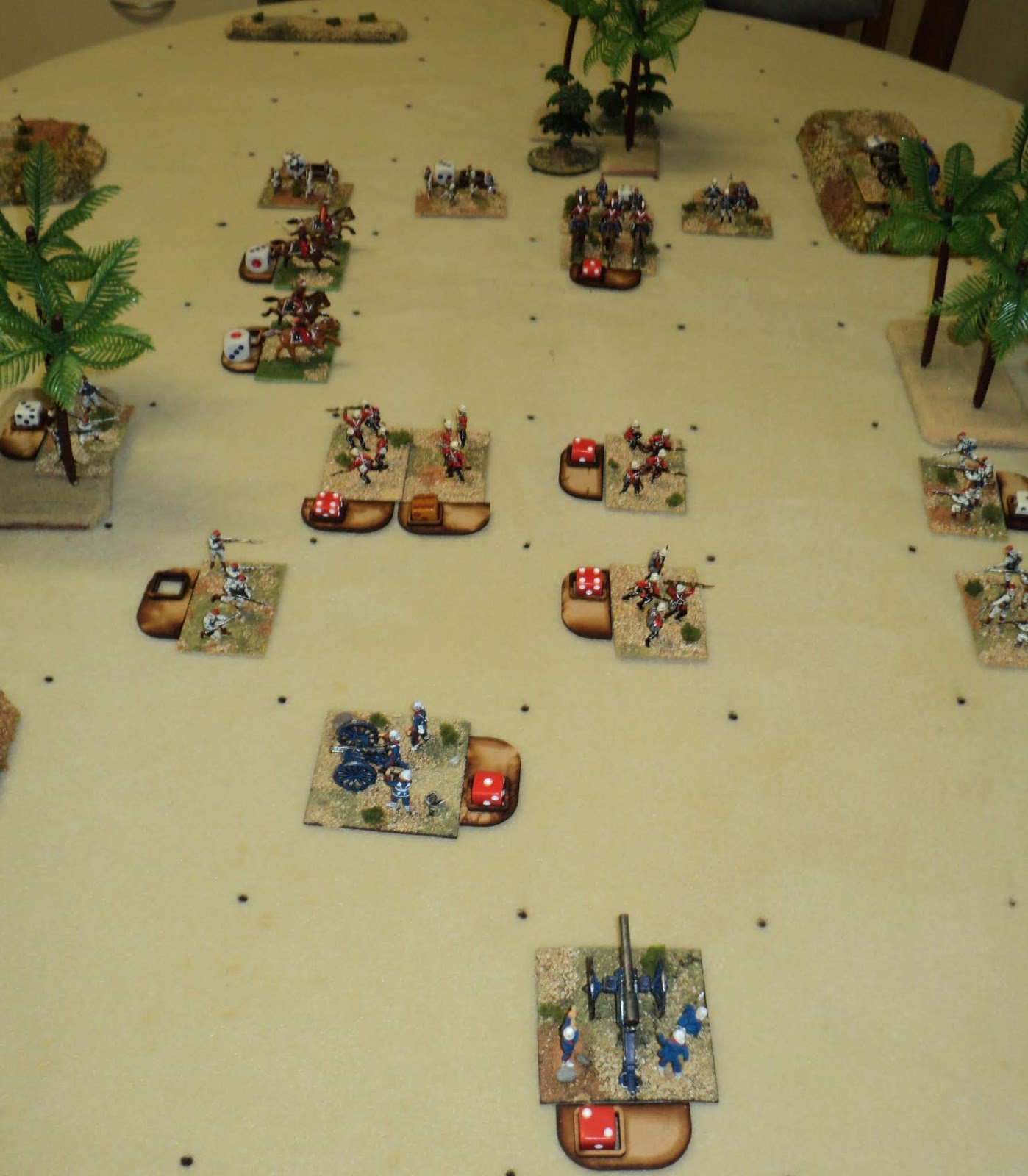
The games that Mark (author of the Chasseur blog) put on at his house are becoming something of an annual (or more) event.  And very enjoyable they are, too: fine table set-up, lovely soldiery to order into battle, and a genial host.  Last Friday but one (7 February 2020) was the occasion for one of the tensest tabletop battles I have ever fought.  Unfortunately my not very coherent series of pictures aren't going to do the thing justice.

The action was the first really major action fought at the beginning of the War of the Third Coalition, 1805.  Ordered to recross the Danube River to the north bank to cut off the main Austrian army being encircled around Ulm, Marshal Ney forced a crossing south of the twin Elchingen villages, stormed them and forced back the whole Austrian line commanded by General Riesch (and General Werneck, according to my, more ... erm ... general, source).  It appears that Mark got much of his information for the scenario from this very interesting and attractive resource:  Obscure Battles.

Mark opted here to umpire the game, whilst Paul ('Jacko' of the Painting Little Soldiers blog) and I chose sides.  I took the French - rolling a die and calling 'odds/Austrians-evens/French' - Paul the Austrians.  I can't say that the opening situation looked all that encouraging - masses of Austrians, none too many Frenchmen on the table.


The action opened with Loison's infantry Division having crossed the Danube, and advancing upon the Ober-Elchingen village.  Villatte's Brigade - brigaded skirmisher companies, 4 infantry (line and light) and two gun batteries - advanced directly upon the place.
Rouget's brigade - another unit of brigaded skirmisher companies plus 5 line and light battalions - moved up alongside towards the ridges east of Villatte's objective, where awaited a line of Austrian  infantry covered by a screen of skirmishing jagers or light infantry.  Accompanying Rouget was General Colbert's small brigade of light cavalry, 3rd Hussards, and 10th Chasseurs-a-cheval.
A considerable distance off to the right, General Laplanche's Divsion of Dragoons had been taking an interest in an Austrian brigade almost as isolated.  A quick charge by 19th Dragoons was quickly rebuffed by an Austrian square.  This was really a probing attack.  Two of the Austrians quickly scuttled into the Unter-Elchingen village, which place they began to prepare for defence.  The third, delayed by the dragoons, didn't make it before being crushed by Laplanche's horse guns.

Villatte's attack on Ober-Elchingen was immediately successful, if only partially.  One battalion broke into the southern quarter of the village, which was to remain in French hands for the duration of the action.  The attempted storm of the west end, however, was being held up.
It was about this point at which matters became very turnip-shaped for the French. The first forebodings, perhaps, could be seen in the advance over the difficult escarpment by a mixed force of Austrian cuirassiers, grenadiers and line infantry. Immediately to hand on the French side was the line of skirmishers, with a light infantry battalion set to support them. Perhaps Marshal Ney (myself) was a little too sanguine about his prospects of holding any Austrian counterattack in this region.
Meanwhile Rouget had also suffered a setback: the loss of his unit of brigaded skirmisher companies.  It was touch and go whether their rout - outshot by their Austrian counterparts - would carry off  some of the close-order foot behind them.

At this point I shall digress from the narrative to discuss something about morale rules, and what happens, or is supposed to happen, when units 'see' a rout.  Personally, I believe that units disappearing over the horizon because - and solely because - of other units routing, was vanishingly rare, except on occasions in which the routers actually burst through, as we might call it, the 'testing' unit.  I'm not talking individuals, here - the Napoleonic wars were notorious for people making off, under this or that excuse, to the rear.  But the units as a whole, I believe, would stick unless they themselves had good reason (taking heavy losses themselves) to apprehend their future at the enemy's hands.  Even if it were true that such things happened more often than I believe to be the case, I would still be inclined to error on the side of 'unit heroism' if only to make our war games less subject, shall we say, to Hexahedral caprice.*

Much less am I persuaded that skirmishers suddenly breaking to the rear would set off in sympathy  the supports seeing this.  Skirmishing clouds were flexible, constantly moving,  soldiers working in pairs, moving back to replenish, replaced by someone from the skirmisher reserve, and, if pressure mounted, sidling back behind the first main line.  No one would take much notice of what they were doing, being (a) used to the behavious of skirmishers to front and flank; and (b) more focused upon what might be coming out of the smoke in front of them.

I have occasionally thought about writing in my tactical level Napoleonic rule set a simplified system for grande-bandee minor tactics, but probably even then it's not really practical at higher than brigade level games.
Having said all that, I should probably have formed my battalion columns into line, and had a go a battering my way up and over the escarpment (represented as a ridge-line in this game).  However, apprehending the possible eviction of Villatte's battalion clinging on to its section of Ober-Elchingen, Rouget send across his left hand battalion to relieve it.
 On the right, Laplanche was disinclined yet to engage the enemy too closely.
Events developed suddenly and rapidly west of Ober-Elchingen.  Although the French infantry caused some damage to the Austrian foot, the cuirassiers cleared the difficult slope of the escarpment, and surged straight into the nearest close order foot, just as the latter were about to drive into the abandoned west end of the village.  The French skirmishers scuttled out of the way, the line infantry failed to form square betimes, the cuirassiers rode straight over the top of them.  Ploughing on, they rode down a second laggard unit, before finally making off.  These disasters very nearly broke Villatte's Brigade.  It seemed that they would be unable to undertake any further positive action.  Yet, perhaps there was still some fight left in what remained.  (Unfortunately, in all the excitement I failed to take pictures of the unfolding drama.)
Rouget's brigade was to share Villatte's misfortune - only more so. My persisting with the battalion columns had to do with the hope of bashing through the Austrian lines at some point, but I also had my eye on the east end of Ober-Elchingen. Villatte was unlikely to take the place with what remained of his force.  Possibly that distraction led to my allowing events to get out of hand.
Although the enemy skirmishers were driven off, the subsequent firefight with the Austrian lines pretty much settled the hash of the leading French battalions.  One of the centre battalions broke, and carried another with it from the field. This left the right hand battalion isolated but for Colbert's light cavalry, and Colbert was not about to hazard his small brigade against Austrian foot at the top of a difficult slope.  It was not long before that lone battalion, too, departed the field of battle.
This was getting embarrassing.  Villatte's Brigade badly knocked about; Rouget's actually broken, though he managed to keep a couple of battalions in the field, one of them still holding on to a part of Ober-Elchingen.  So reduced had the available French forces become, it was very tempting, perhaps, to call the battle right here, before the arrival of Malher's Division astride the Unter-Elchingen road.  Mark even suggested it, with the idea of restarting, I think, but I much preferred to carry on.  If we were to go down, let's go down big.
Malher's Division was as powerful as Loison's.  On and to the right of the road marched Marcoginet's Brigade: 3 light and 2 line battalions and the brigaded legere companies.  Advancing to the left was Labassee's 4 line battalions, plus the divisional artillery, also screened by a cloud of skirmishers. Flanking this Division: Colbert's light horse covering the left, and Laplanche's dragoons, ready, now, to sweep around the Unter-Elchingen village, into the Austrian flank.  The stage was set for Act II of the Carnage at Elchingen...


This seems to me a good moment to pause in the narrative, to resume later on.

* Hexahedra, the Goddess of Random Number Generation using Dice.


Saturday, January 25, 2020

More on 'Other People's Imaginations'


I've just been re-reading my previous posting, and the comments that followed. Some remarks by Neil Patterson reminded me of a half-forgotten still-born project from 45 years ago. To this day, I think about it from time to time with a certain wistfulness. Like one of Neil's concepts, this was set in the Balkans - or at least, a Balkanish sort of region. But the period setting was Late Mediaeval/ Early Renaissance.
Battle of Jazzynitza Lug - as recalled - between the City State
of Dubius and Monteblanco.  The original battle used
Airfix 'Sheriff of Nottingham' and 'Robin Hood' figures.


Somewhere upon the Eastern Adriatic littoral...


Being 'Balkanish', the region - its name lost to antiquity - was split up into several rival States, of varying size and military strength. Each state had its own specialist troop type - one large state of rolling grass plains was famed for its horses, hence for its cavalry; another, a heavily forested alpine province, favoured the pike; the City State (somewhere upon the Adriatic(?) coast) was renowned for its arquebusiers. I think knights, archers and crossbow men also were to feature. Probably everyone might field ordinary humble spearmen.


The whole thing was envisaged as a multi-player game. As a result of the military specialisation among the States, it could be imagined that a certain amount of arms dealing was intended to occur, to supply deficiencies in each other's armed forces.  So this called for a certain amount of cooperation among the States.  Of course, having acquired a consignment of pikes from 'Pikeland', didn't prevent one from using them against 'Pikeland' subsequently - unless you 'bought' the men that went with them. I don't recall whether the campaign involved mercenaries - or how.

I have a feeling this market in arms was predominantly to take the form of trade - of barter - rather than monetary deals. Don't recall exactly. Economic factors were generally pretty fudged out of consideration, but there must have been production and financial constraints upon the manner in which States could develop their military.


For each State, the objective was to become the hegemon overall - very like the Diplomacy board game in that regard. It was impossible, however, for even for the most powerful State to 'go it alone', so alliances and non-aggression deals were de rigueur for even mere survival. In such situations, there was always the possibility of States 'ganging up' against a single State, or perhaps unfair trade sanctions being imposed. To keep the 'States' honest the Game Director had what I called the 'Umpire's Sanction'. 

It was called the Nordic Horde. 

Now, the figures in use for this whole project were Airfix: 'Sheriff of Nottingham' and 'Robin Hood' figures. Quite a lot of the Nottingham spearmen lost their spears and received in return sturdy wire pikes - at least 72 such figures, as I recall from one of the 'test' battles fought. I don't recall where the arquebusiers came from - some adaptation of the plastics, I'm sure. 

So, whence came the Nordic Horde?  Airfix Ancient Britons. Hordes of 'em. That is why this Horde was Nordic rather than Asiatic, I suspect. When the Nordic Horde was feeling restless (at the 'Umpire's' discretion), the 'Balkan States' pretty much had to drop everything and fend them off.  So powerful was 'The Horde', that if just two States stood aloof from the threat, the likelihood was that the whole region would be overrun, and sink into a Nordic Dark Age. End of Game. 

Battle play test.  The City State
horse (right) broke their opponents,
 to 
win the battle.
I recall that Philip - the inventor of this 'project' - and I played a couple of small games to test his very simple game rules (derived from Young and Lawford's Charge!). In one of these he had a force of perhaps 12 or 20 cavalry, and 4 12-figure pike blocks each arranged in 4 ranks of 3 figures. I had as many horse, 2 pike blocks and a 12-figure unit of arquebusiers. Having fewer than 60 or 70 figures a side, the thing was fought on a desk top. As the infantry fight gradually developed in Philip's favour, the even cavalry fight went, by sheer luck, quickly and decisively my way. 
The next battlefield featured a lot of hedged enclosures, with one gateway, which sole defile might be negotiated by cavalry in single file.  That pretty much neutralised my cavalry out of the action. A canny operator, was Philip!  But it rather defeated the purpose of the play test, methinks.


It was a pity that time, marching on as it usually does in step with 'real life events' (one of which was my leaving Auckland to take up work in Wellington), didn't lead to the project getting any further off the ground.  I've always thought it a promising concept - provided, of course, you got together at least a half dozen like-minded war gamers ready to give it a serious go.  I have occasionally toyed with reviving it, but have been forced to conclude that the practical difficulties would be beyond my capacity to overcome them.

Unless I played it solo.


Mabutuland.


That brings me to a project behind which lies the motivating force of my war games buddy, Paul, a.k.a. 'Jacko' of the occasional blog spot, paintinglittlesoldiers.  I would like to see more happening with that blog, but there also happens to be another that has seen no action for several years: The Empire of Jaxonia.  This one, though, I hope will see something happening, and this blogspot revivified.  

Think: East Africa, c.1880, not so far from the offshore island of Madasahatta, with ambitious colonial powers, Arab raiders, Turkish traffickers in ivory, gold and persons, and the  fearsome indigenous tribes wishing everyone else would go away, and leave them in peace to fight among themselves.   

I believe the framework is similar in overall concept to Space 1888, which might be played as a war game, or as a role-playing game.  The RPG aspect offers local sub-plots within a much broader narrative.  The inspiration for this comes from Ubonga: A Solo Campaign from Darkest Africa.  Having some 100 'spare' Zulu Wars British figures, I have offered to create a company-sized force garrisoning some up-river fortified outpost, though I admit that the logistical backup would probably be wanting.  I have suggested that one of the main rivers be called the 'great grey-green greasy Limpopo River, which is as deep as the sea, and bordered with fever trees', just because I like saying 'the great grey-green... etc'.

Schematic of HMS Thunderer that will form the basis
of the construction of HMS Blunderer


On the strength of it, though, I have begun building a coastal battleship based on the old HMS Thunderer (to be called, I think, HMS Blunderer), forming a small flotilla together with a Fly Class gunboat, and an assortment of paddlesteamers and tenders. Other nations might get some ex-American Civil War riverine craft, sold them by a canny US government with an eye for a buck.

All this so far is pretty vague, very much in its early stages.  But 'Jacko' has done quite a lot of work on developing the factions and forces. Not only that, but he's got hold of the map for the S&T Magazine game: Sideshow - German East Africa, 1914-18. Possibly my own Ruberians, Azurians and Turkowazians will have a role to play in what is, in certain respects, really quite a vast undertaking. I hope to have more to write on this topic later on.  


HMS Blunderer, early construction.  The faucet washers will
be the turret 'guides' rather than the gun turrets themselves.
The overall scale length has been shortened slightly
to fit 2 hex-grid widths.  Hence the shortened distance
between the funnels.


Saturday, January 11, 2020

Other People's Imagi-Nations


I received such great responses to my previous posting on Imagi-Nations, that I just had to share them, and my own responses, in this posting.  I will add a few comments as they occur to me.


Neil Patterson:
It's interesting that your Imagi-Nations span different time periods and continents; too many people jumped on the "Old School" bandwagon fad of a good few years ago and created C18th states only. Sadly these were often derivative, lacking imagination and simply historic armies with silly names, formed into impractical sized units and never finished.

For me the key component has to be some sort of internal consistency; whether that's through names or colours as you have done or by basing the project on novels, Tin-Tin comics or other such backgrounds.
This is just the start however; the thing is you can then develop this further or just keep the bare bones or you can develop one aspect, such as designing uniforms or army lists. Where a lot of people fell down was starting here, but without the background consistency, stalled. The internet is littered with such attempts.
Myself, I have been developing Imagination-Nations for more years than I care to mention. A long running project has been to bring to life the Nation states of GDW's "Soldier King" boardgame which gives a ready made campaign system, map and geography. More than 20 years ago I opted for 30mm Spencer Smith plastics for the armies and they have been evolving since then as GDW "Volley & Bayonet" units (I know you don't like these rules!).
I also developed modern Latin American countries to fight out various internal conflicts; Costa Guano (with San Angeles and El Bravado as neighbours). In collaboration with my sadly deceased friend, Danny O'Hara, we had a brief existence on the internet as part of "el Mundo Mythico" for like minded states and players.
For "moderns" I also created the "Central Eurasian Republic" a former SSR of the USSR coping with the breakup in the 1990s; in truth, it was simply an excuse to utilise the 1/87 Soviet models I had accumulated, without having to stick to historical organizations, as in many cases I lacked the correct models or had an unusual mix, such as JS III with T-54s and T-72s. Using the brief hints emerging from the various conflicts, this odd mix was perfectly feasible.
The latter two projects had no map and only vague geography and scanty place names. Attempts at development actually hindered creativity as in attempting to anchor them to real places brought problems of consistency by way of real countries and locations. Costa Guano is vaguely Central American and the Central Eurasian Republic encompasses Caucasian flavours (Armenia, Azerbaijan, Georgia etc.) with the steppes of Tajikistan and similar.
I have also toyed with the idea of developing different historical periods for these Imagi-Nations, such as 1920-30s Latin American or Comic Opera versions of the Soldier King countries based on Czech, Hungarian or Romanian armies of that period. More latterly this has become more generic in the form of "Ruritania v Graustark". (and don't forget Hope Hopkins's Kravonia, or R.L. Stevenson's Gerolstein!)
For me the greatest appeal in Imagi-Nations has to be in CREATING history not following it; as much as I enjoy historical research, there is also something deeply satisfying in being able to simply indulge in your own desires or delusions. No longer do you need to find a formation that used your favourite tank or search for a particular uniform colour combination, as if you so wish it, just create it without fear on censure. Likewise, if a historical battle captures you, but you lack the correct units or even armies, you have a set of proxies that can step in which will allow any result, not just the historic one.
I was captivated by the Wargame by Charles Grant, especially the creativity of the VFS and have spent much of my wargaming life in convincing myself to indulge, rather than follow the crowd of convention. I just wish I'd done it earlier!
Neil

My Reply:
Neil -
Thank you for your delightful response! I like the sound of your imagi-nations already!

One I didn't mention in this article was 'Harad', and invention of a friend, who having (after several years of trying) persuaded me to join in, moved up north to greener pastures. It was a kind of Persian Empire that stretched as far as the Mesogesean (Mediterranean Sea), the non-Iranian bit being known collectively as Khand (at about this point I realised it was J.R.R. Tolkien's world transplanted to the Middle East). The time set was c.1980, with the Empire showing signs of fraying at the edges.


I've used the idea for back history stretching back a century to encompass my 'Chromatic Wars' - the colonial aspects. Ruberia (RED) has a distant sub-continental empire, Rajistan. This has been the setting for my recent 'Long Live the Revolution', and 'the earlier' Mesofluvian campaign.

Having got this far with my response, methinks there is another article in the making!

Cheers,
Ion

Now that I think about it, I too 'jumped upon the 18th century bandwagon'.  That is where Archduke Piccolo came from, the rival realms: the Wholly Romantic Empire, centred upon the Archduchies of Trockenbeeren and Auslese (Trockenbeerenauslese
 a German language wine term for a medium to full body dessert wine); and the Electorate (later Kingdom) of Altmark-Uberheim.  Later were added the Grand Duchy of M'yasma; the Principality of Ursaminor (for my daughter Ursula); the Landgravate of Jotun-Erbsten (for a friend's daughter, the name being an anagram, including the hyphen, of their surname); and later including the late Barry Taylor's Herzogtum von Rechburg.  That last Duchy featured, not altogether peripherally, in the affair of the Ulrichstein Revolt, 1738....
Action at Zaltpig, during the Ulrichstein Revolt.  It was
a disguised scenario based on the Battle of Paltzig, 1759.
Incidentally, as their figures were Napoleonic rather than 18th Century, and as as they were still in my possession, the Armies of Jotun-Erbsten and Ursaminor became the 'Patriot' and 'Loyalist' sides in the Gatonegro War of Independence that featured in a couple of articles, starting with Something Revolutionary. The name, Gatonegro, suggested itself from the heraldic black cat on the 'Patriot' battle flags.

Gowan James Ditchburn: 
Well you know my position of Imagi-Nations. Before Oronegro there were others in the works, more fantasy really. However, I decided upon Oronegro after that trip to Argentina in 2012. I distinctly remember hammering out the story of a covert meeting of world powers to discuss the little nation on the flight home. Such was Oronegro born.

Since then it has become more than just a fictional nation for me, rather it is a prism to explore various things. A world in parallel where the rules are somewhat different. I can explore fantastical ideas with my D&D friends and more grounded ones with other wargamers.

Part of the fun is of course building up this long history for a single nation. However, that does impose limitations. Although as they say limiting factors can actually be a boon when it comes to creativity. It is quite fun trying to string all these different threads together into one, mostly cohesive (ambiguity is left deliberately, some things in history are contentious, so should that of the imagi-nation) whole.My Reply:
I think you are right that what constrains creativity can actually encourage it. I have to admit I don't usually go in very much for 'back history', but have done so with Harad (specifically, the Nawabate of Tchagai) in order to do something with the concept!


I don't generally 'do' fantasy (although in a very real way our imagi-nations ARE fantasy). However, I do recall now that about 20-odd years ago I DID come up with a high fantasy world that I was considering as a Club Project. It was called 'The Lost Kingdom of ...' I forget what I was going to call it. This kingdom had been separated for over a century from the Empire of which it had once been a part. The hundreds of miles of territory between the still existing Empire and this kingdom had long ago become desert.

The Kingdom was bordered to the east by a vast ocean, to the northeast by a sea-going warrior people (Vikingish types), north by frigid wastes, to the northwest by more frozen wastes cut through by a great ravine, to the west by mountains, southwest by forest and to the south by desert.

The precipitous Iron Coast of the desert was abruptly interrupted as the coastline turned westward into a great bay (The Dragon's Bight) that stretched almost to the Western mountains and forests, and which divided the Kingdom into the main realm on the north coast of the bay, and the settled fringe along the south coast.

The Kingdom was under pressure from all sides: Desert raiders, Iron Coast pirates, corsairs from the Eastern archipelago, uneasy relationships with the 'Viking-like' people, Orcish types (etc) to the north, Dwarfs from the western mountains, and Elves from the forests. Assorted other creatures peopled the realm and its environs.

I did consider that somewhere beyond the Great Ravine, an obscure but apparently charismatic leader had emerged that threatened to bring together the disparate enemies and rivals of the Kingdom. He caused to be a built a mighty fortress as the basis for his ambition. I did consider that somehow he had been 'transported' from our own world by some magical means of summoning. His name: Napoleon Bonaparte...

I even drew a map (I don't know if I still have it) but that is about as far as I got with it. I did toy with it as an idea for a children's fantasy novel, the central character a boy also 'summoned' (by mistake) in a sudden storm from a Christchurch yacht race. He'd barely survive, and be picked up by a Kingdom's dromon off the Iron Coast, just before it gets attacked by three corsair vessels.

That was about as far as I got with it. I haven't thought about that idea in well over a decade.Cheers,Ion

Ross Mac 
I somehow missed this post, (Don't know what that says about the new year). I like the idea of fictional worlds but I'm afraid that a nearly pathological difficulty with languages and names (inc place names) other than English and French (a bit of Gaelic) as well as trouble with spatial relations makes it quite difficult at times to follow the story lines or remember who is who and which side they are on. Rather sad really and is one reasons why in my own settings I often end up borrowing names of both people and places from my own history when making up my own fictional storylines and maps.

My Reply:
I have a lot of fun with names, but by and large, the names I choose are, one way or another, English, even when they aren't English. With a side order of Greek and Latin, maybe, and simple words from other languages, but usually disguised English.

To name the Mesogesean Sea and the Medifluvian regions, I just swapped the etymologies of Mediterranean and Mesopotamia. (see map above)

I have an anti-Napoleonic memory for names - especially personal names. I have trouble recalling names of people I even know well, which is highly embarrassing. But the word games I play with my imagi-Nations I find help a great deal, though by now, I have such a volume of them that they are also becoming hard to recall.

One idea I have had - I think Tony Bath might have suggested this in his 'Hyboria' book - is to write up a list of names for characters and places not yet identified or 'in use'. My RED (Ruberian) characters are all given 'red' names: Redmayne, Redford, Scarlett, Carmine. I have also a whole bunch of place names base on three consecutive notes of the musical scale: Dohremi, Remiso and Misofah have already been the scenes of 'Army Men' battles.
An early Jono's World action: the Battle of Dohremi.


In ascending order, they have a Middle Eastern or African look (though to begin with, they were used for an entirely different world: Jono's World). One can reverse into a descending scale: Miredoh, Somire, Fahsomi; or letter order: Imerhod, Osimer, Hafosim. The reversed letter order suggests (to me) an etymology different from the others, so they would be placed in a distinctly separate region.... 

All this does not stop me nicking names from other people, places, histories. About 45 years ago a law student war games buddy took names from from the legal cases he was studying. I still remember the unhappy fate of Brig-Gen Scoones (CSA) whose isolated brigade was swept up by the rapid advance of a whole Union army. And sometimes a real name from history (e.g. George Maniaces) just begs to be included among one's Dramatis Personae...

Cheers,
Ion

Jono's World, by the way, was the brain child of one 'Jono' (the only name by which I knew this young guy) who turned up at the club one day with folders under arm and some 2-3-inch Army Men figures.  I was the only club member in slightest bit interested, but, in the event I might have been too interested - taking the thing where Jono wasn't that interested in going.  He disappeared, but the ideas didn't, so it remains a project in being.  Here's Jono's map of Kiivar and Omez...


...and my adaptation.


Wednesday, December 25, 2019

Imagi-Nations...

.....


I always enjoys others' remarks on Imagi-Nations. This posting is my own take, inspired by other blog articles on the topic of Imagi-Nations or imaginary worlds.  Check out these;

Wargames MiscellanyWargames Miscellany - British Dammalia

My own tend to stay pretty close to history are are more like alternative histories rather than inserted ones. My Trockenbeeren-Auslese looks very Austrian, quite deliberately so, all the Imperial units based upon real ones, including their Inhaber. So my Trauttmannsdorf, Birkenfeldt and Anhalt-Zerbst Cuirassiers are based upon and paint as the real ones of the 7YW.

By and large, I don't like to dilate too much upon the internal societies and structures of my nations, apart from putting together what I hope to be sensible maps. The maps provide a strategic structure to the campaigns.

I do find a lot of fun with naming places and, especially, characters. My Archduke Piccolo was a sort of steal from Young and Lawford's Archduke Guitar. It didn't take long to arrive at Empress Harmonica (based on Maria Theresa), Emperor Violoncello (her father), Archduchess Viola (a rather wayward younger sister), and generals Baron Glockenspiel, Graf Tympani, Lord Kettledrum (an English volunteer), and Generals Zither and Sax.  I forget to mention the Irish Wild Goose General Brian O'Carina.

The capital of Trockenbeeren-Auslese is Schnitzel, lying on the southern bank of the Ister River.

If I want to do a fictitious campaign in a Napoleonic context, e.g. and Allied invasion of mainland Naples in 1809, the world of alcoholic beverages come to my aid. The Anglo-everyone contingent is led by Sir Arthur Whitbread; the Austrian Corps by Graf von Carlsberg, and the French (this was too good NOT to steal from Charles Grant) General Dubonnet (later to become a Marshal of France).


I think I mentioned elsewhere my Ionian Empire, based upon the Byzantine around the turn of the first millenium, presided over by Emperor Dementius, its armies led (if not by the Emperor himself) by George Maniaces (a real character from history), Demetrius Krazius and Michael Psychopathes. I seem to recall a Norman mercenary hight Roussel de Bolluxe, as well.


My 19th Chromatic Wars feature nations named for colours; Ruberia (RED), Azuria (BLUE) - with a side order of Turkowaz (TURQUOISE) - and possible additions of Grauheim (GREY) and Porphyria (PURPLE). 
.......
My more recent foray into a fictitious South American War of Independence features the attempt of Gatonegro from the Empire of De La Reina. The name of the Bolivarian nation derives from the black cat 'passant guardant' on the flags of the rebel (Patriots). The army used is in fact that of the Landgravate of Jotun-Erbsten, itself an imagi-nation.... 

Unfortunately I never did get very far with my Latin Wars, between rival South American states. This was really just WW2 in a fictitious setting, with Orotina the 'Germans', Pan-Andean People's Republic the 'Russians', and Gran Bolivaria the 'British'. There could be a 'United States of Amazonia, but, not having an American WW2 army, it will remain merely a map location.


Naval Projects...

In the wake of recent postings of simple naval wargames for battleships, I have been reviewing my 20th Century warships, and was reminded that I had some years ago begun laying down some destroyers, more or less, roughly and around about to scale.  Approximately.  I hadn't progressed very far: only one haing anything more than the hulls done.

Over the last couple of evenings I made further progress on them.  They're pretty crude, as the pictures will reveal...
There you go.  Four destroyers of the WW2 German Richard Beitzen type, made from cardboard, balsa, plastic tube, pins and assorted junk.  The hulls were made from thick cardboard, not the best material to use for that purpose.  They have my own numbering: Z91, Z94, Z97 and Z99.  Just because.


The little chappy alongside the four is from an actual kit (Tamiya, or Hasegawa, possibly). It came with a submarine and a four-engined US bomber. It's a Japanese submarine chaser of WW2.  Compared with the destroyers, it is way over-scale, so will probably count in my navies as a very small, lightly armed destroyer.

In the distance is a Matchbox kitset destroyer from which I modelled the smaller versions.  Alongside it is the heavy cruiser Prinz Eugen (Airfix, I think), a fine looking vessel, but hard to figure out a use for at the moment...

The question now is, whether the destroyers can be slotted in to the simple naval rules already laid down, or perhaps a new set needs be created.  At that I still need to put together a destroyer or two to go with the Yamato battleships and the Iowa.  The odd cruiser wouldn't go amiss, neither...

One rules idea that has crossed my mind is to play the wargames on the points (corners) of the hexes, rather than the areas, but adding the centre points of the grid areas so as to form a kind of smaller grained grid area.  It will require modifying my board to include the centre points of each hex.  Might have to play test this idea.

Mesofluvian Incident - afterword.

It occurred to me this morning, reading over the latest comment, that I ought to have identified the figures used in this action.  They were:


  • Redcoats and Sepoys - Zulu Wars and Khyber Pass, ESCI
  • Gatling Guns and crews, HaT
  • Mountain guns - modified Napoleonic artillery - Airfix carriage and trail, ESCI wheels, modified Airfix ACW artillery gun barrel.
  • Mounted Turkowaz - Mamelukes, HaT
  • Turkowaz artillery - Souvenir piece from the Tower of London, the crew is just on of my Bashi-Bazouk command stands.
  • Bashi-Bazouks, Strelets-R

Foot Bashi-Bazouks from Strelets-R.  Still work needed
on them, but they look promising.


Rather than using my Azuria (French Foreign Legion) figures as Turkowaz, I'm looking for something more closely resembling Turks of the 1870s.  Strelets-R provides just the thing: 1877 Russo-Turkish War Turks.  Unfortunately finding figures available is not proving easy.  I think I was lucky to get the foot Bashi-Bazouks.  I just need one box each of Regular Turkish foot and horse, mounted Bashi-Bazouks and the Turkish Artillery (with Krupp guns).  And there would be my army.  Who would do a one-box run?

Although the Plastic Soldier review is not exactly fulsome in praise of the Strelets-R figures, I'm rather taken with them.  They paint up nicely, and, if the details are a little exaggerated, that goes to clarity of detail, and to the character of the figures.  In 'character', Strelets-R takes rather after Airfix, but in my view the Streletz figures - what I've seen of them so far - are better quality.

In the distance, some Mamelukes that masqueraded
as Turkowaz horse in recent battles.

Meanwhile, I have been reading Bob Cordery/ Eric Knowles's Madasahatta Campaign, and looking forward to seeing Paul 'Jacko' Jackson's campaign based upon a similar concept and premise.   I thought I was pretty creative coming up with names for people and places, but in the late Mr Knowles, I acknowledge a master.


Saturday, December 21, 2019

Mesofluvian Incident ...

The distant Ruberians encounter Turkowaz tribesmen
at Oasis Nadine, commanded by Sheikh Rahtlin Rohl
himself.

A couple or so nights back, Paul 'Jacko' Jackson and I got together for a bit of a stoush and chinwag. I showed him what I had made so far of my Bashi-Bazouks; he lent me his copy of The Madasahatta Campaign for a read.  We played one Memoir '44 game, which he ought to have won by walking a tank unit to the exit point, but forgot and tried to eliminate a unit instead.
The Turkowaz, lined up in a long, straggly defence line.


But this posting isn't about them.  It's about the action that started our day, this 'Mesofluvian Incident'.

The depredations of the wild and wily Sheikh Rahtlin Rohl and his Wikid tribesmen upon the southwest fringes of the Rajistan Empire had lately become more than a little irksome.  The Ruberian Governor General, after giving vent to divers expletives and fulminations, summoned Brigadier Sir Roderick Redbone.

'The insolent and shifty Sheikh must be chastised,' quoth the Governor General.  'Take, sir, a suitable force of chastisement unto the Sheikh's lair at, I believe, the Oasis Djonibigud, and thereto administer some chastising.  As soon as may be would be a good time to set out...'


Oasis Nadine
The Brigadier scraped up what troops he could at moment's notice ('As I had already worked out the forces involved, 'Jacko' was given no choice.  That might not have been such a good idea). These comprised as follow:

Ruberian Expeditionary Force:

Commander: Brig. Sir Roderick Redbone .... 6SP
83rd Woppington Light Infantry (WLI, known as 'the Wollies'),
      2 Companies (stands) each 4SP ..... 8SP (Elite, rifle armed)
1st Slittigutti Sepoy Infantry, 2 Companies each 4SP ..... 8SP (Average, rifle armed)
Squadron, 2nd Ballygood Erinland Dragoons, ..... 3SP (Elite)
Squadron, 16th Stickituem Lancers .... 3SP (Average)
2 Batteries, Royal Horse Artillery Gatling Guns @2SP
     2 horsed traction teams @1SP .....6SP (Average)
2 Batteries, Royal Artillery Mountain Guns @ 2SP ..... 
     2 horsed traction teams @1SP .....6SP (Average)

Totals: 
15 units (counting the transports separately):
40 Strength Points; Exhaustion point: -14

Ruberians advance rapidly on their right.  Enthusiastic
Turkowaz sipahis and tribesman, masked by a low ridge
close quickly onto the Ruberian left.
The wily Sheikh being, as reputed, full of wile (not to say, guile), was not one to be surprised by retaliatory moves by anyone he had robbed, assaulted or otherwise caused to rue the Sheikh's very existence. Anticipating the likely approach of any Ruberian force bent on avenging the wrong done them - treasures looted, farm steadings burned, the occasional massacre, kidnap, and other dastardly deed - he gathered together such tribesmen as were not otherwise engaged in his behalf on lifting as much wealth as might be had from Rajistan, the Settee Empire, or the trading roads emerging from the dominions of Cathay.

They comprised:

Wild, Wikid Tribesmen:

Led by: Sheikh Rahtlin Rohl - Gotta keep in trim, eh? .....6SP
10 Tribal Foot War Bands (1 stand apiece) @4SP ..... 40SP (Poor, musket armed)
3 Tribal Sipahis (1 stand apiece) @ 3SP ..... 9SP (Average) 
1 Medium Smoothbore Cannon battery @ 2SP
     1 Horsed traction team @ 1SP ..... 3 SP (Average)
Totals:
16 units (counting the traction team separately):
58 Strength points.

Action becomes general along the whole Ruberian front.
Close quarter fighting on the left half of the Ruberian line.
Rather than await the Ruberian onslaught, the Sheikh and his army 'marched' (Turkowazian for 'wandered', 'strolled' or 'sauntered') to Oasis Nadine, not far from the desert's edge, and athwart the likely enemy approach march. There he waited along a line of hills and small palm plantations flanking the Oasis itself. For this action, I offered 'Jacko' the choice of army; he chose the Ruberians.

Now, one of the reasons for putting together this scenario - apart from 'blooding' my new Bashi-Bazouks - was to test the extent to which qualitative superiority might counterbalance a disparity in strength. 58SP vs 40SP was not to be sneezed at - call it 3:2, when you leave the transports out of the equation. But all the Wikid foot war bands were classed 'poor', and were armed with muskets; the Ruberians had 3 stands classed 'elite', and all four infantry stands were armed with longer ranged rifles. And don't forget the dreaded Gatling guns.  We should see.

The terrain we just plonked down more or less at random, except for the oasis 'Jacko' wanted in the middle of the table. It made a suitable immediate objective for the Ruberian Punitive Force.
Ruberians reluctant to close on the right - relying on the 
superior firepower of rifles, Gatlings and mountain guns.
The action opened with a rather cautious advance by the Ruberians. Now, Sheikh Rahtlin Rohl is (I am) not made for patient defence, really he's (I'm) not. So it was here. At once, (almost) without his (my) volition, the sipahis on the right, together with the warbands in the same sector surged forward. The low ridge to their front rather masked the 'denizens of the desert' from the Ruberian riflemen. Over and around the ridge surged the Sheikh's Wikid tribesmen, hastening to close with the loathed redcoats.
From his position at the Oasis Nadine, the Sheikh watches
with satisfaction the fight being taken to the invading
Ruberians.
The close combat quickly spread from the Ruberian left to the centre, with a considerable blood-letting on both sides. Un combat acharné, in the best tradition of Baron de Marbot, in which butt and bayonet, sword and scimitar, pistol and poniard were given free exercise. The elite Dragoons were swiftly enough overwhelmed, but the rest of the Ruberian line, though bent and buckled, would not break.
Though the Sipahis have taken heavy losses, the close
quarter fighting continues with unabated ferocity.
On the other flank, the long ranged Wikid cannon opened an ineffectual fire against the approaching Woppington Light Infantry, before they were masked by rather over-enthusiastic Wikid tribesmen. These gentry closed the range to bring their muskets to bear, but were thrown back by the steady rifle fire of the redcoats. The battle devolved here into a to-and-fro firefight in which neither side seemed able to shift the other (On this flank, the Turkowaz lost 7SP, the Ruberians 6 - a close fight.
Close of the action: the exhausted Ruberians with relief
watch the fierce Turkowaz attacks fade away.  But they
won't be visiting Oasis Djonibigud this trip.


But the close action on the Ruberian left was where the battle would be decided, though in the event, possibly 'decided' is a little too definite for accuracy.  True, the Ruberians reached their exhaustion point first. Brigadier Redbone's later report spoke of  'the Thin Red Line' (actually buff-coloured and blue) ...'stood firm against the frantic surging assaults of the enemy...'  Counter-attack was out of the question (Exhaustion Point rule). But it was only a turn or two before the Turkowaz tribesmen themselves reached their exhaustion point, and the attacks faded away.

Of course, the punitive expedition had been stopped cold. There was no question at all of pushing on to Oasis Djonibigud (even Oasis Nadine has been denied them). The Wikid Sheikh's chastisement would have to await another day. Of course, as was the usual Ruberian habit, they were inclined to extract as much from the events to paint a narrative of victory against overwhelming odds...

After the battle, 'Jacko' allowed that possibly the Ruberians had too high a proportion of artillery and machine guns.  He would have preferred just one battery each of mountain guns and Gatlings, and a couple of extra infantry or cavalry units instead.  From the point of view of assembling a balanced force, I agree. But I reckon that, though the qualitative superiority and firepower of the Ruberians didn't quite balance the disparity in numbers (Strength Points) they came pretty close. The Ruberians lost 17SPs, the Turkowaz, 20 - a close fought encounter.

The figures pictured are:
Redcoats and Sepoys - Zulu Wars and Khyber Pass, ESCI
Gatling Guns, HaT
Mountain guns - modified Airfix Napoleonic artillery
Mounted Turkowaz - Mamelukes, HaT
Bashi-Bazouks, Strelets-R
Turkowaz artillery - Souvenir piece from the Tower of London.